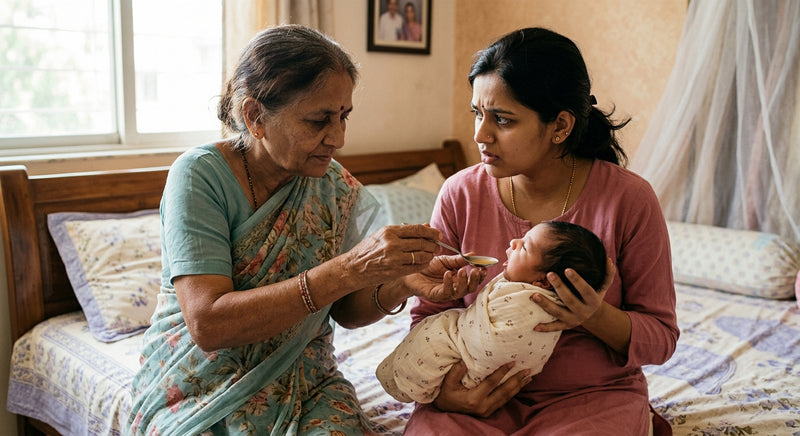
Ten days in, someone will say it. "Hospital mein toh itna gora tha — ab dekho." It arrives kindly, over chai, usually from someone who loves the baby. And a mother running on four hours of sleep starts wondering whether it's the oil, or the sun through the window, or the soap she picked.
So, quickly. A baby's colour on day one is not their settled tone. Melanin production is still switching on, so most babies deepen slightly over the first few months and land close to their genetic tone somewhere in the first year. And the blotchy, marbled, one-half-red look that panics parents? That's circulation, not pigment — a newborn's blood vessels are still learning to regulate temperature. Nothing you rub on the skin changes the pigment a baby was born to have.
What follows is what I end up explaining, again and again, to mothers who were told otherwise. If you want the wider picture first, this article sits inside our complete guide to newborn skin basics.
At a glance
- Newborns are often born lighter than their genetic tone — melanocytes are present but not yet producing at full pace.
- Gradual deepening over the first months is normal maturation, not damage, and not "tanning" from a malish.
- Blotchy, marbled or half-red skin is usually immature blood-vessel control, not pigment change.
- No oil, ubtan, kesar-in-milk or cream alters a baby's genetically determined melanin. Any product that promises it is either doing nothing, or doing something unsafe.
- What you can change is how healthy and even the skin looks — dry, flaky skin scatters light and reads as dull and patchy. Hydration helps with that.
Why does my baby look darker now than at birth?
Because the pigment machinery has only just been switched on.
Your baby was born with essentially every melanocyte she will ever have — the cells that make melanin, sitting at the base of the epidermis. A newborn and a six-month-old have the same number. What differs is output. Melanin gets manufactured inside little packages called melanosomes, and those packages then have to be handed over to the skin cells travelling up to the surface. In the first weeks that whole assembly line is running slow: making, packing, handing over. The visible tone lags behind the genetic instruction. That's all this is.
Then output rises. The tone deepens gradually, and unevenly — the outer rims of the ears, the fingertips and toes, the genital area and the folds usually pigment ahead of the cheeks and belly. So a mother notices that her daughter's ears look darker than her face and assumes something has gone wrong. Same process. Different speeds, different places.
It isn't your massage oil. It isn't ten minutes at a sunny window. It's development.
Myths vs what's actually happening
These land in my DMs every week. From a mother-in-law, a neighbour, the lady in the lift. Always meant well. Still worth answering straight.
| What you've been told | What's actually true |
|---|---|
| "He was fair at birth — the oil made him dark." | Oil sits on the surface and softens it. It cannot reach a melanocyte, let alone tell it to work harder. The deepening was always coming. |
| "Kesar in milk during pregnancy makes a fairer baby." | A lovely tradition with no effect on the baby's pigment genes. Enjoy it as ritual, not as a treatment. |
| "Ubtan / besan will lighten the skin." | Ubtan gives mild friction and lifts flakes, so skin looks brighter for an hour. That's a texture effect, not a pigment one — and on newborn skin, the friction can leave micro-irritation. |
| "The blotchy marbling means poor circulation or weakness." | It usually means an immature circulation doing its job in a cool room. It typically settles as the baby warms. |
| "Dark patches on the back mean a birth injury." | Flat blue-grey patches over the lower back or buttocks are extremely common in Indian babies. It is simply pigment sitting deeper in the skin. They fade over childhood. |
| "Sun exposure will even out the tone." | It will do the opposite — a newborn's thin skin burns fast. Keep babies under six months out of direct sun entirely. |
Why does the skin go blotchy, marbled or half-red?
This is the one that gets a family into an auto at 1am. It almost never needs to.
A newborn's blood vessels are run by a nervous system that is still calibrating. Drop the temperature — you've unwrapped him for a nappy change, the fan is on — and the tiny surface vessels tighten unevenly. What you get is a lacy purple-pink net across the trunk and limbs. Wrap him up. Wait a few minutes. It fades. Hands and feet going bluish-dusky in the first days while the rest of him stays pink is the same story, told at the far ends of the body.
Then the dramatic one. A baby lying on one side, the lower half flushing deep red, the upper half gone pale, a clean line down the middle like someone drew it. It looks terrible. You move him and it goes. If your baby's colour seems to shift by the hour, we've written about why a baby's skin colour keeps changing, mottling and flushing in more detail.
Where flaking comes in — and why it makes tone look patchy
Peeling skin doesn't only feel rough. It looks different. A smooth, well-hydrated surface bounces light back evenly. A surface covered in half-lifted flakes scatters it, and the eye reads that scatter as ashy, uneven, dull. Add one dark line of dry skin in a knee crease and you have a parent convinced their child's pigment is changing in front of them.
Newborn peeling is near-universal, heaviest in the first two weeks, and it often returns around the two-month mark. It gathers at the ankles and wrists, and on the hands and feet, where the skin is thickest. The yellow-brown crusting on the scalp and eyebrows is a different thing entirely, and just as normal — cradle cap.
Which leaves you with something you can actually act on. You cannot make a baby fairer, and you should not try. But you can make her skin look calm, healthy and even, by addressing the dryness. That much is real, and it is the only part of this that cosmetic science can honestly deliver.
What I look for on the label (and what I'd put back on the shelf)
Here's where I can be useful. When a moisturiser makes newborn skin look even, three families of ingredient are doing it together, and no one of them works alone.
- Humectants — glycerin, mainly. They pull water into the upper layers. This is why skin looks plump instead of papery.
- Emollients — light plant oils and esters. They slot into the gaps between flaking cells, and of the three, this is the one you see working fastest on a patchy-looking surface.
- Occlusives — butters and waxes. They slow water loss so the first two aren't wasted. Through a dry Nagpur winter, or Delhi in January, skipping the occlusive is like watering a pot with a hole in it.
And what I'd put straight back on the shelf for a baby under one:
- Anything sold on fairness, brightening or "gora rang". Read that claim as a warning label.
- Hydroquinone, kojic acid, strong AHAs, high-strength niacinamide. Adult pigment actives. They have no business on skin that is 20-30% thinner than yours.
- Unlabelled "herbal" fairness creams from the shop downstairs. A depressing number have been found adulterated with potent steroids. On a baby's thin skin, that is a real risk, and I'm not saying it to frighten you.
- Heavy fragrance and essential-oil blends on a newborn's face.
What to actually do tonight
- Bathe in comfortably warm water for 5-10 minutes, no longer. Long soaks strip lipids and worsen the flaky, uneven look.
- Use a single mild, fragrance-light cleanser — a tear-free head-to-toe foam wash is plenty. Skip soap bars.
- Pat dry, don't rub. Rubbing lifts flakes and leaves skin looking blotchier.
- Moisturise within three minutes of the towel, while the skin is still slightly damp. That bit of timing does more than the choice of product.
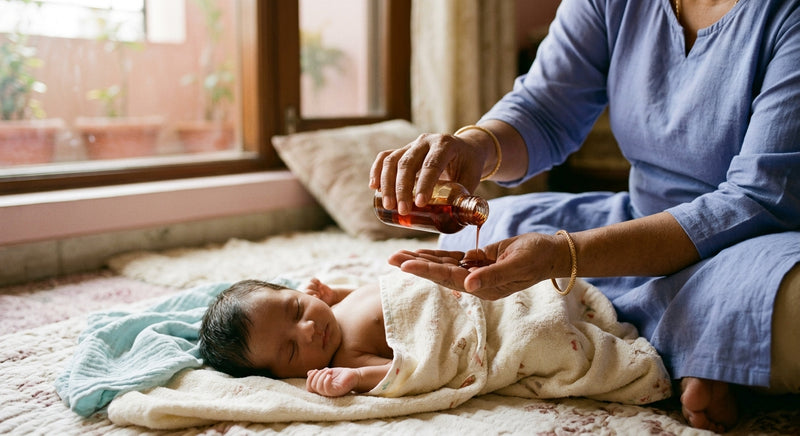
- Massage with a light hand, warm oil, no scrubbing. Malish is for bonding and comfort. Not for colour.
- Keep the room around 24-26°C. Half the mottling you see is a cold baby, not a sick one.
- No direct sun before six months. Shade, a hat, long sleeves — not sunscreen at this age.
- Patch test anything new on the inner forearm and wait 24-48 hours before using it all over.
When to see a doctor
Most colour change is normal. These are not. Call your paediatrician the same day if you see:
- Yellowing of the skin, the whites of the eyes or the gums — especially if it reaches the belly, legs or palms, or the baby is feeding poorly or unusually sleepy.
- Blue or dusky lips, tongue or the skin around the mouth (blue hands and feet alone in a young newborn are usually fine; a blue centre is not).
- Skin that is pale, grey or ashen, or mottling that does not fade when the baby is warmed.
- A colour change that comes with fever, breathlessness, fast breathing, floppiness or refusal to feed.
- Pale, non-pigmenting patches that persist, or a birthmark that grows quickly, ulcerates or bleeds.
None of that is a reason to stand over a sleeping baby with a torch. It's a short list to hold at the back of your mind, so that the rest of the time you can let the normal changes be normal.
What I'd want you to remember at 2am
Her tone will settle where her genes decided it would. No product on earth changes that, ours included. The only skin goal worth having in the first year is a comfortable, intact, well-hydrated barrier — that's what helps ease the itching, the flaking and the patchy look, and that one is genuinely in your hands.
If your baby's skin is dry and flaking and looking uneven because of it, a rich, fragrance-conscious balm twice a day is the simplest place to start — our Hydra Healing Moisturizing Balm was formulated to comfort dry, sensitive skin and help support the skin's natural barrier.
In summary
- A newborn's colour at birth is not their final tone — melanin production ramps up over the first months, so gradual deepening is normal development.
- Blotchy, marbled or half-red skin is usually immature blood-vessel control reacting to a cool room, not a pigment change.
- No oil, ubtan, kesar or cream can alter genetically determined melanin — and fairness products, especially unlabelled ones, are unsafe on a baby's thin skin.
- What you can genuinely improve is how even and healthy skin looks, by treating dryness: humectants, emollients and an occlusive, applied within three minutes of the bath.
- Call your paediatrician for yellowing, blue lips or tongue, grey or ashen skin, or mottling that doesn't fade when the baby is warmed.
Frequently asked questions
Why is my newborn getting darker after birth?
Because pigment production is still ramping up. Babies are born with their melanocytes in place, but those cells make and transfer melanin slowly at first, so the tone visible at birth is often lighter than the genetic tone. Over the first months output rises and the skin gradually deepens, usually starting at the ears, fingertips, genitals and skin folds. It's normal development, not a reaction to oil or soap.
Can any cream or oil make my baby fairer?
No. Melanin production is set by genetics and no topical product changes it. Massage oils and ubtan sit on the surface — at most they lift flakes and make skin look temporarily brighter, which is a texture effect, not a pigment one. Avoid any product marketed on fairness or brightening for a baby; some unlabelled fairness creams have been found adulterated with potent steroids, which is genuinely unsafe on thin newborn skin.
Why does my baby's skin look blotchy and marbled?
Usually because the blood vessels near the surface are still learning to regulate. In a cool room they constrict unevenly and produce a lacy, purple-pink net across the trunk and limbs, which fades once the baby is warm. Bluish hands and feet in the first days are part of the same immaturity. Judge colour by the lips, tongue and gums — those should stay pink.
When does a baby's skin tone settle?
It's gradual. Most of the deepening happens over the first few months, and a baby usually looks close to their settled tone somewhere within the first year, with small changes continuing after that. Different areas pigment at different speeds, so an uneven look during this window — darker ears, lighter cheeks — is expected and evens out.
Are those blue-grey patches on my baby's back a problem?
Flat blue-grey patches over the lower back or buttocks are very common in Indian babies and are simply pigment sitting deeper in the skin. They are harmless, painless and typically fade through childhood. They should be flat and stable — mention them to your paediatrician so they're noted, but no treatment is needed. Anything raised, growing quickly, or bleeding should be checked.
Should I put sunscreen on my newborn to protect their skin tone?
Not under six months. At that age the advice is shade, a hat, light long sleeves and avoiding direct sun altogether rather than sunscreen. And sun avoidance is about protecting thin, easily burned skin — not about influencing colour. From about six months, a gentle mineral sunscreen on exposed areas becomes appropriate alongside shade and clothing.