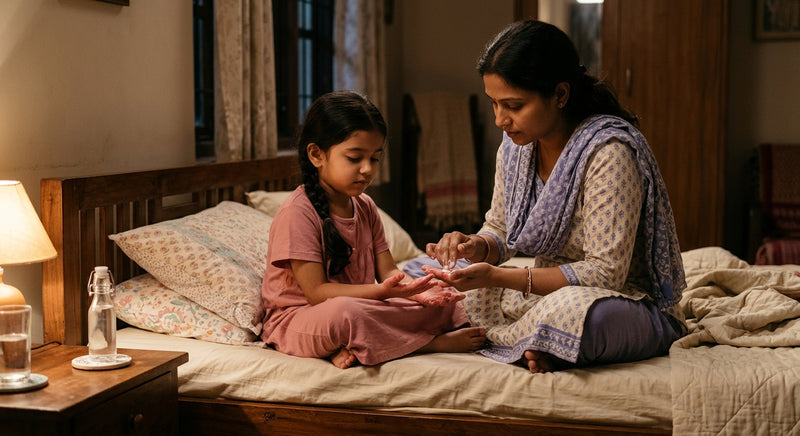
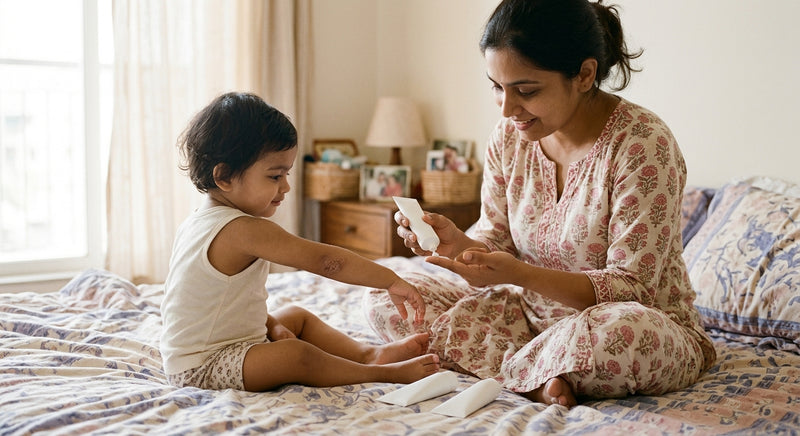
At my niece's naming ceremony, an elderly relative ran her thumb down the baby's shin and delivered a one-second verdict: "Vata. More oil, less soap." No chart, no questions — just a glance. That's how most Indian parents first meet dosha-based skincare, and it usually leaves them with one question: is there anything real underneath?
Here's the short answer. Dosha-based skincare for a baby simply means reading your child's skin tendency — dry and rough (vata-type), warm and rash-prone (pitta-type), or soft and damp-prone (kapha-type) — and adjusting one gentle routine to fit. You do not need three sets of products. You need the same four steps — massage, bathe, moisturise, protect — done with small, sensible shifts. This guide gives you that routine, step by step. If you want the fuller theory behind the three types, our complete guide to Ayurvedic doshas and baby skin goes deeper.
At a glance
- Doshas are a useful lens for reading skin tendencies — they are not a diagnosis.
- The routine stays the same four steps for every baby; only the textures, timing and amounts shift.
- A baby's skin is 20-30% thinner than an adult's, so gentleness matters more than any dosha rule.
- Season often overrides constitution: dry winter air pushes most babies vata-dry, humid monsoon weeks push them kapha-damp.
- Patch test anything new, and take broken or persistent rashes to a paediatrician — no dosha reading replaces that.
What does dosha-based skincare actually mean for a baby?
Ayurveda describes three doshas — vata, pitta, kapha — as constitutions that shape how a body behaves. On the skin, they translate into patterns any observant parent already notices: some babies run dry and flaky, some run warm and go red at the slightest heat, and some have that soft, moist skin where the neck folds never quite seem to dry.
Let me be honest about the science, because I'd want the same honesty as a parent. Modern dermatology doesn't use dosha categories. But it does group baby skin by behaviour — dry, sensitive, normal — and the two systems rhyme far more than they clash. Both are really saying: watch your child's skin, learn its pattern, and adjust. That watching matters, because baby skin is genuinely more reactive than ours — up to ~48.6% of babies experience atopic-type skin issues at some point. The dosha lens, used calmly, just makes you a better observer.
How do I read my baby's skin tendency?
Don't judge from one afternoon. Watch for a full week — after baths, after naps, after an outing — and see which column your baby lands in most often.
| Tendency | What you might notice | What helps |
|---|---|---|
| Vata-type (dry) | Rough shins and cheeks, fine flaking, tight-looking skin; worse in winter, AC rooms and after long baths | A slower, more generous oil massage; shorter baths; a richer moisturiser, reapplied in dry weather |
| Pitta-type (heat-sensitive) | Skin that flushes easily, warmth to the touch, redness in the folds or diaper area; worse in summer | Cooling oils like coconut in hot months; strictly lukewarm baths; light cotton layers; a thinner moisturiser coat |
| Kapha-type (soft, damp-prone) | Plump, moist skin; neck and thigh folds that stay damp; prickly heat in humid weeks | Thorough drying of every fold; a lighter hand with oil; breathable clothing; a gentle weekly ubtan-style cleanse |
Most babies are a blend, and that's fine. You're looking for the loudest pattern, not a perfect label.
The dosha-based routine, step by step
This is the spine of the whole approach. Same steps for every baby, every day — the dosha reading only changes the details inside each step.
- Do a 30-second skin scan every morning. Cheeks, shins, neck folds, behind the knees, diaper area. You're checking today's skin, not last month's label — a vata-dry baby can wake up fine, and a kapha baby can wake up flaky in a Nagpur October.
- Massage before the bath — 10-15 minutes of malish. This is abhyanga, and it's the step Ayurveda gets most right. For a vata-dry baby, go slower and slightly more generous with a sesame-based or richer oil. For a pitta baby in summer, coconut oil's cooling nature earns its reputation. For a kapha baby, use a lighter hand and less oil, and never leave residue sitting in the folds. If you're new to it, our step-by-step guide to shishu abhyanga walks through the strokes.
- Keep the bath short and lukewarm — for every dosha. Five to ten minutes, water comfortably warm to your inner wrist, never hot. Hot water strips a vata baby, flares a pitta baby, and helps no one. Skip soap bars; look for a pH-balanced, tear-free wash — a gentle foam format like our Head to Toe Baby Foam Wash rinses off easily even in hard water. For a kapha-leaning baby, a mild weekly baby ubtan, used safely, is the traditional deep-cleanse — once a week is plenty.
- Pat dry — and dry every fold properly. Pat, don't rub. Then go fold by fold: neck, armpits, groin, behind the ears. For a kapha-type baby this single step prevents more trouble than any product will.
- Moisturise within 3 minutes of the bath. Damp skin seals in water best. Vata-dry babies want a richer balm or butter, with a midday top-up on shins and cheeks in winter. Pitta babies do better with a thinner, even layer in a cool room. Kapha babies still need moisturiser — just less of it, worked in fully.
- Protect the diaper area at every change. Clean, air-dry for a minute, then a barrier layer. This step doesn't change by dosha; wet skin under a nappy is wet skin under a nappy.
- Re-read the skin weekly, and again every season. This surprises parents most: the season frequently overrules the constitution. The same baby can run kapha-damp through a humid Vidarbha monsoon and turn vata-dry within a week of the October air arriving. Adjust the routine to the skin in front of you.
What stays the same, whatever the dosha
A few rules sit above the whole system, and honestly, they matter more than getting the dosha reading right.
Patch test everything new. A five-rupee-coin amount on the inner forearm, then wait 24-48 hours before using it all over. This applies to oils your family swears by just as much as to anything from a shelf.
Be cautious with fragrance and home pastes. Strong fragrance has no business on a young baby's skin, and traditional pastes deserve the same scrutiny as any cream. If a relative suggests chandan for your "pitta baby", read our honest take on whether sandalwood is safe for baby skin before it goes anywhere near a cheek.
Never experiment on broken skin. Cracked, oozing or bleeding skin is a paediatrician's job, not a routine-adjustment job. Doshas describe tendencies in healthy skin; they were never meant to manage wounds.
When to see a doctor
Used calmly, the dosha lens gives you what every anxious parent actually wants: a way to read your baby's skin and a routine that flexes with it. Watch for a week, pick your column, follow the seven steps — and let the season vote too.
And on the nights the scan finds rough, dry patches — vata weather or not — a clinically tested, barrier-supporting balm like our Hydra Healing Moisturizing Balm is a gentle place to start.
In summary
- Use doshas as a lens for reading skin tendencies — dry (vata), heat-prone (pitta), damp-prone (kapha) — never as a diagnosis.
- Keep one four-step routine for every baby — massage, short lukewarm bath, moisturise within 3 minutes, diaper-area protection — and shift only textures and amounts.
- Observe your baby's skin over a full week before picking a tendency, and re-read it at every season change, because weather often overrules constitution.
- Patch test every new oil, paste or product on the inner forearm and wait 24-48 hours before full use.
- See a paediatrician for any rash with fever, broken or oozing skin, a rash in a baby under one month, or anything not improving within a week.
Frequently asked questions
Can I really tell my baby's dosha at home?
You can reliably spot the skin tendency the dosha describes — dry and flaky, heat-sensitive and flush-prone, or soft and damp-prone. Watch your baby's skin for a full week across baths, naps and outings rather than judging one afternoon. That observation is what actually guides the routine. A formal dosha assessment is an Ayurvedic practitioner's job, but for daily skincare the tendency is all you need.
Is dosha-based skincare safe for a newborn?
The observing part is completely safe at any age. For babies under three months, keep the routine minimal: short lukewarm baths, a gentle massage with a well-tolerated oil, and fragrance-free basics. Skip ubtans, pastes and new experiments in the newborn weeks, patch test anything you introduce, and ask your paediatrician before adding anything new to a newborn's skin.
Do I need different products for each dosha?
No, and be wary of anyone selling you three of everything. Every baby needs the same gentle basics: a pH-balanced tear-free wash, a well-tolerated massage oil and a good moisturiser. The dosha reading changes how you use them — a richer texture and extra top-ups for dry skin, a lighter layer for heat-prone skin, less oil and very thorough drying for damp-prone skin.
Which massage oil suits which dosha?
The traditional mapping is sesame-based oils for vata-dry skin, cooling coconut oil for pitta-type skin in hot weather, and a lighter hand with less oil for kapha-type skin. Choose cold-pressed, unfragranced oils, and patch test on the inner forearm for 24-48 hours first. In practice, season matters as much as type — many families rotate to coconut in summer and something richer in winter.
Can my baby's skin tendency change with the weather?
Yes, and it's the most common reason a routine suddenly stops working. Dry winter air and air-conditioning push most babies towards vata-type dryness, while humid monsoon weeks push skin towards kapha-type dampness and prickly heat. That shift is normal, not a problem. Re-read your baby's skin at every season change and adjust textures, bath length and moisturiser frequency to match.