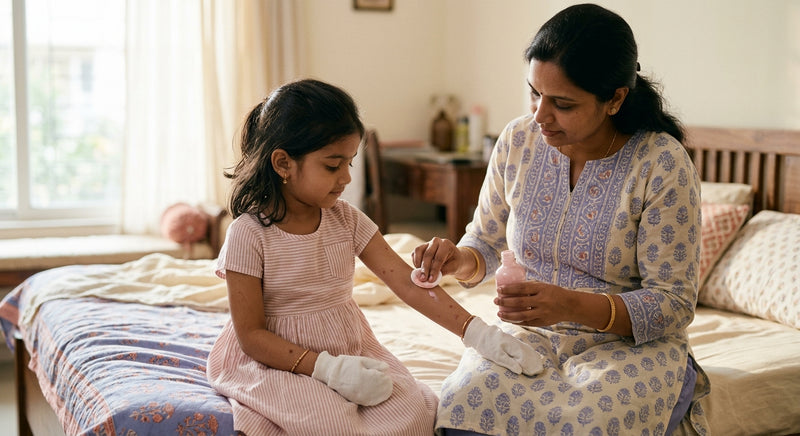
It starts the same way most years. Your 5-year-old comes in from playing and the backs of their legs look chalky and white. At bedtime they're scratching their cheeks. There's a fine flaky dryness on the shins that wasn't there in October. Indian winters do this quietly — the dry-cold of Delhi and Nagpur, the AC-and-heater air, the baths that suddenly get shorter. They pull water out of a child's skin faster than most parents expect.
Here's what's reassuring: dry winter skin in kids is almost always a routine problem, not a medical one. Fix the routine and the skin follows. Below is the exact evening sequence I'd hand a parent — timings, amounts, and the ingredient logic behind each step. It's part of our complete guide to skincare for kids aged 3 and up, narrowed to the one season that causes the most 2am itching.
At a glance
- Winter dryness happens because cold, dry air and longer, hotter baths strip the skin's natural oils faster than the skin rebuilds them.
- The single most important move: moisturise within a few minutes of patting the skin dry, while it's still slightly damp.
- Use lukewarm — not hot — water, keep baths short, and switch to a gentle, soap-free cleanser.
- Look for a moisturiser that combines humectants (draw water in) and emollients/occlusives (lock it in), not just one.
- If skin is cracked, weeping, or intensely itchy despite a good routine, see a paediatrician — it may be eczema, not plain dryness.
Why does my child's skin get so dry in winter?
Three things gang up at once. Cold winter air holds far less moisture, so it pulls water straight off the skin's surface — that's transepidermal water loss, and it speeds up the drier the air gets. Indoor heating and air-conditioning make the air inside the house even more parched. And the one parents actually control: winter baths drift longer and hotter, and hot water dissolves the skin's own protective oils.
A child's skin barrier is more fragile than yours, full stop. It's thinner, holds less of its own natural moisturising factor, and loses water more readily. So the same dry week that leaves your skin a little tight leaves theirs flaking. When that outer barrier dries out, the bricks-and-mortar structure of skin cells opens up tiny gaps. Water escapes. Irritants get in. That's the itch.
The winter evening routine, step by step
Do this after dinner, before bed — when the skin has all night to drink it in and nobody's rushing out the door. Ten minutes, start to finish.
- Run a lukewarm, short bath. Test the water on your inner wrist. It should feel barely warm, not steamy. Keep it under 10 minutes. Long hot soaks feel cosy on a cold night and strip oils the most.
- Swap soap for a gentle, soap-free cleanser. Regular soap is alkaline and degreasing — exactly wrong for dry winter skin. Use a mild, pH-balanced body cleanser, and only where it's needed: underarms, feet, nappy-free bottom. Arms and legs rarely need lather every single night.
- Pat — don't rub — dry. Leave the skin very slightly damp. That bit of surface water is what your moisturiser is about to trap.
- Moisturise within five minutes, generously. This is the step everything else hinges on. For a primary-school child you want a properly coated layer over arms, legs, back and tummy — not a thin smear. Damp skin plus moisturiser equals a sealed-in reservoir of water.
- Spot-treat the rough patches. Shins, elbows, knuckles, cheeks — these take the worst of it. Over the regular lotion, press a thicker balm onto those spots to hold moisture where the skin is thinnest.
- Soft fabrics, then bed. Cotton next to the skin. Woollens over a layer — wool straight on dry skin itches and scratches it raw. Mittens or socks on the hands stop overnight scratching.
What should a winter moisturiser for kids actually contain?
This is where, as a cosmetologist, I get particular. A good winter moisturiser isn't about one hero ingredient. It's three jobs done together — and most thin, watery lotions only do the first.
| Ingredient type | What it does | Winter examples |
|---|---|---|
| Humectants | Draw water into the upper skin layers | Glycerin, oats, honey-derived sugars |
| Emollients | Smooth and soften the gaps between skin cells | Almond oil, avocado oil, ghee, ceramides |
| Occlusives | Form a light seal so the water can't escape | Butters, beeswax, heavier oils |
And there's a catch most parents never hear. In very dry winter air, a humectant on its own can actually pull water out of the deeper skin and into the air if nothing is sealing the surface. So you want humectants and an emollient/occlusive layer over them. If you want to go deeper on how these three families work together, I've written a full piece on what's genuinely safe and useful as kids move into the 8–12 age range too.
For everyday winter moisturising, our Hydrating & Soothing Moisturizing Lotion was built around exactly this logic — almond oil and organic ghee as emollients, oats and glycerin to hold water — so all three jobs happen in one post-bath layer. For the cracked, stubborn shins and cheeks, a thicker occlusive on top earns its place. That's where a balm comes in.
Don't forget the bits parents skip in winter
Lips, the corners of the nose, the backs of the hands — these chap first, because they're thin and out in the cold all day. A dab of balm on lips and knuckles before school and at bedtime saves a lot of soreness. And winter sun is still UV sun: a child playing cricket on a clear January afternoon needs sunscreen as much as one in May. I've laid out why in our piece on the sun-protection non-negotiables for kids in India.
Common winter mistakes that make dry skin worse
- Hot baths. The number-one offender. Feels kind on a cold night and quietly undoes everything else.
- Waiting too long to moisturise. Cream on bone-dry skin twenty minutes after a bath traps almost no water. The damp window is short — use it.
- Too little product. A pea-sized blob does not cover two legs. Winter skin is thirsty. Be generous.
- Heavily fragranced or "tingly" products. Menthol, strong perfume and high alcohol all sting and dry compromised skin. Keep it bland and gentle.
- Moisturising only at night. Once a day isn't enough when the air is this dry. Add a quick morning layer before school.
When to see a doctor
Plain winter dryness improves within a week or two of a good routine. See a paediatrician if it doesn't — or sooner if you see intensely itchy, red, oozing or cracked patches, especially in the elbow and knee creases. That pattern points to atopic dermatitis (eczema), which is common in children and needs a doctor's guidance, sometimes with a prescribed cream. Fast-spreading redness, swelling, or any yellow crusting suggests infection and should be seen promptly. A moisturising routine supports the skin around these conditions, but it isn't a substitute for a diagnosis.
Most winters, though, it really is just dry air and a too-hot bath — and a consistent, generous moisturising habit fixes it. If you'd like one product that covers daily winter moisturising for school-age skin, start with the Hydra Healing Moisturizing Balm on the rough, stubborn patches over your child's regular lotion.
In summary
- Use lukewarm, under-10-minute baths and a soap-free cleanser to stop stripping the skin's natural oils.
- Moisturise generously within five minutes of patting the skin dry, while it's still slightly damp.
- Choose a moisturiser that combines humectants with emollients and occlusives, not just one of the three.
- Layer a thicker balm on stubborn rough patches — shins, elbows, knuckles and cheeks — and don't skip lips or winter sunscreen.
- See a paediatrician if skin is cracked, weeping, crusted or intensely itchy despite a careful routine — it may be eczema.
Frequently asked questions
How often should I moisturise my child's skin in winter?
At least twice a day during winter — a generous layer right after the evening bath while the skin is still slightly damp, and a quick layer in the morning before school. Spot-treat rough areas like shins, elbows and cheeks more often if they look chalky or flaky. Once a day is rarely enough when winter air is this dry.
Is hot water bad for a child's dry skin?
Yes. Hot water dissolves the skin's own protective oils and speeds up water loss, leaving skin tighter and flakier afterwards. Use lukewarm water that feels barely warm on your inner wrist, and keep baths under 10 minutes. It feels less cosy on a cold night, but it's the single biggest thing you can change to stop winter dryness getting worse.
What's the best type of moisturiser for kids in winter?
One that combines humectants (glycerin, oats) to draw in water with emollients and occlusives (almond oil, ghee, butters) to seal it in. A thin, watery lotion alone often isn't enough in dry winter air. Look for a richer cream or lotion, and add a thicker balm on top of stubborn patches like knuckles, shins and cheeks.
Why does my child's skin only get dry in winter and not summer?
Cold winter air holds much less moisture and pulls water from the skin's surface faster, while heaters and AC dry indoor air further. Winter baths also tend to be longer and hotter. A child's barrier is thinner and loses water more easily than an adult's, so the same dry conditions that leave you a bit tight leave them visibly flaking.
Can I use coconut oil instead of a moisturiser in winter?
Coconut oil is an emollient and can help on its own for mild dryness, especially sealed over slightly damp skin. But it's mainly a sealing oil — it doesn't draw water in the way a humectant does. For properly dry winter skin, a moisturiser that pairs water-attracting and water-sealing ingredients usually outperforms a single oil. You can still use oil as the occlusive layer on top.