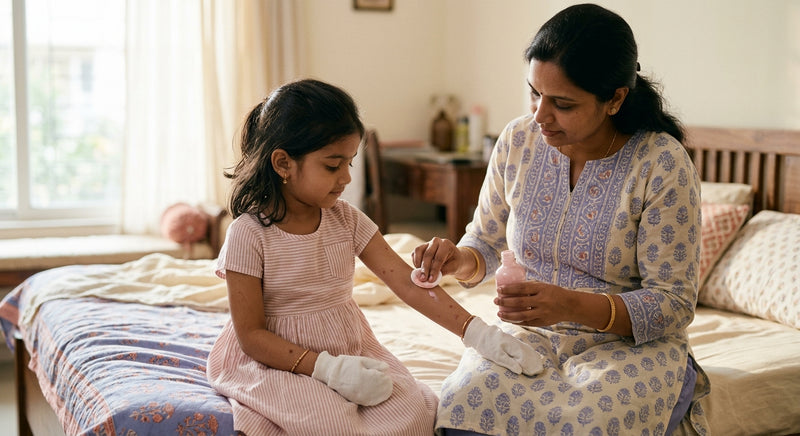
She's eight, maybe ten, and she walks in holding your phone: "Mumma, I need this serum. And a toner. And this one's for glass skin." The video she's copying belongs to a 28-year-old. The bottle she's pointing at has glycolic acid in it. And there you are at 9pm, wondering whether saying no makes you the strict parent — or whether saying yes is the thing you'll regret.
The honest answer should take the pressure right off: a healthy tween needs almost nothing. A gentle wash. A light moisturiser if her skin feels tight. Sunscreen. That's the whole list at 8, 10, even 12. The elaborate routines aren't just unnecessary — some of the actives packed into them can quietly damage a young, still-developing skin barrier. So let me walk you through the lines, age by age, and a routine you can set up tonight.
At a glance
- Most 8-12 year olds need only two products: a gentle cleanser and a daily mineral sunscreen.
- Skip all "anti-ageing" actives — retinol, glycolic/salicylic acid, strong vitamin C, peptides. A young barrier doesn't need them and reacts to them.
- The routine that's actually worth building is sun protection, not glow serums — that's the one with lifelong payoff.
- Around 11-12, early oiliness and the odd pimple are normal — manage with gentleness, not adult acid treatments.
- Fragrance and "brightening" claims are the two things to read the label for.
Why a tween's skin is a different organ to an adult's
This is the part the videos never mention. A child's skin barrier is still maturing. It's thinner. It loses water faster. And it absorbs whatever you put on it far more readily than adult skin does. That last point is the one that matters. An exfoliating acid that gives a grown woman a glow can, on a ten-year-old, strip the barrier, set off stinging, and leave her cheeks pink and reactive for days. The same quick absorption that makes kids' skin feel so impossibly soft is exactly why you don't load it with adult chemistry.
So the whole logic flips. With adult skin, more active usually buys more result. A tween's skin is the opposite case — the goal is to protect a barrier that's already working well and otherwise leave it alone. Add only what's genuinely missing, which is usually just water-resistance against the sun and a little surface moisture. If you want the bigger picture for this age group, we've laid it out in our complete guide to skincare for kids 3 and up.
What's safe at each age: 8, 10 and 12
A lot shifts across these four years, mostly thanks to early puberty. Here's how I'd think about it.
| Age | What's going on | What's safe to use |
|---|---|---|
| 8 | Skin is calm, barrier still developing. No hormonal oil yet. | Water or a mild cleanser at bath time. Moisturiser only if dry. Sunscreen for outdoor play. |
| 10 | Some kids start early oiliness in the T-zone; first interest in "products." | Gentle daily cleanser, light non-greasy moisturiser, daily sunscreen. Nothing with acids. |
| 12 | Puberty oil and the occasional pimple are common. Sweat, sport, more screen-led product requests. | Same three steps. For a stray pimple: gentle cleansing, not adult spot treatments. See a doctor for persistent acne. |
Look at that right-hand column — it barely moves. That's the whole point. The routine that suits an eight-year-old still suits a twelve-year-old. You're just being a bit more consistent about cleansing as the oil and sweat pick up.
The actual tween routine (this is the spine — keep it this short)
Build it as a morning and night habit she can run herself in a couple of minutes. Print it. Stick it on the bathroom mirror. And resist every single urge to add a fourth step.
- Morning — splash and cleanse. Plain water for an 8-year-old; a mild, tear-free cleanser for a 10-12 year old whose skin is getting oilier. Lukewarm, never hot.
- Morning — moisturise only if needed. If her cheeks feel tight or look flaky, a thin layer of a light kids' lotion. If her skin feels fine, skip it. Tween skin often doesn't need daily cream.
- Morning — sunscreen, every single day. A mineral (zinc/titanium) SPF on the face, ears and back of the neck before school. This is the non-negotiable one.
- After school / play — rinse off sweat and dust. A gentle body cleanse after sport or a dusty commute keeps blocked pores and prickly heat away, especially through an Indian summer.
- Night — cleanse and done. Wash the day off, moisturise if dry, and stop there. No serums, no "treatments," no overnight masks.
The highest-value habit in this whole list is sun protection. It does more for her skin over a lifetime than any serum she's seen on a screen. We've written the full version of this in our piece on sun protection for kids in India, including how much to apply and why mineral filters suit young skin. And if she swims, read the before-and-after routine for pool chlorine — chlorine dries out a tween's skin far more than any cleanser ever will.
The actives to keep away from tween skin — and why
This is the bit where being a cosmetologist actually pays off, because the marketing shouts and the science whispers. Here's what's doing the rounds in those "get ready with me" videos, and why none of it belongs on a young face:
Exfoliating acids (glycolic, lactic, salicylic)
They work by loosening the top layer of skin. On a mature barrier, that's controlled exfoliation. On a tween's thinner barrier, it tips straight into over-stripping — stinging, redness, and a barrier that now waves irritants through more easily. Salicylic acid keeps getting pushed for "acne." But a stray pimple on a 12-year-old isn't adult acne, and it doesn't need an acid.
Retinol and retinoids
Brilliant for adult skin renewal, completely wrong here. They're built to speed up the cell turnover a young face is already doing perfectly well on its own. So you get flaking, sensitivity and sun-reactivity, for zero benefit.
High-strength vitamin C and "brightening" actives
"Glow" and "brightening" are the two words to be most sceptical of on a kids' shelf. Strong vitamin C can sting young skin. And brightening claims usually lean on the idea that her natural skin tone needs correcting. It doesn't.
Heavy fragrance and essential-oil blends
A light scent is fine — frankly it's part of why kids enjoy a wash at all. But heavily fragranced "adult" products and concentrated essential oils are a common trigger for contact reactions on young skin. If you want the deeper read on this, we've covered a full daily routine for school-going kids that keeps the ingredient list short on purpose.
How to read a tween product label in 20 seconds
You're not going to memorise INCI lists. So use these shortcuts at the shop, or before you tap "buy":
- Seek: "gentle," "for kids/sensitive skin," tear-free, mineral sunscreen, a short ingredient list, dermatologically tested.
- Skip: retinol/retinaldehyde, glycolic/lactic/salicylic acid, "brightening," "anti-ageing," "whitening," strong fragrance, alcohol high on the list.
- Decode the pitch: if a product is sold on a result an adult wants ("firmer," "younger," "spotless"), it's not built for a tween — no matter how cute the bottle.
For everyday cleansing through these years, a formula actually designed for older kids' skin — gentle surfactants, no harsh actives — does the job without any of the above. Janma's Kids Gentle Body Cleanser is built exactly for this 3-plus age group: it lifts away sweat and grime while supporting the barrier, which is all a tween's skin is really asking for.
When to see a doctor
Most tween skin sorts itself out with gentleness and a bit of patience. But check in with a paediatrician or dermatologist if you see: persistent or worsening acne (not the odd pimple — clusters of cysts or pimples that scar), any patch that's spreading, weeping, crusting or intensely itchy, a sudden widespread rash after a new product, or signs of very early puberty that worry you. A doctor can prescribe for the rare cases that genuinely need an active ingredient — which is the only safe route to one at this age.
The takeaway I give every anxious parent: here, doing less is the expert move. Keep it to a gentle wash, sunscreen, and moisturiser only when her skin asks for it — a light, kid-appropriate moisturising lotion is all the "extra" a tween's face ever needs.
In summary
- A healthy tween needs only two products — a gentle cleanser and daily mineral sunscreen — not a multi-step routine.
- Keep retinol, exfoliating acids, strong vitamin C and "brightening" actives away from young, still-developing skin.
- Sunscreen is the one step worth being strict about; it does more for her skin long-term than any serum.
- A stray pimple at 11-12 is normal — manage with gentle cleansing, and see a doctor for persistent acne.
- Read labels for short ingredient lists and skip anything sold on an adult result like "anti-ageing" or "whitening".
Frequently asked questions
Is it okay for a 10-year-old to have a skincare routine?
Yes, but a very simple one. A 10-year-old can have a gentle cleanser, a light moisturiser if her skin feels dry, and daily sunscreen. That's a complete, healthy routine. What she doesn't need is serums, toners, exfoliating acids or anti-ageing products — those are made for mature skin and can irritate a young, still-developing barrier.
What skincare ingredients should tweens avoid?
Keep retinol and other retinoids, exfoliating acids (glycolic, lactic, salicylic), strong vitamin C, peptides, and any "brightening" or "whitening" actives away from tween skin. These are designed for adult concerns and can strip or sting a young barrier. Heavy fragrance and concentrated essential oils are also common irritants. Stick to gentle, kid-formulated cleansers and a mineral sunscreen.
Should an 8-year-old use face wash?
Usually not a dedicated face wash — plain lukewarm water at bath time is enough for most 8-year-olds, whose skin hasn't started producing puberty oil yet. A mild, tear-free cleanser becomes useful around 10-12 when the T-zone gets oilier or after sport and dusty commutes. Avoid adult face washes with acids or strong fragrance at any of these ages.
My 12-year-old is getting pimples — can she use salicylic acid?
Hold off on adult acne treatments. An occasional pimple at 12 is normal puberty and usually settles with gentle, consistent cleansing — not acids, which can over-strip young skin. If acne is persistent, spreading, painful or scarring, see a paediatrician or dermatologist. They can safely prescribe an active if it's genuinely needed, which is the right route at this age rather than self-treating.
What is the most important skincare step for a tween?
Daily sunscreen, without question. A mineral (zinc or titanium) SPF on the face, ears and neck before school protects skin in a way that pays off for a lifetime — far more than any glow serum she's seen online. It's the one step worth being strict about. Everything else in a tween routine is optional; sun protection is the habit to build early and keep.
How do I say no to the 10-step routines my tween sees online?
Reframe it rather than ban it. Explain that those routines are made for grown-up skin and that her skin is healthier with less. Then give her the fun parts safely — a nice-smelling gentle wash, applying her own sunscreen in the mirror, a soft towel. She gets the grown-up ritual she's after, without any ingredient that could harm a young barrier.