Every May, some version of the same message lands in my inbox: “Ridhee, the school switched to a poly-blend shirt and my son's back is covered in ghamori. Is polyester the culprit?”
Short answer: no. Blocked sweat ducts cause ghamori, not polyester. What a synthetic shirt does is make sweat easier to trap — it sits against the skin instead of leaving it, and in a 38°C classroom with four ceiling fans and fifty children, that's all prickly heat needs. Change how the sweat gets off your child's skin, and the rash usually settles, whatever the label on the collar says.
At a glance
- Ghamori (miliaria) happens when sweat ducts get blocked and sweat leaks into the skin — fabric is a contributing factor, not the cause.
- What decides it: how wet the cloth is, how long it stays on, how tight it sits, how much air reaches the skin.
- A soaked cotton shirt clinging to a back for six hours can be as bad as polyester. Dry beats “natural”.
- Prickly heat powder does not prevent ghamori. Once sweat starts, it cakes.
- If you change one thing, make it a spare cotton vest in the school bag — then a five-minute cool-down and a rinse once they're home.
What ghamori actually is
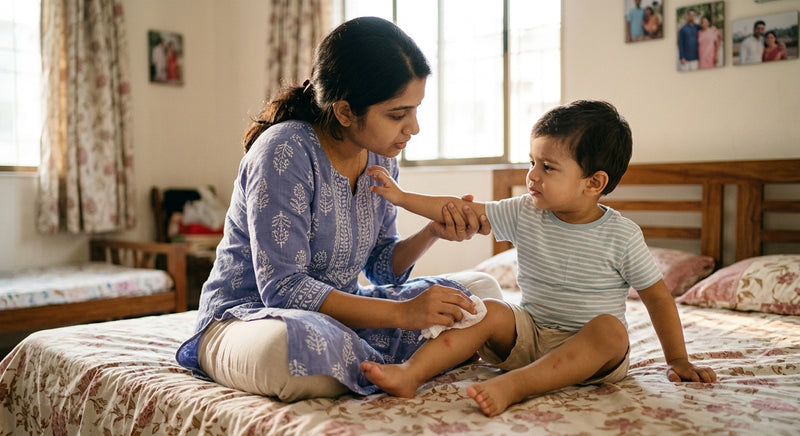
Sweat travels from the gland to the skin surface through a narrow duct. Plug that duct — with dead skin cells, with residue, with skin that's sat under wet cloth for hours — and the sweat has nowhere to go, so it leaks sideways into the surrounding skin. That leak is what your child feels. The pinprick bumps. The prickling. The itch that flares again the moment they get warm. In school-going kids I see it most on the upper back where the bag straps press, along the collar line and the back of the neck, across the chest under a tight banian, at the waistband, and in the elbow and knee creases.
Myth: “The polyester uniform is causing the rash”
Polyester fibres don't absorb water. That's the whole story, and it cuts both ways. A well-made technical polyester moves sweat along the fibre and lets it evaporate fast — which is why sports jerseys are synthetic. A cheap, tightly woven poly-blend school shirt does the opposite. Nothing absorbs, nothing evaporates, and the sweat pools in the film between cloth and skin. Add a snug vest underneath and you've built a small greenhouse over the upper back.
So the shirt didn't create the blocked duct. It created six hours of warm, wet, airless skin, and the duct followed. Most parents have spotted the pattern themselves before they ever write to me: the rash sits on the back and chest, exactly where cloth lies flat, and never on the forearms, where air reaches.
Myth: “Just switch him to 100% cotton”
This one surprises parents. Cotton absorbs beautifully — and then holds what it absorbed. A drenched cotton shirt in Nagpur humidity does not dry on the child; it stays plastered to the back until home time. I've seen plenty of ghamori under full-cotton uniforms.
Fit does as much work here as fibre. A looser cut, a weave that lets air through, and a layer underneath you can swap at lunch.
| Uniform fabric | How it handles sweat | Real-world verdict for Indian schools |
|---|---|---|
| 100% cotton | Absorbs a lot, dries slowly, gets heavy and clings | Best in dry heat and loose-fitting cuts. Struggles in monsoon humidity. |
| Poly-cotton blend (65/35 or 60/40) | Absorbs less, but dries faster than pure cotton | What most schools mandate. Workable — if the fit is loose and there's a cotton vest under it. |
| 100% polyester | Doesn't absorb; sweat sits as a film unless the weave lets it evaporate | The hardest one. Prioritise a loose fit, open collar, and a mid-day change. |
| Cotton vest (banian) under the shirt | Soaks sweat off the skin surface directly | The layer that matters most. Only if it's changed once it's wet — a soaked vest is worse than none. |
If the school allows one size up, take it. Air moving between the shirt and the back is worth more than any fabric label.
Myth: “Powder will keep it away”
Powder feels lovely on dry skin at 7 in the morning. By 11am, after games period, it has mixed with sweat and turned into a fine paste — sitting in exactly the creases you were trying to protect. It doesn't unblock a duct. Caked, it adds to the plug.
Cooling powders with menthol sting badly on skin that's already broken from scratching. Children rarely say so. They just refuse the powder the next morning. And loose powder puffed near a small child's face isn't worth the inhalation risk when it isn't solving the problem anyway.
What genuinely cuts the friction on a sweaty upper back is a dry layer and a looser strap. Not a dusting.
Myth: “Ghamori is a summer thing”
Ask any parent in Mumbai, Kolkata or coastal Kerala and they'll tell you August is worse than April. In dry heat, sweat evaporates and cools the child. At 85% humidity it has nowhere to go. It just sits. The uniform washed on Sunday is still faintly damp on Monday, the collar never quite dries, and the raincoat over the shirt on the bus turns the whole thing into a steam pocket.
For those months you want a lighter routine, not a richer one: a quick-rinsing cleanser, thin moisturiser only where skin is genuinely dry, and clothes that are bone-dry before they go on. That's the thinking behind our Monsoon Care Ritual for kids — humid-weather care needs less product on the skin, not more.
Myth: “Put him straight under a cold shower”
Understandable instinct. It backfires. A child who walks in at 45°C and stands under cold water gets a sharp shock, shivers, and starts sweating again within minutes of stepping out — often onto skin you've just moisturised. You've sealed the sweat in.
Let the sweating stop first. Five minutes under a fan, uniform off, water to drink. Then a cool-to-lukewarm rinse. Skin that is cool and dry before the bath tends to feel more comfortable afterwards, and it costs nothing to try.
The after-school reset: five minutes, tonight
- Uniform and vest off within two minutes of walking in. Not after homework. Not after a snack.
- Five minutes under a fan in loose cotton shorts, with a glass of water. Let the sweating actually stop.
- Cool-to-lukewarm rinse. Not cold, not warm. Two minutes is plenty.
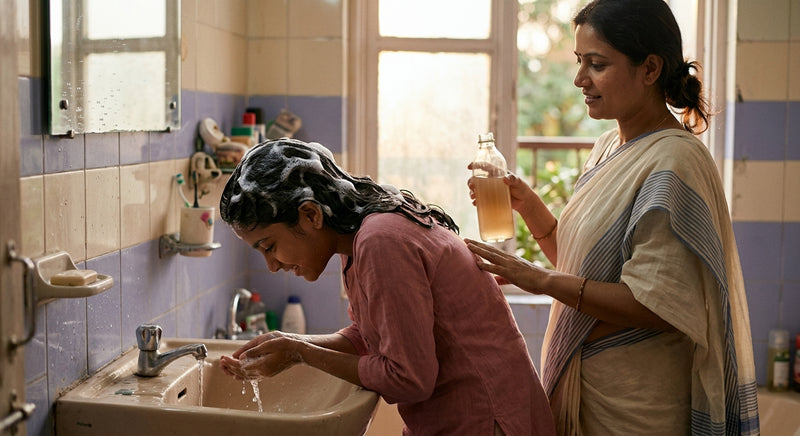
- A mild, low-foam cleanser on the sweaty zones only — back, chest, neck, underarms, waistband line. Plain water everywhere else.
- No scrubbing, no loofah, no soap bar on an itchy back. Friction on inflamed skin keeps the prickling going for hours.
- Pat dry with a soft towel, then check the creases — neck, elbows, behind the knees — are properly dry before dressing.
- Moisturise only where skin is dry or flaky. On an active ghamori patch, skip it; heavy cream over a blocked duct is the wrong direction.
- Loose cotton for the evening. The tight tee can wait for a cooler day.
What to change at school, not just at home
Home routines only cover four hours of the day. The other six are where the rash is forming.
- A spare cotton vest in the bag. Ask your child to change it after games or the lunch break. This one habit does more than any product I can sell you.
- Open the top button on the way to and from school. The collar line is the most common ghamori site I see in juniors.
- Look at the school bag. Narrow, unpadded straps digging into a sweaty upper back create exactly the pressure-plus-damp combination that triggers a flare. A wider padded strap, or a trolley bag, changes that.
- Tell the class teacher. In my experience most are perfectly willing to let a child sit near a window or change a vest, once they know it's a skin issue and not fussiness.
- Two shirts in rotation. One dries fully while the other is worn. In monsoon, this matters more than the fabric.
One laundry note that's easy to miss: in hard-water cities, detergent residue doesn't rinse out cleanly and sits in the weave against already-irritated skin. Run an extra rinse, drop the fabric softener for a few weeks, and see if the itch changes. And skip starching the collar through the peak sweat months — a stiff collar on a wet neck rubs all day.
When to see a doctor
Ghamori usually calms down within a few days once the skin stays cool and dry. See your paediatrician if the bumps turn into pus-filled spots, if the skin becomes warm, swollen or painful to touch, if there's fever, if the rash spreads rapidly or doesn't improve after about a week of cooling measures, or if the itching is disturbing your child's sleep. Rashes that look similar can have very different causes — fungal infections are common in humid months and need a proper look. Don't self-diagnose a spreading rash, and don't use a leftover prescription cream from a previous episode.
Most cases, honestly, are a logistics problem dressed up as a skin problem. Get the wet cloth off sooner, get air to the back, keep the wash gentle, and the skin does the rest.
If you're rebuilding that after-school wash, a mild, low-foam cleanser made for 3+ skin — like our Kids Gentle Body Cleanser — is the simplest place to start.
In summary
- Ghamori comes from blocked sweat ducts, so treat trapped moisture as the problem rather than blaming the uniform fabric itself.
- Put a spare cotton vest in the school bag and have your child change it after games — the highest-impact single change.
- Get the uniform off within two minutes of reaching home, cool down under a fan for five, then rinse cool-to-lukewarm.
- Skip prickly heat powder on sweaty skin; it cakes in the folds and can sting already-scratched patches.
- See a paediatrician if the rash blisters, turns pus-filled, comes with fever, spreads fast, or doesn't settle in about a week.
Frequently asked questions
Does a polyester school uniform cause ghamori?
Not directly. Ghamori comes from blocked sweat ducts, and polyester doesn't absorb sweat, so it can leave a wet film sitting against the skin for hours. That trapped moisture is the real trigger. A loose fit, an open top button, a cotton vest underneath and a mid-day vest change usually solve it without changing the uniform at all.
Is cotton always better than polyester for heat rash?
Not always. Cotton absorbs well but dries slowly, so a soaked cotton shirt clinging to a child's back all afternoon can trap just as much moisture as polyester. What matters more is how loose the fit is, how much air reaches the skin, and whether the wet layer gets changed. Dry beats natural, every time.
Should I use prickly heat powder on my school-going child?
Powder feels cooling on dry skin but it doesn't stop ghamori. Once sweating starts it mixes with sweat and cakes in exactly the folds you wanted to protect. Menthol-based powders also sting broken, scratched skin. A dry cotton vest, a looser shirt and a prompt cool rinse after school do far more than any dusting.
How soon after school should my child bathe?
Change out of the uniform within a couple of minutes, but wait about five minutes under a fan before bathing. Let the sweating actually stop first. Then a cool-to-lukewarm rinse for two minutes. A straight-in cold shower shocks the skin and often restarts sweating within minutes of stepping out, which undoes the cooling.
Why does my child get ghamori in monsoon and not just summer?
High humidity stops sweat evaporating, so it pools on the skin even when the temperature is lower. Add a uniform that never fully dries, a raincoat over it on the bus, and damp collars, and the monsoon becomes the worst season for heat rash in many coastal and central Indian cities. Rotate two shirts so each dries fully.
Can the school bag make heat rash worse?
Yes, and it's commonly missed. Narrow unpadded straps press wet cloth flat against the upper back and shoulders, blocking both airflow and the sweat ducts underneath. If the rash sits in two strips over the shoulders or across the upper back, look at the bag first. Wider padded straps or a trolley bag often change things within a week.