At a glance
- For babies under 6 months, shade, light clothing and timing come first — not sunscreen.
- Most paediatric guidance says keep young babies out of direct midday sun rather than rely on SPF.
- When shade genuinely isn't possible, a small amount of mineral (zinc/titanium) sunscreen on tiny exposed bits — cheeks, backs of hands — is generally considered okay.
- Avoid chemical (organic) UV filters on very young skin; mineral filters sit on top and aren't meaningfully absorbed.
- A newborn's skin is thinner and reacts faster, so patch test anything new for 24 hours first.
June wedding, family courtyard. Baby on your hip, sun bouncing off the whitewashed wall behind you. An aunty leans in: “beta, put some sunscreen on her, na.” And you freeze — because somewhere you also read that sunscreen isn't for newborns. So which is it?
Short, honest answer: for a baby under 6 months, sunscreen is not the first thing you reach for. Shade, a light muslin layer, a wide hat, and simply staying out of the harsh 10am–4pm sun protect a young baby far better — and more safely — than any cream. Sunscreen isn't dangerous. It just isn't the main tool at this age. When shade truly can't be arranged, a small dab of a mineral sunscreen on the little exposed patches is fine. Below is the science, and how I'd handle each Indian season.
This piece sits inside our complete guide to sun care for babies and kids — start there if you want the full picture across every age.
Why is a newborn's skin treated differently?
Here's where the skin science earns its place. A baby's skin is 20–30% thinner than an adult's, and the outermost barrier — the stratum corneum — is still maturing through the first months. Thinner skin, more surface area for its body weight, a barrier still finding its feet. Two things follow. Young skin burns faster. And it takes up whatever you put on it more readily than grown-up skin does.
That second point is the real reason the advice stays cautious — not because sunscreen is toxic, but because coating a large stretch of a tiny, absorptive body with active chemistry you don't actually need makes little sense. Better to shrink the need for sunscreen in the first place.
What actually protects a baby under 6 months?
Picture it as layers, in order. Sunscreen is the last one, not the first.
- Timing. Keep direct-sun outings before ~10am or after ~4pm. In peak Nagpur or Delhi summer, that window isn't negotiable.
- Shade. Pram canopy, a wide umbrella, the shaded side of the courtyard, a tree. Shade knocks out a huge share of UV.
- Clothing. A loose, light, tightly-woven full-sleeve cotton or muslin kurta covers more skin than any cream ever will — and never needs reapplying.
- A wide-brim hat to shade the face, ears and the back of the neck.
- Never park the pram in direct sun “to get some vitamin D.” A young baby doesn't need direct sun for that, and overheating is a real risk in Indian heat.
When is a little sunscreen actually okay under 6 months?
Real life isn't a lab. There's the long walk across a baking parking lot, the outdoor function you can't skip, the beach trip the whole family booked months ago. In those moments, most dermatological guidance agrees: a small amount of sunscreen on the small areas you can't cover — cheeks, the backs of the hands, the tops of the feet — is a sensible thing to do. It was never “banned.” The message was always “shade first,” not “never, ever.”
What matters is which sunscreen. For a young baby, pick a mineral one — and only that. Here's why the formula type counts for more at this age than any other.
Mineral vs chemical filters on young skin
Sunscreens fall into two families. Mineral (physical) filters — zinc oxide and titanium dioxide — sit like a fine veil on the skin's surface and mostly reflect and scatter UV. They barely absorb, they're gentle, they rarely sting. Chemical (organic) filters — avobenzone, oxybenzone, octinoxate and the like — soak up UV inside the skin, which means they have to penetrate a little to work. On thin, absorptive newborn skin, that's exactly what you'd rather avoid.
| Mineral (zinc/titanium) | Chemical filters | |
|---|---|---|
| How it works | Reflects UV on the surface | Absorbs UV within skin |
| Absorption into skin | Minimal | Some — by design |
| Sting/irritation risk | Low | Higher on sensitive skin |
| Best for a young baby? | Yes, if any | Better to wait |
I've gone deeper on this in mineral vs chemical sunscreen for kids — worth a read before you buy anything. And once your little one is older and sunscreen turns into a daily habit, how to choose the best kids' sunscreen in India walks through what to look for on the label.
Season by season in India
The right call shifts with the weather here — UV doesn't take a monsoon holiday.
| Season | The real risk | What I'd do |
|---|---|---|
| Summer | Intense UV + overheating | Strict 10–4 shade rule; light full cover; AC/fan indoors |
| Monsoon | UV still high through cloud + humidity rash | Don't drop your guard; breathable cotton; shade on bright breaks |
| Winter | Deceptively strong midday sun + dry skin | Hat and shade still apply; keep the barrier moisturised |
Two Indian realities worth saying out loud: clouds let plenty of UVA through, so overcast monsoon days aren't “safe” — and a young baby's skin dries out fast in dry-winter and AC air, which leaves it more reactive. Keep the barrier calm and well-moisturised between outings, and it copes far better.
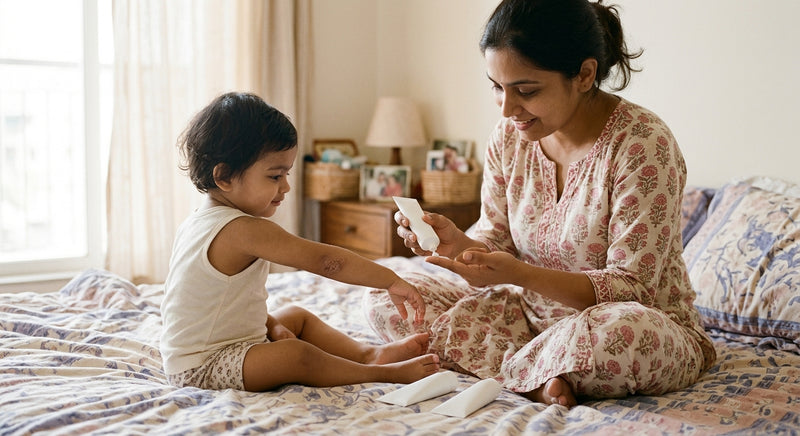
How to patch test and apply, if you do use it
- Use a mineral-only formula, ideally fragrance-free, broad-spectrum SPF 30–50.
- Apply a thin, even layer to small exposed areas only — not the whole body.
- Keep it away from eyes and hands that go straight into the mouth.
- Reapply roughly every 2 hours if you're still out, and after any water.
- Wash it off gently at bath time with a mild, tear-free cleanser.
When to see a doctor
So — back to that courtyard. The line you can hand the aunties, calmly: “She's covered and in the shade. That's what's safest at her age.” And if you do need a little SPF for the bits you can't cover, reach for a gentle mineral formula. Our Daily Defender mineral sunscreen (SPF 40 PA++++) uses skin-surface mineral filters and is dermatologically tested — the kind I'd trust on small exposed areas when shade simply isn't an option.
In summary
- For babies under 6 months, protect with shade, light clothing and timing before reaching for sunscreen.
- A newborn's skin is 20–30% thinner and more absorptive, so minimise anything you apply over large areas.
- When shade isn't possible, use a small amount of mineral (zinc/titanium) sunscreen on tiny exposed areas only.
- Choose mineral over chemical filters on young skin, and patch test any new product for 24 hours first.
- Keep sun protection up through monsoon and winter, and see a paediatrician for any sunburn, fever or lethargy.
Frequently asked questions
Is sunscreen safe for babies under 6 months?
It's not the first line of defence at this age. Paediatric guidance favours shade, light clothing and avoiding direct midday sun over sunscreen. Sunscreen isn't dangerous, but a newborn's thinner, more absorptive skin means it's better to minimise what you apply. When shade genuinely isn't possible, a small amount of mineral sunscreen on tiny exposed areas is considered reasonable.
Why can't I just use sunscreen instead of keeping my baby in the shade?
Because a baby's skin is 20–30% thinner than an adult's and still building its barrier, so it burns faster and takes up topical ingredients more readily. Clothing and shade block UV completely, never wear off, and don't add any chemistry to the skin. Sunscreen is a backup for the small areas you can't cover, not a substitute for covering up.
What kind of sunscreen is safest for a young baby?
A mineral (physical) sunscreen using zinc oxide or titanium dioxide. These sit on the skin's surface and reflect UV rather than being absorbed, so they're gentle and rarely sting. Avoid chemical filters like oxybenzone or avobenzone on very young skin, since they work by penetrating slightly. Choose fragrance-free, broad-spectrum SPF 30–50 and patch test first.
Does my baby need sun protection during the monsoon or winter?
Yes. Clouds let plenty of UVA through, so overcast monsoon days still carry sun exposure. Winter midday sun in India is deceptively strong too. The clothing-and-shade approach applies year-round; you don't have to reach for sunscreen, but you shouldn't assume the sun has taken a break either.
How do I protect a newborn from the sun without sunscreen?
Keep outings before 10am or after 4pm, use a pram canopy, umbrella or tree for shade, dress your baby in loose, light, tightly-woven full-sleeve cotton, and add a wide-brim hat for the face and neck. Never park a pram in direct sun. These layers, in that order, protect a young baby far better and more safely than any cream.