Last month at an expo stall in Nagpur, a father picked up a jar from the table, turned it over to read the back, and asked the question we get more than any other: "Powder hai aapke paas? Talc-free wala?"
Talc-free is not the same as safe for a baby. Swapping talc for cornstarch or arrowroot settles one argument about one mined mineral. It leaves untouched the part that actually worries paediatricians: a cloud of very fine dust drifting up near a baby's face. And it still doesn't do the job most parents buy powder to do. We own our GMP facility. A talc-free baby powder could be on our shelf in a few weeks, and it would sell. We've decided not to make one. Here's the honest reasoning.
At a glance
- "Talc-free" answers the mineral question. It says nothing about the dust.
- Cornstarch and arrowroot are milled fine enough to hang in the air, exactly like talc.
- Powder absorbs sweat and then cakes. In a humid Indian skin fold, damp starch turns gritty and adds friction instead of taking it away.
- Powder leaves no protective film on the skin. Keeping the area dry and using a barrier cream does more.
- Using it anyway? Never shake the bottle near your baby. Tip it into your own palm first, well away from the cot.
Is talc-free baby powder actually safe?
Two separate worries got bundled into one word. The market fixed the first and quietly walked past the second.
The first is talc itself. It's a mined mineral, hydrated magnesium silicate, and talc deposits can sit geologically close to asbestos. Which is why cosmetic-grade talc is meant to be asbestos-tested at source. That testing is the entire safety argument, so it's only ever as good as your supplier's paperwork. Most brands stepped away from talc to stop having the argument at all. Honestly, fair enough.
The second worry is powder as a format, and nobody has solved that one. A baby powder works by being milled small enough to feel silky and flow freely. Small enough to feel silky is small enough to float. Change a nappy with the fan on, which is most of India for eight months of the year, and a visible haze rises around the changing mat at roughly the height of your baby's nose. Paediatric guidance here and abroad has said for years to keep powder away from a baby's face. Plenty of paediatricians now say skip it. None of that was ever really about talc versus starch. It was about the cloud.
What's actually inside talc, cornstarch and arrowroot powder?
I've spent enough hours on a blending floor to read these labels a particular way, because the label rarely tells you the whole story.
Talc
Listed as Talc or Magnesium Silicate. Plate-shaped particles that slide over each other. That sliding is the slip you feel between your fingers. It doesn't absorb much moisture; it mostly reduces friction.
Cornstarch (maize starch)
Listed as Zea Mays (Corn) Starch. Rounded granules, a fair bit larger than cosmetic talc platelets. "Larger" here still means a small fraction of the width of a human hair, which is roughly 70 microns. It genuinely absorbs moisture. That's the selling point, and inside a wet fold it's also the problem.
Arrowroot
Listed as Maranta Arundinacea Root Powder, or arrowroot starch. Sold as the gentler, more "natural" pick. It behaves like any other starch: absorbent, fine, quick to clump once it's damp. Natural origin tells you nothing about particle size, and particle size is the whole issue.
Then there's everything sitting next to the hero ingredient. Most powders on Indian shelves are blends: kaolin or silica for slip, zinc oxide for a mild soothing effect, and fragrance, often a lot of it, because raw starch smells faintly of cereal and somebody has to cover that. When a powder is sold on the strength of one ingredient, read the full INCI list before you believe the front of the pack. It's the same habit we used when we pulled apart an Indian baby wipe label ingredient by ingredient. The front markets. The back tells you.
| Powder base | What it is | Why parents switch to it | What doesn't change |
|---|---|---|---|
| Talc | Mined mineral, plate-shaped particles | — | Fine airborne dust; no barrier film; cakes in wet folds |
| Cornstarch | Maize starch granules | "Talc-free", food-familiar, absorbent | Still a fine dust; absorbs sweat then clumps; no barrier film |
| Arrowroot | Maranta root starch | "Natural", sounds gentler | Still a fine dust; same clumping in humidity; no barrier film |
| "Talc-free" blends | Starch plus kaolin, silica, zinc oxide, fragrance | Better slip, added claims | More ingredients near the airway, usually more fragrance |
Why the cloud matters more than the mineral
A baby's airway is narrow and their breathing is fast. They can't turn their head away or hold their breath the way you would. And the exact quality that makes a powder feel luxurious in your palm, that weightless drift, is what keeps the particles suspended long enough to be breathed in.
I'm not going to catastrophise this. A light dusting on a dry back, bottle nowhere near your baby's face, is not an emergency. Just notice where the risk actually sits. It's in the format. Whether the tin says talc or corn changes nothing about it, and switching to arrowroot doesn't remove a single floating particle.
Does cornstarch feed a fungal nappy rash?
You'll read this everywhere. Cornstarch is a carbohydrate, yeast eats carbohydrate, therefore cornstarch worsens a candida nappy rash. It sounds airtight. The actual evidence is thinner than the confidence with which it's repeated: studies looking at this haven't produced a clean verdict, and it's no longer the main reason clinicians steer parents away from powder.
My objection is more boring and more useful. Starch absorbs. In a sweaty neck fold in a Nagpur May, or a nappy area at 85% monsoon humidity, absorbing means it takes up moisture and forms damp clumps. Those clumps sit down in the crease and rub. You've added grit to a fold that was already chafing. Parents usually find this out a few days in, when they open the fold and see pale, pasty flakes packed into the deepest part of the crease.
What powder actually does — and doesn't do — for a damp fold
Powder does one thing decently. It reduces skin-on-skin friction on a surface that is already dry. That's the whole job. Friction reducer, not moisture barrier.
It can't form a film that keeps urine, stool or sweat off the skin. That's what a barrier cream or balm is for, and it's a different piece of physics entirely. It also can't do anything for a barrier that's already struggling. A baby's skin is 20–30% thinner than an adult's, so it loses water faster and gives way sooner under friction. Dusting starch over the top of that rebuilds nothing.
Why we don't make a baby powder, even though we easily could
We make our own formulations in our own GMP-certified facility. Powder is one of the easiest things you can produce there. Blend, sieve, fill. No emulsion to stabilise, long shelf life, low cost, healthy margin. Every distributor who has walked our floor has asked for one.
The claim is where it falls apart. To sell a baby powder we'd have to imply it protects the skin, and it doesn't. It reduces friction on skin that's already dry, and in Indian humidity it mostly stops doing even that. We build products we can put through in-vivo testing on real subjects and then stand behind the result. The barrier support we can point to shows up in a lab study as increased Keratin-10 and Filaggrin expression, which is the language of skin building itself back up. A tin of milled starch has no equivalent story to tell.
So the honest answer to "powder hai?" is no. We'd rather explain that than sell you the easy SKU.
What to do tonight instead: a fold-care routine that works in Indian heat
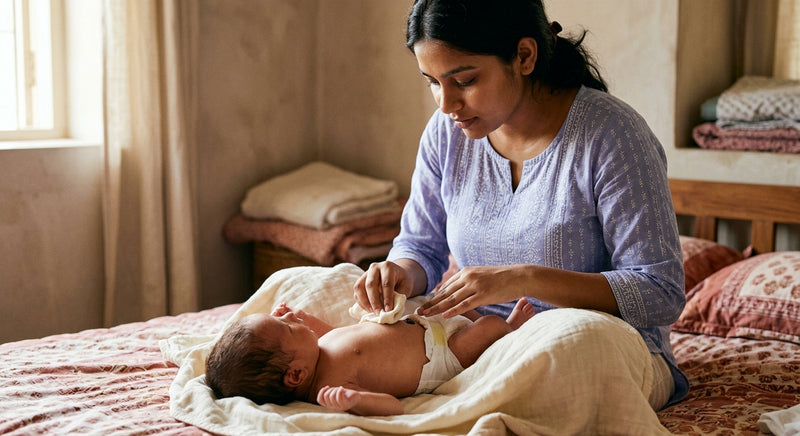
Sweaty neck creases. Thigh chafing. A damp nappy area. Everything powder is supposed to solve responds better to drying properly and sealing lightly. Give this three nights.
- Wash gently, not often. One short bath in comfortably warm water with a mild, tear-free cleanser is enough; a gentle foam wash made for babies rinses out of folds more easily than a thick lather does.
- Open every fold and rinse inside it. Neck, behind the ears, armpits, thigh creases, wrists. Milk, sweat and dust collect exactly where you can't see.
- Pat dry with soft cotton. Never rub. Then hold the fold open and count to 60. Air does what powder pretends to do, for free.
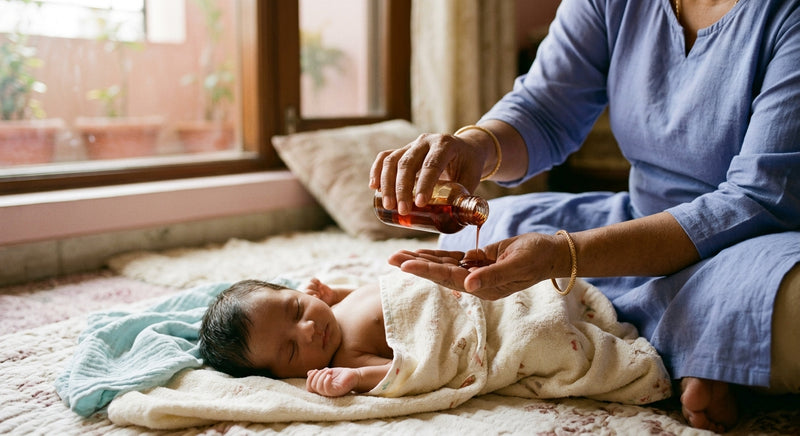
- Seal only the friction points with a thin layer of barrier balm where skin meets skin, and across the nappy area at every change. Thin and even beats thick and patchy.
- Change the nappy every 2–3 hours, more often in monsoon weather, with 10 minutes of nappy-free time before you fasten a fresh one.
- Dress for the room, not for what the calendar says the season should feel like. Loose cotton. One layer fewer than you think. Skip the vest under the vest.
If you're still going to use powder, do it this way
Plenty of households will keep a tin going, for a dadi's ritual or simply because it has lived in that cupboard for two generations. I'd rather hand you a safer method than pretend nobody uses it.
- Take your baby out of the bottle's line, or turn away yourself, before you open it.
- Tip a small amount into your own palm first. Never shake it directly onto the body, and never over the chest or face.
- Rub it between your palms, then smooth it on. No puffing. No clouds.
- Completely dry skin only. Powder on damp skin is how clumps start.
- Never on the nappy area if there's any redness or broken skin. Never on the face. Never near the genitals.
- Fan off, cap on, bottle back in a closed drawer.
When to see a doctor
Call your paediatrician the same day if your baby coughs, wheezes, chokes or breathes noisily after being near powder. That one is not wait-and-watch. Get a rash looked at too if it's bright red with satellite spots or a defined raised edge, if the skin is broken, weeping or bleeding, if there's swelling, warmth, pus or fever, or if a fold rash hasn't improved after three days of careful drying and a barrier cream. A doctor can tell friction rash, fungal infection and eczema apart in a moment. A label can't, and neither can an article. Nothing here is a diagnosis.
If you keep one thing on the shelf for damp folds and chafe-prone spots, make it a barrier. Our Hydra Healing Moisturizing Balm is what we'd hand you instead of a tin of powder.
In summary
- Treat "talc-free" as answering the mineral question only — cornstarch and arrowroot create the same fine airborne dust.
- Read the full ingredient list, since most powders are blends of starch plus kaolin, silica, zinc oxide and fragrance.
- Expect starch to absorb sweat and cake into gritty clumps inside humid Indian skin folds, adding friction rather than removing it.
- Dry folds properly — open the crease, pat with soft cotton, air it for 60 seconds — and seal only the friction points with a thin barrier layer.
- If you keep powder at home, tip it into your palm away from your baby, use it on dry unbroken skin only, and store the bottle capped and out of reach.
Frequently asked questions
Is talc-free baby powder safe for newborns?
Talc-free removes the mined-mineral question but not the main caution, which is inhaling fine airborne dust. Cornstarch and arrowroot are milled just as fine and drift the same way near a baby's face. Most paediatricians now suggest skipping powder for newborns entirely and keeping folds dry with careful patting, air-drying and a thin barrier cream instead.
Is cornstarch powder better than talc for nappy rash?
Not meaningfully. The old claim that cornstarch feeds yeast has weaker evidence than its popularity suggests, but there's a simpler problem: cornstarch absorbs sweat and urine, then cakes into damp, gritty clumps inside the crease. That adds friction to skin that was already chafing. A thin barrier layer at every nappy change does the job powder is bought for.
Can I use arrowroot powder on my baby's skin folds?
Arrowroot is a plant starch, and natural origin tells you nothing about particle size — which is the actual concern. It behaves like any starch in Indian humidity: it soaks up moisture and clumps in the deepest part of a fold. Rinsing folds properly, patting dry with soft cotton and letting them air for a minute works better and costs nothing.
What can I use instead of baby powder for prickly heat?
Cool the skin and reduce sweating rather than dusting it. Loose single-layer cotton, a fan or AC set comfortably, a short lukewarm bath with a mild cleanser, and thorough drying of neck, armpit and thigh creases. Apply a light barrier only where skin rubs skin. Powder can trap moisture in a hot fold and make the prickle worse, not better.
Is powder okay on a baby's body if I keep it away from the face?
Keeping it away from the face is the right instinct, and it lowers the risk considerably. Tip powder into your own palm first, well away from your baby, rub your hands together and smooth it on — never shake the bottle over the body. Use it only on completely dry, unbroken skin, and store the bottle in a closed drawer out of reach.
Why doesn't Janma make a baby powder?
We manufacture in our own GMP-certified facility, so a powder would be one of the easiest and highest-margin products we could add. We haven't because we can't stand behind the claim. Powder reduces friction on already-dry skin; it forms no protective film and offers nothing to a barrier that's already struggling. We'd rather make products we can test in-vivo and defend.