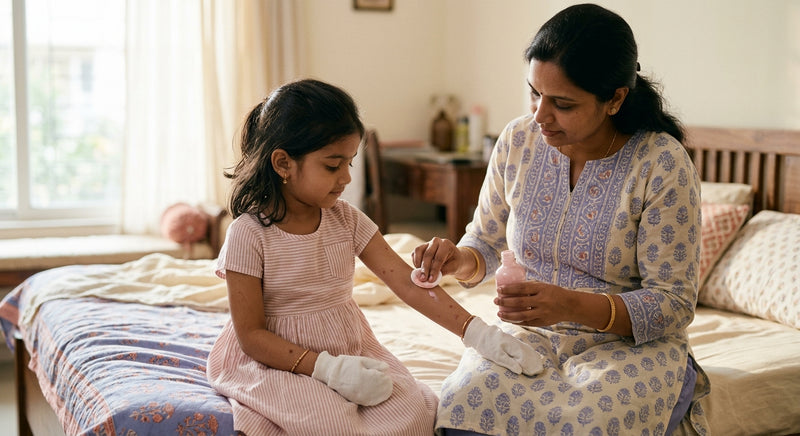
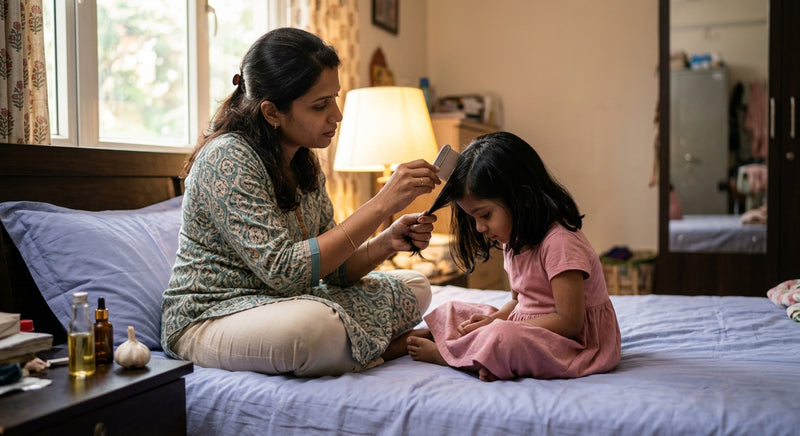
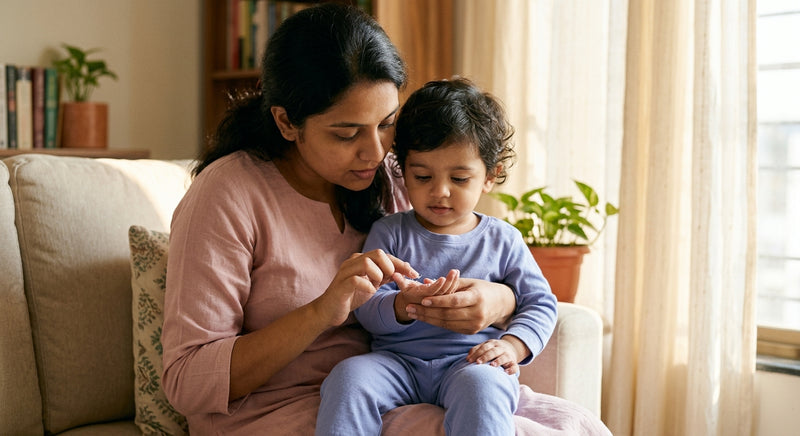
Day three. Your mother-in-law arrives with a small steel dabbi of homemade kajal and a face that has already closed the discussion. A dot behind the ear, a line along the lower lid, the way it's been done for four generations. And you're standing there holding your phone, because at 2am you read something about lead.
So, the answer first. A large share of kajal tested — homemade and shop-bought, Indian and imported — has come back containing lead, sometimes as a majority ingredient. Health authorities in India and abroad have issued repeated warnings and product recalls over exactly this. The eye rim is thin, highly absorbent skin. Babies rub their eyes, then put their hands in their mouths. Which is why paediatricians are near-unanimous: don't put kajal inside or along a baby's eyes. The dot on the cheek or behind the ear is a separate question — that part of the ritual is about protection and love, and it's worth talking through with your family instead of winning an argument with them.
At a glance
- Testing of kajal/surma products across multiple countries has repeatedly found lead — including in samples sold as "herbal" or "natural."
- Homemade kajal is not automatically safe: the risk sits in what's added to the soot (metal salts, unmarked pigments), not in the ghee or the lamp.
- There is no known safe blood-lead level in children — which is why regulators treat this as avoid, not moderate.
- Indian summers and monsoon make it worse in practice: sweat and humidity carry product down into the eye and onto hands.
- Keep the ritual, move the placement — a kajal tikka behind the ear or on the sole of the foot, not on the lid.
What does the lead testing on kajal actually show?
None of this is new, and none of it is fringe. For two decades now, public-health labs in India, the UK, the US and the Gulf have been testing kajal, surma and kohl — samples pulled off shop shelves, samples handed over from family homes. A substantial proportion come back positive for lead. In the worst samples the lead compound isn't contamination that crept in during grinding or storage; it is the colour. Usually lead sulphide, the traditional galena. That's exactly what makes the line so black, and what makes it sit there all day without fading.
Two things tend to stop parents short when I explain this.
One: "herbal" on the label means nothing here. Several of the recalled products carried that word on the front. Lead doesn't turn up because someone added a chemical. It turns up because a mineral has been ground into a cosmetic, and a mineral is, technically, natural.
Two: homemade doesn't equal lead-free. If your kajal really is lamp soot, collected on a clean plate, mixed with ghee or castor oil, then there's no lead in it. But almost every family recipe I've been shown over the years has something extra in it — a pinch of black powder bought loose from the shop at the corner, a bit of surma "for shine," an unmarked sachet somebody carried back from a pilgrimage. That's where it comes in. Not the lamp. The extras.
Why is it riskier in Indian weather specifically?
Almost nobody writes about the weather part, and the weather is what decides how much product actually ends up inside your baby's eye.
Peak summer (April–June). A baby in a Nagpur or Delhi May sweats along the hairline and temples all day long. Anything on the lid margin doesn't stay on the lid margin — it runs. Parents describe the kajal "spreading." Then they wipe it. And the wiping pushes pigment deeper into the lid margin and along the lashes. Sweat stings, too, so there's more rubbing to begin with.
Monsoon (June–September). Humidity keeps oil-based kajal semi-liquid from morning to night. It simply never sets. Meanwhile the season brings its own rise in eye irritation and conjunctivitis — the "eye flu" waves that come round every year in Indian cities — so you're putting a pigmented, often non-sterile paste onto a lid that may already be inflamed. And a dabbi that's been sitting open through a humid August is a microbial problem all by itself, before you even get to the lead.
Dry winter (November–January). Cold air, dry indoor heat, flaky lid skin, watery eyes. The water carries product down the cheek in a grey streak. Parents scrub the streak. That scrubbing, on skin that's already dry and thin, is the single most common reason I'm asked about an irritated patch under a baby's eye every January.
Hard water. Across much of North and Central India the water you'd reach for to wipe it off leaves a residue of its own and dries the skin further. Wipe repeatedly with a hard-water-wet cloth and you've done more damage than the application ever did.
But my mother used it on me and I'm fine — isn't this overblown?
I hear this constantly. It's a fair thing to say and it should get a straight reply. Lead doesn't announce itself. Its effects are subtle, they build up slowly, and in any one child they're invisible — which is precisely how the practice carried on for generations with nobody joining the dots. "I turned out fine" is a genuine observation. It just isn't evidence, because there's no second version of you, raised without it, to hold up alongside.
There's a second belief here too. Kajal does not make a baby's eyes bigger or brighter, and it does not thicken lashes. Eye shape and lash growth are genetic. What you're seeing is contrast: a dark line makes any eye look larger, on a baby exactly as on an adult. Nothing has grown.
As for drishti — the black mark against the evil eye was never about the eye itself. The traditional protective mark is a tikka, a small dot placed somewhere visible but off the centre of the face. That's where the meaning lives. Keeping it costs you nothing.
What to do instead: keeping the ritual without the risk
"Stop it" doesn't work in an Indian household. It lands as disrespect, and it gets ignored the moment you leave the room. What works is a swap that leaves the gesture whole.
- Move the placement. One kajal dot behind the ear, on the sole of the foot, or on the outer cheek near the hairline — the classic anti-nazar spots — instead of the lid margin. Same dabbi, same hands, same blessing.
- Keep it off the hands-and-mouth route. Behind the ear works best because a baby can't easily reach it, so none of it travels to the mouth.
- Wipe it before bed. One damp cotton pad, one gentle pass, no scrubbing. Nothing pigmented stays on overnight.
- Retire the mystery powders. Anything in your family kajal that was bought loose or arrived unlabelled is the ingredient to drop. Lamp soot in ghee, made at home, is one product. Soot plus an unmarked black powder is a completely different one.
- Have the conversation with the elder, not around them. Ask them to make the tikka. "The doctor said the eye area, not the kajal" is accurate, and it keeps both the tradition and the person intact.
A season-by-season view of the eye area
| Season | What actually goes wrong | What to do |
|---|---|---|
| Peak summer | Sweat carries product into the eye; more rubbing; sticky lids | No eye-area product at all; wipe sweat with a soft dry cloth, not a wet one |
| Monsoon | Nothing dries; conjunctivitis season; open dabbis grow microbes | Skip entirely during any eye redness or discharge; separate cloth per eye |
| Dry winter | Watery eyes streak; flaky, irritated under-eye skin | A thin barrier moisturiser on the cheekbone (never the lid) after the evening bath |
| Hard-water areas | Repeated wiping dries and irritates thin lid skin | Wipe with cooled boiled water or filtered water, once, then leave it alone |
What about the under-eye skin itself?
Once the lid application stops, the next question is nearly always about the skin around the eye. The dry patch under the lower lid in winter. The dark-looking crescent that shows up after a stretch of bad nights.
Very little is needed here. A small amount of plain, fragrance-free barrier moisturiser on the cheekbone, blended upward, stopping well short of the lash line. A pea-sized amount covers both cheeks. Do it after the evening bath while the skin is still slightly damp — that's when it actually holds the moisture. Nothing pigmented. Nothing scented. Nothing near the lid margin.
For that job — dry, thin, easily-irritated skin on a baby's face through a Nagpur summer or a north Indian winter — a simple barrier balm that helps support the skin barrier is all that's needed.
When to see a doctor
Book a paediatrician appointment if:
- Your child has used kajal on the eyes regularly and you want lead exposure assessed — ask directly about a blood-lead test.
- There's persistent eye redness, swelling, yellow or green discharge, or the eyelids are stuck together in the morning.
- Your baby seems to be in pain, keeps the eye shut, or is unusually sensitive to light.
- You notice unexplained irritability, poor appetite, constipation, or a stall in developmental milestones in a child with a history of regular kajal use — these are non-specific, but worth raising in the same conversation.
- Any eye symptom in a baby under 3 months. Newborn eye infections get assessed straight away rather than watched at home.
Take the actual dabbi or packet along. Doctors find it genuinely useful to see what's been going on the skin.
The short version
It's the pigment, not the practice. Lead has shown up in kajal often enough, across enough independent testing, that no paediatrician will call the eye-area application safe — and there's no dose small enough to make it fine, because for a child there's no known safe level at all. Move the dot behind the ear. Drop the unlabelled powders. The ritual survives; only the placement changes.
There are more of these tradition-versus-evidence questions worked through in the Janma Journal, with the reasoning laid out rather than a verdict handed down.
In summary
- Repeated testing across countries has found lead in kajal, surma and kohl — including products labelled herbal or natural.
- Homemade kajal is only as safe as its additions; the risk is in purchased black powders, not the lamp soot or ghee.
- Indian summer sweat, monsoon humidity and winter watery eyes all push eye-area product into the eye and onto hands.
- Keep the ritual by moving the dot behind the ear or on the sole of the foot, and wipe it off before bed.
- Ask your paediatrician about a blood-lead test if your child has used kajal on the eyes regularly.
Frequently asked questions
Is homemade kajal safe for babies?
Not automatically. Pure lamp soot mixed with ghee isn't a lead source, but most family recipes include an extra purchased black powder or surma, and that's where lead typically enters. Homemade also means unpreserved and often stored in an open container, which is a microbial risk in humid weather. Paediatricians advise against any kajal in or around a baby's eyes, homemade or not.
Does kajal make a baby's eyes bigger or lashes thicker?
No. Eye shape and lash growth are determined by genetics, not by anything applied to the lid. The effect people notice is purely visual contrast — a dark line makes any eye look larger, in a baby exactly as in an adult. Nothing is actually growing. The belief is widespread but there's no mechanism behind it.
Where can I safely put a kajal dot for nazar?
Behind the ear is the best spot — it's visible enough for the ritual, and a baby can't reach it to transfer pigment to their mouth. The sole of the foot and the outer cheek near the hairline are also traditional. Keep it well away from the eyes and nose, wipe it off before bed with a damp cotton pad, and don't reapply over old product.
What are the signs of lead exposure in a baby?
They're frustratingly non-specific: irritability, poor appetite, constipation, tiredness, or a plateau in developmental milestones. Many children show nothing obvious at all, which is exactly why it's dangerous. Don't try to diagnose this at home. If your child has used kajal regularly on the eyes, tell your paediatrician and ask whether a blood-lead test is appropriate for your situation.
My baby's eye is sticky in the morning — will kajal help?
No, and it makes things harder. A sticky or crusted eye in a young baby is usually a blocked tear duct, which is very common and typically resolves on its own with a warm compress and gentle massage as your doctor demonstrates. Applying pigment over a weeping eye risks irritation and obscures what your paediatrician needs to see. Get any discharge checked, especially under three months.
Is imported or branded kajal safer than the local kind?
Not reliably. Recalls and testing failures have involved branded, imported and 'herbal'-labelled products, not just loose local powders. The word herbal on a pack tells you nothing about lead content, because lead compounds in kohl come from a ground mineral, which is technically natural. Treat all eye-area kajal for babies the same way: skip it.