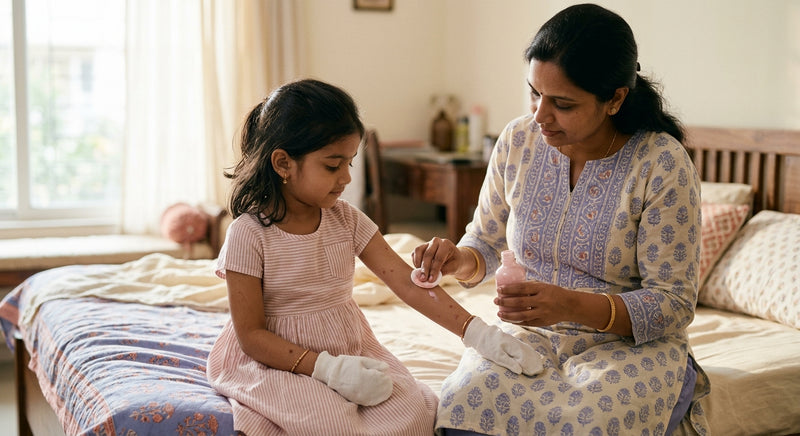
You run your hand down your child's upper arm and feel it — dozens of tiny, rough bumps, like fine sandpaper or the skin of a plucked chicken. Sometimes they're skin-coloured. Sometimes each one sits in a little ring of pink. They don't itch much. They don't hurt. But they don't go away either, and no amount of scrubbing in the bath seems to smooth them.
That's almost certainly keratosis pilaris (KP) — one of the most common, most harmless skin things parents ask me about. It's a build-up of keratin around the hair follicles, it runs in families, and it has nothing to do with poor hygiene or anything you did wrong. Let me be honest up front: KP can be softened and made much less noticeable, but no cream permanently erases it, and most kids grow out of it anyway. So here's what actually helps — and what quietly makes it worse.
At a glance
- Keratosis pilaris is harmless keratin build-up around hair follicles — the "chicken skin" on upper arms, thighs and cheeks.
- It's genetic and often runs alongside dry skin and eczema. You didn't cause it.
- Scrubbing makes it redder and rougher. Gentle, consistent moisturising is the real workhorse.
- It usually fades with age — the goal is comfort and smoother-looking skin, not a cure.
- For kids, choose the gentlest effective option first, not the strongest acid on the shelf.
What exactly is keratosis pilaris?
Your skin makes a tough protein called keratin — it's what forms the protective outer layer. In KP, a little too much keratin collects at the mouth of each hair follicle and forms a tiny plug. Multiply that by hundreds of follicles on the outer upper arms, the front of the thighs, sometimes the cheeks and buttocks, and you get that fine, grater-like texture.
The bit that ties it all together: KP travels with dryness. Children with a weaker skin barrier — often linked to how much filaggrin their skin makes, a protein that holds the barrier together and keeps it hydrated — tend to have both drier skin and more KP. That's why so many kids with KP also have eczema, or just generally dry, sensitive skin, and why the same barrier care helps all of it. If your child has both, our complete guide to baby & kids' eczema and dry skin is worth reading alongside this.
Is it keratosis pilaris — or something else?
Most of the time it's clearly KP. But a few things get confused with it. Quick tells:
- KP: tiny, even, rough bumps in the same spots on both arms and thighs; barely itchy; texture you feel more than redness you see.
- Eczema: red, itchy, sometimes weepy or scaly patches that come and go and clearly bother your child — more inflamed than KP. See our guide on spotting baby eczema and a gentle care routine.
- Heat rash / folliculitis: appears suddenly, can look pus-tipped or hot, often after sweating — KP is slow, chronic and stable.
What actually smooths it? An honest comparison
Here's where most parents get stuck. The internet throws everything at KP, from body scrubs to strong acid creams. As a cosmetologist, this is how I'd rank the real options for a child's skin — gentlest and most sensible first, honestly labelled.
| Option | How it works | Honest verdict for kids |
|---|---|---|
| Daily gentle moisturiser | Softens the keratin plugs, calms the surrounding dryness, supports the barrier | The workhorse. Safe, effective over weeks, no downside. Start here. |
| Mild lactic-acid / urea lotion (low %) | Gently loosens keratin (chemical, not physical, exfoliation) | Can help stubborn cases, but can sting broken or very young skin. Only low strength, patch-test first, and skip on the face. |
| Physical scrubs / loofah / ubtan rubbed hard | Tries to buff bumps off mechanically | Tempting, but it inflames follicles and often makes KP redder and rougher. I'd avoid it. |
| Coconut oil alone | Adds surface softness and a little occlusion | Pleasant and safe, but on its own it doesn't do much for the keratin. Fine as an add-on, not the plan. |
| Strong prescription creams (higher-% acids/retinoids) | More aggressive keratin turnover | Rarely needed in children. A doctor's call only — not a first move at home. |
What we'd actually do
For a child, I'd skip the acids and the scrubbing entirely to begin with, and win this with consistency instead. Nearly all of the improvement I see comes from two boring things done well: a short, lukewarm bath with a mild cleanser, then a barrier-supporting moisturiser on slightly damp skin, twice a day. Give it a full 4-6 weeks before you judge it. KP responds slowly, and most "nothing works" stories are really "we stopped after four days."
Only if the texture is still bothering an older child after weeks of that would I add a low-strength lactic-acid lotion on the arms — never the face — patch-tested first. And if the skin is already dry and cracking in an AC bedroom or a dry Nagpur winter, fix the dryness first. Our note on skin drying out in air-conditioned rooms covers that.
The tonight-and-onward routine
- Keep baths short (5-10 min) and lukewarm — hot water strips the barrier and worsens KP.
- Use a mild, soap-free cleanser; skip harsh soaps and rough loofahs.
- Pat skin almost dry, then moisturise within 3 minutes to lock water in.
- Apply a barrier moisturiser to the arms and thighs morning and night.
- In dry weather or AC, run it up to 2-3 times a day on the roughest spots.
- No scrubbing, no picking the bumps — it triggers redness and dark marks.
About the moisturiser itself: for KP you want something that hydrates and supports the barrier, not a light lotion that vanishes in a minute. Look for humectants like glycerin to draw water in, plus emollients and gentle oils to smooth the surface — the kind of formula in our guide to choosing a moisturiser for eczema-prone skin. Our Hydrating & Soothing Moisturizing Lotion was built for exactly this daily, post-bath job on kids' skin — almond oil and oats to comfort and soften rough, dry patches.
For the roughest, most stubborn areas — the backs of the upper arms in peak winter — a richer balm layered at night helps more. Janma's formulations are made in our own GMP-certified facility and are clinically tested to help support the skin barrier (with increased Keratin-10 and Filaggrin expression in lab study), which is the exact protein story behind KP.
When to see a doctor
KP itself doesn't need a doctor. But check in with your paediatrician or a dermatologist if: the bumps are intensely itchy, red, warm or look infected; they appeared suddenly or are spreading fast; your child is scratching them raw; the redness or dark marks are distressing an older child; or weeks of gentle moisturising have made no difference and you'd like to discuss a mild prescription option. There's no prize for struggling alone — a quick visit rules out eczema or infection and gives you a clear plan.
The reassuring bottom line
Keratosis pilaris looks like something is wrong. It really isn't. It's your child's skin making a little extra keratin, usually alongside a barrier that likes extra moisture. Feed that barrier consistently, resist the urge to scrub, stay patient across a few weeks, and the skin gets noticeably smoother and calmer. And more often than not, KP quietly fades on its own as they grow.
In summary
- Keratosis pilaris is harmless keratin build-up around hair follicles — not caused by poor hygiene or anything you did.
- Skip the scrubbing and strong acids; consistent, gentle moisturising twice a day is what actually smooths KP.
- Apply a barrier-supporting moisturiser to slightly damp skin after short, lukewarm baths.
- Give any routine a full 4-6 weeks before judging it — KP fades slowly and often improves with age.
- See a doctor if the bumps are intensely itchy, red, spreading fast, or look infected to rule out eczema or infection.
Frequently asked questions
Can keratosis pilaris in kids be cured?
There's no permanent cure, and honestly it doesn't need one — KP is harmless and often fades as children grow. What you can do is make it much smoother and less noticeable with consistent, gentle moisturising and by avoiding harsh scrubbing. Think of it as managing texture and dryness rather than curing a disease. Most kids' skin improves steadily over weeks of simple daily care.
Is it okay to scrub the bumps off in the bath?
No — this is the most common mistake. Scrubbing with a loofah or coarse ubtan inflames the hair follicles and usually leaves the skin redder and rougher, sometimes with dark marks. KP responds to hydration, not friction. Keep baths short and lukewarm, use a mild cleanser, and put your effort into moisturising afterwards instead. Gentle and consistent beats forceful every time.
What ingredients actually help keratosis pilaris?
For a child, start with a barrier-supporting moisturiser — humectants like glycerin to draw in water, plus emollients and gentle oils to soften the surface. Applied to damp skin twice a day, this does most of the work. Low-strength lactic acid or urea lotions can help stubborn cases in older kids, but patch-test first and never use them on the face. Skip strong adult acid peels entirely.
Why does my child have KP but their sibling doesn't?
Keratosis pilaris is largely genetic and often linked to how the skin's barrier and a protein called filaggrin work. Siblings inherit different mixes of genes, so one child can have noticeably dry, KP-prone skin while another doesn't. It also tends to run alongside eczema and general dryness. It's nothing you did differently as a parent — it's just how that child's skin is built.
Does keratosis pilaris go away as kids get older?
Very often, yes. KP tends to be most noticeable in childhood and adolescence and then softens or fades for many people in adulthood. It can flare in dry winters and settle in humid months. There's no guarantee it disappears completely, but the trend for most kids is improvement over time — which is why gentle, patient care beats aggressive treatments that risk irritating young skin.
Should I stop moisturising if the bumps aren't improving in a few days?
Give it much longer than a few days. KP improves slowly — aim for a full 4 to 6 weeks of twice-daily moisturising before you judge whether it's working. Most "nothing helped" stories are really about stopping too soon. Stay consistent, apply to slightly damp skin after baths, and increase frequency in dry or air-conditioned conditions. If there's genuinely no change after weeks, ask your paediatrician.