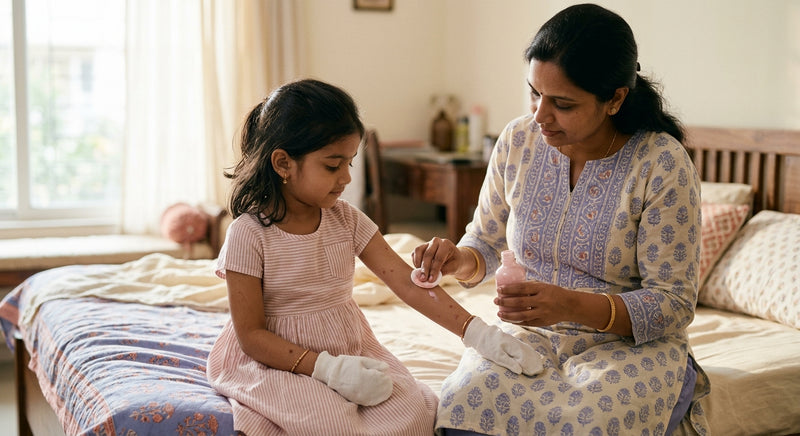
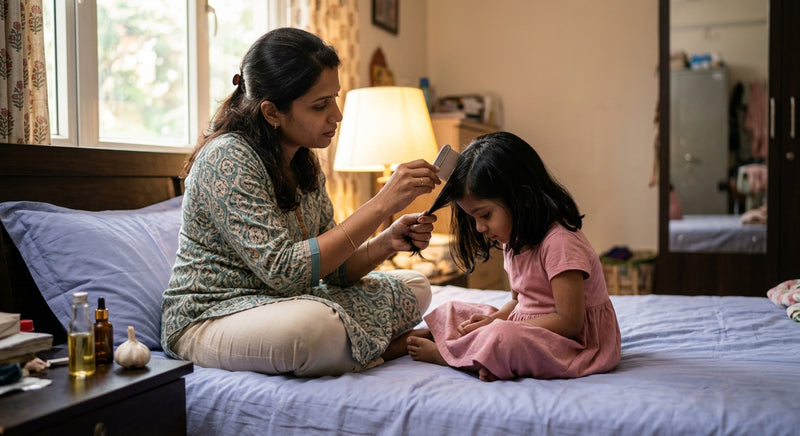
It usually arrives one of two ways: a line in the school diary, or a forward in the class WhatsApp group at 9pm. "Cases of head lice reported in Grade 2. Kindly check your child." And then you're standing in the bathroom with your phone torch, parting your child's hair, not really sure what you're looking for.
Here's the short version. Check tonight — bright light, damp conditioned hair, a fine steel nit comb, 15 minutes. If you find a live louse, treat that head, then wet-comb every 3-4 days for two full weeks, and check every other head in the house the same night. Don't shave anyone. Don't put kerosene on a child's scalp. And don't keep your child home out of embarrassment — by the time a note goes out, half the class has already been exposed.
At a glance
- A comb finds lice; your eyes don't. Looking without combing is how most cases get missed.
- Only treat a head where you find a live, moving louse. Old empty nits stuck near the ends aren't an active case.
- Wet-combing on conditioned hair is the part that actually clears a head — not one bottle of anything.
- Comb on days 1, 5, 9 and 13, then two clear combings in a row before you relax.
- Lice don't jump, fly, or live on pets. They need head-to-head contact or a shared comb, pillow or dupatta.
- No kerosene, no petrol, no bleach, no undiluted essential oils — these can burn and break the skin on a child's scalp.
First, is it actually lice — or dandruff?
This is where most parents go wrong, in both directions. One flake near the parting and a whole family is treated unnecessarily. Or a child scratches for three weeks and it's written off as "dry scalp from hard water" while an entire infestation builds up behind the ears.
The quickest way to tell is with your fingernail. Try to flick the speck off. A nit — a louse egg — is glued to the hair shaft and won't budge. Everything else moves.
| What you see | Nit (louse egg) | Dandruff / dry flake | Hair cast or oil-product build-up |
|---|---|---|---|
| Flick it with a nail | Stays stuck | Falls off easily | Slides along the hair |
| Colour | Tan-brown when live, white-grey when hatched | White, irregular | White, tube-shaped, wraps the hair |
| Where it sits | Within 1 cm of the scalp — nape, behind the ears, crown | All over the scalp | Anywhere along the length |
| Shape | Oval, teardrop, always on one side of the shaft | Flaky, uneven | Even cylinder encircling the hair |
And itching is a terrible diagnostic. Some children itch within days; some don't itch at all for weeks, because the itch is a reaction that takes time to build. Honestly, the cases caught earliest tend to be the ones where a comb-through already happens during the Sunday champi — it is part of the week anyway, so nothing has time to get out of hand.
What to do tonight
This is the whole routine. Work through it in order; it takes about half an hour the first time, including the arguing.
- Set up in the brightest spot you have — a bathroom with the light on, or a chair by a window if it's still daylight. Phone torch in your other hand if the overhead light is dim.
- Buy a proper steel nit comb, not the plastic one that comes free in a box. The teeth must be metal, long and very close together. Any chemist has one, and it lasts years.
- Wash and towel-dry the hair, then load it with conditioner. Don't rinse it out yet. Lice can't grip and can't scuttle away through conditioner, and the comb glides instead of ripping.
- Detangle first with a wide-tooth comb, root to tip, section by section. Combing tangles with a nit comb is how you end up with a crying child and a hair-fall problem.
- Divide the hair into four or more sections and clip them. Comb one section at a time, from scalp to end, pressing the teeth right against the skin — that is where the eggs are.
- Wipe the comb on a white tissue after every stroke. On white you can actually see a louse. On a dark bathroom tile you will see nothing and conclude, wrongly, that the head is clean.
- Cover the whole head twice — front to nape, then ear to ear — because a single pass misses the crown and the area behind the ears almost every time.
- Rinse, then check every other head in the house the same night. Mothers and grandmothers who sleep next to the child get missed constantly.
- Write today's date on the fridge. You now have a combing calendar to keep.
Do you need a medicated lotion?
If you found live, moving lice, a pharmacy anti-lice lotion is usually part of the plan — and that part belongs to your paediatrician or pharmacist, not to the internet. Ask specifically which product is suitable for your child's age, how long it stays on, and whether it needs repeating. Then follow the leaflet exactly. The two mistakes that waste a bottle: rinsing it off early because the child complains, and skipping the second application a week later, which is the one that catches whatever hatched after round one.
Here's the honest bit most packs won't tell you: no lotion reliably kills every egg. Combing is what clears the head. Treat the lotion as a head start and the comb as the actual work.
The combing calendar
Eggs that survive hatch over the following week or so, which is exactly why one heroic Sunday session fails and a boring schedule works.
- Day 1 — the full session above.
- Day 5 — wet-comb again. Expect to find a few small, pale young lice. That's the schedule working, not failing.
- Day 9 — wet-comb. You should be finding noticeably less.
- Day 13 — wet-comb. Two clear sessions back to back means you're done.
- Found something live on day 13? Keep going on the same 3-4 day rhythm until you get two clear combings in a row.
Hard water makes this harder. In Delhi, Hyderabad or large parts of Bengaluru the hair comes out of the bucket rough and squeaky, and the nit comb drags on every stroke. That's the one place a product choice earns its keep. You want something thick enough to coat the hair, and mild enough to use four times in a fortnight on a child's scalp. It should rinse clean rather than leave a film. Keep it light on fragrance too. Our Rejuvenating & Detangling Conditioner is one option that fits that brief. It doesn't kill lice — nothing in a conditioner does — it just makes the comb glide and spares the scalp.

What not to do
Never put kerosene, petrol, diesel, bleach, phenyl or neat essential oils on a child's scalp. These are still passed around as remedies and they cause chemical burns, broken skin and, with kerosene near a flame, far worse. No version of this is worth it.
- Don't shave your child's head. It isn't needed — the comb reaches the scalp whatever the length — and the social cost at school is real, especially for girls.
- Don't treat a whole family "as a precaution". Check every head; treat only the heads with live lice.
- Don't repeat a medicated lotion more often than the leaflet says. More is not faster, and an irritated scalp itches exactly like lice, which muddies your reading next week.
- Don't dismiss it as dandruff because you looked and saw nothing. Looking isn't checking. Combing is checking.
- Don't send the comb around the family unwashed. Soak it in very hot water for ten minutes between heads.
How much cleaning does the house actually need?
Far less than the panic-clean most of us start. A louse off a head doesn't survive long and cannot start a new infestation from your sofa. So skip the full-house fumigation and do the short list:
- Hot-wash and sun-dry the pillow covers, bedsheets and the towel used that day. Indian sun does the job well.
- Soak combs, brushes, clips, rubber bands and scrunchies in hot water for ten minutes.
- Shake out and sun the school pillow, car headrest cover or the cushion your child always sleeps on in the back seat.
- Nothing needs to be sealed in a bag for weeks, and nothing needs an insecticide spray.
Prevention is mostly habit, not product: hair tied back or plaited for school, no sharing of combs, clips or dupattas, and a quick comb-check during the weekly oiling. Tie it loosely, though — we've written in the Janma Journal about how tight school braids cost a child's hairline, and a lice scare is no reason to pull harder.
After an oil comb-out
Some families prefer to comb through coconut or a light malish oil instead of conditioner. That works too — but the wash afterwards matters, because a child's scalp that has been combed firmly four times in two weeks doesn't need a stripping shampoo on top. Look for a mild, tear-free formula that clears oil without leaving the scalp tight, and use lukewarm water rather than hot. Our Loving & Balancing Shampoo is formulated for that kind of gentle, repeated washing.

Talking to the school — and to the group chat
Tell the class teacher, plainly and without apology. Schools can only break the cycle if more than one family treats at the same time, and silence is what keeps a classroom going round in circles all term. Most Indian schools don't require a child to stay home once treatment has started — ask yours, and go by their policy rather than by the loudest voice in the WhatsApp group.
What not to do in that group: name a child. Lice have nothing to do with hygiene, cleanliness, or how often a head is washed. They move between heads that touch — on a school bus seat, during a game, at a sleepover at nani's. A clean head is just as welcoming as any other.
When to see a doctor
Book a paediatrician if any of these apply:
- The scalp has open sores, crusting, oozing or yellow scabs from scratching.
- Glands in the neck or behind the ears are swollen and tender.
- You still find live lice after two correctly completed rounds of a medicated lotion.
- You see lice or nits on eyelashes or eyebrows — do not put any scalp product near the eyes.
- Your child is under 2, has eczema-prone or broken skin, or reacts to a lotion with a rash, swelling or burning.
- Sleep is being badly disrupted, or the itching continues well after the head is clear.
None of this replaces an examination. A paediatrician can look at a scalp in thirty seconds and settle in one visit what a week of torchlight can't.
Four comb-throughs in a fortnight is a lot of pulling for one small scalp. Slip is what spares it — keep a mild conditioner and the wide-tooth comb out on the shelf before every session, so the comb glides and the scalp is left alone.
In summary
- Check with a steel nit comb on damp, conditioned hair under bright light — looking without combing misses most cases.
- Treat only heads where you find a live, moving louse, and check everyone in the house the same night.
- Wet-comb on days 1, 5, 9 and 13, and stop only after two clear combings in a row.
- Never use kerosene, petrol, bleach or neat essential oils on a child's scalp, and don't shave their head.
- Tell the school, keep hair tied back and stop comb-sharing — and see a paediatrician for sores, swollen glands or lice that persist after two correct treatment rounds.
Frequently asked questions
How do I know if my child has lice or just dandruff?
Try to flick the white speck off the hair with your fingernail. A louse egg is cemented to the hair shaft and won't move; dandruff falls away instantly. Nits also sit within about a centimetre of the scalp, usually at the nape and behind the ears, while dandruff scatters all over. The only reliable check is combing damp, conditioned hair with a steel nit comb and wiping it on a white tissue.
Does my child have to stay home from school?
Most Indian schools don't require it once treatment has begun, but policies vary, so ask the class teacher directly. Keeping a child home out of embarrassment usually does more harm than good — by the time a note circulates, the classroom has already been exposed. Tell the school, start the combing routine that night, and send your child back with hair tied back.
How often should I comb my child's hair during a lice outbreak?
Wet-comb every 3-4 days for two full weeks — days 1, 5, 9 and 13 is an easy pattern to remember. Eggs that survive the first session hatch over the following week, so a single long session almost always fails. Stop only after two consecutive combings turn up nothing live. One careful pass through long hair takes 15-20 minutes.
Is kerosene or an oil treatment safe for lice on children?
Kerosene, petrol, diesel, bleach and neat essential oils must never go on a child's scalp — they cause chemical burns and broken skin, and kerosene near any flame is dangerous. Plain coconut or a light malish oil is safe as a combing medium, which is all it is: it helps the comb glide. For an active case, ask your paediatrician or pharmacist which medicated lotion suits your child's age.
Do I need to wash all the bedding and furniture in the house?
No. A louse away from a scalp doesn't survive long and can't start a new case from your sofa. Hot-wash and sun-dry the pillow covers, sheets and that day's towel, soak combs, clips and scrunchies in hot water for ten minutes, and sun the pillow or car headrest your child leans on. Nothing needs bagging for weeks or an insecticide spray.
Can lice spread from our pet dog or cat?
They can't. Head lice live only on human scalps and cannot survive on animals, so your pet is neither a source nor a carrier. Spread happens through head-to-head contact or shared items — combs, clips, pillows, dupattas, bus seats. That's why tied-back hair and a no-sharing rule for combs and hair accessories do more for prevention than anything you buy.