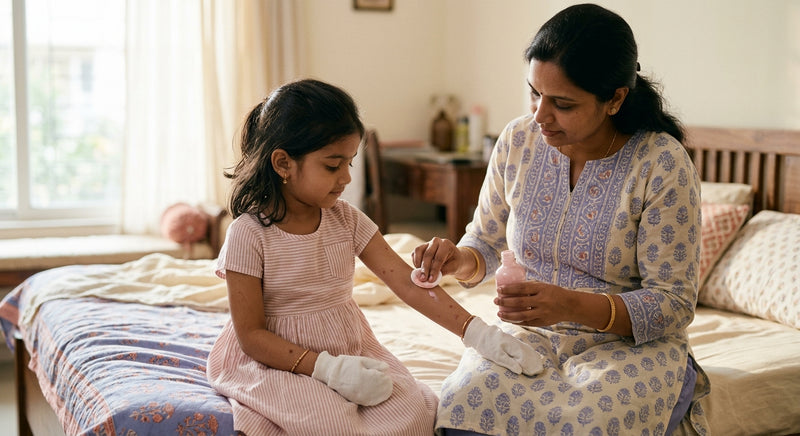
Short answer: yes, a newborn needs moisturiser in all three Indian seasons. What changes is the texture, the amount and the timing, not whether you do it at all. Summer wants the thinnest layer that still absorbs. Monsoon wants less on the body and far more attention to keeping folds dry. Winter wants a richer texture, twice a day, sealed in within about three minutes of the bath.
We get asked this every few weeks, usually at the end of a long day. It is 41 degrees in Nagpur, she is already sweating, why would I put cream on her? Fair question. But heat dries skin as efficiently as cold does. It just takes a different route. Sweat evaporating off a newborn, an air conditioner running all night, two baths a day in hard water: all three pull water out of a barrier that is still being built.
At a glance
- Moisturise year-round. Adjust the texture and the amount by season, not the habit itself.
- Apply within about 3 minutes of patting dry — damp skin holds the moisture you are sealing in.
- Summer: one thin layer after the bath. Winter: two applications, richer texture.
- Monsoon is the exception — folds need to stay dry, not moisturised. Moisturise the exposed, dry areas instead.
- Oil massage goes before the bath. Moisturiser goes after. They are not interchangeable.
Why Indian weather changes what a newborn's skin needs
A baby's skin is 20-30% thinner than an adult's, and it loses water through the surface faster. Most of what follows comes out of that one line. A barrier that is still maturing takes its cue from whatever the air is doing, and in India the air does something completely different three times a year.
In peak summer the humidity in Delhi or Nagpur can sit under 20% while the temperature is 42°C. That combination pulls water out of skin. Then the AC goes on, which dries the room further, and she sleeps in it for ten hours. Monsoon flips it. Humidity near saturation, sweat that never evaporates, damp collecting in the neck, the groin, behind the knees. Winter in the north is dry air plus room heaters. In the south it is a gentler dryness, and most parents miss it entirely.
The goal never changes: skin that is comfortable and intact. What stands in the way keeps changing.
The base routine, unchanged all year
Get these five steady. After that, the seasonal edits are small.
- Oil massage first, 10-15 minutes before the bath. Warm the oil between your palms, never on the stove. Malish belongs before water, so the bath takes off the excess instead of leaving a film that traps sweat all day.
- Keep the bath short and lukewarm. Test with your elbow or wrist, not your hand. Roughly body temperature, never hot. Five to seven minutes is plenty for a newborn.
- Use a gentle, tear-free cleanser only where it is needed: scalp, neck folds, hands, nappy area. Plain water does the rest most days.
- Pat dry, do not rub. Press the towel, lift it. Leave the skin very slightly damp. That damp is the water your moisturiser is going to hold in.
- Moisturise within three minutes, driest areas first: shins, forearms, cheeks, the back of the neck. Warm the product between your palms so it spreads instead of dragging.
What changes by season?
| Summer (Mar-Jun) | Monsoon (Jun-Sep) | Winter (Nov-Feb) | |
|---|---|---|---|
| Texture | Light, fast-absorbing | Light; skip entirely on damp folds | Richer cream or balm |
| How often | Once, after the bath | Once, on dry areas only | Twice — after bath and before bed |
| Amount | Thinnest layer that absorbs | Minimal, targeted | Generous on shins, cheeks, hands |
| Baths | May need two; use cleanser only in one | One or two; dry folds thoroughly | One, shorter and cooler than you think |
| Watch for | Prickly heat, sweat in neck folds | Damp folds, fungal-looking redness | Flaking shins, chapped cheeks, cracked ankles |
Summer: thin layers, and the sweat that gets trapped under them
The mistake I see most in summer is not over-moisturising. It is a thick layer on a baby who is about to sweat. The film sits on top, the sweat collects under it, and prickly heat turns up in the neck and upper back within a day.
So: thinner layer, fully absorbed before she is dressed. Two minutes with the fan on low, then the vest. On a 43°C day when you are giving two baths, use cleanser in only one of them. The second can be plain lukewarm water, and it needs a lighter moisturise, or none at all if her skin feels comfortable.
The AC is its own problem. A room held at 24°C all night is a dry room. If she sleeps in AC, the bedtime application matters more than the one after the bath, and the cheeks and shins will show it first.
Monsoon: humidity is not hydration
The air feels wet, so the cream goes back in the cupboard around July. Then the redness turns up anyway — neck creases, groin, behind the knees — and it reads as dryness.
It is not. That is damp skin, softened and rubbing against itself. Moisturiser on a damp fold makes it worse. The monsoon job is drainage, not hydration. After every bath, lift each fold, pat it properly dry with a soft cotton cloth, and give it a minute of air before dressing. Then check the neck again at the evening change. A baby who is still mostly lying down collects milk and sweat there all day.
Moisturise what is dry: face, shins, forearms, the backs of the hands. Leave the folds alone until they are genuinely dry and calm. And if your bathwater is hard, which is much of Chennai, Hyderabad and Delhi, the mineral residue left on skin during a humid month adds an itch of its own. One more reason to keep the bath short.
Winter: this is where the three minutes matter
Timing stops being optional in December. Warm water opens the skin up, and the minutes straight after the bath are when it loses the most water. Apply while she is still faintly damp and you keep that water in. Wait fifteen minutes and you are moisturising skin that has already dried out.
What we change once the cold sets in:
- Warm the room before the bath, then switch the heater off. A heater running beside the changing mat dries the air exactly where the baby is.
- Shorten the bath to five minutes and bring the water temperature down a little. Hot water is the single biggest cause of winter flaking I see.
- Move to a richer texture, a cream or balm rather than a thin lotion, on shins, forearms, cheeks and the backs of the hands.
- Add a second, smaller application before the night feed. Cheeks, hands, ankles. Thirty seconds.
- Cotton next to the skin, wool only over it. Wool directly on a newborn is a reliable way to start an itch.
A word on south Indian winters. Mild is not the same as absent. Bengaluru and Pune get dry January evenings, and the flaking lands on the shins in exactly the same way, about three weeks later than it does in Delhi.
What to look for in the product itself
Look at the job before the brand. For a newborn: a short, legible ingredient list, no added fragrance, and a texture that matches the weather, so it absorbs in May and stays put in January. Ingredients that help support the skin barrier matter more than anything printed on the front of the pack. Whatever you pick, patch test it on the inner forearm for 24 hours before it goes all over.
For bath time in the humid months, a mild, tear-free wash used sparingly does less damage than soap. Our Head to Toe Baby Foam Wash was formulated for exactly that short, gentle newborn bath.
When to see a doctor
Book a paediatrician's appointment if you see cracked or weeping skin, bleeding, yellow crusting, a rash that spreads quickly or comes with fever, redness in a fold that looks raw or well-defined, or dryness that is not settling after a week of consistent gentle care. Go too if your baby is visibly uncomfortable, scratching through sleep, or unsettled at every change. Newborn skin conditions are very treatable when they are looked at early, and nothing in this article is a substitute for that visit.
For the dry, sensitive stretches — a Delhi January, an air-conditioned May night, the shins that flake no matter what — a richer texture that helps support the skin barrier is what we reach for: Hydra Healing Moisturizing Balm.
In summary
- Moisturise a newborn year-round — change the texture and amount by season, not the habit.
- Apply within about three minutes of patting dry, while the skin is still faintly damp.
- In summer use the thinnest layer that absorbs, and let it sink in before dressing.
- In monsoon keep folds dry rather than moisturised, and treat only the genuinely dry areas.
- In winter move to a richer texture, add a second application at night, and shorten the bath.
Frequently asked questions
Does a newborn need moisturiser in Indian summer?
Yes, but less of it and in a lighter texture. Heat, sweat evaporation and air conditioning all pull water out of a baby's skin, so a thin layer after the bath still helps. Apply it and let it absorb fully for a minute or two before dressing — a thick layer under clothes in the heat traps sweat and can bring on prickly heat.
Should I stop moisturising my baby during the monsoon?
Not stop, but change where you apply it. Humid air keeps folds damp, and moisturiser on a damp neck or groin crease makes rubbing and redness worse. Pat every fold thoroughly dry and let air reach it before dressing. Keep moisturising the genuinely dry areas — face, shins, forearms and the backs of the hands.
How soon after a bath should I moisturise a newborn?
Within about three minutes, while the skin is still faintly damp. Warm water leaves the surface primed to lose water quickly, so that short window is when moisturiser does the most work. Pat dry rather than rub, leave the skin slightly moist, warm the product between your palms, then apply to the driest areas first.
Is oil massage enough, or does my baby also need moisturiser?
They do different jobs. Oil massage before the bath is about touch, circulation and comfort, and most of it washes off. Moisturiser goes on after the bath, on damp skin, to hold water in. In dry weather a newborn usually benefits from both — malish 10 to 15 minutes before the bath, moisturiser within three minutes after.
How much moisturiser does a newborn actually need?
For the whole body, roughly a large-grape-sized blob in summer and about double that in winter. The test is how the skin feels five minutes later: comfortable and matte means the amount was right, still tacky means you used too much. Use less rather than skipping days — consistency matters more than quantity.
My baby's skin is dry even though we live somewhere humid. Why?
Humidity in the air does not automatically mean hydrated skin. Long or hot baths, soap, hard water and air conditioning all strip the barrier regardless of the weather outside. Shorten the bath, lower the water temperature slightly, use cleanser only where it is needed, and moisturise within three minutes of patting dry.