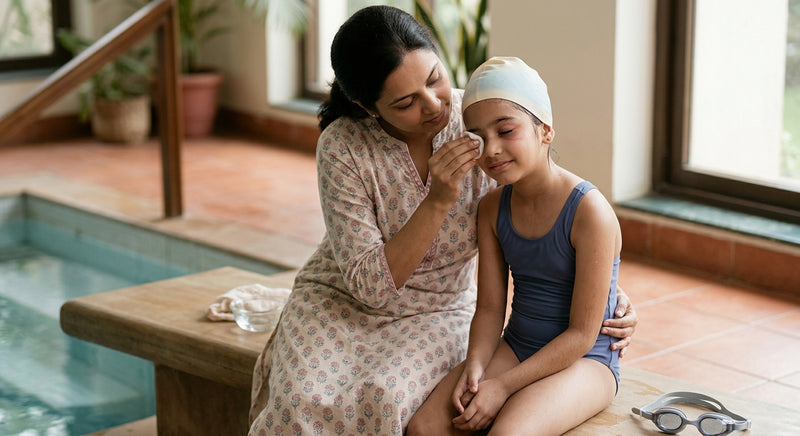
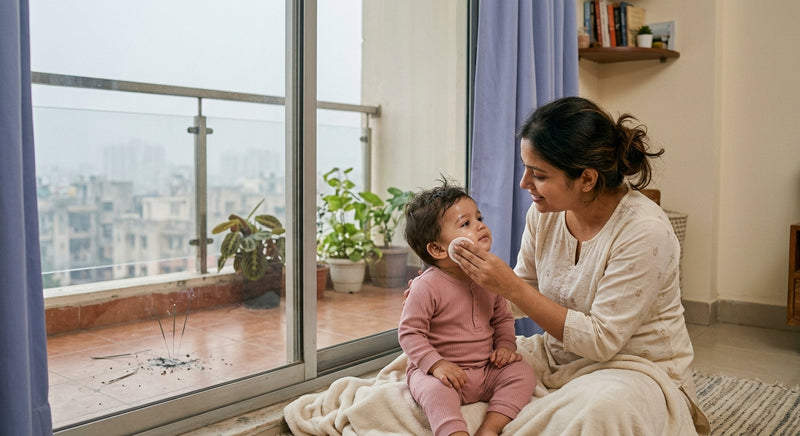
She comes home from school in July with her plaits still cold and damp under the collar. By dinner there's a halo of frizz you can see from across the room. She's scratching at the crown. And there's a smell — faint, but there — like a cupboard nobody has opened since the rains started.
Some version of that reaches me every June and July.
Monsoon hair trouble in kids is hardly ever a hair problem. It's a moisture problem in both directions — humid air pushing water into the strand, and a scalp that stays damp for hours because nothing ever fully dries. Frizz is the half you can see. The itch, the flakes and the smell are the half that needs fixing. Dry it properly, wash a little more often than you do in winter, use a conditioner that really coats the strand. That handles most of it.
At a glance
- Humid air lifts the cuticle and swells each strand. That's frizz, and no amount of extra oil will flatten it.
- A scalp that stays damp for hours is the real monsoon issue — itch, flakes and odour usually trace back to slow drying, not to shampoo.
- Wash more often in the rains, not less. Roughly 2-3 times a week for most school-going kids.
- Swap overnight oiling for a 15-20 minute pre-wash soak. Oil sitting on a humid scalp collects dust and traps damp.
- Never plait, band or bun hair while it's wet. That's where nape breakage and the smell both start.
Why does my child's hair frizz so much in the rains?
Hair keratin holds its shape partly through hydrogen bonds, and hydrogen bonds break and reform around water very easily. So when the air is carrying a lot of moisture — a Nagpur August, a Mumbai monsoon week — water moves into each strand and the strand swells a little. The cuticle is a layer of overlapping scales lying flat like roof tiles. Swell what's underneath and those scales lift at the edges.
Two things follow. Light scatters off a raised cuticle unevenly, so hair looks dull instead of glossy. And each strand catches on the one beside it, so instead of lying together they push apart. Multiply that across thousands of strands and you're looking at frizz.
It's also why wavy and curly-haired kids get hit harder than their straight-haired classmates. At every bend in a curl the cuticle sits slightly lifted already, so humidity has more surface to work on. Their hair isn't worse. It's geometry.
The part parents don't see is the wear. Swell, shrink, swell again, day after damp day. Cosmetic scientists call it hygral fatigue, and it tires the strand out. Hair that's been through a monsoon of wet-dry-wet cycles snaps more easily, and it snaps first wherever it's under mechanical stress — right at the nape, where a school plait rubs against a shirt collar all day.
The bigger problem is a scalp that never fully dries
What often gets described to me as "monsoon dandruff" in a child can be down to oil, plus school dust, plus a scalp that hasn't been properly dry since Tuesday. Only a doctor can say what a particular scalp is actually dealing with.
Trace a rainy week. Oil goes in Sunday night. Wash on Monday morning, towel-dried in a rush, plaited damp, raincoat hood pulled over it at the gate. It sits damp under a bag strap till noon. It comes home damp again. Add sweat under synthetic fabric, add humidity that stops evaporation, and the scalp surface stays warm and wet for hours at a stretch. Skin anywhere on the body objects to that, and the scalp is no exception. Flaking, itching, odour.
Which means the change that pays off most this monsoon has nothing to do with what's in the bottle. Hair goes to school dry, and comes home to be dried again.
How should the routine change from dry season to monsoon?
| Step | Dry season / winter | Monsoon |
|---|---|---|
| Shampoo | Once or twice a week is usually enough | 2-3 times a week — sweat and dust build faster |
| Oiling | Overnight is fine | 15-20 min pre-wash only; wash it out the same session |
| Conditioner | Mid-length to ends | Same, but non-negotiable — this is your anti-frizz step |
| Drying | Air-dry is fine | Squeeze with a cotton tee, then fan; dry the scalp first |
| Styling | Plait when convenient | Only on fully dry hair; loose plait, cloth band |
| Comb | Whatever works | Wide-tooth on damp, brush only when dry |
Does oiling still work in humidity?
Yes. The timing has to change, though, and this is where I think Indian families lose the most ground in the rains.
Oiling before a wash has real, measurable value. Coconut oil is one of the few oils shown in lab work to penetrate the hair shaft rather than sit on top of it — its lauric acid has a straight chain and a low molecular weight, so it slips between the cuticle scales. Once it's inside, the strand takes up less water during washing. Less swelling, and less of the hygral fatigue we just talked about.
Leaving that oil on the scalp for fourteen hours in a Mumbai or Kolkata August is a different story. A humid scalp already can't evaporate freely. Lay a film of oil over it and you slow that down further, while handing every particle of road dust something to stick to. Kids come back from the field with grit welded into a greasy scalp.
My rule for the rains: warm the oil slightly, work it into the scalp and lengths with fingertips for two or three minutes, leave it 15-20 minutes, wash it out. Sunday afternoon, not Saturday night. Use less than you think — a teaspoon for a shoulder-length head is plenty. If it takes two shampoos to get out, you used too much, and it's that second shampoo which dried her hair.
What to look for in a monsoon shampoo and conditioner
Three things, in the order I'd weigh them.
1. A wash that actually cleans in one go
Here's where I part ways with the gentler-is-always-kinder advice. Parents reach for the mildest possible wash. On an oily, sweaty monsoon scalp, an over-mild cleanser tends to leave residue behind — so you shampoo twice, or you're washing again the next day. A well-built tear-free wash that clears oil and dust in a single lather is kinder across a week than an ultra-mild one used four times. Look for balanced surfactant blends — amphoterics and mild non-ionics alongside the primary cleanser — and a mildly acidic pH, around 4.5 to 5.5, which keeps the cuticle lying flat rather than swelling it.
For kids' hair, that's the brief we wrote our Loving & Balancing Shampoo against: tear-free, but not so stripped back that you end up washing twice. We make it in our own GMP-certified facility, so the pH and the surfactant balance are ours to set rather than whatever a contract formula happens to ship with.
2. Cationic conditioning agents beat more oil
This one is pure formulation science, and it's the bit most people get wrong. Hair carries a negative surface charge, and the damaged or weathered spots along a strand carry more of it. Behentrimonium chloride, cetrimonium chloride, guar hydroxypropyltrimonium chloride — all positively charged, so they're pulled towards exactly those damaged sites. The strand essentially tells the conditioner where it's needed. They flatten the cuticle back down and cut the friction between strands.
Oil can't do that. Oil has no charge; it sits where you put it. It's why a child who is oiled every week can still have frizzy, tangly hair, and why two minutes of conditioner does what an hour of oiling doesn't. Fatty alcohols — cetearyl alcohol, behenyl alcohol — round it out with a soft film and proper slip. A label listing none of these isn't really a conditioner.
3. Slip, so the comb isn't the thing doing the damage
Monsoon hair tangles more because raised cuticles catch on each other. Enough slip and the comb glides instead of tearing. In a season when the strand is already fatigued from swelling, that matters more than it does in January. We've covered wet-versus-dry detangling in detail elsewhere in the Janma Journal; in the rains, damp-with-conditioner is almost always the right window.
Do this tonight: a 25-minute monsoon hair reset
- Warm a teaspoon of coconut oil between your palms. Fingertips into the scalp for two minutes, then down the lengths. Set a timer for 20 minutes.
- Wash with warm water, not hot. Hot water lifts the cuticle further and you'll pay for it in frizz.
- Shampoo the scalp only, small circles, fingertips not nails. The lengths get cleaned by what rinses down.
- Rinse for a full 60 seconds. In hard-water cities, under-rinsing leaves a dulling film that reads as "dry hair".
- Conditioner from ear-level down. Never on the scalp. Leave it two minutes while she rinses off elsewhere.
- Finish with the coolest water she'll tolerate — a cool rinse helps the cuticle settle flat.
- Squeeze, don't rub, with an old cotton t-shirt. Terry towel is a frizz machine.
- Wide-tooth comb through the damp hair, ends first, then work upward.
- Point a fan at her scalp for ten minutes while she has her milk. Scalp dry first, lengths second.
- Only once the hair is fully dry: a loose plait with a cloth-covered band.
Rain-day rules for school mornings
Four small habits head off most of what I get asked about.
- Nothing wet leaves the house. If there's no time to dry, don't wash — a dry-but-day-old head beats a damp fresh one in the monsoon.
- Pack a spare cloth band. A band that got soaked in the morning rain and stayed on all day keeps that section of hair wet for eight hours.
- Loosen, don't tighten. Wet or humid hair is more elastic and breaks more easily under tension. A tight monsoon plait is how you get that thin, broken fringe at the hairline by September.
- Own combs, own towel. Sharing combs and towels is a common way head lice pass between classmates, so keep hers to herself.
What I'd skip
Anti-frizz serums built for adult hair, mostly. They lean on heavy silicone loads that build up on fine children's hair and need a stronger wash to remove, which starts a cycle you don't want. Clarifying and anti-dandruff adult shampoos too, unless a doctor has specifically told you to use one on her scalp. And the hair dryer on a hot setting — cool-shot or a ceiling fan does the same job without cooking the cuticle.
When to see a doctor
Home routine covers frizz, tangles and general monsoon dullness. Book a paediatrician or dermatologist if you see:
- A round, scaly patch on the scalp with hair broken off short inside it
- Flaking with redness, weeping, crusting or a bad smell
- Persistent itching, especially with visible eggs stuck close to the scalp along the hair shaft
- Sudden or patchy hair loss, or bald spots appearing over days
- Painful bumps, boils or tenderness on the scalp
- Any scalp problem that hasn't improved after two weeks of a settled routine
These need a proper look and, often, a prescription. They aren't things to work through with a shampoo change.
If the rainy-morning comb fight is the part wearing you both down, a conditioner with real slip is the first thing I'd add — our Rejuvenating & Detangling Conditioner was formulated for exactly that job.
In summary
- Wash your child's hair 2-3 times a week in the monsoon — more often than in winter, not less.
- Shift overnight oiling to a 15-20 minute pre-wash soak so a humid scalp isn't sealed under oil all night.
- Use a conditioner with cationic agents from ear-level down; oil alone cannot flatten a lifted cuticle.
- Dry the scalp first with a fan, squeeze with a cotton t-shirt, and never plait or band wet hair.
- See a paediatrician for a round scaly patch, weeping flakes, visible nits or any patchy hair loss.
Frequently asked questions
How often should I wash my child's hair during monsoon?
For most school-going children, two to three times a week works well in the rains — more than in winter, not less. Humidity, sweat and road dust build up faster, and a scalp left oily and damp is what leads to itching and odour. If your child plays outdoors daily or gets caught in the rain, an extra wash that week is fine, provided the hair is dried properly afterwards.
Should I stop oiling my child's hair in the monsoon?
No — change the timing instead. Oil for 15 to 20 minutes before a wash rather than leaving it overnight. Pre-wash oiling reduces how much water the strand absorbs during washing, which limits swelling and breakage. Left on a humid scalp for hours, though, oil slows evaporation and collects dust. Use about a teaspoon for shoulder-length hair and wash it out the same session.
Why does my child's hair smell damp during the rains?
Almost always because the hair or scalp never fully dried. Hair tied, plaited or covered while damp stays wet for hours in humid air, and that trapped moisture is what produces the musty smell. Dry the scalp first with a fan or cool air, tie hair only when fully dry, and switch hair wash to the evening if mornings are too rushed to dry properly.
What's the best way to stop monsoon frizz in kids' hair?
Use a conditioner with cationic conditioning agents such as behentrimonium chloride, applied from ear-level down after every wash. These carry a positive charge and bind to the damaged spots along the strand, flattening the lifted cuticle that causes frizz. Add a cool final rinse, squeeze water out with a cotton t-shirt instead of a terry towel, and comb with a wide-tooth comb while damp.
Is it bad if my child gets wet in the rain?
Getting wet occasionally is not harmful in itself. What matters is what happens next. Rinse the hair with clean water at home, since first rains carry dust and pollutants, then wash if it's a wash day, and dry the scalp fully before tying anything. The risk is staying damp for hours, not the rain itself.
Can I use an anti-dandruff shampoo on my child's flaky scalp?
Not without a doctor's advice. Flaking in the monsoon is often oil, dust and a scalp that stays damp, which a settled wash-and-dry routine usually resolves within two weeks. Adult anti-dandruff shampoos contain active ingredients at strengths meant for adult scalps. If flaking comes with redness, weeping, a round scaly patch or hair loss, see a paediatrician or dermatologist.