Day four at home. You unwrap her after a feed and the skin on her ankles is lifting off in fine, papery flakes. Around the wrists too. A little across the belly. Nobody warned you about this bit. It looks like she's shedding.
She is. Newborn skin shedding is the outer layer of skin peeling away in the first one to three weeks of life, and in a healthy, full-term baby it's normal. She spent nine months floating in amniotic fluid under a coat of vernix. Now she's out in a room with a fan going and the afternoon heat pressing at the window, and that waterlogged top layer is letting go to reveal the new skin underneath. The peeling asks nothing of you. What you put on it — that's a real decision, and it's where most of the well-meaning advice goes sideways.
At a glance
- Peeling in the first 1–3 weeks is shedding, not necessarily dryness — it usually resolves on its own.
- Hands, ankles, wrists and the belly peel first. Post-term babies (born after 40 weeks) tend to peel more.
- Flat, dry flakes are normal. Deep cracks, weeping, spreading redness, or peeling with fever — call your paediatrician.
- The peeling doesn't need treating. It needs you to stop stripping the skin: shorter baths, cooler water, less cleanser.
- If you moisturise, a simple fragrance-free emollient beats a fancy one. It also beats mustard oil, powder, and scrubbing the flakes off.
Why does a newborn's skin peel at all?
Think of the outermost layer of skin — the stratum corneum — as a brick wall: flattened cells held together by lipids. In the womb that wall stays soft and hydrated, shielded under vernix caseosa, the creamy white coating she was born with. Birth rewrites its job description overnight. It has to stop living in fluid and start holding water in, against the air. So the old surface cells, swollen and finished, let go. And they let go together, visibly, instead of quietly over weeks the way yours do.
Some babies shed more than others. A baby born past her due date has usually lost most of her vernix already, so she arrives with a head start on the peeling. Then there's the skin itself: a newborn's is 20–30% thinner than an adult's, with a barrier still under construction. It loses water faster and it takes offence at friction and cleanser in a way that yours simply doesn't. For the fuller picture of how a newborn's skin settles in these first weeks, we've put it together in our complete guide to newborn skin basics.
Is it shedding, or is it actually dry skin?
Everything downstream hangs on this one call — and it's an easier call than parents expect.
Shedding is flat, translucent flakes lifting at the edges. Hands, feet, ankles, tummy. The skin underneath looks smooth and normal-coloured. Your baby, frankly, doesn't care. It builds over a few days, then it's done.
Dryness reads differently under your palm. The skin feels rough and tight all over, not just at the peel zones. The flakes are fine and white rather than sheet-like. There may be red, scaly patches. And it doesn't fade — it hangs around, or it gets worse week on week. That's a barrier losing water faster than it can replace it, and unlike shedding, it does want help from you. We've mapped how the normal version usually progresses in a week-by-week look at how long newborn peeling lasts, and drawn the line between ordinary shedding and something worth a second look in this honest guide to newborn shedding versus dryness.
The blotchiness that shows up in the same weeks throws people too. Mottled one hour, marbled the next, suddenly flushed after a bath. That's usually an immature circulation finding its feet, and we explain it in why a baby's skin colour keeps changing.
Oil, ghee, lotion or balm — what should you actually put on peeling skin?
I'll be blunt, because I formulate these things for a living. Nearly everything that gets pressed into your hands — by your mother-in-law, by the chemist near the gate, by a WhatsApp group of aunties who mean every word — "works", in that flaky skin looks less flaky for about an hour. Very few of those things do anything for the barrier itself. One or two set it back.
| Option | What it actually does | Where it falls short | Honest verdict |
|---|---|---|---|
| Nothing at all | Lets the shed finish on its own. Costs nothing, risks nothing. | Skin can still feel tight in AC, or in a dry Nagpur winter. Does nothing if true dryness has already set in. | Fine for a mild, comfortable peel — which is most of them. Most babies need no more than this. |
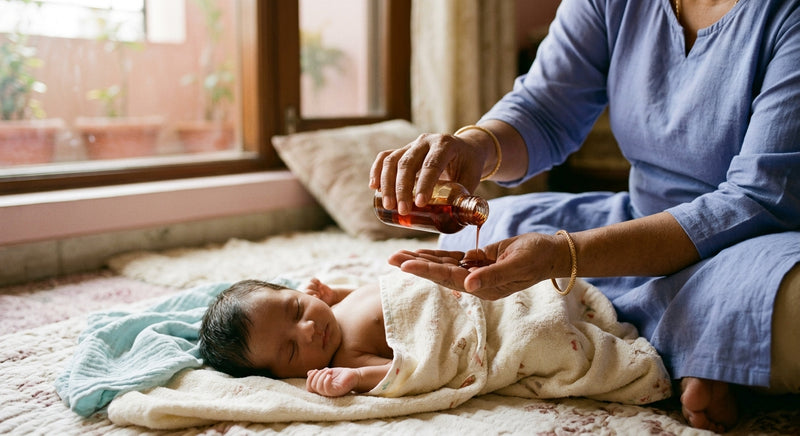
| Coconut oil malish | An emollient — softens flakes and lays down a light occlusive film that slows water loss. | Thin film, and half of it ends up on the vest. No humectant, so nothing is pulling water back in. Cold-pressed, unfragranced only. | A gentle, reasonable choice, and a lovely reason to do malish. Just not the strongest barrier support on this list. |
| Mustard oil malish | Traditional, warming, deeply held in North Indian practice. | Pungent compounds in mustard oil have been linked with barrier irritation on infant skin — the evidence has not been kind to it for newborns. | I'd skip it on a newborn. Keep the ritual, change the oil. |
| Ghee | Rich, occlusive fat. Traditionally used on lips, cheeks and dry patches. | Heavy. Turns rancid in Indian heat, hard to keep hygienic once fingers have been in the jar, and easy to overdo across a whole body. | Harmless on one small dry patch. Not a body moisturiser for a newborn. |
| A light lotion | Water-in-oil emulsion — spreads easily, feels pleasant, hydrates the surface. | All that water can evaporate off fast. And a badly built one, with fragrance or drying alcohol, leaves the skin worse than it found it. | Fine for maintenance on normal skin. Usually too light for a peeling, water-losing newborn. |
| A rich balm or ointment | Humectants pull water in, emollients fill the gaps, occlusives hold it all there. The full barrier repair job. | Feels heavy if you overapply. A thick layer in June humidity will trap sweat. | What I'd reach for when the skin is tight, rough or truly dry. Pea-sized amount. Spread it thin. |
| Talc / dusting powder | Absorbs moisture. Feels dry-smooth. | Absorbing moisture is the last thing peeling skin needs. And the inhalation risk in a newborn is real. | No. Not for this, not for a newborn. |
So what would we actually do?
Comfortable, flaky, full-term, second week? Nothing — or a thin layer of a plain emollient once a day after her bath. That's it. That's the plan. Don't peel the flakes. Don't take a loofah or a chana-dal ubtan to them. Don't slather anything on to hurry them along, because they leave when the new skin underneath is ready and not a day sooner.
Skin that feels tight and sandpapery, red-ish dry patches, a baby who spends all day in AC? Different answer. A proper barrier moisturiser, twice a day, on damp skin. This is where formulation earns its keep. A moisturiser carrying humectants alongside emollients and an occlusive doesn't just lie on top of the flakes — it hands the skin the raw material to rebuild its own wall. In our own lab study, our formulation was associated with increased expression of Keratin-10 and Filaggrin, two proteins the skin uses to build that barrier. That's the outcome worth chasing, rather than a cosmetic smoothing of flakes.
The gentle routine that helps — do this tonight
- Shorten the bath to about 5 minutes. A long soak swells the skin and leaves it drier than it started.
- Test the water with your elbow, not your hand. Your hands lie — they've been in the kitchen all day. You want comfortably warm, around body temperature. Hot water strips a newborn's barrier lipids faster than anything else in the bathroom.
- Cleanser only where it's needed: neck folds, nappy area, underarms. Plain water does the rest in the early weeks. If you use a wash, make it mild, tear-free and soap-free — we formulated our head-to-toe baby foam wash around that brief, so the daily bath doesn't undo the barrier you're trying to protect.
- Pat dry, never rub. Rubbing lifts half-shed flakes and leaves raw spots behind. Blot with a soft cotton towel and let her stay slightly damp.
- Moisturise within 2–3 minutes. Pea-sized for the body, warmed between your palms, slow strokes. Extra on the ankles, wrists and shins — the peel zones.
- Fix the room, not just the skin. AC above 24°C, vent pointed away from the cot. If the air is very dry, a bowl of water in the corner or a humidifier will do more than a second layer of cream.
- Cotton, loose, washed. Everything new gets one wash before it touches her — mild detergent, extra rinse. Yes, including the gift-wrapped set from your neighbour.
Hard water: the reason your routine may not be working
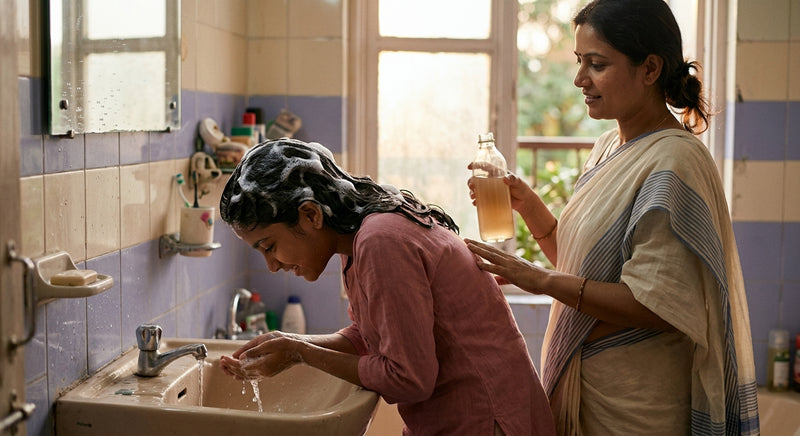
Delhi. Chennai. Parts of Nagpur. Anywhere the tap leaves white crust on the bucket, really. Calcium and magnesium ions in that water bind to cleanser residue and settle a fine film over the skin. The film nudges up the surface pH, and flaky skin gets flakier. Parents blame the moisturiser and go shopping for a new one. It's the water.
Two fixes, both cheap. Use less cleanser — the more surfactant there is, the more film the hard water can make with it. Then finish with a final rinse of stored, filtered or boiled-and-cooled water from a steel tumbler. It sounds fussy standing there at 8pm with a slippery baby. It also changes how her skin feels inside a week, visibly enough that you'll stop doubting it.
When to see a doctor
Ordinary shedding is quiet and painless, and it ends on its own. Speak to your paediatrician if you see:
- Deep cracks, bleeding, or skin that weeps or oozes
- Peeling with fever, poor feeding, or a baby who seems unwell or unusually floppy
- Blisters, pus, honey-coloured crusts, or redness that spreads outward
- Peeling that starts after the first month, or keeps getting worse past 4–6 weeks
- Thick, plate-like or fish-scale scaling, or peeling across large sheets of the body
- Any itching that clearly distresses her, especially with red, rough patches — that can be an early eczema pattern and deserves a proper look
And no, you're not wasting anyone's time by asking. A paediatrician can settle this in two minutes flat.
If her skin is peeling and tight and dry to the touch, a thin layer of our Hydra Healing Moisturizing Balm on damp skin after the bath is the simplest way to make her comfortable while the shedding finishes on its own.
In summary
- Peeling in the first one to three weeks is normal shedding as your baby's skin adjusts to air — not a sign you've done anything wrong.
- Tell shedding from dryness: flat flakes over smooth, comfortable skin is shedding; rough, tight, scaly skin that lingers needs a barrier moisturiser.
- Skip mustard oil, talc and scrubbing; never pull half-shed flakes off, as the skin underneath isn't ready.
- Cut the bath to five minutes in comfortably warm water, use mild cleanser only where it's needed, pat dry, and moisturise damp skin within two to three minutes.
- See your paediatrician for deep cracks, weeping or blistering skin, peeling with fever, or peeling that begins after the first month or worsens past four to six weeks.
Frequently asked questions
Is newborn skin shedding normal?
Yes. In the first one to three weeks, most full-term babies shed the outer layer of skin as it adjusts from amniotic fluid to dry air. It shows up most on the hands, feet, ankles, wrists and belly, and it's painless. Babies born after their due date usually peel more, because they've lost most of their vernix before birth. It resolves on its own.
Should I put oil on my newborn's peeling skin?
A cold-pressed, unfragranced oil like coconut is a gentle choice and makes malish pleasant, but it softens flakes rather than rebuilding the barrier. If the skin is only mildly flaky and your baby is comfortable, you may not need anything at all. If it feels tight, rough or dry, a moisturiser that combines humectants, emollients and an occlusive does more. Skip mustard oil on a newborn.
Can I peel off the loose flakes?
No. Under a half-shed flake, the new skin isn't ready, and pulling it creates a raw patch that can sting and get infected. The same goes for scrubbing with a loofah or an ubtan. Leave the flakes alone, keep baths short and cool, moisturise damp skin, and let the shedding finish on its own timeline.
How long does newborn peeling last?
Typically it starts within the first few days, peaks around the end of the first or second week, and settles by three to four weeks. If peeling begins after the first month, keeps worsening past four to six weeks, or comes with cracks, weeping or red scaly patches, that's no longer ordinary shedding — have your paediatrician look.
Does peeling mean my baby's skin is dry?
Not necessarily. Shedding produces flat, translucent flakes over smooth, normal skin on a comfortable baby. True dryness feels rough and tight all over, with fine white scale, sometimes red patches, and it lingers or worsens. Shedding needs nothing more than a gentle routine. Dryness genuinely benefits from a barrier moisturiser twice a day.
How often should I bathe a newborn who's peeling?
Two or three short baths a week is plenty in the early weeks, with a daily top-and-tail clean of the face, neck folds and nappy area. Keep baths to about five minutes in comfortably warm water, use a mild soap-free wash only where it's needed, pat dry, and moisturise within two to three minutes while the skin is still damp.