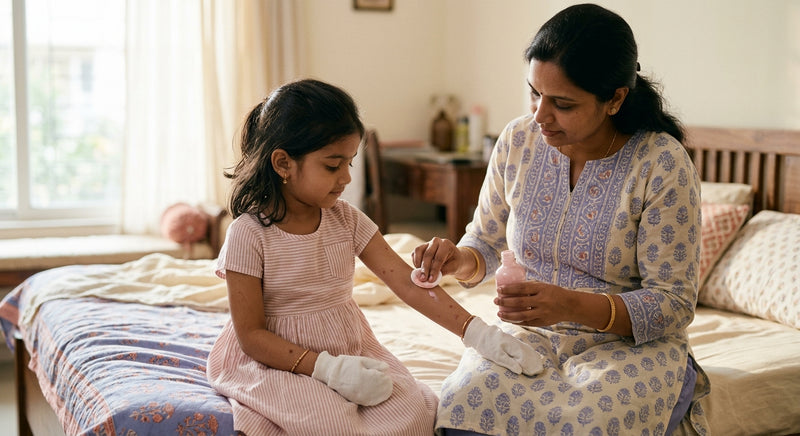
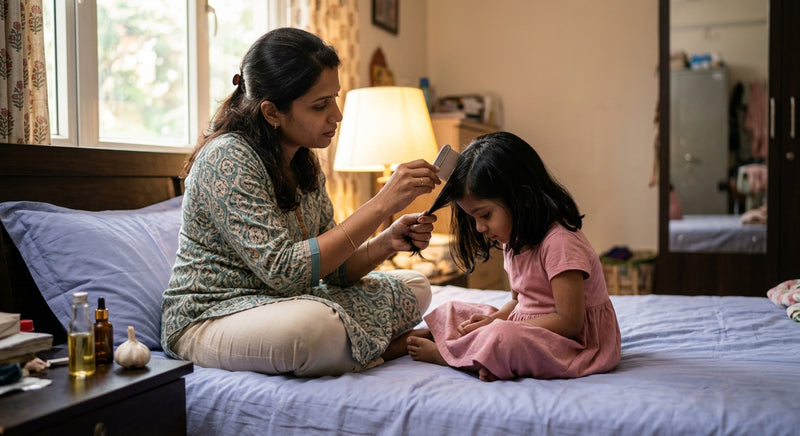
The moment comes right after the malish. Baby is warm, oiled, half asleep across your legs. Dadi takes a little sarson ka tel on her fingertip and moves it towards those tiny nostrils. "Do boond daal do, naak khul jayegi." Something in you goes tight. You don't want to argue. You don't want to say yes either.
Your instinct is right. Don't put oil inside a baby's nose, and don't pour it into the ear canal. Outside is fine. The bridge of the nose, the outer ear, behind the ears, the whole scalp. It's the drops going in that carry a real, documented risk. A baby's airway can't reliably keep oil out of the lungs, and the ear canal was never a place that needed oiling.
Most inherited practices survive scrutiny. We went through a long list of them in our complete guide to traditional baby-care practices and what's actually safe, and the majority turn out to be harmless or useful. This one doesn't. It belongs in the small pile you retire quietly instead of adapting.
At a glance
- No oil inside the nostrils, and no oil poured into the ear canal, at any age in the first year.
- Oil in the nose can be silently breathed into the lungs, because it doesn't trigger a cough the way water does.
- Classical nasya is a therapy for older bodies, administered by a trained vaidya. It is not a two-drop home ritual for a six-week-old.
- The ear canal cleans itself outward. Oil traps wax and softens the skin, which is how itching and infection start.
- For a blocked nose, saline and suction do the job. Safely, and better.
Is it safe to put oil in a baby's nose?
No. The reason is more specific than "babies are delicate", and it's worth knowing properly, because you may have to say it out loud to someone you love.
Small babies breathe almost entirely through the nose for the first few months. That's why a blocked nose wrecks a feed so completely, and why parents get desperate enough to try anything. The same anatomy is the problem. Whatever you put at the top of that airway has a short, direct path down.
Then there's the thing most parents don't expect. Oil doesn't feel like a foreign body. Send water down the wrong way and a baby splutters, coughs, protests. The airway defends itself, loudly. Oil is bland and slippery. It slides past the same reflexes without setting them off. What shows up is a stubborn cough weeks later, or breathing trouble that doesn't behave like an ordinary cold. The condition has a name, exogenous lipoid pneumonia, and paediatric case reports from India keep tracing it back to nasal oil instillation in infants.
Add the position. Malish happens flat on the back, usually on your outstretched legs, head sitting a little lower than the chest. For anything liquid near a nostril, that is the worst angle there is.
But isn't nasya a real Ayurvedic practice?
It is. That's exactly what makes this hard to argue at the dinner table, so be accurate rather than dismissive.
Nasya is a classical therapy with rules attached. Indications. Doses. Seasons. An age gate. Traditional texts restrict it in very young children, and in several other states entirely. A trained vaidya prescribes it, and only after assessing the child in front of them.
What happens in most homes isn't that. It's two casual drops of whatever oil is lying on the bed, given to a newborn by a grandmother who adores her, with no assessment and no reason beyond a slightly snuffly nose. You can hold the tradition in real respect and still say no to the kitchen version. If you want an Ayurvedic route for something specific, go and see a registered practitioner. A bottle of mustard oil doesn't stand in for one.
Is putting oil in a baby's ears safe?
Also no. Not into the canal. The kaan mein tel habit is almost always well meant: to soften wax, to "keep the cold out", or because the baby has been tugging at an ear all evening.
The canal is a self-cleaning tube. Wax forms deep inside and travels outward on its own, picking up dust on the way. Oil interrupts that. It settles into a warm, closed, humid space, and in a Nagpur summer or a Mumbai monsoon week that space is humid enough already. Skin that stays wet softens and breaks down, which is precisely how an itchy, sore outer-ear infection begins. Oil also swells and clumps old wax, so the blockage a parent set out to clear usually ends up worse.
Two more reasons I hold the line here. If the eardrum has a perforation you don't know about, and you can't know, you can't see in there, then oil goes somewhere it should never go. And if discharge turns up later, oil in the canal muddies the one signal a paediatrician needs to read clearly.
Ear tugging can have many different causes, and it isn't something to interpret at home. If it comes with fever, discharge, poor feeding or disturbed sleep, let your paediatrician assess the ear rather than guessing. Either way, it is never a reason to pour anything in.
What the ritual is trying to fix
| The worry | What oil in the nose/ear does | What actually helps |
|---|---|---|
| Blocked nose, baby can't feed | Adds liquid to an airway that can't defend itself; risk of aspiration | Saline drops, then gentle suction, 10 minutes before a feed |
| Dry, crusty nostrils in winter or AC | Slides inward rather than staying put | Humidify the room; a smear of a bland balm on the outer rim only |
| Hard earwax | Clumps wax and macerates canal skin | Leave it. Wax clears itself. Show the doctor if it's truly blocking |
| "Keeping cold out of the ears" | Nothing — colds are viral, not draught-borne | A soft cap outdoors in winter; that's genuinely all |
| Baby tugging at ear | Hides signs a doctor needs to see | Check for fever, poor feeding, night waking — then call the paediatrician |
What to do tonight instead
If you're reading this at 2am because the baby is snuffly and can't latch, here's the sequence. It's dull. It's also the thing that shifts a blocked nose.
- Run a hot shower and sit in the steamy bathroom with the baby for 5-10 minutes. Never near the water, never with a steam pot within reach.
- Use plain saline nasal drops, the ready-made sterile kind from the medical store, not homemade salt water, at the dose your paediatrician advises. Saline is safe to breathe in. Oil is not.
- Wait a minute, then use a bulb syringe or a nasal aspirator. Gently, one nostril at a time. Suction before feeds, not after.
- Raise the head end of the mattress a little by sliding a folded towel under it. Nothing loose ever goes in the cot.
- Don't let the room go bone dry. If the AC runs all night, a bowl of water or a humidifier does the job.
- For the ears: wipe the outer ear and the fold behind it with a soft damp cloth, dry it properly, stop there. No cotton buds, no oil, no fingernails.
How to do malish without going anywhere near nose or ears
None of this is an argument against malish. Oil massage is one of the best things Indian families do for babies. For the skin, for sleep, for the plain pleasure of being handled slowly by someone who loves you.
Just keep the geography clear. Warm the oil between your palms, never on a flame, and test it on your inner wrist. Work the limbs, back, chest, tummy. On the face use very little, and stay on the cheeks and forehead. Around the nose and ears your fingertip stops at the outside: the ridge of the nose, the outer curve of the ear, the crease behind it. Nothing enters. If the baby wriggles and oil ends up near a nostril, lift it off with a dry cloth instead of smoothing it aside.
Wash the oil off within the hour afterwards, especially in humid weather, or it becomes a film that traps sweat in the neck folds. A soft, tear-free cleanser like our Head to Toe Baby Foam Wash lifts oil without stripping, which matters when you're bathing daily through a Nagpur summer. If you're weighing traditional cleansers against modern ones, we've compared them honestly in what ubtan does and doesn't do. And the same rule that applies here, that nothing goes into a newborn's mouth, nose or ears in the first months, is why we're just as cautious about janam ghutti and milk-only feeding for the first six months.
When to see a doctor
Call your paediatrician the same day if your baby has fast, laboured or noisy breathing; a cough that persists beyond a normal cold or came on after oil was instilled; fever in a baby under three months; discharge, blood or a foul smell from an ear; an ear that is red, swollen or painful to touch; refusal to feed; or unusual drowsiness. If you think something solid has gone into the nose or ear, don't try to fish it out at home. You'll push it deeper. That's an ENT visit.
One last thing, for the exhausted. The practice being wrong doesn't make the family wrong. Every generation does the best thing it knows. You just know one more thing now.
For everything outside the nose and ears, the dry cheeks, the flaky shins, the winter-rough patches malish alone doesn't fix, a bland barrier balm like our Hydra Healing Moisturizing Balm comforts dry, sensitive skin and helps support the skin's natural barrier.
In summary
- Never instil oil inside a baby's nostrils — it can be breathed into the lungs without triggering a protective cough.
- Keep oil out of the ear canal too; the ear cleans itself, and trapped oil softens skin and clumps wax.
- Classical nasya is a practitioner-administered therapy with age limits, not a two-drop home ritual for infants.
- For a blocked nose tonight: steamy bathroom, sterile saline drops, gentle suction before feeds, and a slightly raised mattress head.
- Carry on with malish — just stop at the outer nose and outer ear, and wash the oil off within the hour in humid weather.
Frequently asked questions
Can I put mustard oil in my newborn's nose to clear a blocked nose?
No. Mustard oil, or any oil, should not go inside a baby's nostrils. Oil doesn't trigger the cough reflex the way water does, so it can be breathed into the lungs silently and cause a form of pneumonia doctors call lipoid pneumonia. Use sterile saline nasal drops and a gentle aspirator before feeds instead, at the dose your paediatrician advises.
Is it okay to put oil in a baby's ears to soften wax?
No. The ear canal cleans itself, moving wax outward naturally. Oil poured in traps that wax, keeps the canal humid, and softens the skin — the usual setup for an itchy outer-ear infection. It can also enter the middle ear if the eardrum has an unnoticed perforation. Clean only the outer ear with a damp cloth, and let a doctor deal with genuinely blocked wax.
My mother-in-law did this for all her children and they were fine. Is the risk real?
The risk is real but not guaranteed — most babies who get a drop or two come to no harm, which is exactly why the practice survived. Paediatric case reports in India, though, consistently link nasal oil instillation in infants to lung problems weeks later. Given there is a safer method that works better, there's no reason to accept even a small avoidable risk.
Isn't nasya an authentic Ayurvedic treatment?
Yes, but it isn't the home version. Classical nasya has specific indications, doses and age restrictions, and is meant to be prescribed and performed by a trained vaidya after assessing the person. Two casual drops given to a newborn during malish is not nasya. If you want an Ayurvedic approach for a specific problem, consult a registered practitioner rather than improvising.
What should I do if oil has already gone into my baby's nose?
Stay calm — a single small amount often passes without incident. Wipe what you can see, keep the baby upright for a while, and watch closely for the next few days. If you notice repeated coughing, fast or noisy breathing, wheezing, fever or poor feeding, see your paediatrician and tell them exactly what went in and when. That detail speeds up the right assessment.
Can I still oil my baby's head and body during malish?
Absolutely. Oil massage is one of the genuinely good parts of Indian baby care — for skin comfort, calm and sleep. Warm the oil between your palms, test it on your inner wrist, and massage the limbs, back, chest and tummy. Around the face, use very little, and stop at the outside of the nose and ears. Wash the oil off within the hour in humid weather.