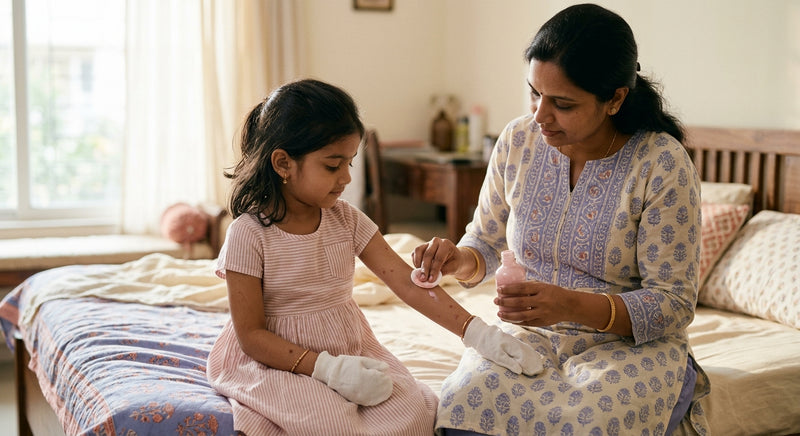
Three bumps on your daughter's ankle on Monday. By Thursday there are nine, the Monday ones are red and swollen again, and she's scratching in her sleep hard enough to wake herself up. You've changed the soap. Washed the sheets. Checked for chickenpox twice.
Clusters of firm, intensely itchy bumps that calm down and then flare again — week after week, usually on arms, ankles and legs — are most often papular urticaria: a delayed, over-enthusiastic skin reaction to insect bites. Mosquitoes, usually. Fleas, often off a street dog the kids stop to pet on the walk home. Bedbugs, sandflies. And the bit that throws everyone: the number of bumps has almost nothing to do with the number of bites. One fresh bite can wake up every older spot on the body.
It isn't contagious. It isn't a sign of dirty skin. It does settle, as the child's immune system learns to ignore that insect's saliva — but that can take months, and that is the part nobody wants to hear. So the work in front of you is itch control, barrier care, and cutting new bites.
At a glance
- Papular urticaria is a hypersensitivity reaction to insect bites, not an infection. Your paediatrician confirms it by looking at the pattern, not by running a test.
- Old bumps re-flare when a new bite happens — which is why it looks like it "keeps coming back" in a week with no bites at all.
- Most common in children roughly 2 to 10 years old. It fades as tolerance builds.
- Itch control beats everything else: cool compress, short nails, a thick fragrance-free emollient, loose cotton clothes.
- Scratched bumps on brown Indian skin leave dark marks that outlast the bumps by months. Protecting the surface is protecting the complexion.
Why the same bumps keep coming back
Because this is a memory reaction, not an ongoing attack. When an insect feeds, it leaves a little protein from its saliva behind. The first few times, the skin barely registers it. After enough exposure the immune system starts recognising those proteins and mounts a delayed response — hours later, sometimes a day or two later. That delay is why parents almost never see the bite happen.
Then the odd bit. Once that sensitivity exists, a new bite anywhere on the body can re-inflame bumps that were already fading. The old spots swell, redden, itch again in sympathy. Parents describe it to me as the rash moving around, or coming back without any new bites. Usually it's the opposite: there was one new bite nobody saw, and it set off the whole crowd.
Where they sit gives it away. Below the shorts line. The forearms. The back of the neck. That gap of ankle above a school sock. Clusters of three or four, sometimes in a rough line, each one firm, often with a tiny darker dot at the centre — and after a few days, a scab on top where it's been scratched.
Bites, or something else?
This is the question I get asked most, usually at 11pm over WhatsApp. I can't diagnose your child and neither can an article. What I can hand you is the pattern-reading paediatricians use, so you walk into the clinic with something better than "a rash".
| What it looks like | Where it shows up | The tell |
|---|---|---|
| Papular urticaria (bite reaction) | Uncovered skin — ankles, calves, forearms, neck | Clusters or short lines of firm bumps; old spots re-flare when new ones appear; one child in the house affected, not all |
| Scabies | Between fingers, wrists, waistband, armpits, groin | Itch is dramatically worse at night and several family members start itching. Needs prescription treatment — see a doctor |
| Heat rash / ghamori | Covered, sweaty skin — neck folds, chest and back under a uniform | Hundreds of tiny uniform pinpricks appearing within hours of heat; settles fast once the child cools down |
| Eczema flare | Elbow and knee creases, cheeks | Dry, rough, ill-defined patches rather than separate bumps, on a child with a history of dry skin |
| Chickenpox or a viral rash | Starts on trunk or face, then spreads outward | Fever, feeling unwell, and blisters at different stages at once — same-day doctor visit |

What calms the itch tonight
None of this is a cure. The aim is narrower than that: make the next six hours bearable so your child sleeps and stops scratching. Scratching is what turns a two-day bump into a three-week scab, and the scab into a dark mark that stays for months.
- Cool, not cold. A soft cotton cloth wrung out in cold water — or ice wrapped in a cloth, never ice straight on skin — 5-10 minutes on the worst crop. Cold genuinely dampens itch signalling for a while.
- Lukewarm bath, never hot. Hot water feels wonderful on an itch and then makes it far worse an hour later. Keep it short, around body temperature, and use a mild soap-free cleanser; regular soap at pH 9-10 strips a barrier that is already struggling.
- Moisturise within three minutes of patting dry, while the skin is still slightly damp. A thick layer over the bumpy areas. Not a smear.
- Nails short, and filed smooth. Trim weekly. At 3am a smooth edge does far less damage than a jagged one.
- Cotton pyjamas at night — full sleeves, long legs. Physical cover beats willpower. For a child who scratches herself raw, soft cotton mittens or socks over the hands for a few nights aren't cruel. They're sleep.
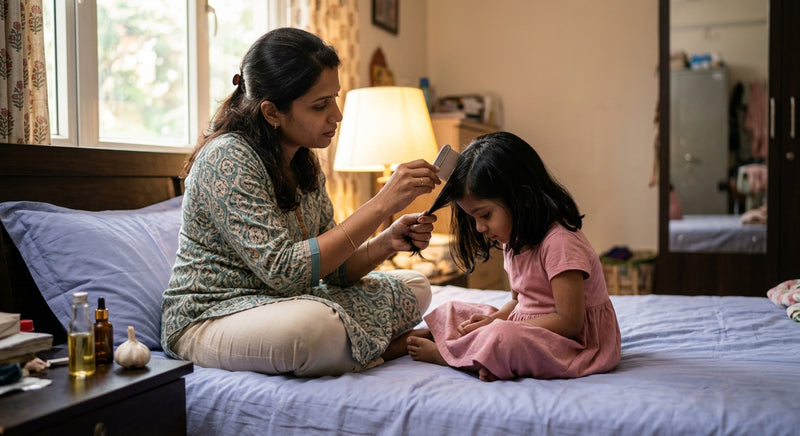
- Wash bedding and the mattress cover in hot water if you suspect bedbugs or fleas, and treat the pet with whatever the vet gives you.
If the itch is wrecking sleep, ask your paediatrician about an oral antihistamine and the right dose for your child's weight. That's a prescription conversation, not a chemist-counter guess. Steroid cream is the same story: a few days of it, used correctly on a doctor's say-so, is a reasonable tool. Weeks of it out of a cupboard with nobody watching is not. We've written separately about what actually stops a child scratching a healing bite — the healing phase is where most of the lasting damage happens.
Where moisturiser actually earns its place
Further than most parents expect — and this is the part of my job I enjoy most, because it's formulation, not luck. A bite reaction is inflammation sitting in skin that is being scratched, washed more often than usual, and pushed around by the weather all at once. Every one of those damages the barrier. A damaged barrier itches at a lower threshold, so the child scratches more, which damages it further. Break that loop and the skin is far more comfortable while the reaction runs its own course — you haven't changed the reaction, you've simply stopped making the skin's job harder.
Three jobs need covering. Humectants — glycerin, a little urea in older kids — hold water in the tissue. Emollients like shea and kokum butter and light plant oils fill the gaps between skin cells, so the surface stops catching on a bedsheet. Occlusives slow water loss long enough for the repair to actually happen. Soothing actives worth paying for: colloidal oatmeal, panthenol, licorice root extract, ceramides. On bitten skin, leave fragrance, essential-oil blends and dyes on the shelf.
Texture matters more than the ingredient list, and this is where it usually goes wrong at home. A light lotion is 70-80% water. It sinks in, feels lovely, and leaves the skin uncovered an hour or two later. On a scratched, scabbing bump you want something that stays — a high-butter balm, or a cream with an ointment texture and a low water content. It cuts the friction from nails and clothing, keeps the surface soft and supple rather than tight and flaky, and holds the moisture gradient steady through the night. A rule from the lab bench: if it vanishes the second you rub it in, it isn't doing occlusive work.
That's the thinking behind our Hydra Healing Moisturizing Balm: a deliberately rich, fragrance-free butter texture for dry, scratched, eczema-prone skin, made in our own GMP-certified facility. In our lab work it showed increased Keratin-10 and Filaggrin expression — the proteins the skin uses to build its own barrier — and in in-vivo testing on 24- and 36-month subjects, visibly calmer skin in as little as one day. It comforts and supports the barrier while the reaction runs its course. It is not a treatment for bites. Nothing in a jar is.

Stopping new bites is what ends the cycle
One unseen bite re-lights everything, so this is the only part that genuinely shortens the episode. Give it two weeks of being strict:
- Own the dusk hour. Aedes and Culex mosquitoes feed heavily at dawn and dusk, which is exactly when the kids are down in the colony park. Full sleeves and covered ankles for that one window changes a lot.
- Mosquito net over the bed, every night, tucked in properly. Cheap, zero chemistry, and better than anything else you'll buy.
- Empty standing water weekly. The cooler tray, the plant saucers, the terrace bucket, the money-plant bottle on the windowsill. Mosquitoes breed in a capful.
- Treat the pet and the sofa if the bumps cluster on ankles and lower legs. Flea bites love that zone, and the child who sits on the floor in front of the TV collects most of them.
- Check the mattress seams for bedbugs if bumps appear in lines and only after nights at home or in a hostel.
- Repellents by age, by the label. In India these are regulated as insecticides, so follow the product's own age instructions and your paediatrician's advice, apply only to intact skin, keep it off hands and faces, and wash it off at bedtime.
Then the dark marks — the complaint that outlasts all of this on Indian skin. Post-inflammatory hyperpigmentation fades on its own, but slowly. Think months, not weeks. You speed it along by not scratching, keeping the skin well moisturised, and using sun protection on exposed arms and legs, since UV deepens every healing mark. The Janma Journal has more on how pigment behaves on brown skin.
When to see a doctor
Book a paediatrician visit — don't wait it out — if you see any of this:
- Fever, the child seems unwell, or the rash is spreading fast over the trunk and face
- A bump that becomes hot, swollen, painful, or starts oozing yellow pus (signs of a skin infection that may need antibiotics)
- A rapidly spreading swelling, especially around the lips, eyes or throat, or any difficulty breathing — that is an emergency
- Several people in the house itching, or night-time itch between the fingers and at the waistband
- Itch bad enough to break sleep for more than a few nights, or bumps that aren't settling after several weeks
- Any rash you can't explain, in a child under two
And you're allowed to go in simply because you're not sure. A two-minute look at the pattern is exactly what a paediatrician is for. Papular urticaria is one of those things that's obvious to a trained eye and completely baffling at the dining table.
While the bumps run their course, keeping the skin soft and the barrier supported is the most useful thing you can do at home. Our Hydra Healing Moisturizing Balm was formulated for exactly that kind of scratched, irritated, dry skin.
In summary
- Clusters of itchy bumps that fade and flare are usually a bite hypersensitivity reaction — one new bite can re-inflame all the old spots.
- Note where bumps appear for four nights; bite reactions track with exposure, heat rash with sweat and eczema with dryness.
- Tonight: cool compress for 5-10 minutes, lukewarm short bath with a soap-free cleanser, thick fragrance-free emollient, full-sleeve cotton pyjamas.
- Trim and file nails weekly — less scratching means faster healing and fewer dark marks on brown skin.
- Break the cycle by cutting bites: tucked-in mosquito net, covered arms and ankles at dusk, pets treated, standing water emptied weekly.
Frequently asked questions
What is papular urticaria in children?
It's a hypersensitivity reaction to insect bites — commonly mosquitoes, fleas or bedbugs. The skin responds hours or days after the bite with firm, very itchy bumps, usually in clusters on uncovered areas like ankles, calves and forearms. It isn't contagious or caused by poor hygiene, and it typically eases as a child builds tolerance to that insect. A paediatrician confirms it from the pattern.
Why do the bumps flare up again when there are no new bites?
Usually there was a new bite you simply didn't see. Once a child is sensitised, a single fresh bite can re-inflame older spots anywhere on the body, so bumps that were fading swell and itch again. That sympathetic flare is the classic feature of papular urticaria and the reason it looks like the rash is travelling or relapsing on its own.
How long does papular urticaria last?
Each individual bump usually settles over one to two weeks, but the condition comes in repeated crops for as long as bites keep happening — often several months, sometimes across a whole season or two. Cutting bite exposure (nets, dusk cover, treating pets, clearing standing water) is what actually shortens it. The tendency fades as the child grows and builds tolerance.
Will the dark marks on my child's legs go away?
Yes, but slowly. Those marks are post-inflammatory hyperpigmentation, and on brown Indian skin they can take several months to fade. You help them along by stopping the scratching, keeping the skin consistently moisturised, and protecting exposed arms and legs from the sun, since UV deepens a healing mark. Avoid scrubs, lightening creams and bleach entirely.
Can I put a mosquito repellent on the bumps to stop more bites?
No — repellents go on intact skin only, never on broken, scratched or bitten areas, where they sting and can irritate further. In India repellents are regulated as insecticides, so follow the product's own age instructions and ask your paediatrician what suits your child's age. For children, physical barriers work better anyway: a tucked-in mosquito net and covered arms and ankles at dusk.
Should I stop bathing my child while the bumps are there?
Keep bathing — just change how. Use lukewarm water rather than hot, keep it short, and choose a mild soap-free cleanser instead of regular soap, which is far too alkaline for irritated skin. Pat dry rather than rubbing, then moisturise within about three minutes while the skin is still slightly damp. A warm bath before bed also takes the edge off night-time itch.