Your eight-year-old walks in from swim class and you can smell the pool before she reaches the door. Her hair feels like coir rope. There's a faint pink itchiness across her chest and the backs of her arms, and she's already scratching at it. Somewhere around 11pm you type "chlorine skin rash kids" into your phone. So here's the answer first.
Chlorinated water strips the thin film of natural oil off skin and hair and nudges the surface pH upward, so both end up tight, rough and itchy. Only a doctor can say what a particular rash is, but that dryness is what most post-swim routines are up against, and two habits go a long way. Wet your child down with clean water and seal the skin and hair before they get in. Then rinse, cleanse and moisturise within about 15 minutes of getting out. The rest of this is how to do those two things properly, and what actually earns space in the swim bag.
At a glance
- Chlorine dries skin and hair — it strips the natural oil film and raises the surface pH. It rarely "burns" a healthy child.
- Pre-swim: soak hair and skin in clean water, then apply a conditioner and a moisturiser. Saturated hair absorbs far less pool water.
- Post-swim: fresh-water rinse fast, then a mild cleanser (not soap), then moisturiser on damp skin.
- Sunscreen still matters at an outdoor pool — reapply after towelling off.
- An itchy rash that keeps flaring, or spreads, needs a paediatrician's eyes on it, not a moisturiser.
If you're building your child's whole routine from scratch, this fits inside our complete guide to skincare for kids 3 and above. Swim season is one chapter of it.
Why does pool water dry out skin and hair so badly?
Chlorine is only half the story.
Start with the oil. Your child's skin holds a thin lipid film, sebum plus barrier lipids, and that film is what keeps water in. Chlorinated water is a mild solvent for it. Forty minutes of splashing lifts a good chunk away. Hair has the same problem. The cuticle sits under a microscopic oil layer, and once that layer is gone the scales lift, catch on each other, and the comb hits that dull, straw-like tangle.
The other half is chloramines. Chlorine reacts with sweat, sunscreen, body oils and, let's be honest about a busy Sunday-morning club pool, urine. That sharp "swimming pool smell" is not clean chlorine. It's chloramines, and they irritate skin and eyes more than chlorine itself does. They build up in pools that are heavily used and lightly rinsed. It's also why the pool that made your child itchy last Tuesday may leave her fine this Tuesday. The water load changed.
The pre-swim step almost every parent skips
Hair behaves like a sponge. Drop a dry one into pool water and it drinks. Soak it in clean water first and it can't take much more.
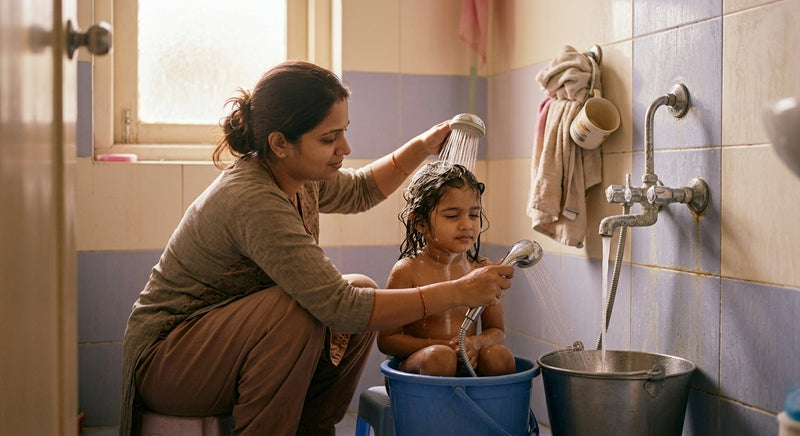
So, five minutes before she gets in, take her to the shower. Even in a crowded changing room. Even if the shower is out of order and it's a steel tumbler and a bucket, which at plenty of Indian pools it is. Soak her hair right through with plain tap water. Then work a small amount of conditioner through the lengths and leave it in. That's your barrier. Water fills the shaft, conditioner coats the cuticle, and the pool water that does get in arrives diluted and slowed.
Skin, same logic. A light moisturiser or balm on the dry, rough spots before the swimsuit goes on: knees, elbows, shins, the backs of the arms. It won't waterproof her, and it isn't trying to. It gives the barrier a head start so it isn't stripped bare.
- Soak hair and scalp thoroughly with clean water — not a splash, a proper soak.
- Leave-in a small amount of conditioner through the mid-lengths and ends.
- Long hair: plait it, or use a swim cap over the conditioned hair.
- Moisturiser or balm on dry patches: elbows, knees, shins, chest.
- Outdoor pool: mineral sunscreen 15–20 minutes before, ears and the tops of the feet included.
What to do in the 15 minutes after they climb out
This is the part that decides whether bedtime is peaceful.
Chloramines and chlorine residue sit on skin and hair after the swim and keep working. So the single most useful thing you can do is a fresh-water rinse, and do it fast. Before the drive home. Before the samosa. Before the towel comes off and dries onto her. Head to toe, warm not hot, two full minutes. Plain water does most of the job here. Genuinely.
Then, in order:
- Cleanse with a mild body wash, not a soap bar. Chlorinated water has already pushed the skin's surface pH up. Alkaline soap pushes it further and holds it there. You want a gentle syndet-type cleanser that leaves the barrier where it should be.
- Shampoo only if the hair is heavily chlorinated — a long outdoor session, a strong pool smell. For a 30-minute class, water and conditioner are enough. Daily shampooing on top of daily swimming is what really wrecks hair through a summer camp season.
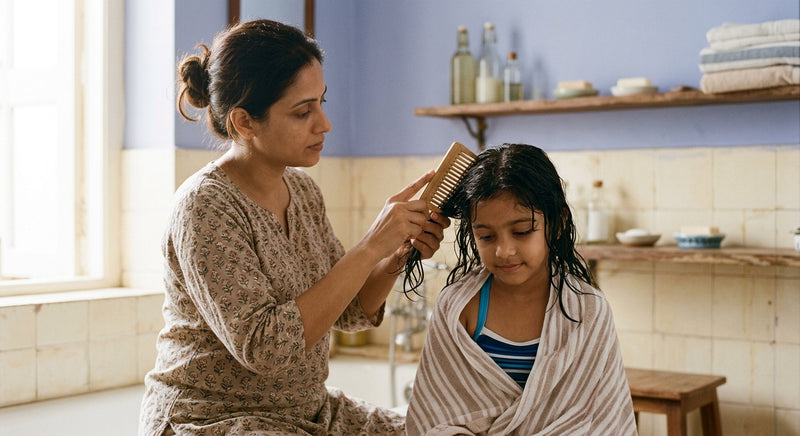
- Condition, always. Every single swim. This is the non-negotiable one if you want to comb that hair without tears, and our guide to detangling without tears covers the technique.
- Moisturise within three minutes of towelling off, while the skin is still damp. Damp skin plus moisturiser traps water in. Dry skin plus moisturiser is a much weaker version of the same thing.
| Before the swim | After the swim | |
|---|---|---|
| Hair | Soak with clean water; leave-in conditioner; plait or cap | Rinse fast; condition every time; shampoo only when needed |
| Skin | Moisturiser on dry patches; sunscreen if outdoors | Rinse; mild cleanser; moisturise on damp skin |
| Face | Sunscreen; nothing heavy or occlusive | Gentle face wash, then a light moisturiser |
| Eyes | Well-fitting goggles — the cheapest fix there is | Rinse with clean water only; no drops without advice |
What to actually look for on the label
I read these lists for a living, so let me save you some squinting in the aisle.
Post-swim cleanser. Mild synthetic detergents, not saponified soap. Sodium cocoyl isethionate, coco-glucoside, decyl glucoside, sodium lauroyl sarcosinate — you want one of those high up the list. Ignore anything sold on a foam-mountain promise. That foam usually costs you barrier lipids. And in a child who's already in the water five days a week, skip sodium lauryl sulphate. SLS, note. Not the gentler SLES.
Conditioner. Here you want a cationic conditioning agent: behentrimonium methosulfate and cetrimonium chloride are the common two. The reason is worth knowing. Chlorinated water leaves the hair cuticle swollen and negatively charged, and that charge is exactly what makes strands cling and knot. Cationic molecules are positively charged, so they bind to it, lie the scales flat, and let the comb glide. Add a fatty alcohol or two, cetyl or cetearyl, plus a light oil for slip, and you have a real post-swim conditioner. The proportions matter as much as the ingredient list.
Moisturiser. Three jobs, three kinds of ingredient. A humectant (glycerin) to pull water in. An emollient (almond, avocado, oats) to smooth. An occlusive (shea, kokum) to hold it all there. Any one of them alone is a half-measure, which is why a thin "hydrating" lotion never seems to hold through a swim-season week.
One more, because you'll see it advertised. "Chlorine-removing" sprays and vitamin C rinses aren't nonsense; ascorbic acid really does neutralise free chlorine. But with a wet, shivering child in a changing room, what decides the outcome is how quickly clean water reaches her skin and hair, not whether you spritzed something first. Fresh water at fifteen minutes beats a clever spray at forty. Don't spend money there.
Don't forget the sun above the pool
Water bounces UV straight back up at your child, and a wet child feels cool, so the usual "I'm getting too hot" signal never arrives. That's how kids come home from a Sunday at the pool with a burn across the shoulders and the nose.
Use a mineral sunscreen. Zinc oxide sits on the surface, doesn't sting swimming-sore eyes the way some chemical filters can, and holds up better on wet skin. Apply 15–20 minutes before, and reapply after every towelling off, not just every two hours. Almost everybody under-applies, so our guide to how much sunscreen a child actually needs gives you the quantities. Our Daily Defender Kids Mineral Sunscreen SPF 40 is built for these days: pool mornings, outdoor play, reapplied on damp skin without the chalky mess.
And look again if the itchiness sits on the chest and neck rather than everywhere, and if it flares in the sticky drive home rather than in the water. Heat and trapped sweat can leave their own mark in the Indian summer — our note on heat rash in the Indian summer explains why. The two are easy to confuse, so if you're unsure what you're looking at, ask your paediatrician rather than guessing.
When to see a doctor
Please see your paediatrician or a dermatologist if you notice:
- Hives, welts or swelling that come on during or right after swimming — that needs proper assessment, not a moisturiser.
- Eczema that flares badly after every session despite the pre- and post-swim routine.
- Skin that stays red, itchy or scaly for more than a week, or that cracks, weeps or crusts.
- Wheezing, a persistent cough or eye pain after indoor pools — poorly ventilated indoor pools concentrate chloramines in the air, and that's a respiratory issue, not a skincare one.
- Any patch that's spreading, ring-shaped or oozing — pool changing rooms and shared floors do pass infections around, and that needs a doctor, not a cream off the shelf.
Nobody should give up swimming over dry skin. Five minutes of thought on the way in, fifteen on the way out. That's the whole ask.
And if one thing in that swim bag has to earn its place every single time, make it a proper conditioner. Our Rejuvenating & Detangling Conditioner was formulated for exactly this kind of rough, chlorine-tangled hair.
In summary
- Soak your child's hair and skin with clean water and apply conditioner before they get into the pool — saturated hair absorbs far less chlorinated water.
- Rinse head to toe with fresh water within about 15 minutes of getting out; this simple step does most of the work.
- Use a mild, soap-free cleanser instead of a soap bar, and moisturise while the skin is still damp.
- Condition after every swim, but shampoo only after long or heavily chlorinated sessions.
- See a paediatrician if there are hives during swimming, a rash that spreads or weeps, or irritation that lasts beyond a week.
Frequently asked questions
Should my child shower before swimming, not just after?
Yes, and it's the step most people skip. Soaking hair and skin with clean water for a few minutes means both are already saturated, so they absorb far less pool water. Add a leave-in conditioner and a moisturiser on dry patches and you've given the barrier a real head start. It also cuts the sweat and oil your child carries into the pool, which is what forms irritating chloramines.
How soon after swimming should my child rinse off?
Aim for within about 15 minutes — before the drive home, not after. Chlorine and chloramine residue keeps working on skin and hair as it dries. A two-minute head-to-toe rinse with plain fresh water does most of the work. Follow it with a mild, soap-free cleanser and a moisturiser applied while the skin is still damp.
Do my child's hair really need conditioner after every swim?
Yes. Chlorinated water lifts the hair cuticle and leaves it swollen and negatively charged, which is exactly what causes clinging and knotting. A conditioner with a cationic agent such as behentrimonium methosulfate binds to that charge, lays the scales flat and restores slip. Shampoo, by contrast, is only needed after long or heavily chlorinated sessions — daily shampooing through swim season does more harm than good.
Do chlorine-removal sprays actually work?
There is real chemistry behind them — ascorbic acid does neutralise free chlorine. But in practice, how quickly clean water reaches your child's skin and hair matters far more than whether you spritzed something first. A prompt fresh-water rinse beats a spray applied forty minutes later. Spend the money on a good conditioner and moisturiser instead.
Does chlorine turn hair green?
Not directly. The green tinge is copper — from pool pipes or copper-based algaecides — binding to the hair shaft, and it shows up mainly on light or chemically treated hair. On the darker hair most Indian children have, chlorine shows as dullness, roughness and tangling rather than colour change. Pre-wetting and conditioning reduce how much of anything the hair absorbs.
Can my child swim if they have eczema?
Usually yes, with preparation. Moisturise well before swimming, rinse immediately afterwards, cleanse with a mild soap-free wash and reapply moisturiser to damp skin. Many children with eczema swim through the summer without trouble. If flares happen after every single session despite this routine, speak to your paediatrician or dermatologist rather than stopping the sport.