Last Holi, about eight at night, I was standing in a bathroom in Nagpur with a six-year-old who had gone green from the ears down. His mother was holding a bath sponge like a weapon. I asked her to put it down. Holi colour comes off a child's skin with oil first, a mild cleanser second, lukewarm water third, in that order, and whatever refuses to shift that night will fade on its own over the next two or three days. Scrubbing doesn't lift pigment any faster. It lifts the top of your child's skin along with it, and then you spend a week managing raw, stinging patches instead of a little leftover purple behind the ears.
At a glance
- Dust off dry powder before water touches your child. Water turns loose gulal into a paste that grips.
- Massage plain oil into dry, coloured skin for 3-4 minutes. Oil dissolves the greasy base most wet colours are mixed into.
- One pass with a mild, soap-free cleanser. Hands only. No loofah, no ubtan scrub, no washing powder.
- Moisturise while the skin is still damp. Holi lands at the tail of dry-winter skin, and one bath can undo weeks of care.
- Knuckles, nails, hairline and neck folds will stay tinted for two to three days. That is normal. Nobody has done anything wrong.
Why does scrubbing make Holi colour worse?
Two reasons, and both hit a child harder than they hit you.
Most of the stubborn colour is no longer sitting on the skin. It has settled into the tiny grooves of the surface: knuckle creases, the skin around the nail folds, the hairline. A loofah can't reach into a groove. All it does is abrade the flat surface around it, so you get sore skin and a purple knuckle anyway.
Then there is the skin itself. A baby's skin is 20-30% thinner than an adult's, and a five-year-old's isn't adult skin either. Still thin. Still learning to hold water. By March, at the end of a dry Indian winter, it is already running low on moisture. Take a rough sponge to a sun-warmed, dehydrated body that has been out for six hours and you strip whatever barrier lipid was left. That is when the itching starts at 2am.
What's actually on your child — and what each thing needs
"Holi colour" isn't one substance. That is why a single removal method never works across a whole body. Look at what is actually sitting on the skin, then treat it.
| What's on the skin | What it is | Gentle way to lift it |
|---|---|---|
| Dry gulal | Fine powder sitting on the surface, usually starch-based | Brush and shake it off dry. Then oil, then wash. Most of it never needs water. |
| Wet or "pakka" rang | Pigment carried in an oily or greasy base | Oil dissolves oil. Massage in, wait, wipe with a soft cloth, then cleanse. |
| Silver or metallic paste | Sticky metallic-looking paint, often smeared on faces | Oil on a cotton pad, press and lift. Rubbing only spreads it further. |
| Stained knuckles, nails, hairline, neck folds | Pigment lodged in creases and in the nail's keratin | Leave it. Daily normal washing fades it over 2-4 days. Nails may take longer. |
The same-evening routine, step by step
Fifteen minutes, done properly, beats forty minutes of fighting. Do it before dinner, while the child is still warm and cooperative. By bedtime everyone has run out of patience and it goes badly.
- Undress outside the bathroom, on the balcony, the terrace, the verandah, wherever you have. Shake the clothes out there. Half the powder leaves the house before you start.
- Dust the skin dry. A soft dry towel, or a clean makeup brush, over arms, back and face. Sixty seconds. No water yet.
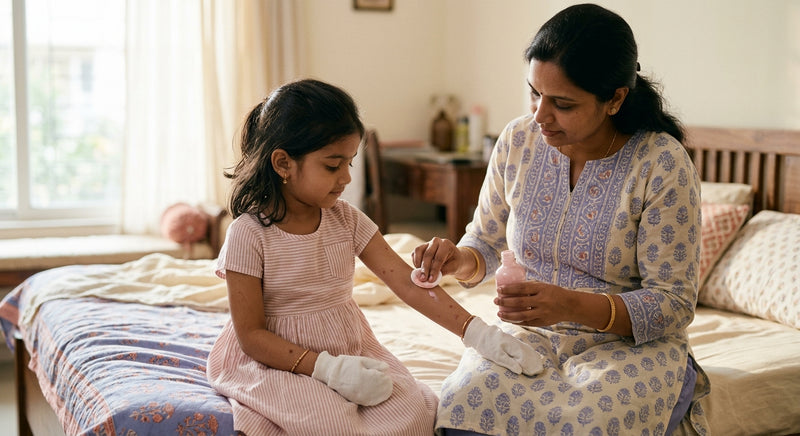
- Oil, generously. 2-3 teaspoons of any plain oil already in the house: coconut, sesame, almond. Warm it between your palms. Massage arms, legs, neck, face and ears for 3-4 minutes. The colour will start moving onto your hands. That is what you want to see.
- Wipe, don't rub. Soft cotton cloth or cotton pads, one direction, changing the cloth as it colours.
- Lukewarm water only. Hot water feels like it's cutting the colour. It isn't. It strips oils and turns mild redness into real irritation.
- One cleanser pass. Hands, not a loofah. Top to bottom, rinse, done.
- Pat dry and moisturise within three minutes, while the skin is still slightly damp. This is the step that gets skipped, and then nobody can work out why the child is scratching by Sunday.
- Stop there. No second bath the same night to get the rest off.
The face and around the eyes
Oil on a cotton pad. Press, hold for ten seconds, sweep outwards. Around the eyes, work with the pad only, no fingers on the lid. If colour has got into the eye itself, keep oil well away from it: rinse with clean, room-temperature water for a couple of minutes and watch for redness that doesn't settle.
Hair and scalp
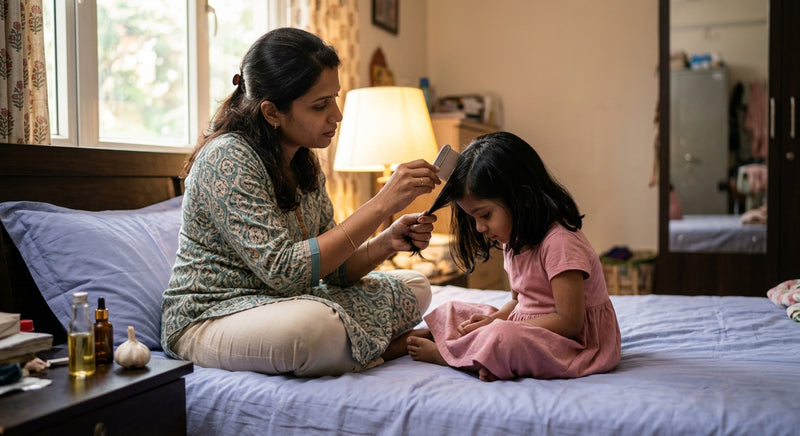
If you oiled before the party, most of the colour rinses out with far less effort. That is the whole logic of the pre-Holi oiling checklist we published in the Janma Journal, and it's worth a bookmark for next March. Tonight: hold the head under running lukewarm water for a full minute before any shampoo, so the loose powder leaves instead of getting foamed into a paste. Shampoo once. Detangle only after the conditioner, wide-tooth comb, from the ends up. Never comb a coloured, tangled, wet head from the roots down. That is how you end up with a crying child and hair in the comb.
Hands, nails and feet
These stay stained the longest, and nothing safe will change that overnight. Trim and clean the nails, oil the cuticles, let time do the rest. If your child is old enough to mind at school pickup, warn them the evening before that their hands will look funny for a few days. The worry that it will never come off is usually worse than the stain.
Your bathroom water is doing half the damage
Across most of central and north India — Nagpur, Delhi, Jaipur, much of Maharashtra's bore-fed housing — the tap runs hard. Hard water and traditional soap react and leave a fine film of scum on the skin. That is why a child can come out of a long bath feeling tight and squeaky and still be faintly purple. On Holi night, that film settles on skin that has already been out in the sun for hours.
Two things help. Use a soap-free (syndet) cleanser rather than a bar; it lathers properly in hard water and doesn't leave that residue. And do the last face rinse with stored filtered or RO water from a mug. Small thing, but you can feel the difference in how tight the cheeks are afterwards. What you want is soap-free, light on fragrance and built for children's skin rather than a scented family body wash. Ours is the Kids Gentle Body Cleanser, and it's what sits in my bathroom for exactly this week of the year.
Please don't use these
Day two and day three: the fading stage
Holi sits at an awkward point in the Indian calendar: the last of winter's dryness, with the first real summer sun on top of it. Your child has spent four or five hours outdoors between ten and two, which is peak UV, and has come home a little sun-stressed as well as coloured. So the next two days are about moisture. There is nothing left to remove.
Moisturise twice a day, morning and after the evening bath, with something thicker than usual. Keep baths short and lukewarm. Don't start a new scrub, face pack or "brightening" product on stained skin; that is the most common way a mild post-Holi irritation becomes a real one. And keep sunscreen going on exposed skin if they're back outdoors. Freshly washed, well-scrubbed skin is not the moment to skip it.
Most children are back to their normal colour by day three without anybody doing anything clever. The families who struggle are nearly always the ones who scrubbed on night one.
When to see a doctor
Take your child to a paediatrician or dermatologist, and don't wait it out, if you see any of these:
- Skin that stays red, swollen or burning more than 24 hours after washing, or spreading hives
- Blisters, oozing, or broken skin anywhere the colour sat
- Colour in the eye with persistent redness, watering, or complaints of pain or blurred vision
- Any colour swallowed, along with vomiting or breathlessness — that's an emergency
- Itching bad enough to keep the child awake a second night, or eczema-prone skin that has clearly flared
If your child has known eczema or a history of reactions, a quick call to your doctor before Holi is worth the two minutes. Then you have a plan instead of a panic.
For the two or three nights after, when the colour has gone but the skin still feels tight and papery, a thicker barrier balm on slightly damp skin does more than anything else. Our Hydra Healing Moisturizing Balm was formulated to comfort exactly this kind of dry, over-washed skin and help support its natural barrier.
In summary
- Dust dry powder off before water touches the skin — water turns loose gulal into a paste that clings.
- Massage plain oil into dry, coloured skin for 3-4 minutes, then wipe with a soft cloth before washing.
- Use one pass of a mild, soap-free cleanser with lukewarm water and your hands — never a loofah or scrub.
- Moisturise within three minutes of patting dry, and again the next two mornings, since Holi lands on dry end-of-winter skin.
- Let knuckles, nails and hairline fade on their own over two to three days, and see a doctor for blisters, spreading redness or colour in the eye.
Frequently asked questions
How do I remove Holi colour from my child's face without scrubbing?
Use oil on a cotton pad. Press it onto the coloured area, hold for about ten seconds, then sweep outwards — repeat with fresh pads until most of the colour transfers. Follow with one gentle wash using lukewarm water and a mild, soap-free cleanser, then moisturise. Skip the pad near the eyes; there, only rinse with clean water.
Does lemon juice or baking soda remove Holi colour?
Neither is worth using on a child. Lemon juice is acidic and can make skin more sun-sensitive, which is exactly wrong the morning after a day outdoors. Baking soda pastes are alkaline and abrasive, and they disturb the skin's natural acidity. Both sting on skin already reddened by a day of sun and colour. Plain oil works better and hurts nobody.
How long does Holi colour take to fade from a child's skin?
Most of it goes on the first proper oil-and-wash round. What's left on knuckles, the hairline, neck creases and behind the ears usually fades over two to three days with normal daily washing. Nails and cuticles can hold a tint for a week or more. That timeline is normal — repeated hard washing shortens it barely at all.
Can I use a loofah, scrub or ubtan on my child after Holi?
Not a loofah or a gritty scrub. Children's skin is thinner and, in March, already dry from winter — abrasion removes barrier lipids far more efficiently than it removes pigment. Traditional ubtan is fine as a soft, short-contact paste applied with flat hands and rinsed off, but never rubbed in hard or left to dry and crack on the skin.
How do I get Holi colour out of my child's hair?
Rinse under running lukewarm water for a full minute before any shampoo — this carries loose powder away instead of foaming it into the hair. Then shampoo once, condition, and detangle with a wide-tooth comb from the ends upward. Oiling the hair well before playing is the single thing that makes this easy; dry, un-oiled hair holds pigment much longer.
My child's skin is red and itchy the day after Holi. What should I do?
Stop all washing beyond one short lukewarm bath, keep the skin generously moisturised, and dress them in loose cotton. Avoid new products, scrubs and hot water. If the redness, swelling or itching is still there after 24 hours, or you see blisters, oozing or broken skin, see a paediatrician or dermatologist rather than trying more home remedies.