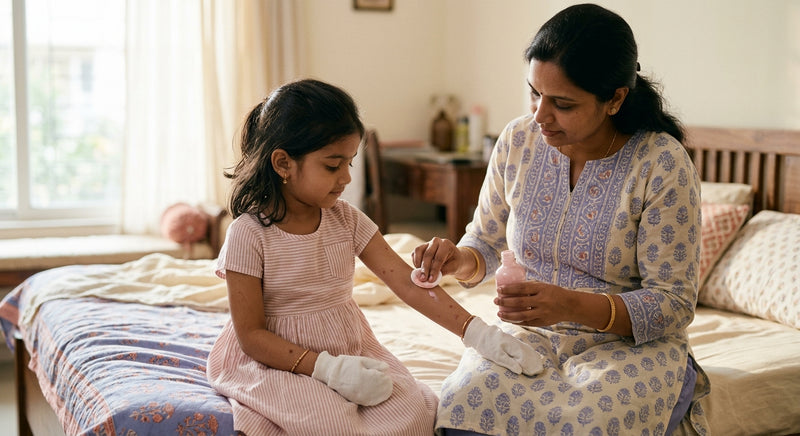
Eight in the morning, a terrace in Nagpur, October light. The malish is finished. The baby is warm and oiled, laid on a cotton dupatta in a rectangle of sun. Thodi dhoop lag jaayegi, vitamin D ho jaayegi.
The honest answer: an Indian baby does not need deliberate sun exposure to get vitamin D, and under six months she should not be in direct sun at all. Infant vitamin D in India comes reliably from a daily supplement your paediatrician prescribes. Not from a sunbath. Sun protection and vitamin D aren't really competing for that terrace. We think they are because the ritual came first and the science arrived a long way behind it.
I work on the formulation side at Janma. UV filter dossiers, stability reports, stability-chamber data — that is my desk. Diagnosis belongs to your paediatrician. But this is the question parents ask us most at expos, so here is everything I would tell a friend, with the Indian seasons built in. If you want the longer version of how we weigh evidence like this, it sits inside our complete guide to the clinical side of baby skincare.
At a glance
- Under six months: shade and clothing. No deliberate sunbathing, and generally no sunscreen.
- Infant vitamin D comes from a prescribed daily supplement. Sunlight alone is unreliable in India.
- There is no paediatric "dose" of morning sun. Nobody can promise you fifteen minutes is enough, because it depends on skin tone, season, haze and how much skin is bare.
- Oiled skin heats faster in direct sun. Do the malish indoors, then dress and shade.
- From about six months, a mineral sunscreen on exposed skin, reapplied every two hours outdoors.
So how much morning sun does an Indian baby actually need?
None, as a prescription. No paediatric body publishes a sunlight dose for infants, and the reason is practical rather than cautious. How much UVB her skin needs to make meaningful vitamin D shifts with her skin tone, the month, the hour, the latitude of your city, the haze that morning, and how much of her is uncovered. You cannot measure any of that from a terrace. You can measure drops in a bottle.
Breast milk is naturally low in vitamin D. That is why Indian paediatric practice routinely starts infants on vitamin D drops in the early weeks and keeps them going through the first year and beyond. Formula is fortified, though the dose your baby actually gets still depends on how much she takes. Ask your paediatrician for the exact drops and dose at the next visit. Thirty seconds, and the question is settled for good.
India has sun everywhere. Why is deficiency still so common?
This one catches parents out, and it caught me out too. A sun-drenched country, and vitamin D deficiency is still widespread across Indian cities. Five things get in the way:
- Melanin. More pigment, more time in UVB for the same vitamin D. Indian skin is doing what it evolved to do, which is protect itself. That protection cuts both ways.
- Timing. The UVB that makes vitamin D peaks in the middle of the day — the one window when no baby should be out in it. Morning light is gentle because it carries less of the wavelength you were hoping for.
- Haze and particulate. A north Indian winter morning under smog. A Nagpur summer sky gone white with dust. Both scatter a good deal of UVB before it reaches anyone's terrace.
- Glass. Ordinary window and car glass blocks most UVB while letting plenty of UVA through. A baby napping in a sunny window gets warmth and ageing rays, and almost no vitamin D.
- Life indoors. Between AC, school, screens and traffic, most urban Indian children see far less real sky than their grandparents did at the same age.
Season by season: what the Indian sun is actually doing
| Season | What the sun is doing | What to do |
|---|---|---|
| Summer (Mar–Jun) | High UV from mid-morning. Heat is the bigger immediate risk than burn, especially with sweat trapped in folds | Outdoor time before 9am or after 5pm only. Loose cotton full sleeves, wide hat, pram hood. Sunscreen on exposed skin from 6 months. |
| Monsoon (Jun–Sep) | Cloud does not switch UV off. Plenty gets through a grey Mumbai or Kochi sky, and the humidity keeps skin damp all day | Keep the sunscreen going on outdoor days. Dry the folds properly after every soaking; damp skin is where trouble starts. |
| Winter (Nov–Feb) | Lower UV, more haze, and the temptation to park a baby in the sun for warmth for far too long | Short, shaded stretches of warmth are fine. Dry cold air is the real skin problem in winter: moisturise, don't sunbathe. |
| Hills and coast | UV climbs with altitude, and sand, water and snow bounce it back up under the hat brim | Treat a Goa beach or a Manali afternoon as high-exposure whatever the temperature says. Reapply every two hours. |
The dhoop-after-malish ritual: keep the malish, change the dhoop
I am not going to tell you to drop a hundred-year-old ritual. Keep it. Move it indoors.
Oil and sun are a poor pair. A film of oil on skin holds heat, and a baby who cannot yet roll away or tell you she is too hot will simply go quiet and flushed. So do the massage inside, in warm air, let it absorb, dress her, and then out into shade. The ritual survives intact.
The other thing worth knowing is that some oils are genuinely photosensitising. Cold-pressed citrus oils, bergamot above all, contain furocoumarins that react with UV and can cause a burn-like reaction on skin that was never in strong sun for long. That is why we keep expressed citrus oils out of anything meant for a baby's body, and why a "fragrance blend" on a label is worth reading twice before a beach day.
And if your baby was born early, the whole calculation shifts. Thinner skin, less reserve, specific guidance on both massage and emollients. We wrote that up separately in our guide to preterm baby skin, malish and emollients.
What to do tomorrow morning
- Ask your paediatrician to confirm the vitamin D drops and dose at the next visit. Write it on the fridge.
- Move the malish indoors. Take her out afterwards, dressed, into shade.
- Through summer, shift outdoor time to before 9am or after 5pm.
- Dress for the sun before you reach for a bottle. Full-sleeve cotton, a wide hat and a pram hood cover more skin than any cream.
- From six months, mineral sunscreen on the face, ears, back of the neck and hands — roughly half a teaspoon for the face and neck of a small child.
- Reapply every two hours outdoors, and after swimming or heavy sweating.
- At bath time, rinse off the sweat and sunscreen with a gentle wash, pat dry, moisturise while skin is still slightly damp.
What to look for in a baby or kids' sunscreen
Here I am on home ground, because we make ours in our own GMP-certified facility rather than buying someone else's base. What I check on any label:
- Mineral filters. Zinc oxide and titanium dioxide sit on the surface and work from the moment they go on. Non-nano grades are the ones you want on young skin.
- SPF 30–40 with PA+++. SPF is the UVB number. The PA pluses are UVA, the one that comes through cloud and car glass. A high SPF with weak UVA protection is half a product.
- In-vivo SPF testing, and BIS compliance. An SPF number should come from testing on people, not from a calculation on a spreadsheet.
- No added fragrance on a child who will be sweating in it for hours.
- Texture that survives Indian humidity. A formula that pills or slides off a damp forehead gets reapplied by nobody, which makes its SPF irrelevant. Try a small amount on a hot, humid day before you rely on it for a long outing.
The other half of the job is the skin barrier underneath. Sweat, sun and repeated wiping wear skin down through a humid September in much the same way as the constant damp behind drool rash in humid weather. If your child's skin looks tight or dull after a long day outdoors, look for a plain, fragrance-free barrier balm at night — ours is the Hydra Healing Moisturizing Balm — to comfort dry, sensitive skin and support its natural barrier.
When to see a doctor
Call your paediatrician if your baby has been in the sun and develops blistering, a spreading rash, fever, unusual sleepiness or fewer wet nappies. Any redness on a baby under one year that follows sun exposure deserves a call rather than a wait. And ask at your routine visit if you are unsure whether her vitamin D supplement has been started, if she was born preterm or has a medical condition, or if she has skin that reacts to almost everything. Those conversations belong with a doctor who can examine her, not with an article.
Once she is past six months and heading out into that sun, our Daily Defender Kids Mineral Sunscreen SPF 40 PA++++ is the one we made for these Indian mornings.
In summary
- Keep babies under six months out of direct sun entirely — shade, a pram hood and loose cotton do the work, not sunscreen.
- Get your baby's vitamin D from the daily drops your paediatrician prescribes; there is no reliable sunlight dose for infants in India.
- Move the malish indoors and take your baby out into shade afterwards, since oiled skin heats faster in direct sun.
- Shift outdoor time to before 9am or after 5pm in summer, and keep sunscreen going on cloudy monsoon days from six months onward.
- Choose a non-nano mineral sunscreen with SPF 30–40 and PA+++, in-vivo tested and fragrance-free, and reapply every two hours outdoors.
Frequently asked questions
Should I put my newborn in the morning sun for vitamin D?
No. Babies under six months should be kept out of direct sunlight altogether — their skin is far thinner than an adult's and they overheat quickly. There is no recommended sunlight dose for infants anywhere in paediatric guidance. Vitamin D for newborns comes from the daily drops your paediatrician prescribes, which is both safer and far more reliable than a terrace sunbath.
Does my baby get vitamin D through a window?
Barely. Ordinary window and car glass blocks most UVB, which is the wavelength involved in making vitamin D, while letting a good deal of UVA through. So a baby napping in a sunny window or strapped into a car seat by the window gets warmth and UVA exposure without the vitamin D benefit. Shade the window and keep the supplement going.
Can I use sunscreen on a three-month-old?
Generally no. Under six months the advice is shade, a pram hood, a wide hat and loose full-sleeve cotton rather than sunscreen. If a small patch of skin cannot be covered on an unavoidable outing, ask your paediatrician before applying anything. From around six months, a non-nano mineral sunscreen on exposed skin becomes the sensible addition.
Does my breastfed baby still need a vitamin D supplement?
Breast milk is naturally low in vitamin D regardless of how well the mother eats, which is why Indian paediatric practice routinely starts infants on vitamin D drops in the early weeks. Formula is fortified, but the amount depends on how much your baby actually drinks. Confirm the product and dose with your own paediatrician rather than working from a general figure.
Do children need sunscreen during the monsoon?
Yes, on days they are outdoors. Cloud cover reduces UV but does not remove it, and a grey Mumbai or Kochi sky still carries enough UVA to matter. The bigger monsoon issue is dampness — sweat and rain sitting in skin folds. Reapply after heavy sweating, and dry the neck, elbow and knee folds properly when you get home.
Is sunlight a treatment for newborn jaundice?
No. Home sunbathing has not been shown to clear jaundice safely, and the exposure needed risks overheating and dehydration in a newborn. Jaundice is assessed and treated by a doctor, with phototherapy using controlled light if it is needed. If your baby looks yellow across the chest, tummy or eyes, contact your paediatrician the same day.