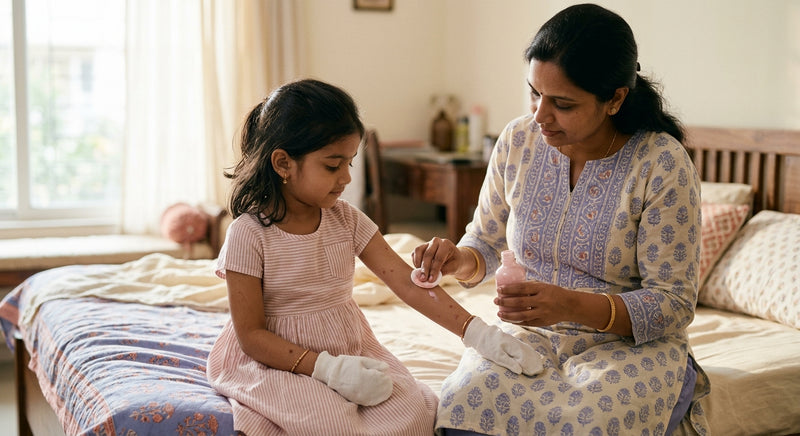
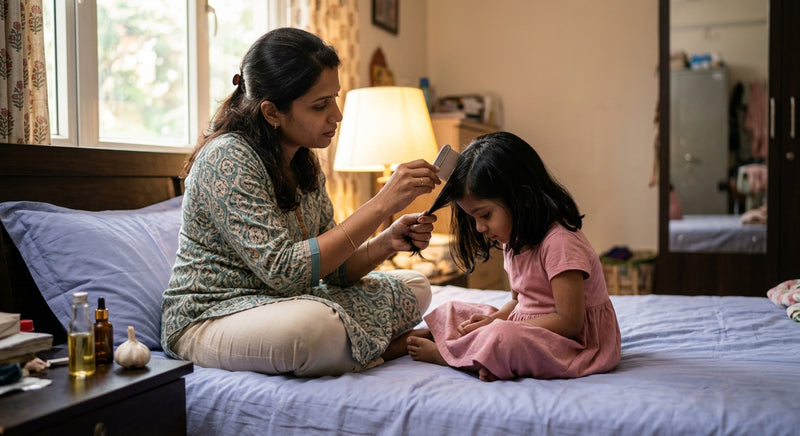
Nine at night, third aisle, a bottle of kids' face wash in your hand, and the question is whether seven is too young. It usually is. The short answer across the four products parents ask about most: sunscreen from 6 months, conditioner from about 2-3 years (whenever hair gets long enough to tangle), face wash from around 8-9 years when skin genuinely starts to get oily, and deodorant from about 9-10 years when body odour actually begins. Most of what's sold before those ages is a product looking for a problem.
The ages are the easy part. What's worth knowing is why each gate sits where it does, because that's what tells you which bottle to pick up when you finally do need one.
At a glance
- Sunscreen: from 6 months. Under 6 months, use shade and clothing instead — a baby's skin is 20-30% thinner than an adult's and absorbs more of what you put on it.
- Conditioner: from 2-3 years, but driven by hair length and texture, not birthday. Curly or wavy hair often needs it earlier than straight hair.
- Face wash: from 8-9 years, when oil glands wake up. Before that, plain water at the basin is genuinely enough.
- Deodorant: from 9-10 years, at the first real smell. Deodorant (masks odour) — not antiperspirant (blocks sweat) — is the right first step.
- Every one of these is a range, not a rule. Start when your child's body needs it, not when the box says a number.
Sunscreen: from 6 months, and why not before
Six months is the one age gate with real consensus behind it. Below that, paediatric guidance is to keep babies out of direct sun altogether. Hats. Sleeves. The pram hood down. Walking on the shady side of the road even when it means crossing twice.
The reason is absorption. A newborn has a far higher surface-area-to-weight ratio than you do, plus a thinner stratum corneum, so proportionally more of any topical ingredient crosses into the body. This isn't about one villain ingredient. It's why formulators go conservative on everything meant for under-sixes — sunscreen, yes, but equally lotions, oils and balms.
After six months, in a country where the UV index runs high for nine months of the year, the maths changes. A 9am school assembly is real sun exposure. So is the auto ride home at half past two. Daily sunscreen on exposed skin stops being optional.
What to look for on a kids' sunscreen label
- Mineral filters: zinc oxide or titanium dioxide as the active. They sit on the surface and work the moment you apply, no 20-minute wait.
- SPF 30-50, with PA+++ or higher. SPF handles UVB (burning); the PA rating covers UVA (ageing, pigment, and the rays that come through window glass). An SPF number with no PA rating tells you half the story.
- "Broad spectrum" stated plainly.
- No fragrance in the top five ingredients if your child has reactive skin — sunscreen goes on the face daily, so this is the category where fragrance load matters most.
- A texture your child will actually tolerate. Chalky and draggy gets scrubbed off with a shirt sleeve by mid-morning, and then you've bought nothing.
That last one is a formulation problem, and it's harder than the marketing lets on. Zinc oxide is a white powder. Getting it to disperse without a grey cast on brown skin comes down to particle size and the dispersing system — not, as is often assumed, more emollient. Ours is a mineral SPF 40 PA++++ built specifically to sit invisibly on Indian skin tones, for the plain reason that the version leaving a cast never makes it out of the house.
Conditioner: from about 2-3 years, or whenever tangles start
Honestly, age barely comes into this one. Length and texture do. A two-year-old with dense wavy hair to her shoulders needs conditioner long before a five-year-old with a short crop.
Watch for the signal instead: your child crying through the after-bath combing, or hair snapping to get the comb through. That's mechanical damage. Brushing more gently doesn't fix it, because the problem is that the hair has no slip.
Conditioner deposits a thin cationic film that reduces friction between strands. Nothing is being fed or repaired. That's also why a light rinse-out formula suits a toddler and a heavy adult mask doesn't — adult products are built for chemically treated hair, and on young, fine hair they read as limp and coated.
Getting it right
- A rinse-out, not leave-in formula for the first few years — less product left on the scalp.
- Mid-lengths and ends only. Conditioner on a child's scalp is unnecessary and can look greasy by day two.
- Tear-free is irrelevant here (it's not going near the eyes) — prioritise light texture and easy rinse-out instead.
- A wide-tooth comb used while the conditioner is still in, in the shower. Most parents who try this stop dreading hair-wash day.
If detangling is the daily fight in your house, a gentle detangling conditioner applied mid-lengths-down and combed through in the bath takes most of the drama out. We've written more on the mechanics of tangling in the Janma Journal.
Face wash: from 8-9 years, not before
Parents are usually surprised by this, and fairly so — kids' face washes are marketed hard at six-year-olds. But a young child's face doesn't produce meaningful sebum. Sebaceous glands sit largely dormant from a few months old until adrenarche, the hormonal shift that typically begins around 8-9 in girls and 9-10 in boys.
Until then, what's on that face is dust, sweat, tiffin and playground grime. Water at the basin takes all of it off. Add a surfactant twice a day and you strip lipids the skin has no surplus of. The tight, flaky feeling that follows gets read as "dry skin, needs more product" — and so a second product joins the first.
The genuine start signals: a shiny T-zone by afternoon, the first closed comedones on the forehead or around the nose, or hair that suddenly needs washing more often. They arrive together, because they're the same hormonal event.
| Age | What the face actually needs |
|---|---|
| 0-3 yrs | Water, or the same gentle body wash used at bath time. Nothing separate. |
| 3-7 yrs | Water morning and evening. A mild cleanser only after a sweaty, sunscreen-heavy or very grubby day. |
| 8-12 yrs | A mild, low-surfactant face wash once daily (evening), water in the morning. Moisturiser after. |
Choosing a first face wash
- Gentle surfactants — the coco-glucoside and glutamate/sarcosinate families clean without the squeaky strip of harsher sulphate systems.
- No salicylic acid or benzoyl peroxide in a first cleanser. Save actives for actual, persistent acne, ideally with a doctor's input.
- No scrub particles. Physical exfoliants on young, thin skin cause more inflammation than they clear.
- Skin should feel comfortable, not tight, 60 seconds after rinsing. Tightness means the formula is too strong for that face. Nothing else needs measuring.
Deodorant: from 9-10 years, at the first real smell
Body odour starts when apocrine glands in the underarms activate at adrenarche. What those glands secrete is odourless by itself; skin bacteria break it down, and that's the smell you're noticing on the school shirt. Which means the first and most effective intervention isn't a product at all.
Do this first, for two weeks
- Daily wash of the underarms with a mild cleanser — not just water. This lowers the bacterial load that creates odour.
- Dry the underarms properly before dressing. Damp skin under a school shirt in Nagpur humidity is a bacterial incubator.
- Cotton uniforms, changed daily — including the vest under the shirt, which is usually the part nobody thinks to swap. Synthetic fabric holds odour compounds even after washing.
- Wash sports kit after every single use. Not "it looks fine."
For most nine-year-olds, that's the whole fix. If the smell survives two honest weeks of it, a deodorant is reasonable.
Deodorant vs antiperspirant — a real distinction
| Deodorant | Antiperspirant | |
|---|---|---|
| What it does | Reduces odour-causing bacteria or masks the smell | Aluminium salts temporarily plug sweat ducts to reduce sweat |
| Right for a 9-12 yr old? | Yes, when odour genuinely starts | Rarely needed at this age |
| Watch out for | Alcohol-heavy sprays sting freshly shaved or irritated skin | Can irritate; unnecessary unless sweat itself is a problem |
Practical picks: roll-on or stick over an aerosol — a tween aiming a spray around a shared bathroom inhales most of it. Fragrance-light. Never on broken or freshly shaved skin. And skip the "natural" baking-soda formulas at this age; the pH is high enough to leave underarm irritation that looks alarmingly like a rash.
What to do tonight
- Check the sunscreen you own for a PA rating. If there's an SPF number but no PA, it's only doing half the job in Indian sun.
- If combing causes tears: apply conditioner mid-lengths to ends in tomorrow's bath, comb it through with a wide-tooth comb before rinsing.
- If your child is under 8: put the face wash away for a fortnight. Water only. See if the dryness you've been treating disappears.
- If odour has started: start with a proper daily underarm wash and cotton uniforms. Give it two weeks before buying deodorant.
- Patch test anything new — inner forearm, small amount, 24 hours, then repeat once more before it goes on the face.
When to see a doctor
Book a paediatrician if any of these show up:
- Body odour, underarm hair or breast development before age 8 in a girl or 9 in a boy — early adrenarche is worth a check.
- Acne that is cystic, painful or scarring, rather than a few blackheads.
- An underarm rash that persists after you stop the deodorant.
- Sunburn on a child under one year, or a blistering burn at any age.
- Sudden hair loss, patchy bald spots, or a scaly, itchy scalp — these are medical, not a conditioner problem.
Whichever bottles you end up buying, the order that matters is the same: work out whether your child's body actually needs the product yet, then read the ingredient list, then look at the brand on the front.
In summary
- Sunscreen starts at 6 months; below that use shade, hats and sleeves instead of any product.
- Conditioner is driven by hair length and texture, not age — start when combing causes tears, from about 2-3 years.
- Hold off on face wash until 8-9 years, when a shiny T-zone or first blackheads appear; water is enough before then.
- Introduce deodorant (not antiperspirant) around 9-10 years, after two weeks of daily underarm washing and cotton uniforms.
- See a paediatrician for body odour before 8 in girls or 9 in boys, or for painful, scarring acne.
Frequently asked questions
Can a 5-year-old use face wash?
Usually there's no need. A five-year-old's oil glands are still largely dormant, so plain water at the basin removes the dust, sweat and food that accumulate on a young face. A mild cleanser after a very sweaty or sunscreen-heavy day is fine, but daily washing with a surfactant can leave young skin feeling tight and flaky. Wait for a shiny T-zone or the first blackheads, typically around 8-9 years.
At what age can a child start using deodorant?
Around 9-10 years, when body odour genuinely begins. Before reaching for a product, try two weeks of washing the underarms daily with a mild cleanser, drying them properly before dressing, and switching to cotton uniforms changed every day. That resolves it for most children. If odour persists, choose a deodorant rather than an antiperspirant, and a roll-on or stick rather than a spray.
Is conditioner safe for a 2-year-old?
Yes, a light rinse-out conditioner is safe from around 2-3 years if hair is long enough to tangle. Apply from mid-lengths to ends only, never the scalp, and comb it through with a wide-tooth comb before rinsing. Avoid heavy adult masks — they're built for chemically treated hair and can leave fine young hair limp and coated.
Why can't babies under 6 months use sunscreen?
Babies under six months have a thinner skin barrier and a higher surface-area-to-weight ratio, so proportionally more of any topical ingredient is absorbed. Guidance is to avoid direct sun altogether at that age — use shade, a pram hood, a wide hat and long sleeves instead. From six months onward, daily mineral sunscreen on exposed skin is sensible in Indian conditions.
Do kids need sunscreen every day in India?
On exposed skin, yes for most of the year. India's UV index stays high across roughly nine months, and school assemblies, break time and travel all count as real exposure. Look for SPF 30-50 with a PA+++ rating, since the PA number covers UVA — the rays that pass through window glass and contribute to pigmentation.
Should a tween use antiperspirant or deodorant?
Deodorant. It reduces or masks the odour caused by skin bacteria, which is the actual issue at this age. Antiperspirants use aluminium salts to plug sweat ducts and are rarely needed by a 9-12 year old. Avoid baking-soda-based formulas too — the high pH can irritate underarm skin in a way that looks like a rash.