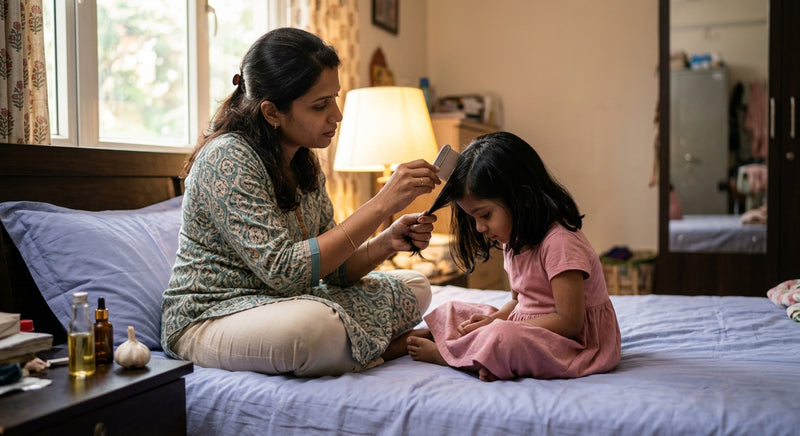
Nearly 11pm. The school picnic is Saturday. You're typing "kids sunscreen no white cast that doesn't sting eyes" into your phone with one thumb. Short answer: a good children's sunscreen has to do four things at the same time. Sink into brown skin in about a minute. Not sting when sweat runs down into the eyes. Hold its film through 40 to 80 minutes of water and sweat. And feel light enough that your child lets you put it back on at 2pm. The SPF number is the easy part. Those four are where most bottles fail.
I make these formulations for a living. So this is about what's happening inside the bottle, and what you can judge with your own hands at a chemist's counter in sixty seconds.
At a glance
- White cast is physics. A well-milled, well-coated zinc dispersion should still sheer out in 30–60 seconds of rubbing.
- Stinging almost never comes from the UV filter. Blame fragrance, the emulsifier system, or sweat carrying product into the eye.
- "Water resistant" is a tested claim with a number attached: 40 minutes or 80. Nothing may be sold as waterproof or sweatproof.
- In 38°C with a running child, treat two hours as the ceiling, not the target.
- Texture decides everything. A sunscreen that takes three minutes to rub in will never get reapplied.
Age to start, which SPF, how the routine shifts with the season — that's all in our complete guide to sun care for Indian children. This piece is narrower and more technical. It's about the formula, and how it either survives a child's face or doesn't.
Four tests that predict whether it gets used
Parents are handed SPF numbers, star ratings and the word "natural". None of those tell you whether the sunscreen will still be on your child's cheeks at 3pm. Four questions do: can you get it on, will it be tolerated, will it survive sweat, and can you redo it in a hurry. A formula that wins three and loses one is the bottle sitting unused in the cupboard by June.
Why mineral sunscreen goes white
Zinc oxide protects by scattering and absorbing UV. It also scatters some visible light, which is why a zinc paste looks white on skin, and why a truly invisible mineral sunscreen at a meaningful SPF does not exist. Anyone promising you one is selling a very low SPF, or a chemical filter with mineral on the front label.
Four things sit in a formulator's hands. The first is grade and particle size: how finely the zinc is ground before it ever reaches the mixing vessel. Then the coating — usually silica, a silane, or a dimethicone type — which keeps the particles separate instead of letting them clump. Then dispersion, meaning how long and how hard that zinc is milled into the oil phase. And the oil phase itself matters more than people expect: light esters spread a thin, even film, while heavy butters drag, streak, and hold the whiteness on the surface.
Dispersion is the quiet failure. Badly dispersed zinc agglomerates into little clusters, and clusters do two bad things at once. They look chalky. They also leave microscopic gaps in the film, so the protection that lands on skin is patchier than the number on the pack. A sunscreen that looks streaky is usually telling you something true about how evenly it's covering.
So, my test at the counter. Rub it out on the back of your hand and count. A well-made mineral formula goes from opaque white to a faint sheen in 30 to 60 seconds, then settles further over the next five minutes. Still ghostly at ten minutes? That's the formula, not your technique, and no amount of rubbing will fix it on a wriggling six-year-old. If you want the detail on particle size and the whole non-nano argument, we've written that up separately in the Journal on what non-nano zinc oxide really means.
One more thing about spread
Sunscreen spreads badly over dry, flaky skin. The film breaks where the skin is rough, and your child feels it dragging. If their arms and legs are ashy by April, moisturising the night before does more for the morning application than any amount of technique. A barrier cream like our Hydra Healing Moisturizing Balm is a night thing, though. Not a layer under sunscreen at 7am.
Why it stings their eyes (it's almost never the SPF)
Zinc oxide doesn't sting. It's inert, it sits on the surface, and it has no business in the tear film. What stings is the vehicle carrying it.
In the order I'd suspect them: fragrance and essential oils first. Citrus and lavender oils turn up constantly in "natural" kids' sunscreens, and they are well-known eye irritants. Next, the emulsifier system. Emulsifiers are surfactants by nature, and a water-loving surfactant starts travelling the moment sweat runs down a forehead. Some organic filters carry a long-standing reputation for eye discomfort. And alcohol, used at a high level to make a formula feel light and dry fast, also makes it mobile.
Which makes the label reading simple. Fragrance-free. No citrus or lavender oil. A proper cream rather than a thin runny milk, because a higher-viscosity emulsion physically stays where you put it. That's also why a good kids' sunscreen often feels slightly richer than the one you use yourself. Staying put is the whole point.
Three habits help tonight, whatever bottle is already in the house. Apply to a dry face, never a damp one. Stop at the brow ridge and let a cap handle the forehead. And teach your child to blot sweat with a dry cloth instead of wiping with a wet hand. The wet hand is what carries product into the eye.
| What you notice | What's usually causing it | What to look for instead |
|---|---|---|
| Chalky white film that won't budge | Poorly dispersed or uncoated zinc; heavy butters in the oil phase | Sheers out in under a minute; light ester base |
| Stinging eyes on a hot day | Fragrance, essential oils, mobile surfactants, alcohol | Fragrance-free, thicker cream texture |
| Gone after one swim | No film-former; no water-resistance testing behind the claim | A stated "water resistant (40 or 80 minutes)" |
| Child refuses reapplication | Tacky, slow-rubbing formula that traps heat | Fast rub-in, matte-ish finish, small decanted bottle |
Water resistance: 40 minutes, 80 minutes, and what sweat does differently
"Water resistant" is measured, not asserted. Subjects immerse in water for set periods and the SPF is re-measured afterwards, and only then may the label say water resistant (40 minutes) or very water resistant (80 minutes). Those are the only two durations. Waterproof and sweatproof are not claims anyone can legitimately make, and if a pack says either, I put it down.
A swim and a sweaty afternoon are different problems, and this is where Indian heat breaks things. Swimming is one big challenge to the film. Sweating is a continuous one: salt water pushing up through the film from underneath, hour after hour. Then there's the bigger issue, which is mechanical. A forearm across the forehead. A collar. A hand through the hair. A towel. Rubbing takes off far more sunscreen than water alone ever does. If your child has towel-dried, the sunscreen has gone. Reapply. No exceptions, whatever the minutes on the pack say.
And there's a trade-off nobody advertises. Water resistance comes from film-forming polymers and waxes that make the film cling, and those tend to feel heavier and tackier. Push it too far and you have a formula no child will tolerate in a Nagpur May. Getting that balance right — enough film strength to survive sweat, light enough to actually be worn — is the hardest judgement call in a kids' sunscreen. It's also why we develop and make our own formulations in our own GMP-certified facility instead of buying a stock base off a shelf.
Reapplying at 38°C
Two hours is the standard. In real Indian heat, with a child who won't sit still, treat two hours as the outer limit rather than the plan. After a swim. After a towel. After games period. Reapply, and don't check the clock first.
The school problem is real, and chemistry can't solve it. A 7:30am application does not cover a 2:45pm games period, and UV in most of India peaks between 10am and 4pm, which is precisely the school day. What helps is timing rather than heroics: apply at home, add a cap, and send a small decanted bottle if their school allows it. We've laid out a workable version in the Journal for sunscreen for school kids, and the wider buying decision — SPF, age, format — in choosing a kids' sunscreen in India.
One more thing on dose, because it quietly undoes everything above. SPF is measured in the lab at 2 mg per square centimetre, which is considerably more product than any of us apply in the five minutes before the school van arrives. Roughly two fingers' length of cream covers a face and neck. In practice most children get well under the tested dose, and that gap is a common reason a good sunscreen underperforms.
How I judge a sunscreen in sixty seconds
- Find the filter and its percentage. Zinc oxide should be named with a number beside it, not buried in a paragraph of marketing.
- Rub a pea-sized amount on the back of your hand and count. Under a minute to a faint sheen is good. Ten minutes of ghosting is not.
- Look for a stated water-resistance duration in minutes. No number, no claim.
- Scan for fragrance, perfume, parfum, and citrus or lavender oils. That's the eye-sting shortlist.
- Smell it. A strong scent on a kids' sunscreen was a decision someone made for the shelf, not for your child's eyes.
- Patch test on the inner forearm for two nights before a full-day outing, especially on eczema-prone skin.
Why kids' formulas are built differently
A baby's skin is 20–30% thinner than an adult's, and there is more of it relative to body weight. Both facts push the same way: less room for irritating extras. So the good children's formulas are conservative rather than technically clever — mineral filters, no fragrance, a short and deliberate ingredient list. That restraint is the design, not a corner cut.
If you want a mineral formula built around exactly these trade-offs, our Daily Defender Kids Mineral Sunscreen SPF 40 PA++++ is the one I'd hand a parent asking this question.
When to see a doctor
See your paediatrician if a sunburn blisters, if your child has fever or chills or seems unwell after sun exposure, if a rash after sunscreen spreads beyond where it was applied or involves swelling of the face or lips, or if any sun-exposed patch keeps flaring despite protection. A child under six months who has had significant sun exposure should be reviewed rather than managed at home. Nothing in this article is a diagnosis. It's what to look for in a bottle, not on your child's skin.
In summary
- Judge a kids' sunscreen on four things: rub-in time, eye comfort, a stated water-resistance duration, and whether reapplication is realistic.
- White cast comes from zinc scattering visible light — a well-dispersed formula should sheer out in 30 to 60 seconds, not stay chalky for ten minutes.
- Stinging is caused by fragrance, essential oils, alcohol or mobile emulsifiers, not by the mineral filter itself.
- Only "water resistant (40 minutes)" or "(80 minutes)" are tested claims — and any towel-drying means reapply immediately.
- Apply about two fingers' length for face and neck, decant a small bottle for school, and patch test any new product for two nights first.
Frequently asked questions
Does a higher SPF mean more white cast?
Usually yes, in a mineral sunscreen, because a higher SPF needs more zinc oxide and zinc is what scatters visible light. But formulation matters more than the number. A well-milled, well-coated SPF 40 can sheer out faster than a badly made SPF 30. Judge it on your own hand rather than on the SPF printed on the front.
Is stinging a sign my child is allergic to the sunscreen?
Not necessarily. Stinging that happens when sweat runs into the eyes is usually irritation from fragrance, essential oils or the emulsifier travelling with the sweat, not an allergy. A true reaction looks different: redness, itching or bumps on the skin where the product was applied. If that happens, stop the product and speak to your paediatrician.
Can I just use my own sunscreen on my child?
For an older child, occasionally, it's not dangerous. But adult formulas often carry fragrance, alcohol and organic filters chosen for a light feel on adult skin, and those are the three things most likely to sting a child's eyes on a hot day. A baby's skin is 20-30% thinner than an adult's, so a fragrance-free mineral formula is the safer default.
How can I tell if a sunscreen is genuinely water resistant?
Look for a stated duration on the pack: water resistant (40 minutes) or very water resistant (80 minutes). Those come from a defined immersion test. If a pack claims waterproof or sweatproof, or claims water resistance with no minutes attached, treat it as marketing. And reapply after any towel-drying, whatever the label says.
How long should a mineral sunscreen take to rub in?
About 30 to 60 seconds of normal rubbing to go from opaque white to a faint sheen, then it settles further over the next five minutes. If it is still clearly grey or ghostly after ten minutes, that is the formula, not your technique, and it will be a daily fight to apply on a child who does not want to sit still.
Do I really need to reapply every two hours in Indian heat?
Treat two hours as the ceiling rather than the plan. Sweat dilutes the film continuously and, more importantly, wiping with a hand, sleeve or towel physically removes it. After swimming, after a towel, or after a sweaty games period, reapply regardless of the clock. A small decanted bottle in the school bag makes this realistic.