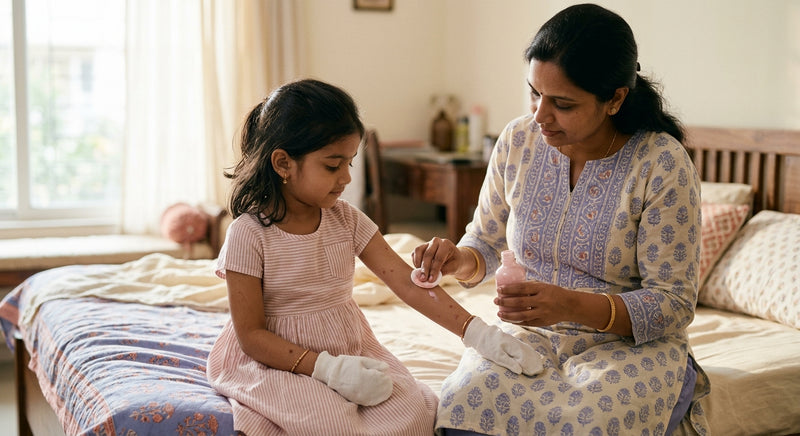
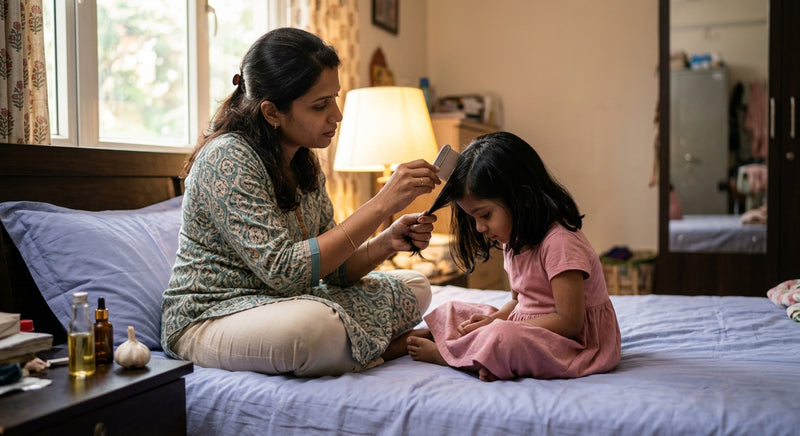
It's 1:20am. Your baby went down calmly at eight, and now there's that sound — the soft, frantic rasp of nails against a sheet, or fingers digging at an ankle. Babies itch more at night for three ordinary reasons. Skin temperature rises under a blanket. The body's natural anti-inflammatory cortisol dips to its lowest point around midnight. And there's nothing — no toy, no face, no light — competing for attention with the sensation. The itch was probably there all day. Night is just when your baby finally notices it.
Then the scratching makes it worse. That's the part most parents haven't been told, and it's the part that changes what you do at bedtime.
At a glance
- Night itch is mostly physiological — warmer skin, lower cortisol, no distraction — not a sign you did something wrong at bathtime.
- Scratching breaks the barrier, which releases more itch signals. That's the itch-scratch cycle, and it can run all night on its own.
- The highest-leverage fix is a thick, occlusive moisturiser applied to slightly damp skin about 15 minutes before the cot — not right at lights-out.
- Room temperature matters more than most parents expect. Aim cool, around 24-26°C with a fan, not a heavy quilt.
- If the scratching draws blood, the skin weeps or crusts yellow, or your baby can't settle for more than a few nights, see a paediatrician.
Why does my baby itch more at night than during the day?
Three things stack up after sundown.
Skin temperature rises. As your baby falls asleep, blood vessels near the skin surface dilate to shed core heat. That's part of how the body starts sleep. Warmer skin means faster nerve conduction and more histamine activity at the surface. Add a May night with the power out and the fan dead, or a December quilt in Nagpur that somebody's mother insisted on, and you've pushed that up by several degrees. Of everything on this page, room temperature is the thing you can change tonight for free.
Cortisol bottoms out. The body's own steroid runs on a daily rhythm, highest in the early morning and lowest around midnight, and cortisol suppresses inflammation. So the patch of eczema that was quietly annoying at 4pm has much less holding it down at 1am. Your baby's skin hasn't got worse overnight. The brakes have just eased off.
Water loss through the skin peaks overnight. Skin loses more water through the night than during the day. A baby's skin is 20-30% thinner than an adult's with a less mature barrier, so it loses that water faster, and by 2am it has been quietly leaking for six hours. Tight, dry skin itches.
Then there's the plain fact that nothing else is going on. Daytime is loud — people, feeds, light, being carried about. At night, the itch is the only thing in the room.
What actually is the itch-scratch cycle?
The loop runs like this.
- Something triggers itch — dryness, a bit of inflammation, sweat trapped in a neck fold, a wool blanket.
- Your baby scratches. Nails are sharp and uncoordinated. Babies don't scratch gently.
- Scratching physically damages the stratum corneum, the outermost brick-and-mortar layer of skin. Corneocytes are dislodged, lipids are disrupted.
- Damaged keratinocytes release inflammatory mediators and itch-signalling molecules. The nerve endings in that patch turn hypersensitive, and even a light touch starts registering as itch.
- So it itches more than before. Your baby scratches more.
Once it's running, it feeds itself. A baby can scratch one spot raw over a single night when the thing that started it was trivial. This is also why "just stop them scratching" fails on its own. Mittens block the hands. They don't lower the signal, and the signal is what's keeping everybody awake.
Formulation matters more here than it does at 10am. As a cosmetologist, what I'd want on a baby at 8pm is not a light, fast-absorbing lotion. Overnight you want occlusion — a film that slows water loss for hours — layered over humectants that hold water in the upper layers. A balm or thick butter beats a summery lotion for night itch, even though the lotion is nicer to apply. And a humectant on its own in a dry AC room can pull water up from deeper skin and let it evaporate. It needs something sitting on top of it.
What to look for in a night-time moisturiser
- A properly thick texture. Balm, butter or heavy cream — not a pump lotion that vanishes in ten seconds.
- Barrier-supporting lipids: ceramides, cholesterol, fatty acids, or plant butters like shea and kokum.
- Glycerin fairly high in the ingredient list is a good sign. Other humectants further down are fine.
- Fragrance-free, or close to it. On skin that's already inflamed, fragrance is one variable you don't need.
- Colloidal oatmeal or licorice-type soothing actives, which help comfort skin that already feels irritated.
- A tub or wide-mouth jar. You'll use more product out of a jar, and under-application is the most common mistake I see.
A thick balm like our Hydra Healing Moisturizing Balm is made for exactly this kind of night-time layer — it helps support the skin's natural barrier and comforts dry, sensitive skin. In lab study it increased Keratin-10 and Filaggrin expression, the proteins that build a competent barrier, and in-vivo testing showed visibly calmer skin in as little as one day.
What can I actually do tonight?
Start about 45 minutes before you want your baby asleep. The order matters more than the products.
- Lukewarm bath, 5-7 minutes maximum. Not hot. Hot water strips barrier lipids and leaves skin itchier an hour later, which catches out every parent who's been using a warm bath to settle a baby.
- Pat dry, don't rub. Leave the skin slightly damp. A towel rubbed briskly over dry skin does much the same thing as scratching.
- Moisturise within three minutes, while the skin is still damp. Use more than feels sensible — a visible layer that takes a minute to sink in. For a six-month-old, about a large grape's worth, head to toe.
- Wait 15 minutes before the cot. Let it set into a film. Put a freshly greased baby straight down and most of it ends up on the sheet.
- Cool the room first, not at bedtime. Fan or AC on 20 minutes early, so the room is already cool when you walk in with a sleepy baby.
- Cotton, loose, single layer. Skip the quilt. If you're worried about cold, one more thin cotton layer beats one thick warm one.
- Trim and file the nails after the bath, when they're soft. The filing is the part that counts. It's the sharp edge that opens skin, not the length.
- Cotton mittens or long sleeves with fold-over cuffs for babies who go for their own faces. That's a holding measure, not a fix.
Does the bath make it better or worse?
Both. It depends entirely on how you run it, and this is the question I'm asked most.
| Makes night itch worse | Makes night itch better |
|---|---|
| Hot water, 15+ minutes | Lukewarm, 5-7 minutes |
| Soap bar or high-pH cleanser | Mild, pH-appropriate, tear-free wash |
| Rubbing dry with a rough towel | Patting, skin left slightly damp |
| Moisturising 30 minutes later, thinly | Moisturising within 3 minutes, generously |
| Cleanser on every inch, every night | Cleanser only where it's needed — nappy area, folds, hands |
| Bath immediately before cot | Bath, then a 30-45 minute wind-down |
About that second-to-last row: a baby's whole body doesn't need lathering every night. Most of a baby isn't dirty. On an ordinary day, water handles the arms and back, and a gentle wash like our Head to Toe Baby Foam Wash takes care of the places that need it. Less surfactant on the skin means less barrier disruption going into the hours when the barrier is under the most strain.
How long before this settles?
If it's plain dryness, two to four nights of a proper occlusive routine usually shows something real — less rummaging, fewer wakings. If it's eczema-type skin, think in terms of two to three weeks of consistency, and expect waves rather than a straight line up. Up to around 48.6% of babies experience atopic-type skin issues, so if that's what you're dealing with you're in a very large group, and your paediatrician has well-established ways to manage flares.
What doesn't work is stopping when it improves. Barrier support is maintenance, not treatment. The skin needs it most on the weeks it looks fine. Every parent who tells me "it came back" also tells me, a sentence later, that they'd stopped moisturising.
When to see a doctor
Book a paediatrician if you see any of these:
- Scratching that draws blood, or open, raw patches that don't close over a few days.
- Yellow crusting, weeping, pus, warmth or a spreading red edge — signs of infection needing assessment.
- Your baby is waking repeatedly and cannot be settled for more than a few consecutive nights.
- Fever alongside the itching, or your baby seems unwell in themselves.
- Itching without any visible rash at all, which needs a proper look.
- You've done a consistent barrier routine for two weeks with no improvement.
Broken sleep from itching is reason enough to go. You don't have to wait until it looks dramatic — a paediatrician would far rather see it early.
If tonight is where you start, start with one thing: a thick layer of a barrier-supporting balm on damp skin, 15 minutes before the cot.
In summary
- Night itch spikes because skin warms, cortisol dips and water loss peaks — not because of anything you did wrong.
- Scratching damages the barrier and releases more itch signals, so the cycle sustains itself once it starts.
- Apply a thick, occlusive balm to slightly damp skin about 15 minutes before the cot, using more than feels necessary.
- Cool the room to around 24-26°C ahead of bedtime and use loose single-layer cotton instead of a quilt.
- See a paediatrician if scratching draws blood, skin weeps or crusts yellow, or your baby can't settle for several nights.
Frequently asked questions
Why does my baby scratch only at night and seem fine all day?
The itch is usually present during the day too — it's just drowned out by activity and stimulation. At night, skin temperature rises as your baby falls asleep, the body's natural anti-inflammatory cortisol falls to its daily low around midnight, and water loss through the skin peaks. Combine that with nothing else to focus on, and the same low-level itch becomes the loudest thing in the room.
How do I stop the itch-scratch cycle in a baby?
Work on both ends. Lower the itch signal with a thick, occlusive moisturiser on damp skin about 15 minutes before bed, a cool room around 24-26 degrees, and loose single-layer cotton. Then limit the damage from scratching with nails trimmed and filed smooth after the bath, and cotton mittens or fold-over sleeves. Mittens alone won't work — you need the moisturiser doing the real job.
Should I use a lotion or a balm for night-time itching?
A balm or thick butter, for night. Lotions have higher water content and absorb quickly, which feels pleasant but doesn't hold up over eight hours. Overnight you want occlusion — a film that slows water loss — layered over humectants like glycerin that hold water in the upper skin. A light lotion in a dry AC room can leave skin tighter by 2am than when you applied it.
Does a warm bath before bed help or make itching worse?
It depends entirely on how it's done. A short lukewarm bath of 5-7 minutes followed by generous moisturiser within three minutes helps. A long hot bath strips barrier lipids and leaves skin itchier an hour later. Keep water lukewarm, skip full-body lather most nights, pat rather than rub dry, and allow a 30-45 minute wind-down between bath and cot.
Can I give my baby something for the itching at night?
Not without a paediatrician's advice. Sedating antihistamines are sometimes prescribed briefly for severe cases, but they don't do much for the itch itself — they mostly cause drowsiness. Never give an adult formulation or an over-the-counter product to a baby on your own judgement. Skincare and environment changes are the safe first line, and they work better than most parents expect.
How long does it take for a night routine to reduce scratching?
For itching driven by simple dryness, most parents notice fewer wakings within two to four nights of a proper occlusive routine. For eczema-prone skin, expect two to three weeks of consistency, improving in waves rather than a straight line. The key mistake is stopping once skin looks good — barrier support is ongoing maintenance, and skin needs it most during the calm stretches.