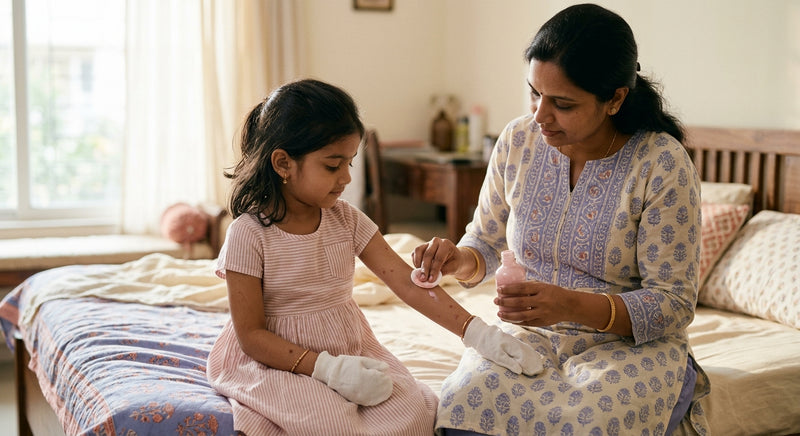
It usually gets noticed on a school morning — you're helping your child into a half-sleeve uniform and your palm catches on tiny rough bumps scattered across their upper arms, like goosebumps that never settle. The instinct almost every parent has next is the same: scrub them off. Please don't. Those bumps are little plugs of keratin sitting inside the mouths of hair follicles, below where any loofah, pumice stone or gritty ubtan can reach. Scrubbing never removes them — it only inflames the skin around each plug and leaves the patch redder and angrier than before.
I'm a cosmetologist, and chicken skin — the medical name is keratosis pilaris, KP for short — is one of the most over-treated things parents ask me about. Let me show you what's going on inside those follicles, and the routine that actually helps.
At a glance
- Chicken skin (keratosis pilaris) is extra keratin plugging hair follicles — the plug sits below the surface, where scrubs can't reach.
- Friction from loofahs, pumice or gritty ubtan inflames the skin around each plug, so bumps look redder and can darken.
- What works: short lukewarm baths, a soap-free cleanse with hands only, and moisturiser within 3 minutes of towelling off.
- Expect gradual smoothing over weeks of consistency, not days. KP is harmless and often fades as children grow.
What is chicken skin, really?
Keratin is the tough protein that makes up the outermost layer of your child's skin. In KP, the follicles on the upper arms, thighs and sometimes the cheeks make a little too much of it. Instead of shedding normally, the keratin packs into the follicle opening as a small hard plug, often trapping a fine hair underneath. Run your hand over the area and it feels like sandpaper — dozens of dry, skin-coloured or slightly red dots.
KP is genetic. It runs in families, and it travels with dry, sensitive, atopic-tendency skin — the same barrier-weak skin type that gets eczema patches in winter. It is not an infection, not a hygiene problem, and not contagious. Your child did nothing to get it, and you did nothing to cause it.
Could it be something else?
KP is rough and bumpy to the touch. If what you're seeing is flat, pale, slightly dry patches on the face rather than bumps, that's more likely pityriasis alba — we've explained those white patches on a child's face separately. Itchy, red, oozing or crusted patches point towards eczema instead. When you're not sure, a paediatrician can usually tell within a minute of looking.
Why doesn't scrubbing work on chicken skin?
Think of each bump as a cork sitting inside a bottle-neck. A scrub works on the flat surface around the bottle — it cannot pull out the cork. What the grit does abrade is the stratum corneum, the thin protective layer between the bumps, along with the barrier lipids that hold moisture in. So you trade a rough-but-calm patch for a rough-and-red one, and drier skin makes the follicles plug up even faster. It's a loop I see constantly: scrub, redden, dry out, worse KP, scrub harder.
On Indian skin tones there's another problem. Rubbed, inflamed skin often heals with post-inflammatory darkening. I've seen upper arms where the KP itself was mild, but months of daily loofah scrubbing had left the whole patch a shade darker than the surrounding skin — and that darkening takes far longer to fade than the bumps ever would. In many of our cities, hard water piles on top: mineral-heavy water already leaves a drying film on skin, and a scrub after that strips what little softness is left.
| The scrub instinct | What actually happens |
|---|---|
| Loofah or nylon scrubber every bath | Micro-scratches around each plug; bumps turn red and feel rougher |
| Gritty ubtan rubbed hard on the patches | Strips barrier oils; the keratin plug stays exactly where it was |
| Pumice stone, "just gently" | Far too abrasive for a child's skin; risks broken skin and dark marks |
| Picking or squeezing the bumps | Inflames the follicle; can leave tiny scars or darkened dots |
| Long, hot bucket baths to "soften" them | Hot water dissolves barrier lipids; skin dries out and KP looks worse |
What about ubtan and the loofah tradition?
I won't tell you ubtan is bad — a soft, finely milled besan ubtan used occasionally on normal skin is a lovely ritual. But on KP patches, anything gritty is friction, and friction is exactly what these follicles can't handle. The other half of the traditional routine, though — malish, the oil massage — is much closer to the right idea, because emollients are half of what actually softens KP. Keep the oil, skip the grit.
The soften-don't-scrub routine (start tonight)
The entire strategy is two lines: hydrate the plug so it loosens and sheds on its own, and stop attacking the skin around it. Here's the routine I give parents, in order:
- Keep the bath short and lukewarm. Under 10 minutes, water comfortably warm on your inner wrist — never steaming. Heat feels nice but it strips the very lipids you're trying to protect.
- Cleanse with hands only. Retire the loofah for good. Use a soap-free, pH-balanced cleanser and your palms — for a school-age child, something like our Kids Gentle Body Cleanser, which cleans without scouring the barrier.
- Pat dry, don't rub. Leave the skin very slightly damp — that dampness is about to do useful work.
- Moisturise within 3 minutes. Applying moisturiser onto damp skin traps water against the keratin plugs, softening them the way soaking softens dal. This one step does more than any scrub ever will.
- At night, layer something thicker on the roughest patches. A balm or butter-texture moisturiser over the bumpy areas seals moisture in for the whole night — the longest uninterrupted softening window your child gets.
- Dress the area in soft cotton. Tight synthetic sleeves rub the bumps all day, which is just slow-motion scrubbing. Loose cotton lets the skin be.
- Repeat twice a day. A quick morning pass of lotion after the bath, the fuller balm layer at night. Consistency is the active ingredient here.
- Take a phone photo once a week. Same arm, same light, every Sunday. KP improves too slowly to see day to day, and the photos will stop you from giving up in week two.
Which ingredients actually soften keratin plugs?
As a formulator, I look for four things on a label for KP-prone skin.
Humectants — glycerin above all. They draw water into the stratum corneum and into the plug itself. A softened plug releases its grip on the follicle and sheds with normal skin turnover; a dry plug just sits there.
Emollients and occlusives — shea butter, kokum butter, oat lipids, plant oils. Emollients smooth the rough edges you can feel; occlusives sit on top and stop the water the humectants pulled in from evaporating. This is why a thicker balm at night outperforms a thin lotion alone.
Soothers — colloidal oatmeal is my favourite for KP that itches, because scratching is just scrubbing by another name.
Gentle keratolytics — only with a doctor. Urea and lactic acid really do dissolve excess keratin, and dermatologists prescribe them for stubborn KP in older children. But please don't borrow an adult 10% urea body lotion off the shelf — adult concentrations sting and irritate a child's skin. Ask the doctor first; concentrations and age matter.
Barrier proteins matter too. KP travels with dry, barrier-weak skin, so a moisturiser should support the barrier, not just coat it. It's why, when we run lab studies on our balm formulation at Janma, we measure proteins like Keratin-10 and Filaggrin — in one such study the formulation increased their expression, which is what lets us say it helps support the skin barrier rather than just hoping so.
How long before the arms feel smoother?
Honestly — weeks, not days. With twice-daily moisturising and zero friction, most parents feel a difference in texture over several weeks, and the weekly photos usually show it before your fingertips do. Expect winter to be the hard season: dry air and long hours in heated or air-conditioned rooms dry the plugs back out, while humid monsoon months often make arms look their smoothest. And there's a comforting long game here — KP very often quietens on its own as children move through their teens. Your job isn't to defeat it; it's to keep the skin comfortable while it grows out.
When to see a doctor
And if the roughest patches need that thicker overnight layer, our Hydra Healing Moisturizing Balm — the same barrier-tested formulation from our lab study — is the one we'd reach for.
In summary
- Chicken skin is keratin plugging the hair follicles — scrubs can't reach the plug, so retire the loofah, pumice and gritty ubtan on those patches.
- Keep baths under 10 minutes and lukewarm, and cleanse the area with hands and a soap-free, pH-balanced wash only.
- Moisturise within 3 minutes of towelling off, twice a day, and layer a thicker balm on the roughest patches at night.
- Choose glycerin, shea or kokum butter and colloidal oatmeal; use urea or lactic acid only if a doctor prescribes a child-safe strength.
- Track progress with a weekly photo and give the routine several weeks — see a doctor if patches turn very itchy, red, crusted or painful.
Frequently asked questions
Does scrubbing remove chicken skin?
No. The bumps are keratin plugs sitting inside hair follicles, below the skin surface, so a loofah, pumice stone or gritty scrub can't reach them. Friction only inflames the skin around each plug, making the patch redder and rougher, and on Indian skin tones it can leave darkened marks that outlast the bumps themselves.
Will my child's chicken skin go away on its own?
Very often, yes — keratosis pilaris tends to quieten as children move through their teens. In the meantime it's harmless, so the goal is comfort, not cure: keep baths short and lukewarm, moisturise twice daily within three minutes of towelling off, and avoid all friction. Texture usually improves over weeks of consistency.
Can I use ubtan or a loofah on my child's chicken skin?
Skip both on the bumpy patches. Anything gritty or abrasive is friction, and friction inflames KP follicles. A soft, occasional ubtan is fine on normal skin, but not on rough patches. The traditional malish oil is actually the more helpful half of the ritual — emollients soften the plugs, grit doesn't remove them.
What should I apply on my child's chicken skin?
Moisturiser, generously and consistently. Look for humectants like glycerin to hydrate and soften the keratin plugs, emollients like shea or kokum butter to smooth the rough texture, and colloidal oatmeal if the area itches. Apply within three minutes of the bath while skin is damp, and layer something thicker on the roughest patches at night.
Is chicken skin contagious or caused by poor hygiene?
Neither. Keratosis pilaris is genetic — it runs in families and often accompanies dry, sensitive skin. It's simply extra keratin plugging the hair follicles. Your child can't pass it to anyone, can't catch it, and no amount of extra washing will change it; in fact over-washing dries the skin and makes the bumps more noticeable.
Can I use urea or lactic acid cream on my child for KP?
Only with a doctor's guidance. Urea and lactic acid do dissolve excess keratin, and dermatologists prescribe them for stubborn KP in older children — but adult off-the-shelf concentrations can sting and irritate a child's skin. Ask a paediatrician or dermatologist for the right strength and age-appropriate product before using any keratolytic.