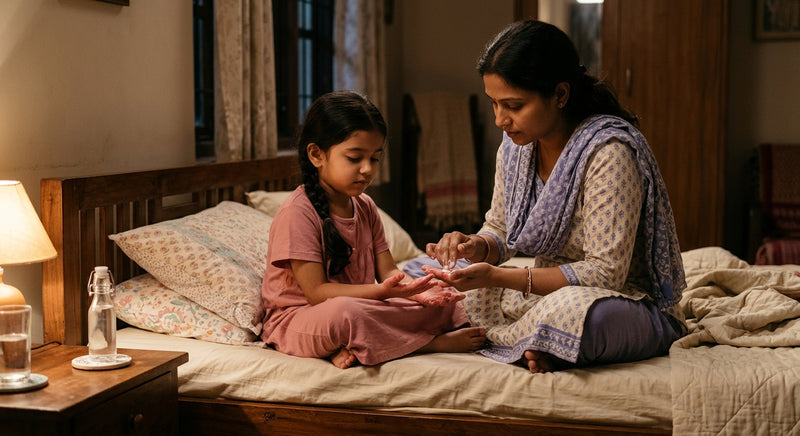
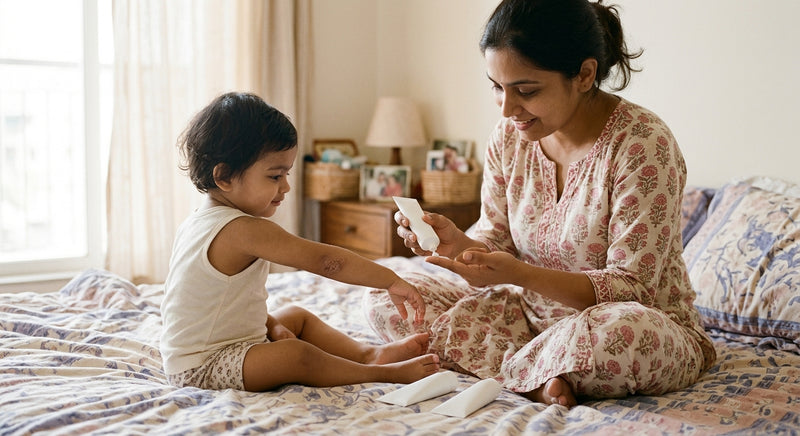
A grandmother presses a small steel katori of pale-yellow mulethi paste into your hands. "Lagao, rash theek ho jayega." You want to trust her — she raised four kids on remedies like this. You also want to know what's in that paste, and whether it belongs on skin that's three weeks old. Both things can be true.
Short answer: yashtimadhu (licorice root, also called mulethi) is one of the gentler, better-studied soothing herbs in Ayurveda — its actives can help calm the look of redness and irritation. But how you use it matters far more than the herb itself. A spoon of kitchen paste and a properly extracted licorice in a tested formula are not the same thing, and on a baby that gap is the whole point.
At a glance
- Yashtimadhu = mulethi = licorice root (Glycyrrhiza glabra) — prized in Ayurveda as a cooling, soothing skin herb.
- Its calming reputation traces to compounds like glycyrrhizin, glabridin and licochalcone — studied for settling visible irritation and uneven tone.
- Raw mulethi paste is cheap and traditional, but unstandardised. On newborn skin, purity, dose and contamination stop being trivia.
- A licorice extract built into a dermatologically tested baby formula behaves the same way every time — and that predictability is the safety.
- Patch test anything new. For weeping, blistering or spreading rashes, see a paediatrician — no herb treats those.
This sits inside our complete guide to Ayurvedic baby skincare and dosha, where we go ingredient by ingredient with the same honest lens.
What is yashtimadhu, and what does it actually do for skin?
Yashtimadhu is the root of the licorice plant. In Sanskrit the word means "sweet stick" — chew a piece and you'll understand instantly. Ayurveda describes it as madhura (sweet), cooling, and vata-pitta pacifying, which is the old language for "takes the heat out of irritated skin." If your little one runs warm and flushes at the cheeks, that's the pitta-leaning picture; we walk through constitution in our piece on matching a massage oil to a vata, pitta or kapha baby.
The science backs part of the tradition. Licorice root carries a handful of well-known actives:
- Glycyrrhizin — studied for anti-irritant, soothing behaviour on inflamed skin.
- Glabridin and licochalcone A — looked at for the look of redness and uneven tone.
- Flavonoids, plus a little natural antioxidant activity.
Read those verbs closely, because the limit lives in them. Licorice can help skin look calmer and more even. It is not a cure for eczema, a fungal rash or an infection — and neither is any other herb. We hold that line, and we hold it for a reason: a baby's skin is built differently. It's 20-30% thinner than an adult's, so it absorbs more and reacts faster, with less margin for a mistake. Up to roughly 48.6% of babies meet some atopic-type skin trouble at one point or another. When the odds run like that, gentle and predictable wins over strong.
Raw mulethi paste vs a formulated licorice extract: which is right for a baby?
This is the choice most parents are quietly stuck on. You have, broadly, three roads. Here's how I weigh them — and I formulate baby products for a living, so I've had to make this call on jars that ship to thousands of homes.
| Option | What it is | Honest pros | Honest cons & our take |
|---|---|---|---|
| Raw mulethi powder paste (DIY) | Mulethi powder mixed with water, milk, honey or ghee, applied at home | Cheap, traditional, easy to find; the herb itself is gentle | Strength varies packet to packet, no purity control, and loose powder sold by weight at the kirana can carry heavy metals or microbes. Messy, no preservative. Honey is a hard no on under-1s. Too many unknowns to put on a newborn. |
| Licorice extract in a tested baby formula | A measured, purified extract built into a moisturiser or wash and safety-tested | Consistent dose, controlled purity, pH-balanced, preserved safely, patch-test data behind it | Costs more than a spoon of powder, and you're trusting the brand's testing — so pick one that actually owns and tests its own formulas. |
| Skip the herb, use plain barrier care | A simple fragrance-light moisturiser, no botanical at all | Lowest risk, fewest variables, works for most everyday dryness | You miss licorice's soothing edge — but for routine dryness, this is usually all a baby needs anyway. |
You'll see the same pattern with almost every Ayurvedic skin herb. We laid it out for manjishtha on baby skin too: the herb has real merit, but the kitchen version keeps the risks the formulated version was designed to strip out. And the contamination worry isn't theatre — unbranded herbal powder, scooped and weighed, has no batch test standing behind it. That's the exact gap we flagged with traditional ghee for baby skin.
So what would we actually do?
No fence-sitting. Here's my real verdict.
For everyday dryness: skip licorice entirely. A clean, well-built barrier moisturiser handles it.
For skin that's looking red, warm or reactive — the pitta picture — a licorice extract inside a tested formula is where its soothing reputation earns its place, with none of the purity guesswork. That's the version I'd reach for on my own child without a second thought.
Raw mulethi paste from loose market powder, on a baby under one? I wouldn't. The herb is fine; it's the uncontrolled powder, the missing preservative and the honey-or-milk mix-ins that worry me. If an elder really insists, the most cautious version I'd allow is a thin paste of trusted, branded mulethi on a small patch of an older toddler — never broken skin, never the face, patch-tested first. On a newborn, no.
How to use a licorice-based product safely tonight
Whatever you've chosen, the routine doesn't change. Five steps.
- Patch test first. Dab a little on the inner forearm. Wait 24-48 hours. No redness or bumps? Carry on.
- Clean, don't scrub. A short, lukewarm bath with a tear-free, pH-considerate wash — then pat dry, never rub.
- Apply to slightly damp skin. Moisturiser holds better when it goes on within three minutes of patting dry.
- Go thin. An even, light layer. You're soothing and protecting, not painting on a coat.
- Watch for 24 hours. Any fresh redness, itch or irritation — stop and reassess.
For the soothing-and-barrier job in particular, I reach for a balm built for delicate, reactive skin — our Hydra Healing Moisturizing Balm is made for exactly this kind of dry, easily-irritated skin and is gentle enough for all ages. In our own in-vivo testing it helped skin look visibly calmer in as little as one day, and lab work showed it helps support the skin barrier (increased Keratin-10 and Filaggrin expression). That barrier support does more for a baby than any botanical name printed on the front of a jar.
When to see a doctor
Yashtimadhu, however gentle, is not a treatment for a skin condition. Call your paediatrician if you notice:
- A rash that is blistering, weeping, crusting yellow, or spreading quickly
- Skin that's hot, swollen or painful to touch, or any fever alongside the rash
- An itchy, oozing eczema flare that isn't settling with gentle care
- Any reaction right after a new product goes on — redness, hives or swelling
- A rash on a baby under three months, which always deserves a professional look
Trust your gut. With a baby, a quick call to the doctor is never an overreaction.
In summary
- Yashtimadhu (mulethi/licorice) is a genuinely soothing Ayurvedic herb, but how you use it matters more than the herb itself.
- Skip raw, loose mulethi paste on babies — purity, dose and contamination are unknowns; a tested licorice extract in a formula is the safer route.
- For everyday dryness, plain barrier care is often all a baby needs — no botanical required.
- Patch test any new product for 24-48 hours, and never apply licorice to broken, weeping or blistered skin or a newborn's face.
- See a paediatrician for spreading, blistering, weeping or feverish rashes — no herb treats a skin condition.
Frequently asked questions
Is yashtimadhu (mulethi) safe for baby skin?
Licorice root is one of the gentler Ayurvedic skin herbs, and its soothing reputation is reasonably well studied. The safety question is really about form. A standardised licorice extract inside a tested baby formula is predictable and safe for daily use. Loose, raw mulethi powder paste is unstandardised and can carry purity issues, so we'd avoid it on babies, especially newborns. Always patch test first.
Can I apply raw mulethi paste on my baby's rash?
We don't recommend it for babies, particularly under one year. Loose market powder has no purity or strength control and no preservative, and common mix-ins like honey aren't safe for under-1s. The herb itself is gentle, but the uncontrolled paste is the problem. For a true rash, see a paediatrician — no herb treats an infection or eczema flare.
What does licorice do for skin?
Licorice contains compounds like glycyrrhizin, glabridin and licochalcone that have been studied for calming the look of irritation and helping even out tone. On the skin it acts mainly as a soother and antioxidant. It can help skin look calmer and more even, but it does not cure eczema, fungal rashes or infections, and shouldn't be relied on as a treatment for any of those.
Is yashtimadhu good for a pitta-type baby?
In Ayurvedic terms yashtimadhu is cooling and pacifies vata and pitta, so it's traditionally matched to babies who run warm and flush or redden easily — the pitta-leaning picture. That fits its modern soothing profile too. It's a sensible choice for skin that looks reactive, ideally as a tested extract in a formula rather than a homemade paste.
How do I patch test a licorice product on my baby?
Apply a small amount to the inner forearm, then wait 24 to 48 hours without washing the spot hard. If there's no redness, bumps or itching, it's reasonable to use more widely. If anything appears, stop and rinse with plain water. Patch testing is worth doing for any new product on a baby, herbal or not, because their skin reacts faster than ours.