Every March, some version of this lands in my inbox: "The packet says herbal — can I let her play?"
Short version: usually, yes. A sealed, matte, food-grade dry gulal is fine on most children's skin for a few hours, as long as you oil them properly first and wash them gently after. The itchy, stained, three-day mess comes from the other stuff. Loose neon powder scooped out of an open sack. The silver and gold pastes. Wet pakka rang, which is engineered not to come off. What you buy on the way home decides how the rest of the week goes, far more than anything you do afterwards.
At a glance
- Sealed, matte, pastel dry gulal with an ingredient list on the packet is the safe buy. Loose ultra-bright powder from an open sack is not.
- Skip metallic silver and gold pastes, oil-based pakka rang, and aerosol colour sprays entirely for children.
- Oil hair and skin 15–20 minutes before play. That one step does most of the protective work.
- Wash once, kindly, with lukewarm water. Don't scrub a child clean on the same night.
- Patch-test any new colour on the inner forearm 24 hours ahead if your child has sensitive or eczema-prone skin.
This sits inside our complete guide to festival and seasonal skin care for Indian kids, where we take each season's actual problem in turn: Holi in March, ghamori in May, the fungal months of the monsoon, cracked heels in December.
Are Holi colours actually safe for children's skin?
Depends entirely on what is inside the packet. "Herbal" on a label is a marketing word, not a regulated promise. I've picked up packets in Itwari market here in Nagpur, labelled herbal and organic, that were a vivid electric pink. No plant makes that colour at that price.
Children aren't small adults at a Holi party, for two reasons. A baby's skin is 20–30% thinner than an adult's. A seven-year-old is much closer to you than to a newborn, true, but still carries more skin surface for their body weight and far less tolerance for being scrubbed. Then there is how they actually play: eight hours outdoors in the March sun, powder worked into the hair, wet clothes that stay wet, hands going to the mouth, colour rubbed into the face by an enthusiastic cousin who thinks that is rather the point.
Which is why the trouble is rarely one dramatic reaction. It's friction, then dryness, then sun, then a strong soap at bedtime. Four small insults stacked into one day. The children who pay for that are the ones with eczema-prone or already dry skin, and they usually pay 24 to 48 hours later, not on the night itself.
Which Holi colours should you buy — and which should you skip?
| Colour type | My honest verdict for kids |
|---|---|
| Sealed matte dry gulal, food-grade or plant-based, pastel shades | Buy. Sits on oiled skin, dusts off, rinses out. The default choice for 3+. |
| Home-made — haldi and besan, beetroot, dried palash or marigold, spinach | Best for under-5s. Cheap, no surprises, comes off in one wash. Haldi will stain pale clothes, so dress them in something you have already given up on. |
| Loose neon powder sold by the kilo from an open sack | Skip. No packet, no ingredient list, nobody accountable. The brightest ones stain the worst and take days to leave small fingers. |
| Silver, gold and glitter pastes | Skip. That shine is metallic or mica dust. It is abrasive, it clings to the hairline and eyelids, and getting it off means exactly the scrubbing you are trying to avoid. |
| Wet pakka rang, oil- or varnish-based colour | Skip completely. Built to survive several washes. On a child that means days of scrubbing, or a green ear until Sunday. |
| Water balloons and pichkari water | Conditional. Plain water, fine. Colour water follows the rules above. And hours in cold wet clothes leaves most kids chapped and shivering by evening. |
| Aerosol colour sprays and foam | Skip for young children. A spray aimed at face height goes into eyes and airways, and nobody at a Holi party is aiming carefully. |
One rule that surprises parents: buy the colours yourself, and send your child down with their own packet. Children share. The packet that comes across from the next building is the one you know nothing about.
What do I put on my child's skin and hair before Holi?
This is the part that decides how Holi night goes. Colour can't stain what it can't reach, and a film of oil is the cheapest barrier you will ever buy. Do it in the twenty minutes before they run downstairs. An oiling the night before, on its own, won't hold.
- Oil the hair properly — coconut or almond oil, parted section by section, right down to the scalp. Then plait it or tie it up. Loose hair collects powder like a mop. Our full pre-Holi oiling checklist walks through the amounts and the order.
- Sunscreen first on the face, neck, ears and arms. Ten minutes to settle, then oil on top. Six hours under the March sun is a real burn risk. And yes, the oil layer dilutes the SPF a little; I still think a well-applied mineral sunscreen with oil over it beats either one alone.
- A thick balm on the sticky spots: hairline, behind the ears, the fold of the neck, knuckles, nail folds, ankles. That is where colour parks itself and refuses to leave.
- Cut and file the nails short, then press a little balm under the free edge so powder can't pack in.
- Old full-sleeve cotton, top and bottom, plus a cap. Skin that stayed covered needs no scrubbing later.
- A swipe of balm on the lips and a water bottle in their hand. Dehydration ruins more Holi afternoons than colour does.
For that barrier layer you want something genuinely thick and occlusive, something that stays put through sweat. Not a light lotion that is gone in ten minutes. In our own range that is the Hydra Healing Moisturizing Balm, which comforts dry, sensitive skin and helps support the skin's natural barrier. Useful before the colour. More useful the night after.
Do this tonight if Holi is this week: take whichever packet you have bought, mix a pinch with a drop of water, dab it on the inside of your child's forearm, leave it a few hours. Red, itchy or bumpy the next morning? That packet doesn't leave the house.
The colour is on and it will not come off — now what?
Stop washing. If you take one line off this page, take that one. The damage I see after Holi almost never comes from the colour. It comes from a loving parent at 7pm with a loofah, a bucket of hot water and a bar of strong soap.
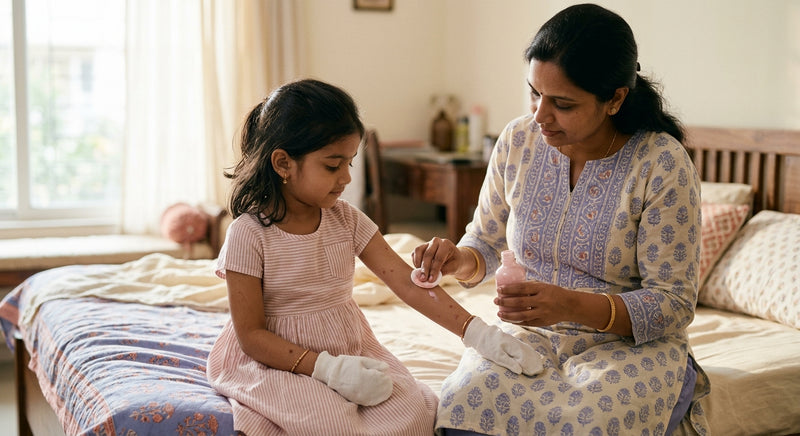
Dust the loose powder off dry first, with a soft cloth. Then one wash: lukewarm water, a mild soap-free cleanser, working from the top down. Two washes is the cap for the day. A besan-and-curd ubtan, left on for five minutes and rinsed, lifts stain far more kindly than friction ever will. Then moisturise generously while the skin is still damp — a thick, occlusive texture is the right one for this, the same kind you used in the morning.
One local thing worth knowing. If your building runs on borewell water, and much of Nagpur does by March, that same wash strips more than it would elsewhere; a final rinse of the face with stored or filtered water makes a visible difference. The rest of the method, including what to do about a stubbornly green ear, is in our guide to removing Holi colour from a child's skin without scrubbing.
A faint tint on the palms, knuckles and hairline for a day or two is normal. It fades. Let it.
When to see a doctor
Keep one thing ready on the shelf for Holi night: a mild, soap-free wash their skin already tolerates. Ours is the Kids Gentle Body Cleanser.
In summary
- Buy sealed, matte, pastel dry gulal with a readable ingredient list — or make it at home from haldi, beetroot or palash.
- Skip loose neon powder from open sacks, metallic silver and gold pastes, oil-based pakka rang and aerosol colour sprays.
- Oil hair and skin 15–20 minutes before play, over a mineral sunscreen, and put a thick balm on the hairline, knuckles and nail folds.
- Wash once with lukewarm water and a mild soap-free cleanser, cap it at two washes, and never scrub a stain off a child.
- Patch-test any new colour on the inner forearm 24 hours ahead, and see a paediatrician for blistering, facial swelling, breathing trouble or a rash still worsening at 48 hours.
Frequently asked questions
Are herbal Holi colours really safe for kids?
Only if the packet backs it up. "Herbal" is a marketing word, not a regulated standard, so judge the product instead: a sealed pack, a readable ingredient list, a manufacturer's name and address, a soft matte texture and a muted shade. Electric neon at a very low price is almost never plant-derived. Home-made haldi, beetroot or palash colour remains the safest choice for young children.
Can a toddler play Holi at all?
Under three, I would keep it to dry home-made colour on the cheeks and hands, ten minutes, indoors or on a balcony, and skip crowds entirely. No water balloons, no sprays, no shared packets. Oil them first, wash once with lukewarm water afterwards, moisturise, and call it a day. Toddlers rub their eyes and put fingers in their mouths constantly, which is the real problem — not the colour on their arm.
Does oiling before Holi actually work?
Yes, and it is the highest-value five minutes of the whole day. A film of coconut or almond oil sits between the pigment and the skin, so most dry gulal brushes and rinses off instead of gripping. Oil the hair to the scalp, plait it, then cover the face, ears, neck, hands and feet. Add a thicker balm at the hairline, knuckles and nail folds, where colour parks itself.
How long does Holi colour take to come off a child's skin?
Good dry gulal on oiled skin mostly leaves in the first wash, with a faint tint on the palms, knuckles and hairline for 24 to 48 hours. That residual stain fades on its own as the skin renews. Wet pakka rang and metallic pastes can hang on for several days. Resist the urge to scrub it away — you will strip the barrier long before you shift the pigment.
Can I put sunscreen and oil on together for Holi?
Yes. Apply a mineral sunscreen to the face, neck, ears and arms first, give it about ten minutes to settle, then add the oil layer on top. The oil does dilute the SPF slightly, but six hours of March sun outdoors is a real burn risk, and both layers together protect better than either one alone. Reapply the sunscreen at lunch if your child is still outside.
What should I wash my child with after Holi?
Lukewarm water and a mild, soap-free cleanser — one wash, working top to bottom, with your hands rather than a loofah. Cap it at two washes on the day. A besan-and-curd ubtan left on for five minutes lifts stain far more gently than friction. Moisturise generously while the skin is still damp, and expect a faint tint to remain for a day or two.