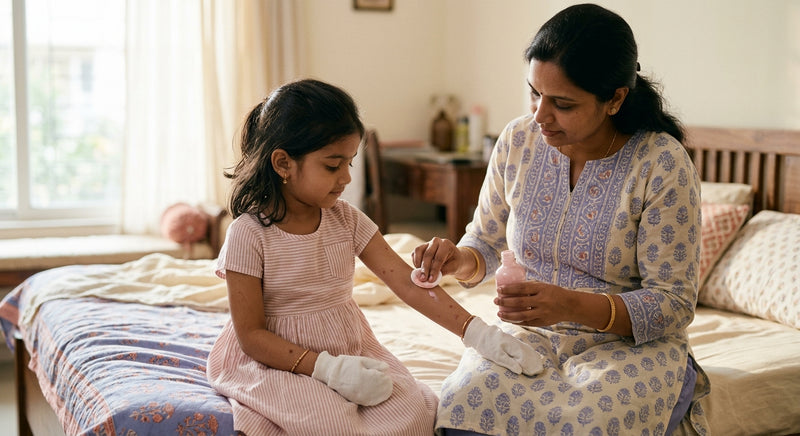
Turn a bottle of baby lotion over at your chemist, or scroll to the breadcrumb on its Amazon listing, and there it sits: Baby Cosmetics. The word lands badly. Lipstick, kajal, a compact — none of it anything a six-week-old has business wearing.
The short version: in India, “cosmetics” is a legal category, not a product type. Under the Drugs and Cosmetics Act, anything applied to the body for cleansing or for improving appearance is a cosmetic. So your baby's wash, lotion, balm, malish oil, powder and sunscreen are all, legally, baby cosmetics. The word tells you which rulebook the bottle answers to. It tells you nothing about whether the formula inside is gentle, herbal, synthetic or well made.
Worth sitting with, that. The fear attaches to the word on the shelf tag. The information you actually need is on the back of the pack, in about three lines nobody reads.
At a glance
- “Cosmetics” is a regulatory bucket. A baby wash and a lipstick share a rulebook, not a formula.
- India has no separate, stricter licence class for babies — “baby” on the front is a description, not a grade.
- The lines worth reading: Mfg. Lic. No., the manufacturer's full address, and the ingredient list.
- Ingredients above 1% are listed in descending order; everything below 1% can sit in any order — so a hero herb at the end may be a whisper.
- Any pack promising to cure, treat or lighten has stepped into drug language. Put it down.
“Cosmetics means makeup, and my baby doesn't need any”
True enough, if you mean colour cosmetics. Nobody needs to put makeup on an infant. And a category page that files baby lotion next to adult eyeliner is a shopping taxonomy, not a safety statement.
The legal definition is much wider than makeup. It covers articles meant to be rubbed, poured, sprinkled or sprayed on the body for cleansing or for appearance. A tear-free wash is a cosmetic. Coconut oil sold in a labelled bottle for massage is a cosmetic. A mineral sunscreen is a cosmetic. So is the plain moisturiser your paediatrician told you to use twice a day.
Being a cosmetic is good news, by the way. That classification is what pulls a product under manufacturing licensing, labelling requirements, restricted and prohibited ingredient lists, and Rule 36 of the Cosmetics Rules 2020, which forbids misleading claims. Loose oil decanted into a reused bottle at a shop counter sits under none of that. The bottle with “cosmetic” on its paperwork is the accountable one.
The word “baby” doesn't buy you a stricter rulebook
This is the part I most want parents to absorb, because it's where the money goes. In India there is no separate legal class of “baby cosmetic” with its own tougher licence. No rule forces a brand to test a baby product on babies. A baby lotion and an adult body lotion go through the same route, the same state authority, the same ingredient restrictions.
“Baby” on the front describes intended use. That's all it does. Everything past the legal minimum — testing on the actual age group, ophthalmologist-supervised eye-sting assessment, dermatological testing, a fragrance allergen review, stability through a 45°C Nagpur summer — is something the maker chooses and pays for. The category doesn't hand it to you.
So read the words around the claim. “Dermatologically tested” means a test was run. On whom? At what age? In-vivo means tested on human skin rather than in a dish or on a model. It's why we report ours the long way: visible improvement in the look of diaper-area redness in 7 days in an in-vivo study on a 12-month-old subject, applied twice daily. The age and the method are the interesting part. A number without them is decoration.
“Ayurvedic products aren't cosmetics”
They can be either, and the pack will tell you which. A herbal oil can be licensed on the Ayurveda side of the law as an Ayurvedic proprietary medicine, with a licence issued by the state AYUSH authority. Or it can be a cosmetic that contains Ayurvedic ingredients, licensed as a cosmetic. Both are legitimate. They're simply governed differently, and the claims each may carry differ.
Ten seconds at the shelf will tell you which one is in your hand. Find the licence line. Then look at how the ingredients are written.
| What the pack says | What it legally is | The line that proves it |
|---|---|---|
| Baby lotion, cream, balm, wash, sunscreen | A cosmetic, under the Cosmetics Rules 2020 | “Mfg. Lic. No.” plus the manufacturer's complete address |
| “Ayurvedic proprietary medicine”, classical oil names | Licensed on the Ayurveda side of the same Act | An AYUSH licence number, usually with a formulation reference |
| “With Ayurvedic herbs”, “Ayurvedic at heart” | Still a cosmetic | Botanical INCI names in the ingredient list (e.g. Glycyrrhiza glabra root extract) |
| “Cures”, “heals”, “treats eczema”, “makes skin fairer” | Drug language, or a claim India restricts outright | Nothing. This is your cue to put it back. |
What a cosmetic is actually allowed to do
Plenty. It just can't say it cures. That single line is the whole reason careful brands sound careful.
A cosmetic may support and protect. A well-built emollient reduces water loss from the skin, which matters a great deal for a baby whose skin is 20-30% thinner than yours and loses moisture faster. In our own lab work, the formula increased expression of Keratin-10 and Filaggrin, two proteins the skin uses to build its own barrier. That is measurable, and it is cosmetic-legal: it helps support the skin barrier. It is not a cure for anything. I'd be wary of anyone who told you a jar of cream was.
“Helps soothe.” “Comforts dry, sensitive skin.” “Helps visibly reduce the look of redness.” None of that is a brand hedging. It is the ceiling of what a cosmetic is permitted to claim, and able to deliver. A pack that vaults past it to “cures nappy rash” is telling you it either hasn't read the rules or doesn't mind breaking them.
What a formulator is actually deciding
Three things do most of the work in a baby product. You can read all three off the label.
- The surfactant system in a wash. Look for names like sodium cocoyl isethionate, decyl glucoside or coco-glucoside rather than harsher sulphates. Across most of India the tap water is hard, and traditional soap leaves a scum film on skin that reads as dryness by morning. A syndet or glucoside system rinses cleaner in hard water. Our Head to Toe Baby Foam Wash is built for exactly that combination: hard water, a slippery wet baby, and no time.
- pH. Baby skin sits mildly acidic. A wash near that range leaves the barrier alone. A high-pH soap raises it for hours.
- How heavy the moisturiser is. A lotion for humid August and a balm for a dry Delhi January are not the same job. We walk through that season by season in moisturising a newborn through summer, monsoon and winter.
How to read a baby cosmetic label tonight
Pick up whatever is sitting on your changing table right now. Two minutes.
- Find Mfg. Lic. No. No licence number means no factory you can trace.
- Read the manufacturer's full address — a real place, not a PO box.
- If the pack is 60 g/60 ml or larger, the complete ingredient list must be there. If it isn't, that's a labelling failure.
- Read the first five ingredients. That's the bulk of the formula; the rest is detail.
- Check where the hero herb sits. Last in the list, after the preservative, means a trace.
- Find the batch number and the “use before” date. Every preservative system has a working life.
- Look for “For external use only” and any caution line.
- Put back anything that promises to cure, heal, detoxify or lighten your baby's skin.
When to see a doctor
A label-reading habit is not a diagnosis. Call your paediatrician if your baby's skin is weeping, crusting, blistering or bleeding; if redness spreads or comes with fever or poor feeding; if a rash hasn't improved in three to four days of gentle care; or if your baby seems in pain when touched. Carry the actual bottles with you. The ingredient list is far more useful to a doctor than the brand name, and it's the fastest way to identify a reaction.
Most of what parents fear in the word “cosmetics” isn't in the word at all. It sits in the gap between what the front of a pack promises and what the back of it admits. Read the back.
For everyday dry patches and barrier support across the whole family, our Hydra Healing Moisturizing Balm is the jar I keep within arm's reach of the changing mat.
In summary
- “Cosmetics” in India is a legal category, so your baby's wash, lotion, oil and sunscreen all belong to it — the word says nothing about gentleness.
- There is no separate stricter licence class for babies, so treat “baby” as a description and judge the maker's actual testing instead.
- Check three lines on every pack: the Mfg. Lic. No., the manufacturer's full address, and the complete ingredient list.
- Remember that ingredients above 1% appear in descending order and everything below can sit in any order, so a hero herb listed last may be a trace.
- Put back any product promising to cure a condition or lighten your baby's skin — both cross lines a cosmetic is not allowed to cross.
Frequently asked questions
Is “baby cosmetics” the same as makeup for babies?
No. In India, “cosmetics” is a legal category covering anything applied to the body for cleansing or appearance, so baby washes, lotions, balms, massage oils, powders and sunscreens all sit inside it. Colour makeup is one small part of that category. Seeing a baby lotion listed under “baby cosmetics” on a website is a shelf label, not a sign the product contains makeup.
Are baby cosmetics regulated in India?
Yes. They fall under the Drugs and Cosmetics Act and the Cosmetics Rules 2020, which cover manufacturing licences, prohibited and restricted ingredients, labelling requirements and a ban on misleading claims. Manufacture for sale requires a licence from the state licensing authority, and the licence number must appear on the pack. An unlabelled oil sold loose sits outside all of that.
What must an Indian baby cosmetic label carry?
The product name, the manufacturer's name and complete address, the manufacturing licence number, net quantity, batch number, date of manufacture and a use-before or expiry date, directions for use, and any caution or warning. Packs of 60 g or 60 ml and above must carry the full ingredient list. Imported products also show an import registration number.
Is an Ayurvedic baby oil a cosmetic or a medicine?
It depends on how it is licensed, and the pack tells you. Some herbal oils are licensed as Ayurvedic proprietary medicines through the state AYUSH authority. Others are cosmetics that contain Ayurvedic ingredients, licensed under the Cosmetics Rules. Look for an AYUSH licence number versus a “Mfg. Lic. No.” — both routes are legitimate, but they permit different claims.
Can a baby cosmetic claim to cure nappy rash or eczema?
No. A cosmetic may say it helps soothe, comforts dry skin, or supports the skin's natural barrier. The moment a product claims to cure, treat or heal a named condition, it has made a drug claim, which a cosmetic licence does not cover. If a pack promises a cure, treat that as a reason to be sceptical of everything else it says.
Does “baby” on the label mean the product was tested on babies?
Not automatically. India has no separate baby licence class and no rule forcing paediatric testing, so “baby” describes intended use rather than a tested grade. Look for specifics instead: in-vivo testing means real human skin, and a trustworthy brand will state the age of the subjects and how the product was applied rather than just the word “tested”.