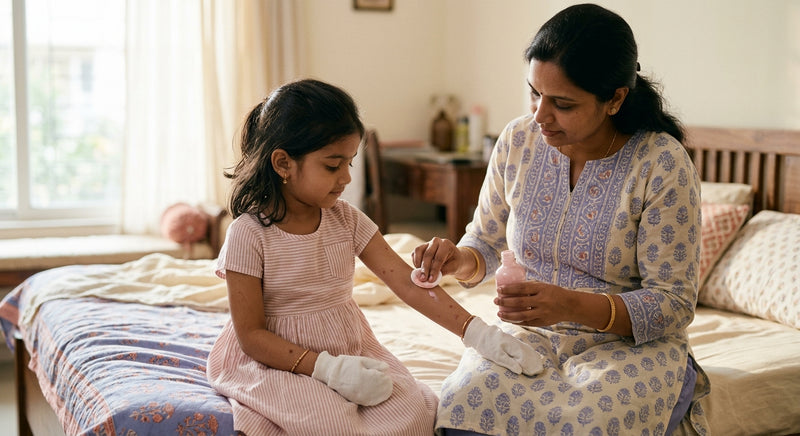
It's 2am and you hear it before you see it — a cheek going back and forth across the bedsheet, over and over, until the skin around the mouth is pink, shiny and sore. By morning there's a raw ring from lip to chin. And there you are, standing over the cot doing the maths: teeth, dryness, or something that needs a doctor?
Most night face-rubbing comes down to one of three things: saliva sitting on skin through a teething stretch, plain dryness from air conditioning, hard water and over-washing, or eczema-type skin that itches. You can usually sort out which one at home in about ten minutes. Wipe the face clean, pat it properly dry, then watch. If the rubbing settles, it was drool or dryness. If your baby keeps going at a clean, dry cheek, you're dealing with an itch, and an itch behaves nothing like a rash. This article sits inside our complete guide to sleep and skin, where we cover the rest of the night-time picture.
At a glance
- Drool irritation sits in a ring around the mouth, chin and neck folds — it appears after a drooly day and calms once the skin is dry and protected.
- Dryness is diffuse and flaky, spread across cheeks and forehead, worse in an air-conditioned room or a dry winter.
- Eczema itches. If your baby rubs a clean, dry, drool-free face, treat it as an itch problem, not a saliva problem.
- The single most useful bedtime step is a thin, occlusive layer on the drool zone before you lay them down — a barrier that saliva can't get through.
- Short nails, cotton sleepwear and a room that isn't too warm do more for night rubbing than any product does.
Why does my baby rub their face raw at night and not during the day?
Because after dark, three things stack up at once.
Daytime itch has competition. You pick them up, the fan turns, someone rattles a set of keys, and a small irritation never quite gets the floor. At night nothing else is happening, so it gets undivided attention. Skin also loses water faster at night, and the body's own cortisol rhythm dips in the evening, which is one reason itch feels worse once the lights are off. Then there's the bit parents almost never think of. At night there is finally something to rub against — a cot sheet, a firm mattress, your shoulder at 3am. A baby can't scratch with any precision, but they will cheerfully scrub a cheek across cotton until it's raw.
Put a teething stretch on top of that and saliva pools under the chin and into the neck fold for hours together. Saliva isn't just water. It carries digestive enzymes — amylase and lipase — that gently break down starch and fat, and across a long night that means the outer layer slowly softens while wet skin drags against fabric. Wet skin is weak skin; it abrades far more easily than dry skin does.
There's less margin to begin with, too. A baby's skin is around 20-30% thinner than an adult's, so it loses water faster and takes irritation harder.
How do I tell drool rash, dry skin and eczema apart?
Three things tell you most of it: where the trouble sits, how it feels under your fingertips, and whether the rubbing stops once the skin is clean and dry.
| What you're seeing | Most likely | What actually helps |
|---|---|---|
| Pink, chapped ring around the mouth and chin, sometimes into the neck fold. Worse after a drooly day. Baby settles once the face is dry. | Saliva irritation (teething drool) | Blot dry — never rub. A thin occlusive layer on the drool zone before every nap and at bedtime. |
| Fine flakes across cheeks and forehead, rough like fine sandpaper, little redness. Worse in an AC room or a dry winter. | Simple dryness | A richer moisturiser twice daily, a shorter and cooler bath, and no soap on the face. |
| Rough, red, sometimes weepy or scaly patches — usually on both cheeks. Baby rubs even when the face is clean and dry. Often a family history of asthma, allergic rhinitis or eczema. | Eczema-type (atopic) skin | Generous, frequent moisturising; short nails; a paediatrician's review for anything weepy, spreading or sleep-wrecking. |
| Face rubbing with ear-tugging or head-rolling, and no rash at all. | Tiredness, self-soothing — or ear discomfort | Check for fever. If ear-pulling persists over days, see your paediatrician. |
In practice, the first two often overlap: a drool-damaged mouth ring sitting on skin that was already dry from a cold bedroom and a full night of AC. Which is exactly why mopping up the drool on its own rarely settles it. The skin underneath still has to be rebuilt.
Which ingredients actually protect a raw, rubbed face?
This is the part I know properly, so I'll be specific.
Occlusives do the heavy lifting on drool. Petrolatum, dimethicone, shea and kokum butter sit on top and form a physical shield, so saliva rests on the product rather than on the cheek. A well-built anhydrous balm — no water in it at all — stays put through a whole night of face-rubbing in a way a light lotion simply cannot. That isn't a marketing line. The more water an emulsion carries, the harder its occlusives have to work to hold on once that water evaporates.
Humectants — glycerin, sodium hyaluronate — pull water into the outer layer, which is precisely what plain dryness is asking for. But a humectant on its own, on a face that's about to be soaked in saliva again in twenty minutes, isn't doing much. Humectant first, occlusive over it. Order matters.
Barrier lipids are what a dry or eczema-prone barrier is genuinely short of: ceramides, cholesterol, free fatty acids. They're slow, and you have to judge them over a fortnight rather than over one bad night, which is hard when you're exhausted and want something to work by Thursday. In our own lab work, a barrier-support formulation showed increased Keratin-10 and Filaggrin expression, two of the proteins skin uses to build and hold that outer layer together.
Soothing agents like colloidal oatmeal and licorice extract make angry skin look calmer, and at 2am that counts for something. They don't replace occlusion.
What I'd keep well away from a raw face: fragrance of any kind, essential oils (lavender included — it's a common sensitiser), anything with a tingle, and the entire DIY shelf. Besan, lemon, malai, toothpaste. Every one of them has a devoted following in somebody's family group, and none of them belong on skin that is already abraded. Saliva sits close to neutral while healthy skin is slightly acidic, so a drool-damaged mouth ring is the last place you want to give the pH another shove.
What should I actually do tonight?
- After the last feed, blot the chin, mouth ring and neck fold with a soft dry cloth. Press and lift, don't scrub — with a drool rash the wiping usually does more damage than the drool.
- Put a thin layer of a rich balm on the drool zone about ten minutes before you lay them down, so it has time to set instead of transferring straight onto the sheet.
- File the nails rather than cutting them, after a bath while they're soft. Check twice a week. This one change stops more damage than any cream.
- Cotton sleepwear only, and run the wash through a second rinse to clear detergent residue. Skip fabric softener altogether.
- Keep the room around 24-26°C with the AC vent pointed away from the cot. A shallow bowl of water left in the room takes the edge off very dry air.
- Swap the muslin or bib under the head the moment it's damp. A soaked cloth under a cheek all night is the whole problem in miniature.
- Keep the face out of the bath wash entirely. Plain water on the face, cleanser on the body — that's all a baby needs.
That last point matters more here than most people realise, because hard water does a lot of the quiet damage in Indian homes. It leaves mineral-surfactant residue on skin and nudges surface pH upward, which dry and eczema-prone skin really doesn't need, and if you're on borewell or tanker supply you already know how the bathroom taps look. A mild, well-buffered tear-free foam wash rinses more cleanly than a soap bar in that same water, and a short bath beats a long one. Then moisturise within two or three minutes of patting dry, while the skin is still slightly damp. That's the window where a moisturiser locks water in rather than just sitting on top.
If the rubbing turns out to be a genuine itch, physical barriers will do more than anything you apply. Scratch mittens, long-sleeved sleepsuits, sleeves that fold over the hands — we've covered what actually works for eczema sleepsuits, mittens and scratch sleeves, and honestly, the winner is whichever one your baby will put up with for six hours straight.
Could it just be that my baby is too warm?
Very often, yes. Heat is an easily missed cause of night rubbing in Indian homes, and it hides well. Sweat trapped in a neck fold irritates skin in exactly the places drool does, and a baby who is too warm fidgets, rolls, and scrubs their face against whatever is nearest.
Feel the back of the neck, not the hands. Babies run cool at the extremities, so hands tell you nothing at all. If the nape is damp or hot, you have your answer. Two things worth reading alongside this: whether baby night sweats are normal or a red flag, and choosing sleep sack TOG by Indian season, since most of the sleepwear sold here is rated for a European winter and behaves accordingly in a Mumbai May.
When to see a doctor
Book a paediatrician visit if any of these apply:
- The skin is broken, weeping, or has yellow-golden crusting — that can point to infection.
- The rash is spreading beyond the drool zone, or covers large parts of the body.
- Your baby is losing sleep night after night despite a consistent moisturising routine.
- There's fever, poor feeding, or your baby is unusually floppy or irritable.
- Nothing improves after two weeks of gentle, consistent care.
- You're not sure. A paediatrician will tell you in five minutes what you've been guessing at for a fortnight — and we'd always rather you asked. Nothing here is a diagnosis.
A word on teething, which gets blamed for a great deal. A drool rash is real and it is teething-related. But eczema that shows up at seven months isn't caused by teeth; the timing is coincidence, because seven months is also when a lot of babies' atopic skin declares itself. Reading an itch as a drool problem is how families end up spending months wiping and re-wiping a face that needed an entirely different plan.
For the nightly barrier layer on a drool-damaged mouth ring or dry, rubbed cheeks, our Hydra Healing Moisturizing Balm is the one I'd reach for — it's in-vivo tested, and shows visibly calmer skin in as little as 1 day.
In summary
- Wipe the face clean and dry, then watch for ten minutes — if the rubbing continues, treat it as an itch, not drool.
- Blot drool with a soft dry cloth after every feed; rubbing does more damage to wet skin than the saliva does.
- Apply a thin occlusive layer to the mouth ring, chin and neck fold about ten minutes before bed so it sets rather than transfers.
- File nails smooth after a bath, use cotton long sleeves, and keep the room around 24-26°C with the AC vent away from the cot.
- See a paediatrician for weeping skin, yellow crusting, spreading rash, fever, or no improvement after two weeks of consistent care.
Frequently asked questions
Is my baby rubbing their face because of teething?
Sometimes. Teething produces heavy drool, and saliva sitting on the chin and neck folds for hours softens and irritates skin, which makes a baby rub. But teething doesn't cause an itch. If your baby rubs a face that's clean, dry and drool-free, look for dryness or eczema instead. A useful check: wipe and dry the face, then watch for ten minutes.
How do I stop my baby scratching their face at night?
File the nails smooth after a bath rather than cutting them, and check twice weekly. Use long-sleeved cotton sleepwear or fold-over scratch sleeves, which most babies tolerate better than loose mittens. Apply a rich occlusive layer to dry or drool-affected areas about ten minutes before bed. Keep the room around 24-26°C — an overheated baby fidgets and rubs far more.
Can I put moisturiser on my baby's face every night?
Yes, and for dry or eczema-prone skin you should. Face skin is thinner and drier than body skin, and a nightly layer helps support the barrier. Choose fragrance-free, and apply within two to three minutes of patting dry after a bath. Avoid essential oils, tingling ingredients and any DIY pastes on skin that's already raw or broken.
What's the difference between drool rash and eczema on a baby's cheeks?
Drool irritation sits where saliva pools — a ring around the mouth, the chin, sometimes the neck fold — and settles once the skin is kept dry and protected. Eczema is usually on both cheeks, feels rough or scaly, can weep, and above all itches, so the rubbing continues even on clean dry skin. Family history of asthma or allergy makes eczema likelier.
Should I stop bathing my baby if their face is raw?
No — keep bathing, but change how. Short baths in comfortably warm water, a mild wash on the body only, and plain water on the face. Hard water plus soap leaves residue that dries skin further. Pat dry rather than rubbing, and moisturise within two to three minutes while the skin is still slightly damp.
Does drool rash go away on its own?
Usually, once the teething burst passes and the skin is kept dry and protected. Most cases settle within a week or two of consistent blotting and a nightly barrier layer. What doesn't settle on its own is eczema, or skin that's become infected. If there's weeping, yellow crusting, spreading redness or fever, see your paediatrician rather than waiting.