It's 2am, your baby has scratched their cheeks raw again, and you're on your phone deciding between a fifty-rupee pair of scratch mittens and a two-thousand-rupee "eczema sleepsuit." Let me save you the spiral: the single biggest thing that reduces night scratching is a well-moisturised, cool, calm skin barrier before bed — not the garment itself. Clothing helps by limiting the damage a scratch can do; it doesn't stop the itch. Get that one thing straight and the whole aisle sorts itself — what's worth buying, and what's just clever packaging.
At a glance
- Garments reduce skin damage from scratching — they don't reduce the itch. The itch is a barrier and inflammation problem.
- Scratch mittens genuinely help under-6-month babies who can't yet aim; they slip off and overheat older babies.
- Integrated-sleeve sleepsuits (fold-over cuffs) are the practical winner for most Indian homes — nothing to lose at 3am.
- "Silver-infused" and "anti-bacterial" fabric claims are mostly marketing for everyday home eczema.
- Plain, loose 100% cotton plus a good moisturiser beats almost any specialty fabric for the price.
I read ingredient lists and fabric claims for a living, and eczema garments are one of the most marketing-heavy corners of the baby aisle. So — mittens, sleeves, sleepsuits, the "technical" fabrics — here's the honest version, ending with exactly what to set up tonight. For the wider picture of how skin and sleep interact, this article sits inside our complete guide to sleep and skin.
Why does eczema itch worse at night anyway?
This isn't in your head, and it isn't the garment's fault. A few real things stack up after dark. Skin loses more water overnight — trans-epidermal water loss peaks in the evening and small hours, so an already-leaky eczema barrier dries out further. Body temperature rises slightly as your child falls asleep, and warmth is a direct itch trigger. Cortisol, the body's natural anti-inflammatory, dips at night. And there's nothing to pull their attention away — no toys, no faces to look at — so the itch gets the whole stage.
Then the itch-scratch cycle takes over: scratching feels relieving for a second, but it releases more inflammatory signals and damages the barrier further, which itches more. We've written about this loop in detail in why your baby scratches at night, and how to interrupt the worst flares in breaking the 3am eczema flare. The reason this matters here: every garment on this list works on the scratch, not the itch. None of them fix the cause. They're damage control — useful, but only alongside the real barrier care.
Scratch mittens: do they actually work?
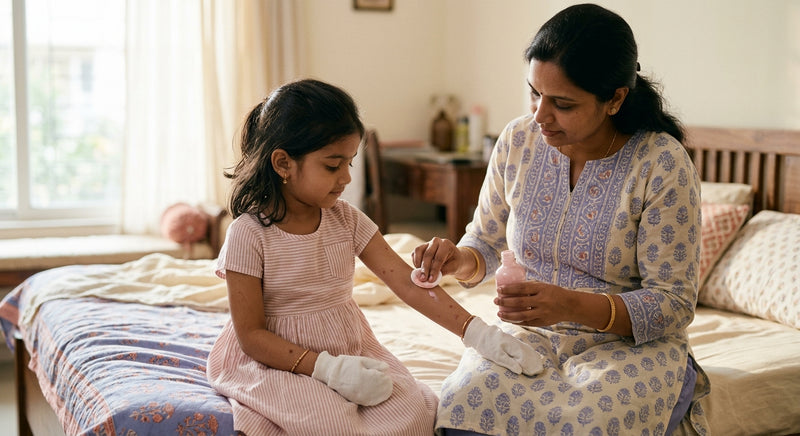
Yes — for the right age. In a newborn, or a baby under about five or six months, the hands are the whole problem: sharp little nails, an involuntary reach for the face, no coordination to do anything gentler. Soft cotton mittens genuinely stop those first-morning cheek gouges, and I'd recommend them in that window without hesitation.
The trouble starts around six months. Older babies pull mittens off within minutes, or learn to scratch through them, or rub their face against the mitten fabric instead. Worse, mittens trap heat at the hands and cut off the sensory feedback babies use to settle — and in a warm Indian bedroom, extra warmth is the last thing an itchy child needs. Ask any parent of a one-year-old how it goes: the mittens are under the cot by morning.
Eczema sleepsuits and scratch sleeves: what's the difference?
This is where the marketing gets loud. Three different things wear the same word, so let's take them one at a time.
Integrated-sleeve sleepsuits are ordinary-looking cotton sleepsuits with fold-over cuffs — mitten flaps built into the sleeve that you can flip over the hands or back. These are the quiet winner. Nothing to lose at 3am, no wrist constriction, and you can uncover the hands during the day. For most families, a couple of plain cotton fold-over-cuff sleepsuits do 90% of what the expensive "eczema suits" do.
Scratch sleeves are tube-like sleeves, sometimes with a mitten end, that cover the forearm — handy when the scratching target is arms and the crook of the elbow rather than the face. Useful in a specific case, less versatile overall.
"Therapeutic" or "wet-wrap" garments are a genuinely different, medical category. Wet wrapping — a damp layer under a dry layer over moisturiser — is a real technique for severe flares, but it should be started on a paediatrician's or dermatologist's advice, not bought off a website and improvised. Don't confuse a marketing "eczema suit" with a prescribed wet-wrap protocol.
| Option | Best for | Honest verdict |
|---|---|---|
| Cotton scratch mittens | Newborns to ~5-6 months | Worth it in the newborn window; slip off & overheat older babies |
| Fold-over-cuff sleepsuit | Most babies, face & hand scratching | The practical winner — nothing to lose at 3am |
| Scratch sleeves | Arm & elbow-crease scratching | Useful in that one case; less versatile |
| Wet-wrap / "therapeutic" suits | Severe flares, doctor-guided | A real technique — but start it with your paediatrician, not solo |
Silver, bamboo, "anti-bacterial" fabrics — is any of it real?
Here's where I'll be blunt, because fabric science is close to my work. The premium claims come down to three things.
Silver-infused / anti-microbial fabric. The theory is that reducing Staphylococcus aureus on the skin calms eczema, and there is some clinical interest in this for moderate-to-severe cases. But for everyday home use, the evidence that a silver garment beats plain cotton plus good moisturising is weak, the coatings wash out over time, and the price premium is steep. For most Indian families, I wouldn't spend on it first.
"Bamboo" and viscose. Marketed as ultra-soft and natural. In reality most "bamboo" fabric is viscose — heavily processed rayon. It can feel lovely and smooth, which matters for eczema, but it's not the pure natural fibre the label implies, and it holds less to the "breathable" promise than good cotton in humid weather.
"Seamless" and "tagless." This one is legitimately useful and cheap to get right. Seams and stiff labels rub eczema-prone skin and trigger scratching. You don't need a specialty brand for it — just turn a normal suit inside-out, or snip the tags.
So what's the fabric verdict?
Plain, loose, 100% cotton in a light weave. That's it. It's breathable in a warm bedroom, soft against thin baby skin, cheap enough to own several, and easy to wash hot to keep it clean. If you've read our note on cotton vs synthetic for eczema babies you'll recognise the theme — the fibre and the fit matter far more than any high-tech claim printed on the tag. Buy the fold-over-cuff version and you've covered the garment side completely.
What to actually do tonight
Garments are the last 10%. Here's the sequence that does the heavy lifting, in order:
- Cool the room first. Warmth is an itch trigger. Aim for a comfortable, slightly cool sleeping temperature — a fan or AC on low, and one light cotton layer rather than two warm ones.
- Moisturise generously after the evening bath, onto slightly damp skin, then again right before bed. This is the tap you're turning down. A thicker balm holds the barrier through the night better than a light lotion.
- Trim and file the nails after the bath when they're soft — short, smooth nails do less damage than any mitten.
- Dress in a loose cotton fold-over-cuff sleepsuit, seams and tags checked. Flip the cuffs over the hands if your baby targets their face.
- Add cotton mittens only if your baby is under ~6 months and can't yet keep them off.
- Keep bedding plain cotton too — a rough sheet undoes a soft suit.
On the moisturiser itself — since that's the part doing the real work — look for a thicker, occlusive balm that seals the barrier overnight, ideally one that supports the skin's own barrier repair rather than just sitting on top. Ingredients that lock in water (occlusives) matched with humectants and barrier lipids are what carry an eczema-prone child through to morning without the flare re-drying.
When to see a doctor
Garments and moisturising manage mild, itchy, eczema-prone skin. See your paediatrician or a dermatologist if: the skin is weeping, crusting yellow, or looks infected; the scratching is drawing blood or causing broken, painful skin night after night; your child can't sleep despite a cool room and consistent moisturising; the eczema is spreading fast or not settling within a week or two of good care; or you're being told to try wet-wrapping — that should be started under medical guidance, not improvised. Infected or severe eczema needs treatment, not a better sleepsuit.
If you're looking for the moisturiser that does the overnight barrier work described above, our Hydra Healing Moisturizing Balm is formulated to comfort dry, eczema-prone skin and help support the barrier through the night — apply it generously before the sleepsuit goes on.
In summary
- Eczema garments limit scratch damage but never stop the itch — barrier care and a cool room do that.
- Use cotton scratch mittens only for babies under about six months; they slip off and overheat older ones.
- A plain, loose cotton fold-over-cuff sleepsuit beats most expensive "eczema suits" for the money.
- Treat silver, bamboo and "anti-bacterial" fabric claims as marketing for everyday home eczema.
- Moisturise generously before bed, trim nails soft after the bath, and see a doctor if skin is broken, weeping or infected.
Frequently asked questions
Do scratch mittens actually stop eczema itching?
No — mittens don't stop the itch itself, which comes from a dry, inflamed skin barrier. What they do is limit the damage when a baby scratches. They work well for newborns up to about five or six months who can't control their hands, but older babies pull them off and can overheat. The itch is better addressed by cooling the room and moisturising well before bed.
Are expensive eczema sleepsuits worth it over plain cotton?
For most families, no. A plain, loose 100% cotton sleepsuit with fold-over cuffs does almost everything a premium "eczema suit" does at a fraction of the price. Silver-infused or anti-bacterial claims have weak everyday evidence and wash out over time. Spend on soft, breathable cotton and a good moisturiser instead, and check that seams and tags aren't rubbing the skin.
What is the difference between scratch mittens and scratch sleeves?
Scratch mittens cover just the hands and suit young babies who scratch their face. Scratch sleeves are tubes covering the forearm, useful when the child scratches arms or the inner elbow. Integrated-sleeve sleepsuits build the mitten into a fold-over cuff, so there's nothing to lose at 3am — that's usually the most practical choice for babies and toddlers.
Is silver-infused fabric better for baby eczema?
There's some clinical interest in anti-microbial fabric for moderate-to-severe eczema, since reducing bacteria on the skin can calm flares. But for everyday home use, the evidence that it beats plain cotton plus consistent moisturising is weak, the coating fades with washing, and the cost is high. It's not where I'd suggest spending first for a mild, itchy, eczema-prone baby.
How can I stop my baby scratching their face at night?
Layer your defences in order: cool the sleeping room, moisturise generously on slightly damp skin after the bath and again at bedtime, trim and file the nails when soft, then dress in a loose cotton fold-over-cuff sleepsuit. Mittens help only for under-six-month babies. If skin is broken, weeping or infected, or scratching draws blood nightly, see a paediatrician.