Six bottles on a kitchen counter, every one promising the same four things: mild, gentle, tear-free, no harsh chemicals. A mother in Nagpur sent me that photo and asked which one to buy. You cannot tell from the front of the pack. Nobody can. A baby shampoo is judged on the first five ingredients after water, on its pH, on the preservative it uses, and on who actually manufactured it — and all four of those sit on the back, in six-point type, somewhere near the barcode. The front is copywriting.
I have spent enough hours on our factory floor in Nagpur, arguing with a chemist about the grade of a raw material, to know which lines on that back panel are a real decision and which are a saving. Here is how to read one.
At a glance
- The cleansing system — the first few ingredients after Aqua — decides how mild a shampoo actually is. Glucosides and isethionates sit better on a baby's scalp than sodium lauryl sulphate.
- "Sulphate-free" sets a floor and nothing more. A badly balanced sulphate-free blend can still leave a scalp tight and flaky.
- "Tear-free" is a claim, not a certificate anyone issues. Ask what test sits behind it — and no, reputable baby shampoos do not numb the eye.
- Low foam still cleans. Mild surfactants lather less, and chasing the lather with three pumps is the commonest mistake I see.
- Hard water changes everything. If the lather collapses in your bathroom, look for a chelator on the list.
- Find the manufacturer's name and licence number on the back. "Marketed by" and "made by" are two different sentences.
What actually makes a baby shampoo mild — is it just "sulphate-free"?
A shampoo is its cleansing system. The surfactants — the molecules that lift oil and dirt off the scalp — are what your baby's skin actually meets. The aloe, the almond oil, the herbal extract photographed on the front: supporting cast, usually present in small quantities. So the first thing I read is the block of ingredients straight after Aqua or Water.
Ingredients are listed in descending order of quantity down to 1%. That is why the top of the list carries so much weight and the bottom tells you very little. If sodium lauryl sulphate sits at number two, no amount of chamomile at number nineteen changes what that shampoo does on your baby's head.
| What you see on the list | What it is | How it tends to behave on a baby's scalp |
|---|---|---|
| Sodium Lauryl Sulphate, Sodium Laureth Sulphate | High-foaming primary detergents | Efficient and inexpensive. Can leave a fine, dry scalp feeling tight and flaky, and more so in hard water |
| Coco-Glucoside, Decyl Glucoside, Lauryl Glucoside | Sugar-derived cleansers, made from coconut and corn | Gentle, low-to-moderate foam; the backbone of most genuinely mild baby shampoos |
| Sodium Cocoyl Isethionate, Sodium Methyl Cocoyl Taurate | Coconut-derived mild surfactants | Creamy lather, mild, and they hold up better in hard water than glucosides alone |
| Cocamidopropyl Betaine, Coco-Betaine | Secondary surfactants and foam boosters | Soften and thicken the blend; rarely the harsh part, occasionally a sensitiser in very reactive skin |
| Sodium Chloride, high on the list | Salt, used as a thickener | Harmless. But thickness is cheap to buy, and a thick shampoo is not automatically a rich one |
Then comes the judgement, because "sulphate-free" has turned into a badge rather than a decision. A glucoside blend can still dry a scalp out — over-concentrated, or pushed to a higher pH so it looks clearer on the shelf and foams better in the hand. Mildness is the whole system: which surfactants, how much of them, what pH they sit at, and what has been put back in to replace what the wash takes away. I have handled sulphate-free formulas that leave a scalp tight, and sulphate-free formulas that are beautifully gentle. The word on the front will not tell you which one is in your hand.
Is "tear-free" a real standard, or just a phrase?
Nobody issues a tear-free certificate. What the claim usually means is that the maker chose a low-irritation surfactant system and then ran an eye-tolerance or ophthalmologist-supervised test on the finished formula. Some brands have done exactly that. Others print the words because the category expects them. The phrase on its own is worth nothing; the test behind it is worth a great deal. Ask for it, or look for the specific wording on the pack.
Now the two things that come up in almost every conversation I have with parents.
No reputable baby shampoo contains a numbing agent. That rumour has been going round for years — usually as a forwarded message, occasionally from a very confident relative. Eye comfort in a well-made baby shampoo comes from the surfactant choice and the pH. An anaesthetic in a rinse-off product for infants would not be a legitimate cosmetic ingredient in the first place.
And tear-free means low-stinging rather than sting-proof. Get a decent amount of any shampoo directly into an eye and it will smart. What a mild formula buys you is that the splash of foam running down during a rinse does not cause a scene. If it does get in, tilt the head back, cup clean lukewarm water over the eye and let it flush. No rubbing. No rose water, no drops.
On pH: a scalp is happiest mildly acidic, in the same range as the rest of the skin. Baby shampoos are usually formulated slightly less acidic than a body wash, because one formula has to be kind to a scalp and to eyes, and those two want slightly different things. What you are looking for on a label is evidence that pH was a deliberate choice at all — "pH balanced" with a stated range, rather than silence.
How do I judge a bottle in 60 seconds, standing in the shop?
This is the routine I use myself. It works the same on a product page at midnight as it does in an aisle with a toddler pulling at your kurta.
- Turn the bottle over and read the five ingredients after Aqua. That is the shampoo. Glucosides or isethionates near the top is a good sign. SLS at number two is your answer.
- Find the preservative — phenoxyethanol, sodium benzoate, benzyl alcohol, a gluconolactone system. A water-based product with nothing preserving it is the bigger risk, by a distance.
- See where Parfum or Fragrance sits. Near the very end of the list, or absent altogether, is what you want in a wash for a young baby.
- Look for a test claim with a noun attached: dermatologically tested, ophthalmologist tested, in-vivo tested. "Doctor recommended" with no test named is just a sentence.
- Read the back panel for the manufacturer's name, address and manufacturing licence number. "Marketed by X, manufactured by Y" tells you the brand does not own the plant.
- Do the per-wash maths before the per-bottle maths. At 2-3 ml a wash, a 200 ml bottle is around 80 washes. The expensive bottle is often the cheaper wash.
- Put back anything promising thicker, longer or darker hair. The number of follicles on your baby's head was set before birth. No shampoo changes it.
Why does the same shampoo behave differently in my bathroom?
Because water is a formulation ingredient too, and yours is not the water the shampoo was tested in. Much of urban India runs hard — high in calcium and magnesium. Hard water fights lather, leaves a faint mineral film on the hair, and makes fine baby hair feel rough and dull however good the shampoo is. Look at the chalky ring on your tap head. That is the same chemistry, happening on your child's hair. If the lather was lovely at your mother's house over the holidays and is disappointing again in Delhi or Chennai, the water changed. The bottle did not.
Look for a chelator on the ingredient list: sodium phytate, sodium gluconate, tetrasodium glutamate diacetate, or EDTA. These bind the minerals so the surfactants can get on with their job. A shampoo built with one behaves far more consistently from a Chennai bathroom to a Nagpur one, and it is one of the least glamorous, most useful things a formulator can put in a bottle.
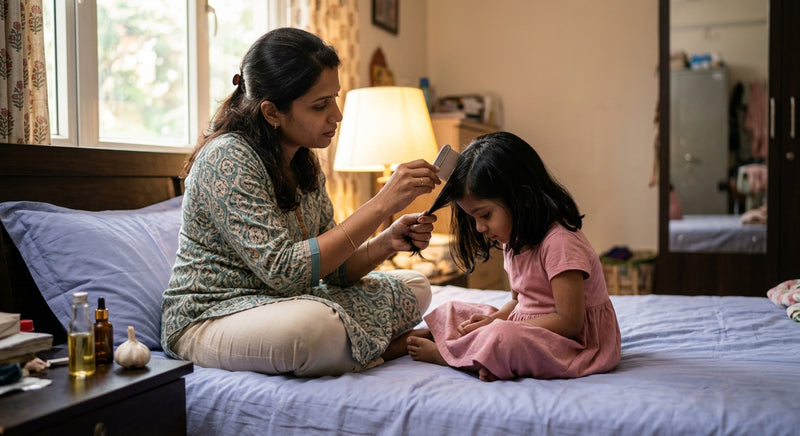
Malish oil is the other variable. A generous coconut or sesame oil massage before the bath is a good tradition, and it puts a real oil load on a mild shampoo. Do not switch to a harsher wash for it. Comb the oil through and out with a wide-tooth comb first, use properly warm water, and do two small washes instead of one big aggressive one — the second lathers easily, because the first has already lifted the bulk. And if your child is past two with hair long enough to knot after a wash, that is work for a conditioner rather than a stronger shampoo: a light, rinse-out detangling conditioner on the lengths only, never the scalp.
Is an expensive baby shampoo actually better?
Sometimes. Rarely for the reason the price tag implies. Money in a shampoo buys surfactant grade, a better preservative system, a chelator, real testing, and a formulator with room to say no to the cheapest raw material on the quote sheet. Often it buys a heavier bottle and a bigger ad budget.
The question most parents never think to ask is the one I would ask first. Does the brand own the formula? A large share of baby brands in this country buy a stock base from a third-party manufacturer, adjust the fragrance and the colour, and print their name on it. That is legal and it is common. It also means nobody at the brand can tell you why a particular surfactant was chosen, or change a grade when a batch of raw material arrives slightly off. We make Janma in our own GMP-certified facility. We own our formulations, which is the only reason I can write an article like this with any authority. It is BioCert Organic, FDA licensed for cosmetic manufacturing and BIS-compliant, and every formula is dermatologically tested before it leaves.
So, a working rule: an expensive shampoo with SLS high on the list is worse value than a modest one built on glucosides. Judge the formula first, then the price. There is a longer piece in the Janma Journal that walks an ingredient list line by line, if you want the detail.
When to see a doctor
A shampoo cleans. It does not treat. A scalp problem that is not settling needs a paediatrician rather than a new bottle. Book a visit if you see yellow crusting, weeping or pus on the scalp; bald patches with broken-off hairs or scaly rings; cradle cap that spreads onto the face, neck or body; redness and itching that has not calmed after two weeks of gentle, regular washing; or any sudden rash, swelling or hives after using a new product. Stop the product, note the name, and carry the bottle with you.
If you want a wash built the way this article describes — a mild, dermatologically tested formula made start to finish in our own GMP-certified facility — our Loving & Balancing Shampoo is the one I would hand you.
In summary
- Judge a baby shampoo on the five ingredients after Aqua — that block is the shampoo; the front of the pack is marketing.
- Treat "sulphate-free" as a starting point, not proof of mildness: the blend, the concentration and the pH decide how it behaves.
- Ask what test sits behind "tear-free" — it is a claim, not a certificate, and no genuine baby shampoo numbs the eye.
- If lather collapses in your bathroom, look for a chelator like sodium phytate or sodium gluconate on the list — that is hard water, not a bad batch.
- Read the back panel for the manufacturer name and licence number, then work out cost per wash at 2-3 ml before you compare bottle prices.
Frequently asked questions
Is sulphate-free always better for a baby's shampoo?
Not automatically. Sulphate-free tells you what was left out, not what went in. A poorly balanced sulphate-free blend, over-concentrated or at the wrong pH, can still leave a scalp tight and flaky. Read the whole cleansing block instead: glucosides or coconut-derived isethionates near the top, a chelator for hard water, and fragrance near the end of the list.
Can I just use baby body wash on my baby's hair?
For a newborn with very little hair, a good head-to-toe wash is genuinely enough, and that is what most paediatricians suggest for the first months. Once there is real hair to clean, especially with oil massage before baths, a dedicated shampoo rinses out more cleanly and leaves hair less limp. Both should share the same mildness standard.
Does tear-free mean the shampoo will never sting my baby's eyes?
No. It means the formula was built with low-irritation surfactants and, in a serious product, eye-tolerance tested, so an ordinary rinse-down of foam does not cause distress. A direct splash into the eye will still smart. And no reputable baby shampoo numbs the eye — that old rumour is not how mildness is achieved.
How do I choose a shampoo if I have hard water at home?
Look for a chelating ingredient on the list: sodium phytate, sodium gluconate, tetrasodium glutamate diacetate or EDTA. These bind the calcium and magnesium so the surfactants can lather and rinse properly. Coconut-derived isethionates also cope better in hard water than glucosides alone. Do not switch to a harsher shampoo to force lather — that treats the symptom badly.
What does the manufacturer name on the back of the bottle tell me?
A lot. "Marketed by X, manufactured by Y" means the brand does not run the plant and usually did not build the formula from scratch. A brand that names its own facility and licence number can explain why each raw material is there and can change a grade when needed. It is the single most useful line on the pack and nobody reads it.
How often should I shampoo my baby's hair?
For most Indian homes, two to three times a week is plenty, with a plain water rinse on other bath days. Daily shampooing is rarely needed unless there has been a heavy oil massage, a very sweaty day, or food in the hair. Use around 2-3 ml — a five-rupee-coin blob — and rinse thoroughly rather than washing repeatedly.