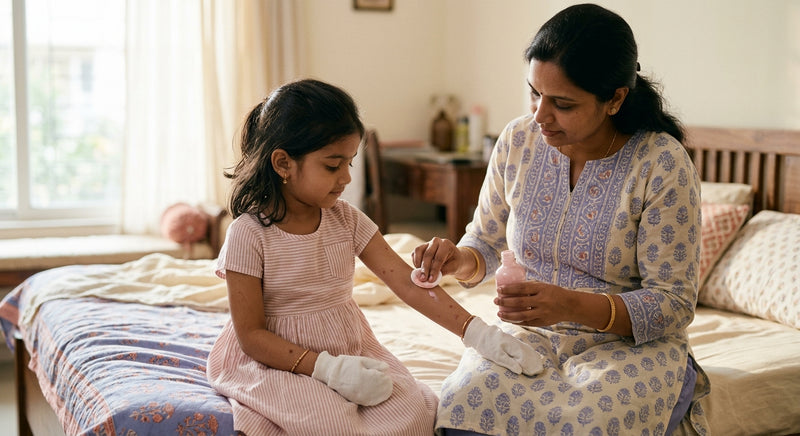
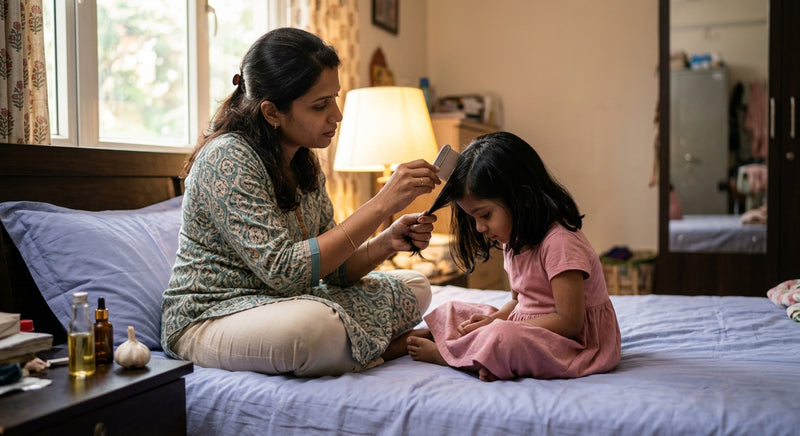
Two bottles on the bathroom shelf and the same question every week: can my eight-year-old just use mine, or can I use hers?
Yes. One genuinely gentle shampoo can serve most of a family, as long as it's built on mild surfactants, sits close to the scalp's own pH, and leaves out heavy fragrance and the known sensitising preservatives. What doesn't transfer is anything medicated. An adult anti-dandruff formula is not a children's product, and a children's shampoo won't do a medicated job. Everything else is one bottle, used a little differently by age.
At a glance
- Read the first three ingredients after water. That surfactant blend decides how gentle the wash actually is. The botanical on the front doesn't.
- Milder picks to look for: sodium cocoyl isethionate, decyl or coco-glucoside, sodium lauroyl sarcosinate, disodium cocoyl glutamate.
- A sensitive scalp does better mildly acidic, around pH 5, than alkaline. Soap-based reetha and shikakai washes sit much higher.
- Fragrance and isothiazolinone preservatives (MIT/CMIT) are the two triggers I see reported most often in rinse-off hair products.
- Kids 3+ and most adults can share one gentle base. Keep medicated shampoos separate, and never on a child unless a doctor has said so.
What makes a shampoo gentle on a sensitive scalp?
The surfactant system. Almost nothing else. The extract at the bottom of the list, the oil at 0.1%, the word "soothing" in the name: all of it matters far less than the two or three cleansing agents doing the actual work.
Sodium lauryl sulphate cleans brilliantly and costs almost nothing, which is why it turns up so often. It also lifts more of the scalp's own lipids than a reactive scalp can spare. Sodium laureth sulphate is a step milder. On a scalp that already itches, I'd rather build on a blend like this:
- Sodium cocoyl isethionate — creamy, low-strip lather. It's the reason a good syndet feels soft rather than squeaky.
- Decyl glucoside / coco-glucoside — sugar-derived and very mild, though low-foaming on their own.
- Sodium lauroyl sarcosinate or disodium cocoyl glutamate — amino-acid derived, and they work well slightly acidic.
- Sodium methyl cocoyl taurate — puts the bounce back into the foam without adding harshness.
Now the part parents don't expect. Cocamidopropyl betaine is the workhorse second surfactant in nearly every family shampoo on the market, ours included, and most people tolerate it perfectly well. It's also one of the more frequently reported contact allergens in rinse-off products. Usually the betaine itself isn't the culprit. Leftover amidoamine from the way it was made is. So it's a purity problem, and purity gets settled inside a factory, which is why who makes your shampoo, and to what standard, matters more than anything printed on the front of it.
Does pH matter in something you rinse off?
It does. Scalp skin sits around pH 4.5 to 5.5, and an alkaline wash swells the hair cuticle so it lies rough instead of flat. Rough cuticle tangles. Tangles get brushed at, brushing breaks fine hair, and on a child you'll watch that whole chain play out inside a week. A well-built family shampoo lands roughly pH 5 to 6. Ask a brand for the number. A formulator will have it, because it's checked on every batch.
Which brings me to reetha and shikakai, and I want to be fair here. As a weekend ritual with a conditioner afterwards, it's lovely, and I'd never talk a family out of it. As the daily wash for an itchy scalp it's a different proposition: soap-based reetha solutions run alkaline and leave hair rougher than most people realise.
Preservatives and fragrance: the two lines I read first
Picture the real conditions. A rinse-off bottle in a steamy bathroom, wet fingers going in and out of it, 32 degrees for eight months of the year. That's a microbiology problem, and an unpreserved "natural" shampoo isn't the safer choice it sounds like. What I avoid is methylisothiazolinone and methylchloroisothiazolinone. What works is a phenoxyethanol-based system, or sodium benzoate with potassium sorbate. That second pair only holds if the formula stays below about pH 5.5, because it loses its effectiveness as pH climbs. One constraint, and it quietly shapes half of a gentle shampoo's formulation.
Fragrance is the other line. "Parfum" can stand for dozens of raw materials, and the allergen-flagged ones sit separately at the end of the list: limonene, linalool, citronellol, geraniol. Essential-oil-perfumed formulas aren't automatically kinder either. Lavender and tea tree are among the more sensitising botanicals I work with. On a scalp that flares, less scent is simply less risk.
Can kids and adults really share one bottle?
For daily washing, mostly yes. And the bottle they share should be the mild one. A baby's skin is 20-30% thinner than an adult's, and a young child's scalp is still maturing, so the gentler formula is the only one both heads can comfortably take.
| A child's scalp (3+) | An adult's sensitive scalp | |
|---|---|---|
| Surfactant strength | Mild blend, low-strip | Same mild blend works daily |
| pH target | Around 5-6 | Around 5-6 |
| Fragrance | Minimal, no essential-oil load | Minimal — usually the trigger |
| Medicated actives | Only on a doctor's advice | Separate bottle, as advised |
| Wash frequency | 2-3x a week, more in summer | Alternate days to daily |
| Conditioner | Mid-lengths and ends only | Mid-lengths and ends only |
Where the sharing breaks down is on the adult side. Heavy silicone styling products, colour-treated lengths, a very oily scalp: any of those can defeat a glucoside-rich mild wash in one pass. You end up washing twice, which undoes the gentleness you paid for. We went into that trade-off properly in whether mums can use baby shampoo on adult hair, and the short version is that it's fine for most people, most weeks.
Whoever is using it, follow with a conditioner on the mid-lengths and ends and keep it off the scalp. That step, rather than another change of shampoo, is usually what helps with tangles and breakage — so look for a mild, rinse-clean formula the whole family can use, such as a detangling conditioner suited to both kids and adults.
Why does a "gentle" shampoo still leave the scalp itchy?
Four culprits. The shampoo is usually not the first one.
Hard water. Across much of Nagpur, Delhi, Hyderabad and Chennai, the calcium and magnesium in tap water bind with cleansers and leave a fine film on the scalp and hair. It dulls colour. It itches. And it makes mild formulas foam poorly, so people pour a second palmful, then a third. Look for a chelator on the label: tetrasodium glutamate diacetate or sodium phytate. They're in there to make the shampoo work in your water.
Chasing lather. Foam is a marketing signal. A coin-sized amount, emulsified in wet palms first, does the job.
Under-rinsing. This is the big one with kids. A child tips their head back under the mug for about fifteen seconds, declares themselves done, and the residue at the nape sits there all day. Give it a full minute. Check behind the ears.
The oiling double-wash trap. An overnight champi with a heavy oil often needs two washes to clear, which is two rounds of stripping. Oil for 45 to 60 minutes before the bath instead of overnight, use half of what you think you need, and one wash will do it.
- Wet hair thoroughly for 30 seconds before any shampoo touches it.
- Emulsify a coin-sized amount in your palms — never squeeze the bottle onto a dry scalp.
- Massage with the pads of your fingers, never nails. Scratching an itchy scalp is what keeps it itchy.
- Rinse for a full 60 seconds; check the nape and behind the ears.
- Conditioner on mid-lengths and ends only, then rinse again.
- Keep the water lukewarm. Hot water pulls out lipids faster than any surfactant.
- Detangle with a wide-tooth comb from the ends upward while damp, never dry and never from the roots.
How do I choose one, standing in the aisle?
Read in this order and it takes ninety seconds. Ingredients four through six, which are the surfactants. Then the preservative. Then whether fragrance is present and where the flagged allergens sit. Then the back panel: who manufactured it, and where.
That last one gets skipped, and it's the one I'd keep. A great many "sensitive scalp" shampoos are the standard base formula with the fragrance taken out and a pastel label added. That's a fragrance-free shampoo. It isn't a formulation designed for reactive skin. Different projects entirely. A brand that owns its formulation can tell you the batch pH, the surfactant ratio and why each preservative is in there. A brand buying a stock base usually can't.
Janma is made in our own GMP-certified facility in Nagpur. We own our formulations, and everything is dermatologically tested before it reaches a shelf, which is why those questions have answers here. A shampoo for a sensitive scalp is decided at the mixing tank, not in the copywriting.
When to see a doctor
Book an appointment with your paediatrician or a dermatologist if the scalp is raw, weeping, crusted or smells off; if there is a round patch of hair loss with broken stubble or scaling; if you spot live lice or nits; if the itching is disturbing sleep; or if flaking and redness haven't settled after three to four weeks of a gentle routine. Sudden hair loss with an itchy, inflamed scalp in an adult deserves a proper look too, rather than another bottle.
If you want one bottle the whole house can genuinely share, our Loving & Balancing Shampoo was formulated for exactly that: a mild surfactant blend, tear-free, and dermatologically tested.
In summary
- Judge a shampoo by its surfactant blend, pH and preservative system — not by the botanical on the front label.
- Aim for roughly pH 5-6 and keep fragrance minimal; those two choices prevent most sensitive-scalp reactions.
- Kids 3+ and most adults can share one mild bottle, but medicated shampoos stay separate and only on medical advice.
- Fix the routine before switching products: a coin-sized amount, lukewarm water, a full 60-second rinse, conditioner on ends only.
- If your water is hard, choose a formula with a chelator such as sodium phytate rather than using twice as much shampoo.
Frequently asked questions
Can adults use a kids shampoo every day?
Most adults can. A well-made kids shampoo uses a mild surfactant blend at roughly scalp pH, which suits a sensitive adult scalp daily. The limit is styling product: if you use silicone-heavy serums, waxes or dry shampoo, a mild formula may need two washes to clear them, which defeats the point. Colour-treated hair usually does fine.
Is sulfate-free always gentler on a sensitive scalp?
Not automatically. Sulfate-free tells you what was left out, not what was put in. Some sulfate-free formulas rely on strong secondary surfactants or heavy fragrance, and many foam poorly in hard water so people use double the amount. Judge the whole surfactant blend, the pH and the fragrance load instead of the one word on the front.
Does tear-free mean the same thing as gentle?
They overlap but are not identical. Tear-free describes eye comfort, achieved largely through surfactant choice and buffering. Gentle on a sensitive scalp is about lipid stripping, pH and irritant potential. A shampoo can be comfortable in the eyes and still be drying. Look for both: a mild surfactant system and a formula that has been dermatologically tested.
Which ingredients should I avoid for a reactive scalp?
I would skip methylisothiazolinone and methylchloroisothiazolinone, keep fragrance minimal and watch the allergen-flagged names at the end of the list — limonene, linalool, citronellol, geraniol. Strong sulfates are worth avoiding if the scalp already itches, and essential-oil-heavy formulas are not automatically safer; tea tree and lavender are among the more sensitising botanicals.
Can hard water stop a gentle shampoo from working?
Yes, and it is the most common reason a good shampoo seems to fail in India. Calcium and magnesium bind with cleansers and leave a film that dulls hair and itches, while cutting the lather so people use more product. Look for a chelator such as sodium phytate or tetrasodium glutamate diacetate on the ingredient list.
How often should a child with a sensitive scalp be washed?
Two to three washes a week suits most children, going up in hot or humid weather, after sport, or after an oil massage. Daily washing with a mild formula is not harmful, but it is rarely necessary before puberty. The rinse matters more than the frequency — a full sixty seconds, including the nape and behind the ears.