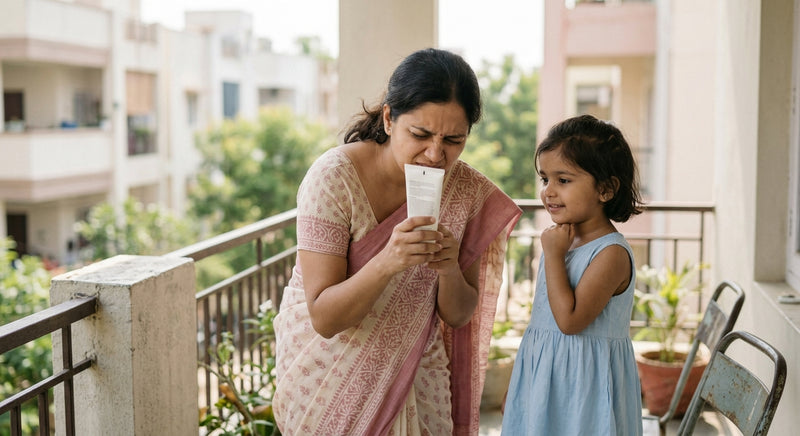
You're standing in the aisle with two tubes in your hands. One has a cartoon on it and says “fluoride-free, safe if swallowed”. The other says 1000 ppm in small grey letters on the back. Your two-year-old is in the trolley, chewing the shopping list.
Short answer first. Current paediatric dental guidance for this age points to a toothpaste with 1000–1500 ppm fluoride, used in a rice-grain smear, twice a day — with your child's dentist confirming what suits your child. Spit it out. No rinsing with water afterwards. Flavour, cartoon and price barely register next to that one number on the back of the tube. There is one thing that should make you pause, and it's drinking water that is naturally high in fluoride — common in parts of Rajasthan, Telangana, Andhra Pradesh, Gujarat, Haryana, Karnataka and Tamil Nadu. Take that one to your dentist. You can't settle it standing in an aisle.
At a glance
- Look for a fluoride level of 1000–1500 ppm printed on the back of the tube. No ppm printed anywhere? Put it back.
- At age two, the amount is a smear the size of a grain of rice. Not a ribbon across the brush head.
- You brush. Let your toddler have a go first, for two-year-old pride, then do it properly yourself.
- Spit, don't rinse. A tumbler of water washes off the fluoride that was doing the work.
- The night brush is the one that counts. Water only after it.
If you're starting from scratch — first tooth, first brush, first tantrum — begin with our complete guide to baby oral care and come back here for the toothpaste decision.
What should a 2-year-old's toothpaste actually contain?
Turn the tube over. Somewhere in the fine print there will be a fluoride figure, usually written as ppm (parts per million), sometimes as a percentage of sodium fluoride or sodium monofluorophosphate. That number is the whole point of the product. Paediatric dental bodies in India and internationally now advise a fluoride toothpaste from the first tooth, at 1000 ppm or above, with the amount scaled down for small children rather than the strength watered down.
Most parents I talk to find that last bit hard to believe, because for years the advice in India was to give the baby a mild fluoride-free paste and switch later. The thinking shifted for a simple reason. A very low-fluoride paste buys you no real protection and no real safety margin either, because the risk of white flecking — dental fluorosis — comes from the total fluoride a child swallows over months. What controls that is how much paste you put on the brush. Not how weak it is.
Is “fluoride-free, safe to swallow” a better choice at two?
For most Indian toddlers, no. A swallow-safe gel with no fluoride is a flavoured cleaning aid. It shifts plaque because you are brushing, and that counts for something, but it does nothing to make enamel more resistant to acid. Think about your own house for a second: night feeds, a biscuit at 4pm, sweets at every function and festival, a chalky white line already showing along the gum margin. That's the situation fluoride is for. We've written a fuller piece on how much fluoride is genuinely safe for Indian babies, including the water-quality question.
There are two real exceptions. Your dentist has told you your borewell or municipal supply is high in fluoride. Or there's visible mottling on the front teeth already. In either case a fluoride-free paste plus a proper dental plan makes sense — decided by a dentist who has actually looked inside your child's mouth, not worked out from a label.
How much toothpaste for a 2-year-old? Rice grain, not a ribbon
Every toothpaste advertisement shows a fat wave of paste running the length of the brush. Ignore it. That is photography. At two you want a smear you can barely see: press the tube gently and stop at a grain of rice, or rub a thin film into the bristles with your fingertip so nothing sits on top waiting to be sucked off.
| Age | How much paste | Who does the brushing |
|---|---|---|
| Before the first tooth | None — a clean damp cloth over the gums | You |
| First tooth to 2 years | Rice-grain smear, 1000+ ppm fluoride | You, child watching |
| 2 to 3 years | Rice-grain smear | Child has a go, you finish properly |
| 3 to 6 years | Pea-sized amount | Child brushes, you re-do the back teeth |
| 6 years and up | Pea-sized amount | Child brushes, you check nightly till 7–8 |
What to skip on a toddler toothpaste label
- No ppm printed anywhere. If the brand won't tell you the fluoride level, you can't dose it. Skip.
- Charcoal and “whitening” pastes. These are abrasive, they're aimed at adults, and nothing about a two-year-old's milk teeth needs whitening. They've become very easy to buy online, which is the only reason they're on this list.
- Strong mint. Not unsafe. Just a losing battle. A burning mouth turns a 90-second job into a nightly wrestling match.
- SLS, if your child gets recurrent mouth ulcers. Sodium lauryl sulphate is the foaming agent, and some children with aphthous ulcers do better without it. If ulcers have never been a problem in your house, don't go hunting for it.
- Sugar or honey in the paste. Rare, but read the ingredients on very cheap or imported novelty tubes.
Now the question parents ask me most: is an adult toothpaste at 1450 ppm acceptable for a two-year-old? Chemically, in a rice-grain smear, it's far closer to correct than a 0 ppm gel. In practice the mint means most toddlers clamp their mouths shut and you get through about half the mouth before it falls apart. So a mild kids' paste at 1000 ppm is the pick I'd make. You'll actually manage it twice a day, which is what decides the outcome.
The two-minute routine that works on a wriggling two-year-old
Do this tonight.
- Fix the time. Brush after the last milk or food of the evening. In most Indian homes that means after dinner, before the bedtime story, while the child is still upright and not yet melting down.
- Load the brush yourself. Rice-grain smear, soft bristles, small head. Keep the tube out of reach the rest of the day, because toddlers will eat it like a snack.
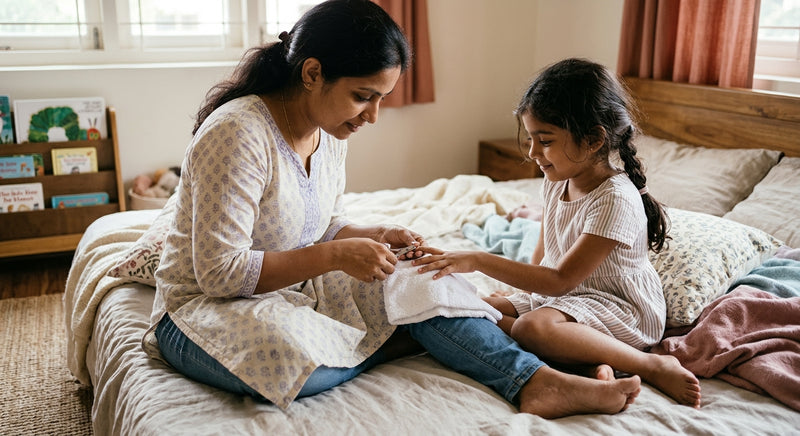
- Let them go first for 20 seconds. Standing at the basin with their own brush satisfies the “I do it” phase and buys you cooperation for the real brushing.
- Then you brush, from behind. Stand or sit behind your child with their head tilted back against your body. Or lay them across your lap, knee-to-knee with a partner. Either way you can see the teeth instead of guessing at them from the front.
- Two minutes, in a fixed order. Outsides of the top row, insides of the top row, then the same below, then the chewing surfaces of the back molars. Same route every night, so you stop skipping the same spots.
- Go slowly along the gum line. Small circles, light pressure. Decay in toddlers usually starts as a dull white line right where tooth meets gum on the upper front teeth, and that strip is exactly what most of us brush straight past.
- Spit, don't rinse. Ask them to spit into the basin. At two most children can't manage it, so just wipe the mouth with a cloth. Skip the tumbler of water.
- Nothing after that. No milk, no biscuit, no juice. Water only. If your child still takes a night bottle, this is the one change worth fighting for.
- Look, once a week. Under good light — the tubelight, not a phone torch — lift the upper lip and check the front teeth for white lines, brown spots, anything chalky. Thirty seconds. It catches problems while they're still small.
What if your water is already high in fluoride?
This is the genuinely India-specific part of the decision. Large pockets of the country sit on groundwater that is naturally high in fluoride, and children in those districts can take in a meaningful amount before any toothpaste is involved. If you're on a borewell, or fluorosis is a known problem where you live, get the water tested. Plenty of municipal labs and private labs do it cheaply. Take the number to your child's dentist and let them tell you whether to stay at 1000 ppm, drop lower, or change where your drinking water comes from. Please don't settle this one off a WhatsApp forward.
Which teeth are you even brushing at two?
By around age two most children have their first molars in and their canines through, with the second molars turning up somewhere between two and three. Those back molars have deep grooves, and they are the easiest teeth in the mouth to under-brush, because they sit right at the point where a toddler's patience runs out. Not sure what should have appeared by now? Our baby teething timeline maps out which teeth come in and when. On the nights you can sense a short fuse coming, do the back ones first.
When to see a dentist
Book an appointment — don't wait for the next check-up — if you notice any of these:
- A chalky white line, brown patch or hole on any tooth, especially the upper front teeth
- Bleeding, swollen or puffy gums
- Pain, night waking that seems mouth-related, or your child refusing to chew on one side
- A tooth that looks grey or darker than the others after a knock or a fall
- Persistent bad breath despite a clean mouth
- You're in a high-fluoride area, or you see white flecking on the teeth and want the amount reviewed
If your child hasn't seen a dentist yet at all, two is not too early. The recommendation is a first visit by the first birthday, or within six months of the first tooth. Early visits are short and friendly, and they're mostly for the parent — nobody is going anywhere near a drill.
Toothpaste is a small decision that pays off for the next two decades. Get the ppm right. Keep the smear rice-sized. Brush it in yourself and skip the rinse. After that it's just persistence at bedtime, which is the hard part anyway. For the full picture across teething, brushing and first dental visits, our baby oral care guide pulls it all together in one place.
In summary
- Choose a toothpaste that prints 1000–1500 ppm fluoride on the tube; if no ppm is stated anywhere, put it back.
- At age two use a rice-grain smear twice a day — the safety margin comes from the amount, not from a weaker paste.
- Let your toddler brush first for twenty seconds, then brush properly yourself from behind until age seven or eight.
- Spit, don't rinse, and allow nothing but water after the night brush.
- If you are on borewell water or in a known high-fluoride district, get the water tested and let your dentist set the plan.
Frequently asked questions
Can a 2-year-old use fluoride toothpaste in India?
Yes. Paediatric dental guidance now supports a fluoride toothpaste of 1000–1500 ppm from the first tooth, with the amount kept to a rice-grain smear under age three. The safety control is the quantity on the brush, not a weaker paste. The one exception is a child living where drinking water is naturally high in fluoride — get the water tested and let your dentist decide.
How much toothpaste should a 2-year-old use?
A smear roughly the size of a grain of rice, twice a day. That is far less than the ribbon shown on advertisements. Load the brush yourself rather than handing over the tube, and rub the smear down into the bristles so less of it sits on top where a toddler can suck it off. At three years, move up to a pea-sized amount.
Should I rinse my toddler's mouth with water after brushing?
No. Ask your child to spit out what they can and leave it at that. Rinsing with a tumbler of water washes away the thin film of fluoride that keeps working on the enamel after brushing. Most two-year-olds can't spit properly yet, so simply wipe the mouth with a clean cloth and avoid milk, juice or food afterwards.
Is fluoride-free toothpaste better for a 2-year-old?
Usually not. A fluoride-free gel cleans mechanically but does nothing to make enamel more resistant to acid, which is the main reason to use toothpaste at all. It makes sense only when a dentist advises it — for example, in a high-fluoride water area or when there is already visible mottling. Otherwise a 1000 ppm paste in a rice-grain smear is the sensible default.
Can my 2-year-old use my adult toothpaste?
In a rice-grain smear it isn't dangerous, and at around 1450 ppm the fluoride level is appropriate. The practical problem is the mint — strong flavour makes most toddlers clamp their mouths shut, and half a brushing session every night is worse than a mild kids' paste used properly. Pick a gentle 1000 ppm children's paste you can actually get into the back teeth.
When should a toddler start brushing their own teeth?
Let them hold the brush and have a go from around two — it builds the habit and satisfies the independence phase. But an adult should do the real brushing until roughly age seven or eight, when a child's hand control is good enough to clean the gum line and back molars. A simple system: they go first for twenty seconds, then you finish the job.