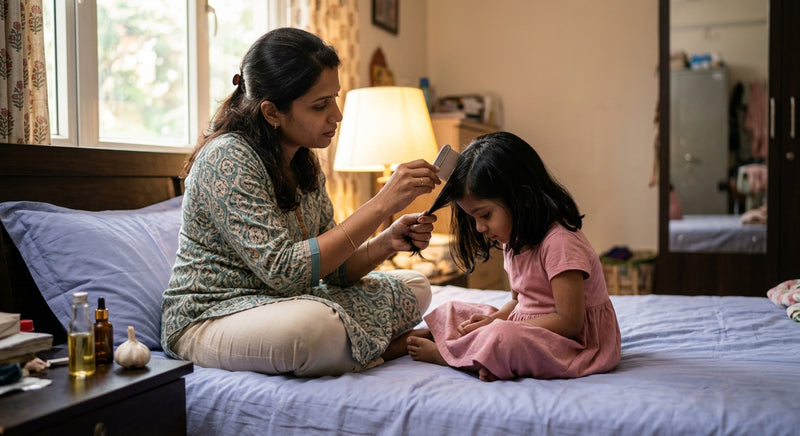
My mother-in-law arrived at our Nagpur flat with a 500ml bottle of sesame oil from a wooden-ghani mill near Itwari. Still cloudy. Still smelling of raw til. On the shelf beside it sat a branded baby oil somebody had gifted us at the godh bharai, seal unbroken. She asked me the question I now get almost every week: which one actually goes on the baby?
Neither category wins on its own. Cold-pressed oil is usually the better raw material. A well-made bottled oil is usually the better finished product. What settles it is how fresh the oil is, which oil you picked, and whether anyone ever tested it on skin instead of in a kadhai.
At a glance
- “Cold-pressed” tells you how the oil came out of the seed. It says nothing about how fresh it is by the time it reaches your baby.
- With loose mill oil, the thing that actually goes wrong is rancidity — and decanting into reused bottles. Not chemicals.
- With a branded bottle, the front label tells you very little — turn it around and read the INCI list, so you know whether you're buying a plant-oil base or a mineral-oil-and-fragrance one.
- Sesame, coconut, sunflower, mustard, almond — which oil you choose matters more than which shelf you bought it from.
- Food-grade certification says nothing about skin safety. Look for skin testing, batch dates and a sealed, opaque bottle.
The belief: “cold-pressed means pure, so it must be safer for a baby”
This one runs deep, and I understand why. You can stand there and watch the ghani turn. Nobody added anything. It feels traceable in a way a printed carton never does. Generations of Indian babies have had exactly this oil warmed in a steel katori and worked into their arms and legs, and most of them turned out fine.
The trouble starts at the jump from “nothing was added” to “nothing can go wrong.” Pressing is one step in a long chain. If you want technique, timing and what malish actually does, that's all in our complete guide to baby massage and malish. This piece is only about what's in the bottle.
What the tradition gets right
Cold-pressing — ghani or expeller, low heat, no solvent — does keep more of what makes a plant oil worth using. Refined, high-heat, solvent-extracted oils lose a chunk of their vitamin E and minor antioxidants. That matters for one very practical reason. Those antioxidants are what slow the oil going off.
Cold-pressed oil also tends to be a single, honest ingredient. No fragrance, no colour, no filler. If you're keeping fragrance off a newborn, that counts for a lot — and it's part of why plain cold-pressed coconut or sesame is still the everyday choice for malish in so many Indian homes.
So the tradition holds up. It just stops halfway.
Where it stops being true
Myth: fresh from the mill means it stays fresh
Cold-pressed oils oxidise. A warm kitchen, a clear bottle catching the afternoon sun, the lid off twice a day for four months — that is not the oil you bought in week one. Rancid oil smells faintly of old crayons, or wall paint. It's also more irritating to skin than fresh oil, which is the last thing you want on a body where skin is 20-30% thinner than an adult's.
Parents find this harder to accept than anything else I tell them. The 5-litre “saal bhar ka” can that saves money is usually the worst buy for a baby.
Myth: loose oil can't be adulterated
It absolutely can, and cheap loose oil sometimes is — cut with a lower-grade oil, or pressed from seed stock nobody inspected. A sealed bottle from a mill you know and trust is not the same thing as a bottle filled from an open drum at the corner shop. Reused plastic, no batch number, no name on it: if something goes wrong, you have nothing to go back to.
Myth: “edible grade” means safe for baby skin
Food certification asks one question — is this safe to eat. It doesn't ask whether it stings broken skin, clogs a follicle, or triggers contact dermatitis. Those are cosmetic questions and they need cosmetic testing. Plenty of perfectly good cooking oils have never been near a dermatologist.
Side by side, honestly
| What matters | Loose / cold-pressed mill oil | Bottled baby massage oil |
|---|---|---|
| Ingredient transparency | Excellent — usually one ingredient | All over the place; read the full INCI list, not the front |
| Rancidity risk | Higher — no antioxidants added, often large packs | Lower — stabilised, sealed, dated |
| Adulteration risk | Real if bought loose or unbranded | Low with a licensed manufacturer |
| Skin testing | Almost never | Should be dermatologically tested — check, don't assume |
| Batch traceability | Usually none | Batch number, mfg and expiry dates |
| Fragrance | None (natural smell only) | Often added — a common reason for reactions |
| Cost | Lower per ml | Higher, sometimes much higher |
| Best suited to | Parents who buy small, fresh and often | Parents who want a tested, consistent, no-thinking option |
The oil you pick matters more than the shelf you pick it from
This is the bit that gets lost in the whole cold-pressed argument. A rancid cold-pressed mustard oil is a worse choice for a two-week-old than a fresh, tested bottled coconut oil. And a fresh cold-pressed sunflower oil may beat both.
Sesame (til): the classic across North and West India. Warming, well tolerated by most babies. Good for winter malish.
Coconut: light, absorbs well, the default across South India — and what I reach for through a humid Nagpur summer.
Sunflower: underrated. In small hospital studies comparing oils on newborn skin, sunflower generally looked kinder to the barrier than olive oil. Cheap, neutral, easy to find fresh.
Mustard (sarson): traditional, and the one I'd go slow with. The evidence on undiluted mustard oil for newborn skin is not reassuring, so the cautious route is to keep it off very young, broken or eczema-prone skin. If your family insists, keep it for older babies and ask your paediatrician first. Never on inflamed skin.
Almond: a lovely oil, and more complicated than the marketing lets on. We've written the whole thing up — whether almond oil is actually good for babies and when to avoid it, including the nut-allergy question.
And if a red bottle of lal tail has landed in your house, our breakdown of what's really in lal tail and who it suits will save you a lot of guessing.
Buying cold-pressed oil for malish, done properly
If you're taking the mill route — and it's a perfectly good route — buy it like it's going on skin, not into the kadhai.
- Buy small. A 200-250ml bottle you finish in 6-8 weeks beats a 1-litre can still sitting there at Diwali.
- Sealed and dated, from a mill with a name on it. No drum decanting, no reused bottles.
- Dark glass or opaque packaging. Not the kitchen windowsill.
- Smell it before every single massage. Sharp, bitter or paint-like means throw it out — don't “use it up”.
- Pour into a small katori and warm that. Fingers never go back into the main bottle.
- Patch test on the inner forearm for 24 hours before the first full-body malish, and again with a new batch.
- Nothing on broken skin, an unhealed cord stump, or an active eczema flare.
Buying a branded oil without falling for the front label
Turn the bottle around. The front is marketing. The ingredient list is the product.
- Read the first three ingredients. Liquid paraffin or mineral oil plus fragrance means you're paying a plant-oil price for a petroleum base.
- Hunt for “parfum” or “fragrance”. For a newborn, fragrance-free is the safer default.
- Batch number, manufacturing date, expiry. No dates, no purchase.
- See who actually made it. A brand with its own licensed, GMP-certified facility owns its quality; a white-labelled brand is trusting a factory you'll never see.
- “Dermatologically tested” should be printed on the pack, not implied by a soft-focus photo of a baby.
- “Chemical-free” and “100% natural” carry no legal weight in India. Ignore them.
What we do at Janma — and what we don't
We don't make a baby massage oil. That's deliberate. Plain, fresh, single-ingredient oil from a source you trust does the job of malish honestly, and I'm not going to invent a reason for you to buy a branded version of it.
What we do make, in our own GMP-certified facility in Nagpur, is everything that happens around the massage — the wash that takes the oil off without stripping the skin, and the balm that goes on after. Those are the steps where formulation and testing earn their keep. A cleanser has to be built for a baby's pH. A moisturiser has to hold water in.
Your malish routine tonight
Order first. In most Indian homes the oil goes on before the bath, and there's a good reason for it — the logic is laid out in malish before or after bath. Then:
- Warm room. No fan or AC blowing straight at the baby. Phone in another room.
- Pour 1-2 tsp of fresh oil into a katori. Test the temperature on your inner wrist.
- Massage 10-15 minutes, slow, firm but light — legs, arms, chest, back, then the tummy in clockwise circles.
- Wait 10-15 minutes, then bathe with a mild, tear-free cleanser like our Head to Toe Baby Foam Wash. Hard water plus a harsh soap undoes everything the oil just did.
- Pat dry, don't rub. Moisturise within three minutes, while the skin is still slightly damp.
Whatever oil you land on, look for a last step that helps support the skin barrier — a simple, fragrance-free moisturiser on slightly damp skin. Ours is the Hydra Healing Moisturizing Balm, made for exactly that point in the routine.
When to see a doctor
Book a paediatrician appointment if you notice a spreading red rash, weeping or crusted patches, tiny pus-filled spots, or skin that looks worse 48 hours after you started a new oil. Go in too if your baby has an unhealed cord stump with discharge or odour, if there's fever alongside a rash, or if dryness and itching keep coming back no matter what you change. Any oil is a comfort measure, not a treatment. A rash that isn't settling needs an actual diagnosis, not a different bottle.
In summary
- Cold-pressed is about extraction, not safety — freshness and the oil you choose matter more.
- Buy malish oil in 200-250ml lots, in dark or opaque bottles, and smell it before every massage.
- Food-grade certification tests eating, not skin — patch test any new oil for 24 hours first.
- Turn a branded bottle around: check the first three ingredients, fragrance, batch number and expiry.
- Skip oil on broken skin, an unhealed cord stump or an active flare, and see a paediatrician if a rash spreads.
Frequently asked questions
Is cold-pressed oil better than branded baby oil for massage?
Not automatically. Cold-pressed oil is usually a better raw material because it keeps more of its natural vitamin E and has no added fragrance. But a branded bottle from a licensed manufacturer is fresher for longer, carries batch dates and is more likely to have been tested on skin. Freshness and the oil you choose matter more than the extraction method.
How do I know if my baby massage oil has gone rancid?
Smell it. Fresh oil smells like its source — nutty for sesame, sweet for coconut. Rancid oil smells sharp, bitter, or faintly like old crayons and wall paint. The texture may feel stickier too. Rancid oil is more irritating to a baby's skin, so discard it rather than finishing the bottle. Buying 200-250ml at a time prevents this.
Can I use cooking oil from my kitchen for baby malish?
Many Indian families do, and plain fresh coconut, sesame or sunflower oil is generally well tolerated. The catch is that food-grade certification tests whether an oil is safe to eat, not whether it suits a baby's skin. Decant a small amount into a separate, clean, dated bottle kept away from heat and light, and patch test before the first full-body massage.
Is mustard oil safe for newborn massage?
It's traditional across North India, but it's the one I'd be most careful with. The evidence on undiluted mustard oil for newborn skin isn't reassuring, and many Indian dermatologists advise against it on very young, broken or eczema-prone skin. If your family strongly prefers it, keep it for older babies, never use it on inflamed skin, and speak to your paediatrician first.
How much oil does a newborn massage actually need?
About 1-2 teaspoons is enough for a full-body massage of a newborn. Pour it into a small katori and warm the katori in hot water rather than heating the oil directly. More oil doesn't mean a better massage — it just means a slippery baby and a longer wash afterwards. Never dip your fingers back into the main bottle.
Does an expensive branded baby oil work better?
Price tells you very little. Turn the bottle around and read the first three ingredients. Some premium-priced baby oils are largely liquid paraffin plus fragrance. Look instead for a clear plant-oil base, no added fragrance for newborns, a visible batch number and expiry, dermatological testing, and a manufacturer that owns its own facility rather than white-labelling.