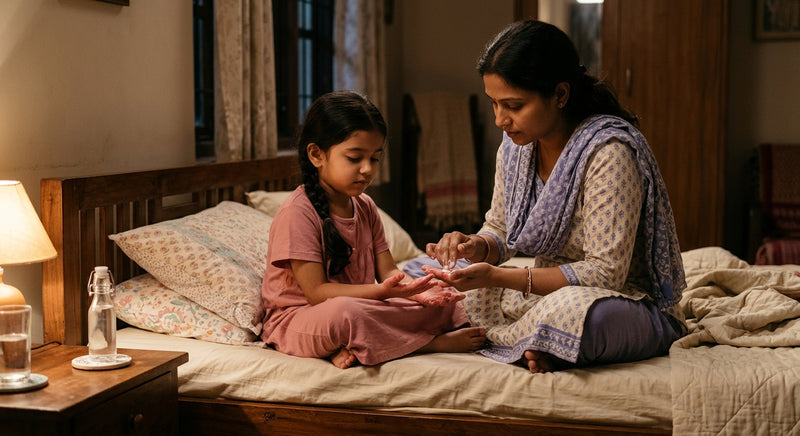
My mother-in-law had one rule and she would not budge on it: oil first, bath after. My paediatrician friend shrugged and said either is fine. So there I was at 6pm with a bowl of warm oil, a baby who wanted feeding, and no idea which of them to believe.
Short answer. For most Indian babies, malish comes first and the bath comes after — a 10-15 minute massage, a short lukewarm wash to lift the excess oil, then moisturiser within about three minutes of towelling off. The other way round — bathe, then oil — does suit some babies. Very dry winter skin. Air-conditioned rooms. Eczema-prone skin. It just needs a lighter hand and a different product. Neither order is wrong. One of them simply fits Indian weather and Indian bathrooms better for most of the year.
At a glance
- Oil before bath is the default: the massage gets its full time, and the wash takes off the surplus.
- Wait 10-20 minutes between malish and bath — not two hours, not two minutes.
- Flip to oiling after the bath in dry winters, AC rooms and on very dry, flaky skin — and use a fraction of the amount.
- Whatever the order, moisturiser goes on damp skin, within about 3 minutes of the towel.
- Never oil broken, weeping or infected skin. That's a paediatrician's call, not a routine question.
If you're still working out when to start malish at all, or which oil to use, that's a separate piece — our complete guide to baby massage and malish. This one is only about the order, because that's the question that comes up every single evening.
So — malish before or after the bath?
Before, in most homes. Before-bath is the order that tends to hold up over months, and the reason isn't romantic: a bath after the massage cleans up the mess.
Picture the reverse. Baby comes out of the water, you oil them, you dress them, and by morning the vest is oily. In Nagpur in April that film plus sweat settles into the neck folds and behind the knees, and by day three there's a prickly little rash you can't place. A Mumbai monsoon is worse — damp cotton and oil together.
Oil first, and none of that happens. The oil does its work during the massage, which is the part that matters — the pressure, the touch, the twenty minutes of skin contact — and then a gentle wash takes the surplus off. What stays behind is enough. Babies don't have to be shiny to be moisturised.
The second reason is plainer still: an oiled baby is slippery. If your bath is a bucket and a mug, or a plastic tub on the bathroom floor, going straight from oil into water asks a lot of two hands. Oil first and the firm grip is already a habit before the water arrives. Oil after and you're handling a baby who is wet, then oiled, then wriggling. That's the sequence where things get dropped.
Why before-bath fits Indian homes
Three reasons, and none of them turn up in the international parenting books.
Hard water. Across much of Delhi, Chennai, Hyderabad and Nagpur, the water from the tap is hard. Hard water leaves a slight film and makes cleansers harder to rinse, and skin often feels tight and squeaky afterwards. A pre-bath oil layer takes some of that edge off. It isn't a fix for hard water — that's a shorter bath, a gentler cleanser and moisturiser straight after — but the order helps.
Heat and sweat. Most of India is warm for eight months of the year. Leave an oil layer under clothes in that weather and it traps sweat. Wash it off.
The malish survives. Nobody says this one out loud. Make oiling the last step before dressing a tired, hungry baby and it gets rushed — thirty seconds of smearing, done. Put it first, while baby is calm and undressed anyway, and it stays a real massage. Which matters, because the benefits parents associate with malish come from the massage far more than from oil sitting on skin; we went through what the research does and doesn't support in our honest look at malish and baby weight gain.
When does oiling AFTER the bath make more sense?
Winter. A dry north-Indian January, or any room with an AC or a heater running for hours. When the air pulls moisture out of skin all day, a light layer left on after the bath is worth having.
Also babies with very dry, flaky, eczema-prone skin, where a paediatrician has asked you to keep the skin covered. And any morning-bath household where the malish would otherwise get skipped altogether.
One caveat, because this is where parents go wrong. Oiling after the bath means a fraction of the amount — a teaspoon warmed between your palms, not the bowlful you'd use for a pre-bath malish. And in dry weather, a moisturiser or balm does this job better than oil. Oil mostly sits on the surface. A well-made cream or balm carries humectants and emollients into damp skin and helps support the skin's natural barrier.
| Malish before bath | Oil/balm after bath | |
|---|---|---|
| Best for | Most babies, most of the year | Dry winters, AC rooms, very dry skin |
| Amount | Generous — 2-3 tsp, warmed | Small — about 1 tsp, or a balm instead |
| Clothes | Stay clean | Can pick up oil marks |
| Heat/sweat risk | Low | Higher in humid weather |
| Grip while bathing | Needs firm two-hand hold | Easier |
How long should I wait between the malish and the bath?
Ten to twenty minutes. Long enough for baby to lie there, kick, settle. Short enough that you haven't lost the window.
The idea that oil needs an hour or two to "soak in" and reach the bones comes up constantly, and it doesn't hold up. Oil doesn't travel that way. What a long wait does buy you is more time in the sun for the traditional dhoop-malish — and that's exactly where I'd slow you down. A newborn's skin is 20-30% thinner than an adult's, and 20 minutes of direct Indian sun is too much. Five minutes of early, gentle light with the baby's back to the sun, or skip it.
What one evening actually looks like
This is the sequence I'd hand a new parent. About 35 minutes end to end, and after a week it runs itself.
- Warm the room first. Close the window, fan off or right down. A cold room ruins everything that follows.
- Warm the oil — bowl inside a bigger bowl of hot water, never the microwave. Test it on your inner wrist.
- Baby on your outstretched legs, head at your knees. Better than the floor, because you can see their face.
- 10-15 minutes of malish. Legs, arms, chest, tummy in slow clockwise circles, then the back. Firm and slow, not fast and light.
- Let them lie and kick for 10-20 minutes. Nappy off, towel underneath.
- Bath: lukewarm water (37-38°C, elbow test), 5 minutes maximum. Longer baths dry skin out. They don't clean better.
- Pat dry — pat, don't rub. Get into the neck folds, armpits, behind the knees.
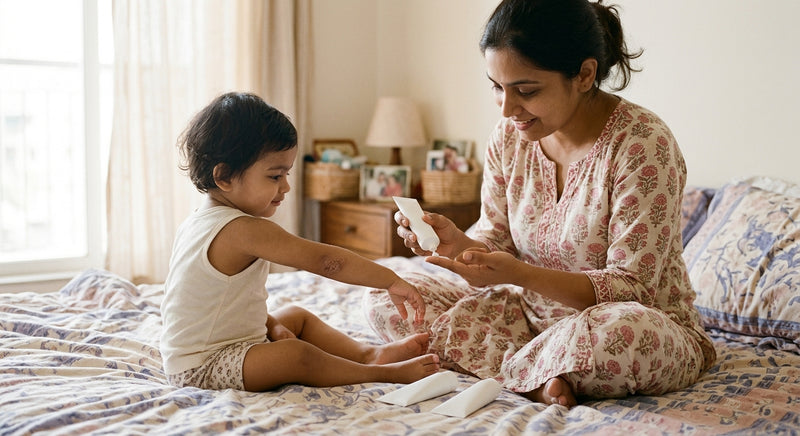
- Moisturise while the skin is still slightly damp, within about 3 minutes. Then dress.
For the wash itself, look for a mild, tear-free, soap-free cleanser at a skin-friendly pH. Regular soap is too alkaline for baby skin and strips off whatever the malish just did. Our Head to Toe Baby Foam Wash was built for exactly this slot in the routine.
What if my baby's skin is dry, sensitive or eczema-prone?
The order barely changes. Keep the pre-bath malish, cut the bath shorter still, and put a real moisturiser on afterwards instead of more oil. That last part surprises people: with dry skin, it's the after step doing most of the work, not the oil.
Be picky about the oil too. Not everything in the kitchen belongs on a baby, and nut-derived oils deserve a thought if there's any family history of allergy — we went into that in our guide to almond oil for babies. And if you're starting from scratch with a newborn whose cord stump hasn't come off yet, the timing rules change again; read when to begin malish first.
When to see a doctor
Book a paediatrician appointment if you notice any of these. None of them are order-of-routine problems:
- Skin that's raw, weeping, cracked or bleeding anywhere you've been massaging.
- A rash that spreads after every malish, or comes up within an hour of oiling — that may be a reaction to the oil.
- Redness with warmth, swelling, yellow crusting or fever.
- A baby who cries in real distress through every massage, or flinches when a particular limb is touched.
- Very dry, itchy, thickened patches that keep returning despite daily moisturising.
And if your paediatrician has told you to skip oil for now, follow that over any routine, including this one. There are babies for whom oil isn't the right choice, and that's a clinical judgement.
Worth saying plainly: parents lose more sleep over this order than it deserves. Ten minutes of unhurried touch, a short warm bath, moisturiser on damp skin — get those three right and the sequence is a detail. Malish doesn't go on forever either; when to stop the daily malish is its own conversation.
For that step after the towel — through a dry winter especially, or in an AC room — our Hydra Healing Moisturizing Balm is made to go on damp skin and help comfort dry, sensitive skin.
In summary
- Oil first, bathe after — it suits Indian heat, hard water and the way real evenings run.
- Leave 10-20 minutes between the malish and the bath, no more.
- Flip to a light oil or balm after the bath in dry winters, AC rooms and on very dry skin.
- Keep the bath to 5 minutes at 37-38°C, pat dry, and moisturise damp skin within about 3 minutes.
- Skip the malish over broken, weeping or infected skin and check with your paediatrician first.
Frequently asked questions
Should baby massage be done before or after a bath?
Before, for most babies. A 10-15 minute malish followed by a short lukewarm bath means the massage gets its full time and the wash lifts off the surplus oil, so baby isn't left slippery or sweaty under clothes. Switch to a light oil or balm after the bath in dry winters, air-conditioned rooms, or on very dry skin.
How long should I wait between malish and bath?
Ten to twenty minutes is plenty. Let baby lie on a towel and kick, nappy off, in a warm room. The belief that oil needs an hour or two to soak deep into the body doesn't hold up — oil largely stays on the surface. A longer wait mainly delays the bath and lets the room cool down.
Can I massage the baby right after a feed?
Better not. Firm strokes on a full tummy usually end in a spit-up. Wait roughly 30-45 minutes after a feed, or do the malish between feeds when baby is alert and calm. If they're hungry or overtired, the massage turns into a struggle — postpone it rather than push through.
Does oil need to be washed off after malish?
Mostly yes, in Indian weather. A residual oil film under clothes traps sweat in warm, humid months and can lead to prickly heat in the neck folds and behind the knees. A short bath with a mild, tear-free cleanser removes the excess while the massage's benefits stay. In dry winters, leaving a light layer is fine.
Which is better for dry skin — oil after bath or moisturiser?
A moisturiser or balm, applied to slightly damp skin within about three minutes of towelling off. Oil sits largely on the surface, whereas a well-formulated cream carries humectants and emollients into the skin and helps support the skin's natural barrier. Keep the pre-bath malish for the touch and bonding, and let the moisturiser handle the dryness.
Is dhoop-malish in the sun safe for a newborn?
Keep it very brief. A baby's skin is 20-30% thinner than an adult's, so twenty minutes in direct Indian sun is too much. If you want the traditional practice, keep it to about five minutes of early morning light with baby's back to the sun, eyes shaded, and skip it entirely once the sun is high or on hot days.