First week of November. The light through the window has gone orange, your phone says AQI 412, and by Thursday your seven-month-old has two chapped patches on her cheeks and is rubbing her face into your shoulder at 2am. You're lying there doing the maths on whether those two things are connected.
They can be. Nothing dramatic — smog doesn't burn skin. Fine particulate matter settles on skin and works against its barrier, and a baby's barrier is thinner and leakier to start with. So it shows up as dryness on the exposed bits, redness across the cheeks, and more scratching in a child who's already eczema-prone. The protection that works is boring. Cut exposure where you genuinely can. Get the particles off gently at the end of the day. Put the barrier back before bed.
One thing before any of that, though. Skin is the third priority in a Delhi winter, not the first. Breathing is first. If you have the energy for exactly one change this week, make it a clean-air room, not a new cream. This piece sits inside our season-by-season guide to Indian weather, festivals and children's skin, and smog season is the one chapter where the honest advice is mostly not about products at all.
At a glance
- Smog does not cause eczema, but particulate pollution is associated with drier skin and more flare-ups in children who already have it.
- The highest-value change is one closed room with clean air — usually where the baby sleeps.
- No mask fits an infant's face. Do not put one on a baby.
- Wash exposed skin gently after outdoor time, then moisturise on damp skin. That's the whole skincare part.
- Breathing symptoms — fast breathing, wheeze, a cough that will not settle — go to a paediatrician, not to a skincare routine.
What does smog actually do to a baby's skin?
Particles land, and they stay put. PM2.5 is small enough to sit in the folds of skin and around hair follicles, and it doesn't simply blow off. On a baby that means cheeks, forehead, the back of the neck, and that strip of wrist between the sleeve and the mitten.
The barrier gets leakier too. Particulate pollution is consistently linked with drier skin and more eczema flares in children — not as a cause of eczema, but as a trigger for skin that's already sensitive. And Delhi's smog months are also its driest and coldest, with room heaters running through the night. Cold dry air, a blower, deposited particles: that's a barrier problem three ways over. Parents tend to blame the third one. It's the one in the news.
Then the itch-scratch loop takes over. A baby who scratches at night breaks skin, sleeps badly, wakes up redder. That cycle is usually what brings parents in — not the pollution itself.
What Delhi parents try in smog season — and what each is actually worth
By the second week of November the advice is coming from everywhere. The cousin in Gurgaon, the other mother in the paediatrician's waiting room, an ad that found you at midnight. Some of it is genuinely useful. Some is money set on fire. Two things on that list are unsafe for a baby.
| What parents try | What it genuinely does | What it does not do | Our call |
|---|---|---|---|
| HEPA purifier in one closed room | Lowers indoor particulate levels in that room, overnight, where your baby spends the most hours | Clean the whole flat, or help at all with the door open | Worth it. Highest impact per rupee — run it in the sleeping room with the door shut |
| Windows shut on Very Poor and Severe days | Keeps the worst outdoor air out during peak hours | Anything about indoor smoke — agarbatti, mosquito coils, tawa smoke, cigarettes | Worth it, but only if you also stop adding smoke indoors |
| Moving or skipping the pram walk | Cuts the single largest exposure block in a baby's day; early morning is often the worst, not the best | Help with a school run or a commute you cannot move | Worth it. The biggest lever after the clean room |
| A mask on the baby | Nothing. A mask works by sealing, and none is made to seal an infant's face | Filter anything, while adding a real suffocation risk | Skip entirely under 2. Paediatric guidance is consistent on this |
| Evening gentle wash, then moisturiser | Lifts deposited particles off skin and puts the barrier back before the longest stretch of sleep | Reduce exposure by a single microgram | Worth it. This is exactly where skincare belongs — at the end, not the front |
| Thick oil on the face before going out | Adds slip and a little occlusion | Block PM2.5 — there is no good evidence for this, and it makes grime harder to lift off later | Skip on the face. Keep oil for body malish at home |
| Detox masks, scrubs, de-tan packs | Nothing appropriate for a baby | Belong anywhere near skin this thin | Skip. Scrubbing a compromised barrier makes it worse |
So what would we actually do in a smog week?
Go by the AQI band, not by how the sky looks. The haze and the number disagree often enough to catch you out. India's CPCB scale calls 201-300 Poor, 301-400 Very Poor, and anything above 400 Severe.
- Under 200: normal outdoor time. Skip the 6-7am walk — cold air traps particles near the ground at dawn. Late morning is usually cleaner.
- 200-300: shorter outdoor time, later in the day. Cover the pram with a light cotton cloth on the windward side, never over the baby's face. Wash hands and face on return.
- 300-400: keep the baby indoors. Purifier on in the sleeping room, door shut. Car windows up, AC on recirculate. No incense, no coils, no cooking smoke in an enclosed kitchen with the baby in it.
- Above 400: essential travel only. Same indoor setup, and this is the week to be extra diligent about the evening wash and moisturiser — dry, sooty air plus a heater will show on the cheeks within days.
The evening routine that does the skin half of the job
Five minutes. It matters more on a smog day than on any other winter day, because you're removing something, not just hydrating.
1. Wash within half an hour of coming in
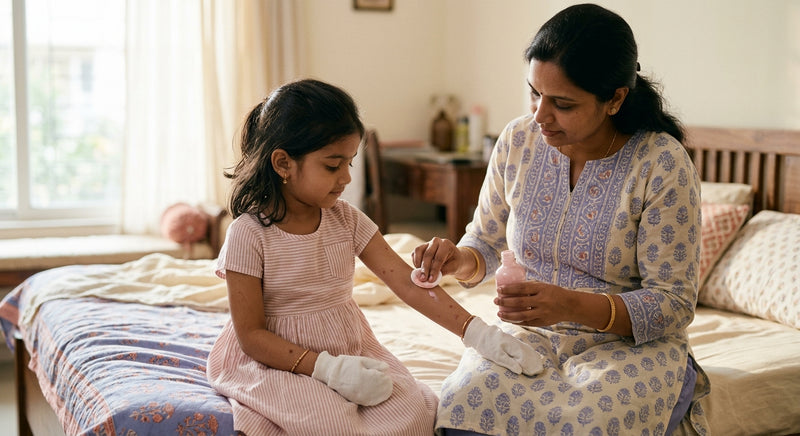
Lukewarm water, not hot — the steel-tumbler-of-hot-water habit strips an already-stressed barrier. Use a small amount of a gentle, tear-free cleanser on the exposed areas: face, neck, hands, wrists. A soft tear-free foam wash made for a baby's skin does this without needing pressure, and pressure is the thing to watch. The instinct on a visibly grimy cheek is to rub. Don't. Same no-scrub principle we walk through in our guide to taking colour off a child's skin without scrubbing — lift, don't abrade.
A full bath every single day isn't required. On most smog days a face-neck-hands wash is enough, and daily long baths in December do more drying than good.
2. Moisturise on damp skin, within about three minutes
Pat dry, don't rub. While the skin is still slightly damp, work a barrier-supporting moisturiser into the face, neck and hands, then the rest of the body. Damp skin holds the water you just put on it. Skin you've dried completely doesn't.
The quantity surprises parents. For a one-year-old's face and neck, you want a blob roughly the size of a chana, properly spread — not a smear. And in a Delhi January a light lotion often isn't enough on cheeks; a thicker balm-type texture holds up better against dry air and a running heater.
3. Barrier before exposure, not oil before exposure
A thin layer of moisturiser on the cheeks before a school run or a car trip is sensible — it stops cold dry air pulling water straight out of the skin. A heavy coat of oil on the face before going out is a different thing, and we wouldn't do it. There's no evidence it keeps particles out, and it makes the evening clean-up rougher. Save the oil for a warm room and an unhurried massage, the way we set it out in our pre-festival oiling checklist, where the point is a barrier layer before a known, time-bound exposure — not an all-day shield.
4. Fix the room, not just the skin
Heaters are the quiet culprit in Delhi. A closed room with a blower running all night will dry a baby out faster than the smog will. Keep the heater low, put a wide open bowl of water in the room, and if the purifier is running, keep the door shut so it's working on one room's air instead of the whole flat's.
When to see a doctor
Smog season is the time of year when a skin question is sometimes a breathing question. Take your baby to a paediatrician if you notice:
- Fast or laboured breathing, wheezing, chest indrawing, or a cough that will not settle — see someone the same day.
- Skin that is weeping, oozing, or forming a yellow-golden crust, which can signal infection.
- A red, itchy rash that is spreading or is not improving after about a week of gentle, consistent care.
- Night after night of broken sleep from scratching, or skin that is bleeding from it.
- Any rash with fever, poor feeding, or a baby who is unusually floppy or drowsy.
What we would tell a friend, in one paragraph
Get one room clean and keep the door shut. Move outdoor time out of the early morning, and drop it altogether above 300. Skip the mask, skip the scrubs, skip face oil before stepping out. Then do the five-minute evening routine properly — lukewarm gentle wash, pat dry, moisturise on damp skin — and be generous with it right through December and January. That's the plan. It's unglamorous, and it works better than anything you can buy in a panic on a Very Poor day.
For the dry, wind-bitten cheeks a Delhi winter leaves behind, our Hydra Healing Moisturizing Balm is the one we reach for at bedtime — clinically tested in-vivo, and made to help support the skin's natural barrier through exactly this season.
In summary
- Smog does not burn baby skin, but it works against an already-thin barrier — expect dryness and more itching, not damage.
- The highest-value change is one closed room with clean air, usually where your baby sleeps; skincare is the third priority, not the first.
- Never put a mask on a baby under two, and skip scrubs, detox packs and face oil before stepping out.
- Wash exposed skin gently in lukewarm water within half an hour of coming indoors, then moisturise on damp skin within about three minutes.
- Fast breathing, wheeze, a cough that will not settle, or weeping and crusting skin all need a paediatrician, not a routine change.
Frequently asked questions
Can air pollution cause eczema in my baby?
Pollution is not considered a cause of eczema, which has a strong genetic component. But research consistently links particulate pollution with drier skin and more frequent flare-ups in children who already have eczema. In practice that means smog season is a trigger to plan around, not something to blame for the condition itself. Keep the daily moisturising routine going even on good-skin days.
Should I put a mask on my baby during Delhi smog?
No. A mask filters only if it seals against the face, and no mask is manufactured to seal an infant's face, so it filters nothing while adding a genuine suffocation risk. Paediatric guidance advises against masks for children under two. Reduce exposure instead: shift outdoor time, keep windows shut on Very Poor days, and run a purifier in one closed room.
Does my baby need a bath every day in smog season?
Not necessarily. On most days a gentle lukewarm wash of the exposed areas — face, neck, hands and wrists — within half an hour of coming indoors does the job. Daily long, hot baths through a Delhi December tend to dry skin out more than they help. If your baby has had a lot of outdoor time, a short full bath followed immediately by moisturiser is fine.
Is malish oil enough to protect my baby's skin from pollution?
Oil is lovely for a warm indoor massage, but there is no good evidence that a layer of oil blocks fine particulate matter. A thick coat on the face before going out also makes the evening clean-up harder and tempts you into rubbing. Use a light moisturiser on cheeks before a car trip or school run, and keep oil massage for home.
Does an air purifier help skin, or only breathing?
Primarily breathing, which is the bigger reason to run one. Less deposited particulate matter on skin is a reasonable secondary benefit, particularly overnight in a bedroom. The practical rule is that a purifier only works on the air in a closed room, so shut the door. Do not expect one unit to clean a whole flat with doors open.
What kind of moisturiser works best during Delhi's smog months?
Something thicker than your monsoon choice. Cold, dry air plus a running room heater pulls water out of skin fast, so a balm-type texture usually holds up better on cheeks than a light lotion. Apply it on damp skin within about three minutes of patting dry, and be generous — roughly a chana-sized blob for a small child's face and neck.