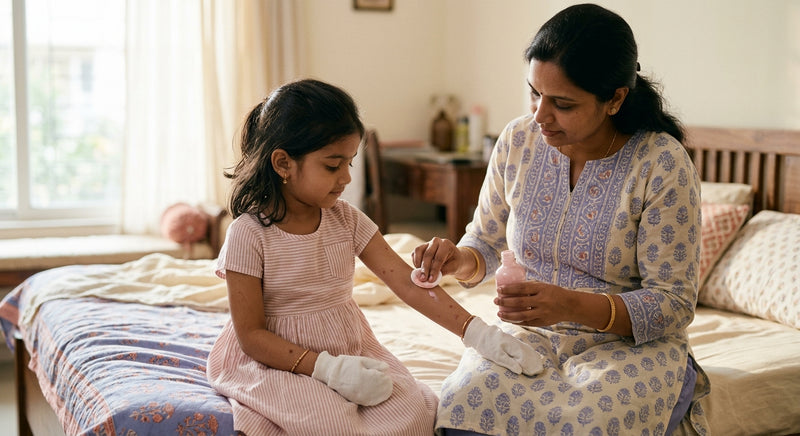
Her son was eleven months old. The rash ran in two neat lines across his upper back, exactly where the vest's shoulder seams sat. Everywhere else, calm skin. She had changed his cream twice, stopped the new dal, and was one bad night away from stopping the moisturiser too. Nothing in the bathroom had caused it. The detergent had changed three weeks earlier, to a scented one that was on offer.
Short version: yes, laundry detergent can set off or worsen a rash on eczema-prone skin. It more often behaves like simple irritation from residue left behind in the fabric than like a true allergy — though only a doctor can tell you what is actually going on with your baby's skin. What you can change at home is mechanical. Use roughly half the detergent you use now. Add a second rinse. Stop fabric conditioner entirely and move to a fragrance-free liquid. Then give it a week or two of washes before you judge whether it helped.
If you read nothing else
- Detergent rash shows up where fabric presses and rubs: neck, shoulder seams, waistband, inner arms. It spares the nappy area and the face.
- The problem is nearly always dose and rinsing, not the brand. Indian hard water makes people use more detergent, and more detergent means more residue.
- Fabric conditioner is designed to stay on the fibre. That is the whole point of it, and the reason it comes off on skin.
- "Unscented" is not "fragrance-free". One may carry a masking fragrance. The other should not.
- Change one thing, then wait 7-10 days. Change five things at once and you learn nothing.
Clothes are the one product category that touches your baby for twenty-three hours a day, and almost nobody reads the label on the thing that washes them. If you want to build that habit across the whole shelf, our complete guide to reading baby product labels safely is the wider map. Treat this as its laundry chapter.
Is it the detergent — or is it just the eczema?
Geography is your best clue. Irritation from detergent follows the fabric: the back and shoulders where seams lie, the waistband line, the inner elbows and the backs of the knees where a sleeve or a legging bunches and sweats. It leaves alone the skin that clothes don't touch. The face. The scalp. The nappy area, which sits under a nappy, not under cloth.
Eczema has its own map. In babies under one it loves the cheeks, the outer arms and legs, and the scalp. If the redness is matched on both cheeks and nowhere near a seam, laundry probably isn't your problem.
Timing is the other half of it. An irritant reaction builds over days and weeks of repeated contact. It does not announce itself an hour after the first wear. So think back three or four weeks, not to yesterday. A new detergent. The jumbo refill pack that felt like a saving. A fragrance booster somebody recommended. A move to a flat on a different water supply. New house help with a different idea of how big a scoop is. Any of those counts.
What in a detergent actually irritates skin?
My working week is spent on the other side of this problem, deciding what goes into a formula meant to sit on a baby's skin for hours. Laundry detergent is built to do the opposite job. Once you see that, the rest of it falls into place.
A detergent is engineered alkaline, typically somewhere around pH 9.5-11, because alkalinity is what lifts oily soil off cotton. Healthy skin sits acidic, around pH 4.5-5.5. That acid mantle is part of how the barrier holds water in and keeps unfriendly microbes down. Anything alkaline left sitting in the fibre nudges that surface the wrong way. On intact adult skin, nothing much happens. On a baby with eczema, where the barrier is already leaky, it is a steady low-grade provocation.
Then the ingredients themselves.
- Anionic surfactants (LAS, SLES and their relatives). Effective, cheap, and harsher than anything we would ever put in a baby cleanser. They are supposed to be strong. Residue is the issue, not the molecule.
- Fragrance. If you change one thing, change this. Fragrance mixes are the most common contact allergens in everyday products worldwide, and laundry fragrance is built to survive drying. That is what "long-lasting freshness" is promising you.
- Optical brighteners. Fluorescent dyes that deposit on the fabric so white reads whiter. Depositing is the point, and they don't wash out.
- Preservatives in liquid detergents. Isothiazolinones (MI, MCI, BIT) turn up here exactly as they do in wipes. They are well-documented sensitisers, which is why we watch them so closely in leave-on formulation, and why the same names come up in what's actually in Indian baby wipes.
- Enzymes (protease, amylase, lipase). Parents worry about these most and I'd rank them last. Enzyme residue on properly rinsed fabric is tiny, and the evidence for it causing dermatitis in ordinary home use is thin. Fix the dose and the rinse first.
Why hard water quietly makes this worse in India
This is the part that advice written abroad skips. Across large parts of North and Central India — Delhi, Jaipur, much of Rajasthan and Gujarat, plenty of Nagpur's own bore-water supply — the tap runs hard with calcium and magnesium. Hard water eats surfactant before it can clean anything, so the lather dies in the bucket. And what does everybody do when there is no lather? Another scoop.
That extra scoop is the real problem. More detergent in the same water means more of it survives the rinse and stays in the fibre, where tomorrow's sweat re-wets it and puts it straight back on skin. Soap bars add a second problem. Calcium reacts with the soap to form an insoluble lime soap that clings to cotton and leaves that stiff, faintly greasy hand. One cycle will not rinse it out.
In a hard-water home, then, fight the instinct to add more. Use a liquid detergent, which disperses at Indian tap temperatures where powder builders often don't fully dissolve. Keep the dose modest. Buy your cleaning power back with agitation time and an extra rinse instead.
How should I wash baby clothes if my child has eczema?
Start with tonight's load. None of this costs anything.
- Halve the detergent. Half the cap, half the scoop, whatever you pour now. Clothes will still come clean. Baby soil is milk, drool and sweat, not engine grease.
- Run a second rinse. Most machines have "Extra Rinse" or "Rinse+". Washing in a bucket, that means two full changes of clean water, not one.
- Stop fabric conditioner completely. Cationic softeners are formulated to bond to the fibre and stay there, carrying their fragrance with them. There is no gentle version of that mechanism.
- No detergent bar rubbed on collars. Concentrated soap on the exact spot that sits against the neck is a reliable way to make a neck rash.
- Skip the extras. Liquid blue or whitener, fragrance boosters, the splash of antiseptic in the final rinse. Phenolic disinfectants on clothing are an irritant, and clothes that are properly washed and dried don't need one.
- Wash new clothes before first wear, twice if they are dark or stiff. New garments carry sizing, dye, and sometimes formaldehyde-based wrinkle-resist finishes.
- Keep the baby's load separate from gym clothes, kitchen cloths and adult wear that has been softened. Softener travels between garments inside the drum.
- Dry all the way through. A half-dry seam is a damp seam, and damp plus friction is an irritant in its own right.
One more, and this one is for you rather than the baby. If you wash by hand, your own hands sit in undiluted detergent every single day. Hand dermatitis in new mothers is extremely common and almost never mentioned. Dose with a mug, and rinse your hands properly afterwards.
What should I look for on a detergent label?
I read a detergent label the way I read a skincare one. What is absent tells you as much as what is claimed.
- "Fragrance-free", not "unscented". Unscented products can still contain a masking fragrance to cover the raw smell of the base. Fragrance-free should mean nothing was added at all.
- No optical brighteners, sometimes printed as fluorescent whitening agents. If the pack promises whiter-than-white, assume they are in there.
- Liquid over powder for Indian tap-temperature washes, and over bars for baby clothes.
- A short list. Detergents aren't obliged to print every ingredient the way cosmetics are, so a brand that discloses anyway is telling you something about its confidence.
- "Hypoallergenic" on its own means nothing. It is a marketing word with no fixed legal definition in India. Fragrance-free is a checkable fact. Hypoallergenic is a hope.
You don't need a special "baby detergent". A plain fragrance-free, brightener-free adult liquid at half dose with two rinses will beat a pastel-packaged baby detergent that has been heavily perfumed. I'd rather you spent the money on the water for that second rinse.
Season by season: what to change through the Indian year
| Season | What goes wrong | What to change |
|---|---|---|
| Summer | Sweat re-wets detergent residue in the fabric and holds it against skin all day. Salt plus friction on the seams does the rest. | Wash daily, loose single-layer cotton, second rinse non-negotiable. Change the vest at the sweaty midday point rather than at bathtime. |
| Monsoon | Nothing dries. Damp clothes smell musty, so families compensate with extra detergent, fragrance boosters and antiseptic in the rinse. All three land on skin. | Wash smaller loads, dry indoors under a fan, iron seams and waistbands dry. Fix the drying, not the smell. |
| Winter | Wool and acrylic next to skin, fewer washes, heavier layers. "Wool wash" liquids are often the most heavily perfumed thing in the house. | Always a cotton layer between wool and skin. Wash woollens rarely but rinse them thoroughly. Moisturise before dressing, not after. |
| Hard-water homes, all year | Poor lather tempts a bigger scoop. Soap bars form lime soap that clings to cotton. | Liquid detergent, modest dose, longer agitation, two rinses. Never increase the dose to chase foam. |
Monsoon needs one extra flag. It is also the season the mosquito patches and roll-ons come out, and a patch stuck on a sleeve or a collar parks its active ingredient right against the skin it is meant to protect. Worth reading which repellent formats are appropriate at which age before you clip one onto a vest. And please don't dust talc or powder into damp neck folds to "dry" them. Caked powder in a wet crease is friction, not protection, as we've covered in the honest look at talc-free powders, cornstarch and arrowroot.
What about the clothes themselves?
Cotton, soft and washed-in, beats everything. Turn vests inside out if the seams are thick. Cut out scratchy woven labels. Choose a size that doesn't grip at the neck or the thigh. And keep starch and kanji off anything a baby wears, because stiffened fabric is abrasive by definition.
Take the naphthalene balls out of the cupboard where the baby's clothes are stored, too. Clothes stored with them absorb the vapour and carry it out, and paediatricians in India advise against them around newborns because of the risk of haemolysis in babies with G6PD deficiency, a condition many families simply don't know they carry. Dried neem leaves, a clean airtight box, or just airing the cupboard does the job with none of that.
Washing the clothes is only half of it
If the barrier weren't already compromised, detergent residue would never register. A baby's skin is 20-30% thinner than an adult's, it loses water faster, and up to around 48.6% of babies go through some form of atopic-type skin trouble. The skin you are dressing is often already working at a deficit.
So the bath counts as much as the wash, and the logic is identical: a true syndet cleanser, no soap, no fragrance, sixty seconds not ten minutes. Our Head to Toe Baby Foam Wash is built pH-appropriate and tear-free for exactly that reason. The cleanser shouldn't undo what the laundry routine just fixed.
Then moisturise within three minutes of patting dry, while the skin is still slightly damp, and again before dressing in the morning. Look for humectants, emollients and an occlusive layer together, plus barrier ingredients that give the skin something to rebuild with. In a lab study, increased Keratin-10 and Filaggrin expression was recorded — two of the proteins the barrier is literally made of. That is the kind of thing worth looking for, rather than a fragrance claim on the front of a jar.
On the patches where fabric rubs all day, that usually means something thicker and more occlusive than a light lotion. Our Hydra Healing Moisturizing Balm is the one I reach for there, to help comfort dry, sensitive skin between washes.
When to see a doctor
Book a paediatrician or dermatologist if: the rash is weeping, crusting yellow or golden, or has small pus spots (that suggests infection, which needs treatment, not a laundry change); your baby has fever alongside the rash; the skin is cracked and bleeding; itching breaks sleep for more than a few nights; the rash keeps spreading despite two weeks of a clean wash routine and consistent moisturising; or it came on suddenly with swelling of the lips, face or eyelids, which needs same-day attention. A doctor can also patch-test for a genuine contact allergy if the pattern keeps repeating. No amount of careful rinsing will tell you that.
In summary
- Detergent rash follows the fabric — seams, shoulders, waistbands — while eczema favours cheeks, outer arms and scalp.
- Halve your detergent dose and add a second rinse tonight; residue quantity matters more than the brand on the pack.
- Stop fabric conditioner entirely — it is formulated to stay on the fibre, which is exactly why it ends up on skin.
- In hard-water cities, never add extra detergent to chase lather; switch to a liquid and rinse twice instead.
- Change one thing at a time and give it ten days, and see a doctor if skin is weeping, crusting or breaking the child's sleep.
Frequently asked questions
Can washing powder really cause a rash on my baby's skin?
Yes, though usually as irritation rather than a true allergy. Detergent residue left in the fibres is alkaline and surfactant-rich, and sweat re-wets it against the skin through the day. The giveaway is location: redness that follows seams, waistbands and shoulders while untouched areas stay calm. Halving the dose and adding a second rinse resolves a good number of these within a week or two.
Which detergent is best for baby clothes if my child has eczema?
A plain fragrance-free liquid with no optical brighteners, used at half the recommended dose. You don't need a dedicated baby detergent — many are heavily perfumed. Choose liquid over powder and over detergent bars, because liquids disperse properly at Indian tap-water temperatures while powder builders often don't fully dissolve, leaving gritty residue in the fabric.
Should I use fabric softener on baby clothes?
No. Fabric conditioners work by depositing cationic softening agents onto the fibre and staying there — that persistence is the product's entire function, and it carries fragrance along with it. Softener also transfers between garments in the same drum, so keep the baby's load separate from adult washes that use it. Clothes will feel slightly stiffer; that's harmless and softens after a couple of wears.
Does hot water wash detergent out better?
Warm water rinses residue slightly better than cold, but heat is not the main lever and very hot washes damage cotton fibres over time, making fabric rougher against the skin. Volume of rinse water matters far more than temperature. Two full rinses in ordinary tap water beats one hot rinse, and costs less.
How long before I know whether the detergent was the problem?
Give it ten days to two weeks of washes, changing nothing else at the same time. Irritant reactions build slowly and settle slowly — you're waiting for existing residue to come out of every garment and for the skin to catch up. If there's no improvement at all by two weeks with consistent moisturising, laundry probably isn't the trigger and it's worth a doctor's opinion.