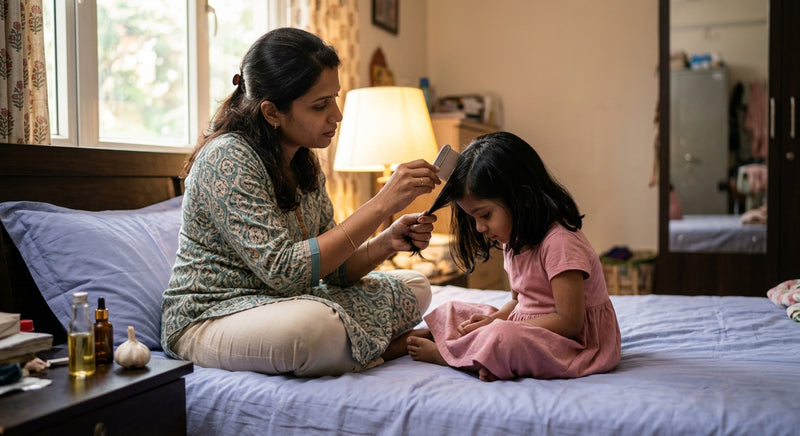
She's seven. The school van comes in twenty minutes. And someone is holding her hair like a rope. Kas ke bandho — baal lambe honge. Tie it tight, the hair will grow long. Most of us heard that line from our mothers, who heard it from theirs.
The honest answer is no. Hair grows from a follicle set deep in the scalp, at a speed that follicle decides. Pulling on the strand that's already out can't hurry it, any more than tugging a plant makes it taller. What a braid can do is protect the length she already has, and that's worth something. But only a loose one. Tighten it and you end up paying for the neatness out of her hairline.
At a glance
- Hair grows from a follicle under the scalp. Tension on the visible strand can't change that rate.
- The myth survives because braided hair tangles less, so it breaks less. Less hair snaps off, so it looks like it grew.
- That's length retention, not growth. Retention is the half you control.
- Sustained pull works against you. The finest hairs, at the temples and the nape, loosen first.
- Two-finger test: you should slide two fingers under the braid at the nape without effort.
- A conditioner's real job is to lower combing force. Lower force, fewer breaks.
Where does hair actually grow from?
At the base of every follicle sits a bulb, and inside it a cluster of matrix cells that divide faster than almost anything else in the body. They push upward, fill with keratin, harden, and die. By the time a strand clears the scalp it is dead protein. No blood supply, no metabolism, no way to repair itself.
Parents rarely hear that part, and it changes what you can reasonably expect from ten minutes with a comb. Whatever you do to the visible hair is cosmetic in the literal sense: you can smooth it, lubricate it, stop it snapping. You can't instruct it to grow. Speed is set at the follicle, roughly a centimetre a month for most people, a little faster or slower depending on the person. How long her hair can ultimately get depends on how many years her follicles stay in their growing (anagen) phase before resting and shedding, and that's largely genetic. Plenty of children simply have a shorter anagen phase than the adults around them. It's why some girls' hair sits stubbornly at shoulder length until they're older, no matter how it's tied.
So why does the braid seem to work?
Because our grandmothers were reading a real result and guessing the wrong mechanism.
Loose hair on an Indian school day takes a beating. It rubs on a cotton collar, a backpack strap, a car headrest, a pillow, a ceiling fan pushing it into knots all afternoon. Every pass scuffs the cuticle, the overlapping scales on the outside of the strand, arranged like roof tiles. Once those scales lift, strands catch on each other, tangles form, and the comb finishes the job. Braid the same hair and all that loose surface area is bundled into one contained rope: less friction, fewer knots, fewer breaks.
Less hair snaps off, so more length stays on her head. That's retention, not growth. It's also the more useful of the two, because it's the one you can do something about at 7am.
What actually breaks a child's hair
- Water. Wet keratin swells and some of its bonds temporarily give way, so damp hair stretches further and snaps sooner. Braid wet hair, leave it tied all day, and you have manufactured breakage.
- Hard water. Borewell and municipal supply across much of India carries calcium and magnesium that deposit on the cuticle and react with soap. The strand feels rough and squeaky-grabby, friction climbs, tangles multiply.
- The comb, used dry and from the top. Combing from the roots down drags every tangle into a tighter knot at the ends before you reach it.
- The band. Rubber bands and elastics with a metal crimp grip individual strands and shear them at the tie point. You can usually see the evidence: a little fringe of short, broken hairs exactly where the band sat.
- Sustained tension. Constant pull on the fine hairs at the temples and nape gradually loosens them. It shows up as slow thinning rather than a dramatic event, which is why it goes unnoticed for months.
Tight, loose or open: an honest comparison
| Style | What it does for length | What it costs | Our verdict |
|---|---|---|---|
| Tight plait or high tight ponytail | Controls tangles well | Breakage at the tie point, tenderness, slow thinning at the temples and nape | Retire it. This is the style the myth recommends. |
| Loose single plait, started a finger's width off the scalp | Almost all the tangle protection, none of the pull | Needs redoing by lunchtime some days | Our default for school. |
| Two loose plaits or a low, soft ponytail | Spreads weight across the head instead of one anchor point | Slightly more morning time | Best for sports day, long hair, and hot humid weeks. |
| Tight bun or juda for dance/karate class | Keeps hair fully off the face and neck | Concentrated pull at one point; worst if done daily | Fine occasionally. Not the everyday style. |
| Hair fully open all day | Zero tension on the roots | Maximum friction and tangling — the biggest source of snapped ends on fine, long hair | Save it for home, weekends and sleep-in mornings. |
| Braided while still damp | Looks neat for an hour | Weakest state of the strand, held under tension for eight hours | Never. Wait until it's properly dry. |
How tight is too tight?
Four checks. None of them takes more than five seconds.
- Slide two fingers flat under the braid at the nape. If they don't go, loosen it.
- Look at her temples in daylight. If the skin tents or pulls into little ridges near the hairline, it's too tight.
- Ask her ten minutes later. A well-tied braid disappears from a child's attention. "It hurts when I take it out," or a headache after school, is a clear no.
- Check the comb when you undo it. A few long strands is normal daily shedding. A small ball of short broken pieces is breakage, and it tells you where the friction is.
What we'd actually do
Braid her hair. Just stop treating tightness as the active ingredient. The braid works by containing the hair, and containment doesn't need force. Detangle first, plait loosely, use a soft tie, move the parting, let the scalp off duty at night. Keep that up for one school term and you'll see it in what's still on her head.
- Detangle before braiding, never after — on dry or barely-damp hair, in sections, from the ends upward, with a wide-tooth comb.
- Start the plait about a finger's width away from the scalp instead of gripping the roots. Same neatness, far less pull.
- Use a cloth scrunchie or a ribbon. If it's an elastic, one wrap fewer than feels right, and nothing with a metal join.
- Move the parting every few days. A parting that never shifts concentrates tension in one line.
- Undo it at bedtime. If she needs it contained for sleep, a loose low plait on a smooth cotton or satin pillowcase is plenty.
- Oil the scalp, not the braid — and wash it out the same day.
- One day a week with no tie at all. Weekends exist.
Wash day, and what a conditioner actually does
This is the part I care about most, because it's the one place a formulator can help. Conditioning is electrostatic, not magical. A weathered cuticle carries a negative surface charge. Cationic (positively charged) conditioning agents — behentrimonium methosulfate, cetrimonium chloride, behentrimonium chloride — adsorb onto exactly those damaged sites, lay the scales flat, and drop the force needed to pull a comb through. Pair them with fatty alcohols like cetearyl alcohol and you get the gel network that delivers slip. That's the whole mechanism, and it's all a bottle can honestly promise. A kids' conditioner claiming it will grow hair is selling you the myth back.
For the wash itself, look for a mild, sulfate-light surfactant system that lifts oil and sweat off the scalp without leaving the lengths stripped and squeaky. And a properly tear-free profile, because you're already negotiating with a child who'd rather be anywhere else. Our Loving & Balancing Shampoo is built on that brief. We make it in our own GMP-certified facility, so we pick the surfactant blend ourselves rather than accepting someone else's base.
Does oiling before a braid help?
Pre-wash oiling has better science behind it than most traditions. Coconut oil is rich in lauric acid, a small, straight-chain fatty acid with a real affinity for hair protein, so it penetrates the shaft instead of sitting on top of it. That limits how much the strand swells during washing and how much protein it loses. Real benefit. Good reason to keep the Sunday malish going.
What it does not do is grow hair faster. And the version I'd argue against is oil massaged in, plaited tight, and left for four days through a Nagpur summer. That's an itchy, flaky, sweaty scalp waiting to happen. Oil in the afternoon, wash it out the same evening. Keep the tradition, lose the buildup.
If detangling is the daily battle in your house, what to look for is a kids' conditioner built for slip — cationic conditioning agents, fatty alcohols, nothing promising growth. Ours is the Rejuvenating & Detangling Conditioner. Easier combing means fewer snapped ends, and that is the half of length you actually control.
When to see a doctor
Take her to a paediatrician or a paediatric dermatologist if you notice a hairline that has receded or thinned over weeks to months and doesn't recover after you switch to loose styling; persistent tenderness, redness, crusting or pustules along the part or hairline; a smooth bald patch that appears quickly; or a scaly, itchy patch with hairs broken off short. That last one needs a proper look and prescription treatment, not a home remedy. Sudden heavy shedding after a fever or illness is also worth a consultation. Only a doctor can say what is actually going on with any of these, so book the appointment rather than waiting it out — and in the meantime, loosening the braid this week rather than next term costs you nothing.
In summary
- Tension can't speed up growth — hair grows at the follicle, and the strand you can see is already dead protein.
- A braid's real value is length retention: less friction, fewer tangles, fewer snapped ends.
- Use the two-finger test at the nape, and watch the temples for tenting or ridging.
- Detangle before braiding, start the plait a finger's width off the scalp, use a cloth tie, and undo it at night.
- See a paediatrician or paediatric dermatologist for a receding hairline, tender or bumpy scalp, or a scaly patch with broken hairs.
Frequently asked questions
Does tight braiding make hair grow faster?
No. Hair grows from the follicle under the scalp, and its speed is set there — pulling on the strand above the skin can't influence it. What tight braiding does change is how much hair survives the day, and the change is in the wrong direction: constant tension weakens the fine hairs at the temples and nape over months.
Is it okay to braid my daughter's hair every day for school?
Yes, as long as it's loose and it comes out at night. A daily plait is one of the better things you can do for long hair, because it stops the friction and tangling that snap ends. Keep two fingers of slack, start the plait slightly away from the scalp, shift the parting every few days, and use a cloth tie.
Should a child sleep with her hair braided?
A loose low plait is fine and often helpful for long hair, since it prevents the overnight knots that turn into a painful morning comb-out. Never a tight one, and never a damp one. If her hair is short or she sleeps restlessly, leaving it open on a smooth cotton or satin pillowcase works just as well.
Does oiling before braiding make hair grow longer?
It doesn't speed up growth, but it isn't pointless either. Coconut oil's lauric acid penetrates the hair shaft, which limits swelling and protein loss during washing — so hair that's been oiled before a wash tends to break less. Apply it to the scalp and lengths in the afternoon and wash it out the same evening rather than leaving it in under a braid for days.
How tight is too tight for a school braid?
If you can't slide two fingers under the braid at the nape, it's too tight. Other signals: the skin tenting or ridging at her temples, an after-school headache, a scalp that's tender when you undo it, or short broken hairs on the comb where the band sat. A well-tied braid is one she stops noticing within ten minutes.
Will her hairline recover if I stop tight braiding?
Doctors generally find that early traction thinning improves once the pulling stops, though it takes months rather than weeks. If the hairline has been receding for a long time, or the skin there looks smooth and shiny with no visible hair openings, get a paediatrician or paediatric dermatologist to assess it — that stage needs a professional eye, not a home fix.