You saw it after the bath. A pale, dry patch on her cheek — or on the outside of one upper arm. Lighter than the skin around it, and it won't rub away however much oil you work in. Ten minutes later you're still turning her towards the tubelight, and there's a search open on your phone that you're a little afraid to finish.
Here's the short version. In babies, dry white patches are almost always one of four ordinary things — plain dryness, pityriasis alba, drool or milk irritation, or a fungal patch. Three observations usually get you there: where the patch sits, whether it is scaly or smooth, and whether the edge is fuzzy or sharp. Actual loss of pigment looks different from all four. It is also the least likely thing on this list.
At a glance
- Most white patches on baby skin are dry, lifted scale scattering light — not lost pigment.
- Fuzzy edge, fine powdery scale, little or no itch: usually dryness or pityriasis alba.
- Around the mouth, chin and neck folds, suspect drool and milk before you suspect a "spot".
- A patch with a raised, scaly rim that creeps outward is fungal territory — that one needs a doctor's eye.
- Consistent twice-daily moisturising for two weeks helps more of these settle than most parents expect.
Why does a dry patch look white?
The top layer of skin is built like a wall. Flat skin cells are the bricks; a lipid mix — ceramides, cholesterol, fatty acids — is the mortar. Run short of mortar and the bricks lift at their edges instead of lying flat. Lifted, dry scale scatters light in every direction, so the patch reads pale, dusty, ashy against the skin beside it. A cracked heel looks white for the same reason. A moisturised one doesn't.
On deeper Indian skin tones that contrast shows up earlier and looks starker. So parents here spot these patches sooner, and worry harder than the situation usually deserves. If you want the wider picture of dry and eczema-prone baby skin, we keep a longer complete guide to baby eczema and dry skin alongside this piece.
The four causes, side by side
| What it is | How it looks | Where it turns up | The tell |
|---|---|---|---|
| Everyday dryness | Dusty pale, fine flakes, skin feels rough under a fingertip | Shins, outer arms, cheeks, upper back | No real border; visibly better within days of consistent moisturising |
| Pityriasis alba | Round or oval pale patches with very fine, powdery scale | Cheeks, chin, outer upper arms | Hazy, ill-defined edge; barely itches; fades slowly over weeks to months |
| Drool or milk irritation | Shiny when wet, flaky and pale when dry, sometimes pink underneath | Chin, around the mouth, neck folds, along the bib line | Tracks with feeds, teething and damp bibs — better on days you barrier-protect |
| Fungal | Defined rim with scale, or many small pale finely-scaly spots | Neck, chest, back, groin, any warm fold | Spreads outward, often itches, doesn't budge with moisturiser alone |
1. Ordinary dryness — commonest by a mile
Honestly, this accounts for most of what worries parents. Borewell-hard water in Nagpur, Delhi or Chennai. One soap bar used head to toe. The AC running all night. A Delhi January. Any of it strips lipids faster than a baby's skin can rebuild them. There's no clean border to find — the patch just fades into normal skin.
Try this: rub in a little moisturiser and watch. The patch darkens back to your baby's real skin tone within seconds, then goes pale again as it dries. That settles it most of the time, and it costs you nothing.
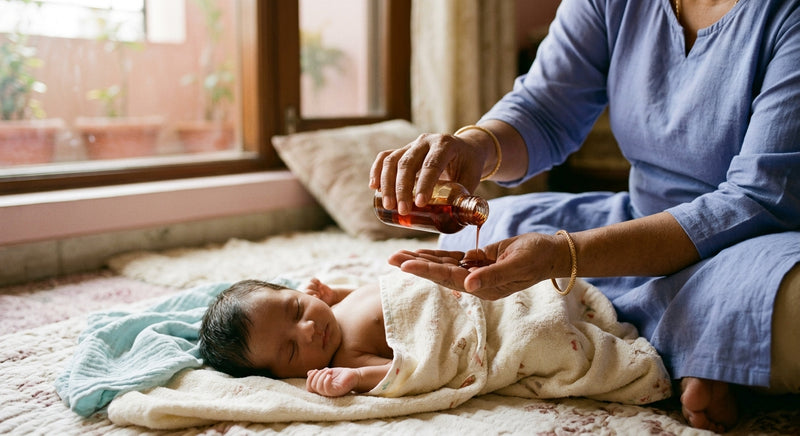
Massage oil on its own won't fix it. Oils are emollients — they soften and smooth — but they hold very little water in, and a patch short of water needs a humectant too. That's the reason a baby can have a daily malish and still have flaky shins. If it's the legs and arms you're seeing, we've written about dry patches on a baby's legs and arms separately.
2. Pityriasis alba — the one that scares parents most
Pale, faintly scaly, coin-sized ovals on the cheeks or outer arms, usually on a child whose skin is already a bit dry or eczema-prone. Extremely common. More visible in deeper skin tones. It often shows up after a long sunny stretch or a dry winter, and it doesn't itch much. Hold your baby at arm's length and you'll notice you can't say exactly where the patch stops — that missing edge is the detail worth describing to your paediatrician, who is the one to put a name to it.
What wears parents down is the timeline. It clears on its own, but over weeks to months, not days. Sun darkens the skin around it, so the patch looks whiter by contrast — for a baby that means shade, a wide-brimmed hat and long sleeves, not a big sun-protection routine. Your paediatrician can confirm it in one look. Worth doing, if only so you can stop searching at midnight.
3. Drool and milk irritation
Saliva carries digestive enzymes, and a chin that goes wet-then-dry twenty times a day loses its lipids fast. Shiny first, then tight, then flaky and pale. The same thing happens in a neck fold where milk dribbles down and sits there, and humid coastal weather makes it quicker. Watch the pattern, not the patch: worse on teething days, worse after an afternoon in a damp bib, better on the days you remembered to barrier it.
Three things actually help. Pat the chin dry with a soft cotton cloth instead of wiping — wiping is friction, and the friction is what's injuring the skin. Change the bib the moment it's damp, not at the next feed. And put a thin layer of a bland barrier balm around the mouth before feeds and before sleep, while the skin is still fine. Fabric matters more than most parents expect, too; we go into it in our note on cotton versus synthetic clothing for eczema-prone babies.
4. Fungal patches
Two of these turn up in Indian homes. Ringworm is one: a patch with a raised, scaly rim that grows slowly outward while the middle clears. The other is pityriasis versicolor — many small, finely scaly pale spots across the neck, chest or upper back when the weather is hot and damp. It's uncommon in small babies, though monsoon humidity and a sweaty fold make it possible. Both usually itch at least a little. Neither improves with moisturiser.
A three-question check you can do tonight
Do it in daylight if you can, or under one warm lamp. Mixed tubelight and phone torch will mislead you.
- Stretch it. Gently stretch the skin flat between two fingers. If the pale look mostly vanishes and normal colour comes through, you're looking at surface scale rather than lost pigment — the dry end of this list. Your paediatrician is the one to put a name to it.
- Light it from the side. Hold a torch at a shallow angle across the patch. Dry scale throws visible texture and tiny shadows. A patch that stays smooth and evenly pale with a sharp border is a different question, and one for your doctor.
- Photograph it. Same spot, same light, same time of day, one photo daily for seven days, with your fingertip in frame for scale. A week of photos tells you more than a week of staring.
What to put on it, and what to look for on the label
I sign off formulations for a living, so this is the part I have real opinions about. A moisturiser for a dry white patch has three jobs. Most products bought in a hurry do one.
- A humectant to pull water into the top layer — glycerin, colloidal oatmeal, honey-derived humectants.
- An emollient — light oils, ghee, butters — to fill the gaps between lifted cells so the skin feels smooth again.
- An occlusive to slow water loss, or the first two are wasted. It's why a balm beats a watery lotion on a properly dry patch.
Read the first five ingredients on the INCI list. That's roughly where the bulk of a formula sits; everything sprinkled in below it is mostly a story. For babies I'd skip urea at exfoliating strengths, salicylic acid, fruit acids, and heavy fragrance or essential-oil blends — natural is not a synonym for mild, and a chin already sore from drool doesn't need a bouquet of botanicals on top. One more thing: a jar you dip damp fingers into needs a proper preservative system. An unpreserved "chemical-free" tub sitting in a 34°C Indian bathroom worries me far more than a well-chosen preservative ever has. Patch test anything new on the inner forearm for two days first.
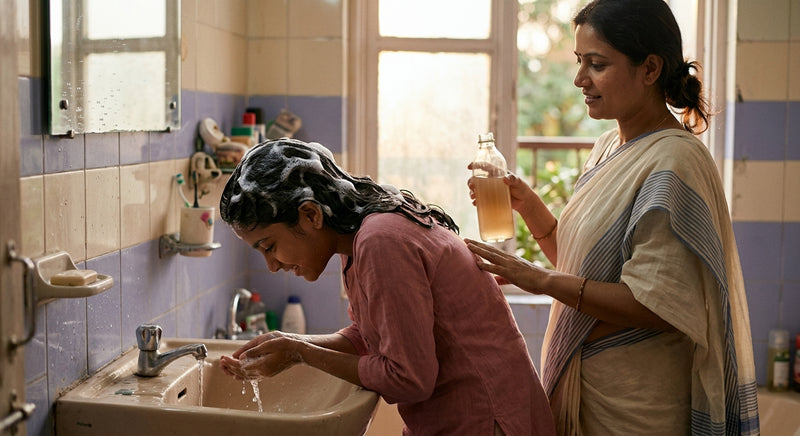
Then look at what you're washing with, because that's often the actual culprit. Hard water plus a high-pH soap bar leaves skin squeaky. Parents read squeaky as clean; skin reads it as stripped. What to look for is a mild syndet-style wash closer to skin pH, used only on folds, hands and the nappy area; what you wash with is worth as much attention as what you put on afterwards — our Head to Toe Baby Foam Wash is built for exactly that job. Keep the bath short and lukewarm; our bathing routine for a baby with eczema has the full sequence.
Do this tonight
- Bath under 10 minutes, water lukewarm — test with your inner wrist, not your hand.
- Cleanser on folds, hands and the nappy area only. Plain water everywhere else.
- Pat dry with a soft towel and stop while the skin is still slightly damp.
- Moisturise within 3 minutes — generously, over the patch and about 5 cm beyond its edge.
- Repeat in the morning, after the first nappy change.
- Fresh cotton bib the moment the old one is damp; barrier balm around the mouth before feeds and before sleep.
- Trim nails tonight; add cotton mittens if there's night scratching.
- One photo a day, same light, for a week.
What doesn't help
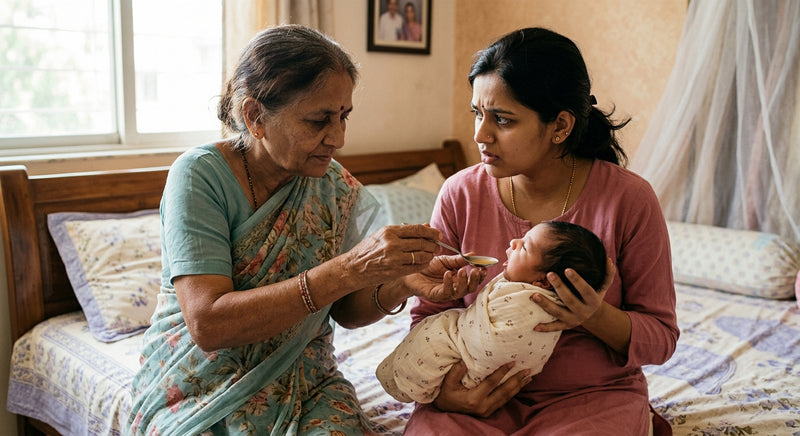
Deworming syrup, given because someone said white patches on the face mean worms. They don't — and no medicine should go into a baby without your paediatrician. Calcium supplements, same story. Scrubbing the patch with ubtan or a loofah: ubtan has a real place in Indian baby care, but a scaly patch isn't it, and abrasion only lifts more scale. And never, at any age, a fairness or bleaching cream. There is nothing here to lighten, and those products have no business near a baby.
When to see a doctor
- A milky-white patch with a sharp, clean border and no scale that isn't changing.
- A patch that spreads outward with a raised scaly rim, or spots multiplying across the chest and back.
- Itching that disturbs sleep, or any weeping, yellow crusting, swelling or warmth.
- A patch where your baby doesn't seem to feel a light touch the way she does elsewhere.
- Any patch in a baby under 3 months old.
- No visible change after two weeks of consistent twice-daily moisturising.
- Fever, poor feeding, or a baby who simply seems unwell.
None of that means something is seriously wrong. It means the answer needs trained eyes and not a search bar, and a paediatrician can usually settle it in one appointment.
For the dry, flaky, barrier-short patches that make up most of what parents worry about, the boring answer wins: a rich balm, twice a day, for a fortnight. Our Hydra Healing Moisturizing Balm was formulated to comfort dry, sensitive skin and help support the skin's natural barrier, with increased Keratin-10 and Filaggrin expression seen in a lab study.
In summary
- Stretch the patch and light it from the side — if the paleness lifts and you see fine scale, it's dryness or pityriasis alba, not lost pigment.
- Match the pattern to the place: shins and outer arms mean dryness, chin and neck folds mean drool, spreading scaly rims mean fungal.
- Moisturise twice daily on damp skin within three minutes of a bath, covering 5 cm beyond the patch edge, for a full 14 days before judging.
- Choose a moisturiser that combines a humectant, an emollient and an occlusive, and swap a soap bar for a mild pH-appropriate wash if your water is hard.
- See your paediatrician for a milky-white sharp-edged patch, a spreading scaly rim, a numb patch, any baby under three months, or no change in two weeks.
Frequently asked questions
Are white patches on my baby's face a sign of worms or calcium deficiency?
No. This is one of the most persistent beliefs in Indian families, and it isn't supported by evidence. Pale patches on a baby's cheeks are far more often dry skin or pityriasis alba, both of which respond to moisturising and time. Never give deworming syrup or calcium supplements for a skin patch without your paediatrician's advice.
Will the white patch on my baby's cheek go away on its own?
Usually, yes. Simple dryness often improves within one to two weeks of twice-daily moisturising and a gentler wash. Pityriasis alba fades on its own, but slowly — weeks to months, sometimes across a season. Keep moisturising, keep her out of strong sun, and photograph the patch weekly so you can actually see the change rather than guess at it.
Can I just put coconut oil on the white patch?
Coconut oil softens skin and does no harm for most babies, but it works only as an emollient. A dry white patch is short of water as well as lipids, so oil alone tends to make it feel smoother without making it fade. Applying a proper moisturiser on damp skin within three minutes of a bath does considerably more.
How do I know it isn't vitiligo?
Depigmented patches typically look milky-white with a sharp, clean border and no scale, and they don't change with moisturiser. The four common causes here all involve dryness or scale and hazy edges. If a patch on your baby fits that milky-white, sharply-edged description, don't self-diagnose or self-treat — book your paediatrician, who can examine it properly.
Does sunlight make white patches on babies worse?
Sun doesn't cause pityriasis alba, but it makes it far more obvious: the surrounding skin darkens while the patch doesn't, so the contrast sharpens. For babies, manage this with shade, a wide-brimmed hat, long light sleeves and avoiding 11am-4pm outdoor time rather than with heavy sun-care routines. Talk to your paediatrician before using sunscreen on a baby under six months.
Can hard water be causing the dry white patches?
Often, yes. Hard borewell water leaves mineral and soap residue on skin and raises its pH, which weakens the barrier and produces exactly this dusty, flaky look. Shorten baths, drop the soap bar for a mild pH-appropriate wash used only where it's needed, and finish with a final lukewarm rinse. Moisturise within three minutes of patting dry.