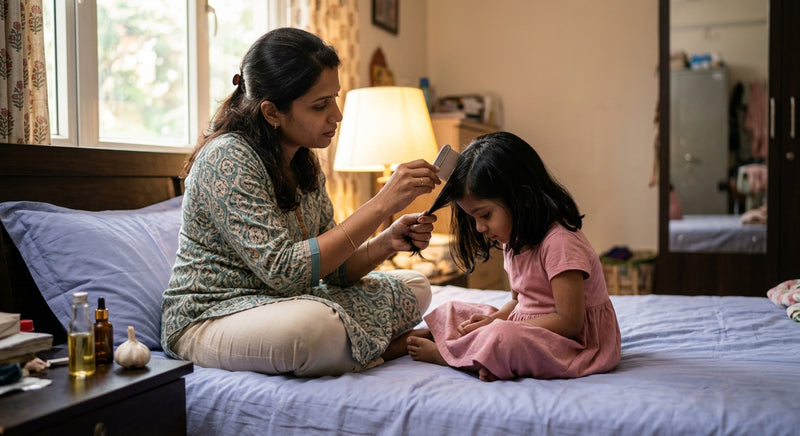
It usually starts with a note in the school diary. Or your child scratching the same spot behind the left ear, third evening running. Everything after that comes down to the comb-out. And most of us get it wrong for one small, fixable reason. We start combing hair that is still full of tangles.
The short answer: use a metal comb with long, rigid teeth spaced less than 0.3 mm apart. Wash the hair, coat it in conditioner, detangle it completely with a wide-tooth comb first, then work through soaking-wet, slippery hair in 1 cm sections, scalp to tip, wiping the comb on a white tissue after every single stroke. Give it 20–40 minutes. Repeat every third day for two weeks.
At a glance
- A nit comb's teeth sit closer together than a louse egg is wide. Plastic combs with visible gaps between the teeth cannot do this job.
- Eggs are glued to the hair shaft. They don't shake out; they have to be scraped off, which needs one unbroken stroke from scalp to tip.
- A tangle stops that stroke dead. Detangle first, or the comb-out barely works at all.
- Wet, conditioner-slicked hair is the easiest version of this task: lice stay still, hair lies straight, the comb glides.
- One comb-out is never enough. Every third day for two weeks is the cycle that matters.
- Nothing you comb with is a treatment. If you find live lice, ask your paediatrician or pharmacist about a medicated lotion and comb alongside it.
Which comb actually gets nits out?
Head lice glue their eggs to individual hair shafts, almost always within a centimetre of the scalp, with a cement that water and shampoo don't dissolve. So the comb isn't sieving anything loose out of the hair. It scrapes. Its teeth have to be closer together than the egg is wide, stiff enough not to spring apart under tension, and long enough to pass through the full thickness of Indian hair without the hair bunching above them.
That rules out most of what's in the house.
| Comb | What it does with nits | Honest verdict |
|---|---|---|
| Long-tooth metal nit comb (steel teeth, ~5–7 cm long, micro-grooved) | Teeth sit tight enough to scrape eggs off the shaft; rigid, so they don't flex open mid-stroke | The one to buy. Costs more than the others and is the only one that reliably does the actual work |
| Plastic lice comb (the free one in the lotion box) | Catches adult lice reasonably well; teeth flex apart and ride over eggs | Useful as a spare for a second adult combing at the same time. Not your main comb |
| Fine-tooth kanghi (plastic or wood) | Combs hair. Gaps are far too wide for eggs | Fine for smoothing afterwards; does nothing for nits |
| Electronic / battery "zapper" comb | Marketed at live lice; teeth are spaced for buzzing, not scraping, and it must be used on bone-dry hair | Skip it. Dry hair means lice run, and you lose the one advantage water gives you |
| Wide-tooth comb | Nothing — and it isn't meant to | Essential, but as the first comb, for detangling. Not a nit comb |
Why detangling first changes the whole job
Picture the stroke you need. Comb tips flat against the scalp, then one smooth pull all the way to the ends. That stroke is where the scraping happens. Now put a knot 4 cm down. The comb stops, you tug, your child jerks away, and you move on to another section, leaving every egg below that knot exactly where it was. I've watched parents comb for forty minutes and cover maybe a third of a head, because the tangles quietly decided which parts got done.
Then there's slip. Conditioner-coated hair lets fine metal teeth travel instead of catching, so they stay in contact with the shaft the whole way down. That contact is what pops eggs off. On dry, fluffy, frizzy hair the comb bounces. Bouncing misses.
The part most people leave out is cooperation. You need a seven-year-old to sit still for half an hour. With tangles you get about eight painful minutes before the evening collapses. Detangled, combing stops hurting and the whole thing turns boring instead of traumatic. You have a scalp check ahead of you every three days for a fortnight, so boring is exactly what you want. If the school has sent a general alert, our calm step-by-step plan for a lice outbreak at school covers the household side: who to check, what to wash, what to leave alone.
Practically: wash with a mild shampoo so the scalp isn't already irritated from scratching. A gentle, tear-free kids' shampoo is the right register here, because you'll be washing far more often than usual this fortnight. Then load the hair with conditioner. Don't be delicate about the quantity.
Wet, dry or oiled — which way should you comb?
All three happen in Indian homes. They don't work equally well.
| Method | Good at | Trade-off |
|---|---|---|
| Wet + conditioner | Lice stay put in water-saturated hair instead of scattering; hair lies straight and sections cleanly; best glide; nits show up clearly against a white tissue | Needs a bath first, so it's a 45-minute commitment including drying |
| Dry | Quick spot-check between full sessions; easier to see nits against the shaft in daylight | Lice move and relocate; static and frizz make the comb skip; hurts more. Not a substitute for a full comb-out |
| Coconut-oil soaked | Excellent slip, and a familiar, comforting routine for most Indian kids | Oil hides nits on the comb — you can't tell what you've removed; the clean-up is a job in itself. Workable, but wipe the comb on tissue twice as often |
Oil is a reasonable fallback when a full bath simply isn't happening. A power cut in a Nagpur May. A child already melting down. Treat it as the fallback it is, and go back to the wet method the next session.

The comb-out, step by step
- Set up by a window in daylight, or with a lamp plus your phone torch. Old bedsheet or towel over your child's shoulders, a bowl of hot water beside you, a stack of white tissues, and something to watch — this takes as long as an episode.
- Shampoo, rinse, then apply conditioner generously and leave it in. Do not rinse it out.
- Detangle completely with a wide-tooth comb, tips first, working upward in small handfuls until a comb passes from scalp to ends with no resistance anywhere. Nothing further down this list works if you rush this.
- Divide the head into four quarters and clip three away. Work only on the open quarter.
- Take a 1 cm section — about the width of your little fingernail. Thicker than that and the teeth can't reach the shafts in the middle.
- Press the comb's teeth flat against the scalp, twist slightly so they touch skin, then draw one unbroken stroke to the very tip. Keep the hair taut with your other hand.
- Wipe the comb on a white tissue and look. Adults are sesame-seed sized and move. Nits are teardrop-shaped specks that stick. Rinse the comb in the hot water before the next stroke.
- Comb each section four times — two strokes with the comb's flat face, two with it rotated a quarter turn. Nits sit on one side of the shaft; one angle misses them.
- Pay extra attention behind both ears and along the nape. Most often that's where the oldest, most densely clustered nits are.
- Finish, rinse the conditioner out, and pour boiling water over the comb and clips. Bag the tissues and bin them outside.
How often, and for how long?
There is a reason behind the three days. Eggs hatch roughly a week to ten days after they're laid, and a newly hatched louse needs about another week before it can lay eggs of its own. Combing every third day means anything that hatched since your last session gets removed before it can start the cycle again. Stop after two good sessions because the head "looks clear", and you simply meet the next generation in ten days.

What we'd actually do
If you want one plan, this is ours. Buy a long-tooth metal nit comb, one per child, plus a spare plastic one so two adults can work in parallel on a sibling. Tonight: wash, condition heavily, detangle until a wide-tooth comb runs free, then wet-comb the whole head in quarters. If you find live, moving lice, ask your paediatrician or pharmacist for a medicated lotion and use it as directed. The comb-out runs alongside it, not instead of it. If you find only nits sitting more than a centimetre from the scalp and nothing moving, comb them out, repeat in three days, and keep checking — but whether that is an active case, and whether any medicated lotion is needed, is a call for your paediatrician or pharmacist, not something to judge from an article.
Keep the detangling habit after this is over. Smooth, knot-free hair is faster to check, so you catch the next school round in week one instead of week three. And if your child's hair knots badly by nature, our Journal pieces on kids' hair tangles and conditioner by age go deeper into that.
Mistakes that waste the whole hour
Combing dry, so the lice relocate while you work. Taking sections the width of your palm. Starting at the middle of the hair instead of at the scalp, where every egg actually is. Forgetting the nape. And stopping at session two.
When to see a doctor
Book an appointment with your paediatrician if the scalp has open sores, crusting, oozing or yellow scabs from scratching; if the glands at the back of the neck are swollen or your child has a fever; if live lice are still present after two full courses of a medicated lotion used exactly as directed; if the child is under two, or you're pregnant or breastfeeding and need a safe option; if you see anything near the eyelashes or eyebrows; or if the itch comes with scaly rings, bald patches or a rash elsewhere on the body — ringworm and scabies are common, treatable, and routinely mistaken for lice. A doctor can also confirm whether what you're seeing is lice at all, which saves weeks of unnecessary combing.
For the detangling half of all this, what matters is slip: look for a conditioner light enough to use far more often than usual for a fortnight, and slippery enough that a nit comb can travel from scalp to tip in one unbroken stroke. Our Rejuvenating & Detangling Conditioner is the one we make for that job — it comforts dry hair and makes combing comfortable, and like any conditioner it is not a lice treatment.
In summary
- Buy a long-tooth metal nit comb — plastic teeth flex open and ride straight over the eggs.
- Detangle the hair completely with a wide-tooth comb before the nit comb touches it; one knot cancels a whole section.
- Comb wet with conditioner left in, in 1 cm sections, scalp to tip, four strokes at two angles, wiping the comb on white tissue each time.
- Repeat the full comb-out every third day for two weeks — two good sessions are not enough to break the cycle.
- Never use kerosene, insect spray or pet products on a child's scalp, and see your paediatrician for sores, swollen neck glands, or lice that persist after two proper lotion courses.
Frequently asked questions
How do I know if I'm using a real nit comb or just a fine-tooth comb?
Hold it up to a window. A nit comb's steel teeth sit so close together that the comb looks almost solid until you tilt it; you should not see easy daylight along the full length of the gaps. The teeth should also be long, around 5 to 7 cm, and stiff enough that they don't spring apart when you pull them through thick hair.
Should I comb my child's hair wet or dry for nits?
Wet, with conditioner left in. Water-saturated hair keeps lice still instead of letting them scatter, hair lies straight so sections stay neat, and the comb glides rather than skipping. Dry combing is fine as a quick between-session check in daylight, but it hurts more, creates static, and lets lice relocate while you work. It isn't a substitute for a full wet comb-out.
Why does detangling have to happen before nit combing, not after?
Eggs are glued to the hair shaft near the scalp, so they only come off when the comb makes one unbroken stroke from scalp to tip. A single knot stops that stroke partway, and everything below it stays untouched. Detangle fully with a wide-tooth comb first and the nit comb can reach every centimetre of every strand — which is the difference between a thorough session and a wasted one.
How often should I comb, and when can I stop?
Do a full comb-out every third day for two weeks. Eggs hatch about a week to ten days after they're laid, and a new louse needs roughly another week before it can lay its own, so a three-day rhythm clears each new batch before the cycle restarts. Stopping after one or two sessions is the most common reason lice seem to come back.
Does conditioner kill lice?
No, and nothing in this routine should be sold to you as a treatment. Conditioner's job here is slip — it lets fine metal teeth travel the full length of the hair and scrape eggs off, and it makes combing comfortable enough that a child will sit through it. If you find live, moving lice, ask your paediatrician or pharmacist about a medicated lotion and keep combing alongside it.
Can I use coconut oil instead of conditioner for the comb-out?
You can, and the glide is excellent. The drawback is visibility: oil coats the comb, so you can't tell what you've actually removed when you wipe it on tissue, and every nit check becomes guesswork. If you go the oil route, wipe the comb twice as often and work in strong daylight. For a full session, washed and conditioned hair is the easier version.