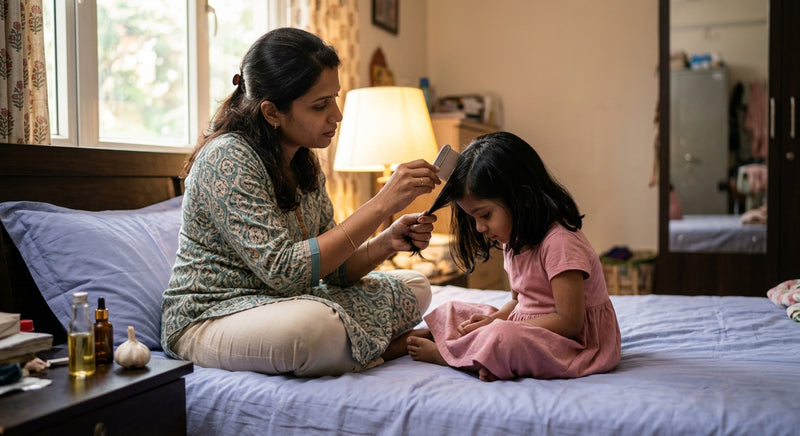
A steel katori, held upside down over a lit diya all night. By morning there is fine black soot on the inside of it, ready to be mixed with a little ghee. In plenty of Indian homes that is the sixth-day ritual, or the one after mundan, and it is done out of love. The answer is still no. Kajal should not go in or on a baby's eyes — not the homemade diya soot, not the herbal one, not the branded tub with a lead-test report on the back. What surprises parents is the reason. It has nothing to do with the recipe. You can change what goes into the tub. You cannot change where it drains.
I run formulation and manufacturing at Janma. We have been asked to make a baby kajal more than once, and it would sell — kajal moves in every chemist shop in the country. The answer has been no every time. Below is the reasoning we used, including the comparison I would put in front of a worried parent.
At a glance
- The hazard is the route of exposure, not the recipe. Anything on the lid margin lands in the tear film and drains into the nose and throat.
- Homemade kajal is unsterile from the first minute, and gets recontaminated every time a finger goes back into the katori.
- A heavy-metal test report solves one problem out of four. It says nothing about sterility, particle irritation or drainage.
- Kajal does not make eyes bigger or lashes grow. There is no mechanism for it.
- If the ritual matters, and in most homes it does, move the dot. Behind the ear, on the sole, on the cheek — washed off at bath.
Why can't a "safe" baby kajal exist?
Formulation controls three things: what goes in, how clean it stays, and how it behaves on the surface it sits on. For an eye-area product on a baby, the third one is where the whole thing falls apart.
The eyelid margin is not skin the way a cheek is skin. It sits at the border of the conjunctiva, a mucous membrane: wet, absorptive, with no stratum corneum to slow anything down. Whatever you line it with mixes into the tear film within minutes and gets spread across the eye with every blink. Then it drains, through two pinhole openings at the inner corner (the puncta), into the nasolacrimal duct, into the nose, into the throat. Your baby swallows a fraction of everything you put on that lid. That is not a flaw. That is the plumbing working exactly as it should, and no chemist can design around it.
Now add a baby's hands. They rub, and they rub hard, especially when something feels gritty. A pigment particle and a rubbing fist is how corneas get scratched. The same fist then goes into the mouth.
Four risks, stacking: heavy metals, microbes, scratchy pigment particles, and whatever gets swallowed through the tear duct. An ingredient list speaks to the first one. We wrote a longer guide to judging baby product safety around exactly that gap — read the panel, then ask where the product is going.
What a formulator actually checks before anything goes near an eye
This is the standard we work to at our own GMP unit in Nagpur. It is also why kajal cannot meet it, in a kitchen or in most of the market.
Microbial limits. ISO 17516 sorts cosmetics into tiers. Products for children under three and products for the eye area sit in the strictest one: no more than 100 colony-forming units per gram, with Staphylococcus aureus, Pseudomonas aeruginosa and Candida albicans absent in a gram. Pseudomonas is the name to know here. It is the organism most associated with serious eye infections, it loves water and fat, and a humid Indian kitchen offers plenty of both.
Preservative challenge testing. A challenge test (ISO 11930) deliberately inoculates the product with those organisms and checks that the formula kills them down over 28 days. That test exists because real life is a jar that gets opened, fingered, left on a warm bathroom shelf and used for months. Homemade kajal has no preservative system at all. Ghee and oils go rancid; the soot gives them something to feed on. By week two you are lining an eye with an unpreserved fat that has been finger-dipped forty times.
Particle size and grade. An eye-area pigment has to be cosmetic grade and tightly specified. Lamp soot is not that. It is unburnt carbon carrying whatever else the flame didn't finish. Nobody can specify it at home, and no report on a finished tub tells you what those particles will do once a baby drags a fist across a cornea.
Label-reading is a skill worth building for everything in the nursery. It is the same habit that tells you what is really inside Indian baby wipes. It just can't rescue a product whose problem is the place it goes.
Homemade, herbal or branded: an honest comparison
Parents rarely ask whether kajal is safe. They ask whether their kajal is safe, because theirs is homemade, or lead-tested, or from a brand they trust. Fair question. Here it is, straight.
| What families use | What actually happens | Our verdict |
|---|---|---|
| Homemade diya-soot kajal in ghee or almond oil | Unsterile from minute one, no preservative system, and the fat turns fast in Indian heat. A shared finger recontaminates it daily. Soot is unburnt carbon plus combustion residue. | No. The love in it is real. The safety isn't testable. |
| Branded "herbal, chemical-free" baby kajal | Cleaner ingredient list, often a heavy-metal report. Still a pigment paste on the lid margin, still draining through the tear duct, still opened and re-dipped for months. | No. Better recipe, same route. |
| Imported surma or kohl brought by family | These have repeatedly turned up in public-health testing with very high lead. The US FDA has never approved kohl as a colour additive and blocks its import outright. | Strongest no on this list. Bin it, don't pass it on. |
| A kajal dot away from the eye — behind the ear, on the sole, on the cheek | Keeps every pigment particle out of the eye. Still an unpreserved paste on thin baby skin, so it can irritate a sensitive baby. | The workable compromise. Small dot, washed off at bath. |
| Nothing near the eye at all | Tears clean the eye continuously and do it better than anything you can add. The lid margin and the puncta stay clear. | What we would do. Every time. |
Does kajal make eyes bigger or lashes thicker?
No. Worth saying plainly, because it is the reason most families keep going. Eye size is bone: the orbit is set, and a line of pigment only draws an outline around it, which washes off by evening. Lash growth happens inside the follicle, under the skin. A paste sitting on the lid margin never gets there. What it can do is block the meibomian gland openings that run along that exact edge, and a blocked lid turns sticky and crusty. Parents read that as the eye pushing the dirt out. So more kajal goes on.
The "cooling" and "cleaning" logic hits the same wall. A healthy eye cleans itself. Watering, blinking, the tear film — that is the entire system, and adding oil-bound pigment to it is the opposite of cleaning.
Keeping the ritual, without the eye
Most families I have talked to are not attached to the eye at all. They are attached to the protection: to nazar, to doing the thing that has always been done for a new baby. That deserves an answer, not a lecture.
The kaala teeka already has a version that lives away from the eye. A small dot behind the ear, or on the sole of the foot, or low on one cheek. Same meaning, nothing anywhere near the conjunctiva, and it comes off in the evening bath. When an elder reaches for the katori, hand them the baby and point at the spot. You are not refusing the ritual, only moving it off the eye.
The line I use: "Aai, the teeka stays — it just doesn't go in the eyes, so we do it here now." Short, no blame, done.
Kajal has already been going on. What to do tonight
None of this is an emergency, and please don't scrub a small face in a panic. Pigment already in the lid margin clears over a few days on its own. The tears do it.
- Stop applying from today. That is the entire intervention.
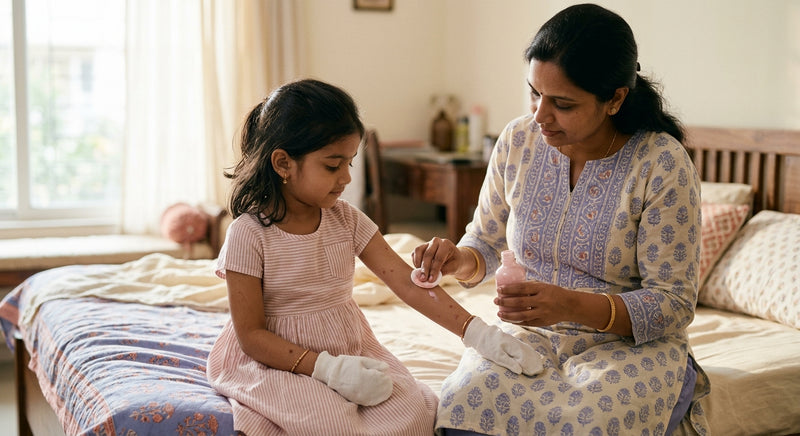
- Wash your hands. Then wipe each eye once with a clean soft cloth or sterile gauze moistened with cooled boiled water, inner corner outward, a fresh surface for each eye. Never the same wipe twice.
- Skip cotton wool wisps near the eye; loose fibres are their own irritant. And don't dig at the lid edge trying to lift pigment out.
- At bath, wash the face with a tear-free baby wash and rinse well with plain water. Use something genuinely mild and dermatologically tested — the face is where a stinging formula shows up first.
- Throw the shared katori or tub out. Don't save it for the next baby.
- If a dot is going on skin instead: keep it small, keep it off broken or drool-wet skin, take it off at bath.
- Watch for two or three days. By the end of the week the eye should look clear and white.
We take the same line on the rest of the traditional nursery shelf. There is a straight read on whether talc-free baby powder is actually safer elsewhere in the Janma Journal, and we have looked separately at what lead testing on kajal really shows.
When to see a doctor
This is not written to scare you. Blocked tear ducts are common in the first year and usually settle by themselves, and most babies who have had kajal are completely fine. A doctor is simply the right person to look at an eye. No formulator, me included, can do that from a distance.
What we would actually do
Nothing in the eye. Not a line, not a dot, no exception for "just for the photo" or "only on the waterline, for nazar". If the ritual matters in your home, move it behind the ear and keep it. If a relative lands with surma from abroad, thank them and bin it quietly.
One principle outlasts this stage: a test report tells you what is in a product. It never tells you whether that product belongs where you are about to put it. We hold our own range to that, which is why it has a wash, a balm and a lotion, and will never have a kajal.
If you are washing kajal off a small face tonight, use something built for the job. Our tear-free Head to Toe Baby Foam Wash will clean the face gently, and nothing else needs to go near those eyes.
In summary
- Stop applying kajal in or on your baby's eyes — homemade, herbal and lead-tested versions all carry the same risk.
- The danger is the route, not the recipe: anything on the lid margin enters the tear film, drains into the nose and gets swallowed.
- A heavy-metal report covers one risk out of four and does nothing about sterility, pigment irritation or drainage.
- Keep the ritual by moving the teeka behind the ear, on the sole or on the cheek, and washing it off at bath.
- Clean crusting with cooled boiled water on fresh gauze, and see your paediatrician for redness, discharge or a swollen lid.
Frequently asked questions
Is homemade kajal safer than store-bought kajal for a baby?
No. Homemade kajal avoids added dyes, but it has no preservative system and is unsterile from the first minute — soot in ghee, stored warm, and finger-dipped daily. Eye-area products must meet the strictest microbial limits precisely because organisms like Pseudomonas cause serious eye infections. Homemade preparations cannot be tested against that standard at home.
Is lead-free or herbal kajal safe for babies then?
A heavy-metal report solves one risk out of four. It says nothing about how sterile the tub stays after weeks of finger-dipping, about pigment particles scratching a cornea when your baby rubs, or about the product draining through the tear duct into the nose and being swallowed. Those risks come from where kajal goes, so no formulation removes them.
Does kajal make a baby's eyes bigger or lashes thicker?
No. Eye size is fixed by the bony orbit and lashes grow from follicles below the skin, which a paste on the lid margin never reaches. Kajal only outlines the eye visually until it washes off. It can block the tiny oil-gland openings along the lid edge, which produces crusting parents often mistake for the eye cleaning itself out.
Can I put a kajal dot behind the ear or on the foot instead?
Yes, that is the sensible compromise and it keeps the ritual intact. A small dot away from the eye means no pigment reaches the conjunctiva or tear duct. It is still an unpreserved paste on thin baby skin, so keep it small, avoid broken or drool-damp skin, and wash it off at bath time each evening.
How should I clean my newborn's eyes if not with kajal?
Tears do most of the work. For visible crusting, wash your hands, moisten a clean soft cloth or sterile gauze with cooled boiled water, and wipe once from the inner corner outward — a fresh surface for each eye, never reused. Skip cotton wool wisps, which shed fibres. If discharge is yellow, green or persistent, see your paediatrician.