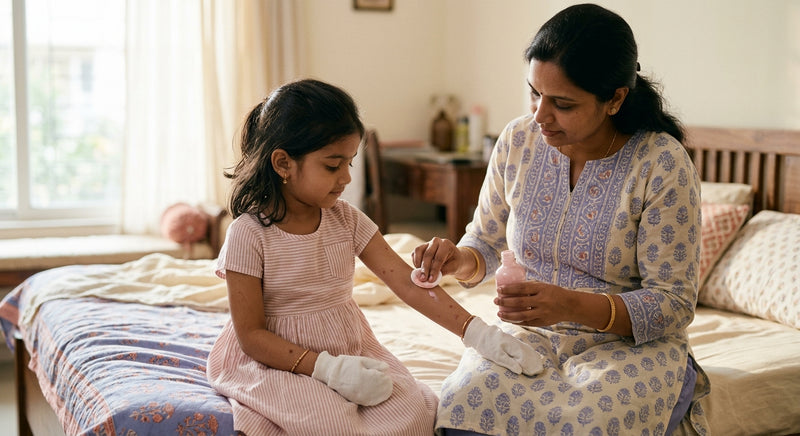
Here's a line I hear at least once a week, usually from a dad: “It's just a mild body wash — why can't my six-year-old use mine?” Fair question. On the shelf, an “adult sensitive” wash and a “kids gentle” wash can look almost identical, and the cynical read is that the kids' version is the same liquid with a cartoon on the bottle and a higher price.
The short answer: a genuinely well-made kids' body wash is not watered-down adult wash, and a good one differs in real, measurable ways — a milder surfactant system, a skin-friendly pH, far less (or no) fragrance and dye, and no actives like salicylic acid or strong exfoliants that adult washes often carry. But it's also true that plenty of “kids” products are pure marketing. So the honest job here is to tell you which differences actually matter, so you can spot a real one.
At a glance
- The biggest real difference is the surfactant system — what does the cleaning. Kids' formulas should use milder ones.
- A child's skin is thinner and its barrier still maturing, so harsh cleansers strip it faster than they'd strip yours.
- Adult washes often carry actives (salicylic/glycolic acid, strong fragrance, menthol, scrubby beads) a child's skin doesn't need.
- “Kids” on the label guarantees nothing — read the ingredient list and the pH, not the mascot.
- For most kids over 3, one gentle wash a day is plenty; you don't need a shelf of products.
If you like getting under the hood on these decisions, this fits into our complete guide to head-to-head skincare comparisons — the same “what actually differs” lens, applied product by product.
Myth: “Kids' body wash is just diluted adult wash”
Sometimes it genuinely is — and that's the frustrating part. A lazy brand can take a base formula, drop the fragrance load a little, print “for kids,” and charge more. That version deserves your scepticism.
But a properly formulated kids' wash is a different build from the ground up. The change isn't dilution; it's substitution. You swap the ingredients that clean aggressively for ones that clean gently, and you leave out everything a child's skin has no use for. Let me show you where that actually happens.
Where the formula really differs
1. The surfactant system (this is the big one)
Surfactants are the molecules that lift oil and dirt off skin and let water rinse it away. They're the engine of any wash. The difference between a stripping cleanser and a kind one is almost entirely here.
Older, cheaper adult washes and most bar soaps lean on strong surfactants — the sulfate family (SLS/SLES) at higher levels, or high-pH soap salts. They clean brilliantly and foam like a dream, but they don't stop at dirt: they pull out the skin's own lipids too. On an adult that means a bit of tightness. On a child, whose barrier is thinner and holds water less well, the same surfactant strips faster and dries harder.
A good kids' formula uses milder, often amino-acid-derived or coco-based surfactants (you'll see names like sodium cocoyl isethionate, coco-glucoside, sodium lauroyl sarcosinate) at gentler concentrations. They foam a little less enthusiastically — that's the trade-off — but they respect the barrier. If you want the deeper version of this, we compared the main baby cleanser types and what suits Indian skin.
2. pH
Healthy skin sits slightly acidic — its “acid mantle” protects against bacteria and keeps enzymes working. Traditional soap is alkaline (pH 9–10), which pushes skin's pH up and takes time to recover. A well-made kids' wash is pH-adjusted to sit close to skin's own range, so it cleans without disturbing that mantle. Many adult shower gels are fine here too — but a lot of “fresh, foamy” adult washes and all true soaps are not.
3. Fragrance, dyes and “extras”
Adult washes are often sold on experience — heavy perfume, menthol tingle, bright colour, exotic botanicals. Fragrance is one of the more common triggers for irritation and contact reactions, and a child's thinner skin gives it an easier route in. A sensible kids' formula either drops fragrance or keeps it minimal and allergen-screened, and skips the dyes and the tingle. We wrote about when fragrance is actually a problem and when it isn't if you want the nuance rather than a blanket rule.
4. Actives your child doesn't need
This is the one parents miss most. Grown-up washes increasingly carry actives: salicylic acid or glycolic acid for exfoliation, physical scrub beads, high-dose essential oils, anti-acne agents, strong antibacterials. None of that belongs on a healthy child. A kids' formula leaves it out on purpose.
| In the formula | Typical adult body wash | Well-made kids' body wash |
|---|---|---|
| Main surfactants | Stronger (higher sulfates / soap) | Milder (amino-acid / coco-based) |
| pH | Varies — often alkaline | Close to skin's own range |
| Fragrance & dyes | Often heavy, for “experience” | Minimal or none, screened |
| Exfoliating acids / scrubs | Common (AHA/BHA, beads) | Left out on purpose |
| Menthol / tingle / strong oils | Sometimes | No |
Why a child's skin needs the gentler build
This isn't precaution for its own sake. A young child's skin is structurally different from yours: the outer layer is thinner, it loses water more readily, and the barrier is still maturing. That means two things — anything harsh does more damage per wash, and anything that penetrates (fragrance, actives) gets a slightly easier ride in.
Add the Indian layer to this. In hard-water cities — much of the north and west — the calcium and magnesium in your tap water react with soap-based washes to leave a drying, faintly gritty residue on skin, which makes a stripping cleanser feel even harsher. A low-soap, pH-friendly formula rinses cleaner in that water. In humid, sweaty months a child may genuinely need a proper wash daily; in dry Nagpur-style winters, over-washing with the wrong product is a fast route to flaky, itchy legs.
So — can I just use my mild adult wash on my kid?
Honestly? Occasionally, in a pinch, if your wash is a genuinely gentle, fragrance-light, sulfate-free, pH-balanced one with no actives — it won't harm a healthy child once. The problem is that most adult washes fail at least one of those tests, and you can't tell by the foam. The tingle you like, the perfume you enjoy, the “exfoliating” line you bought for your own rough skin — those are exactly the parts a child doesn't need.
What I'd steer you away from entirely: regular bath soap and “deep clean / oil control” adult washes on kids, and anything medicated unless a doctor told you to use it.
What to look for in a kids' body wash
- Mild surfactants first on the list (sodium cocoyl isethionate, coco-glucoside, sarcosinate)
- pH-balanced / close to skin's natural range
- Fragrance-free or minimal, allergen-screened fragrance
- No salicylic/glycolic acid, scrub beads, menthol or strong essential oils
- Dermatologically tested, and honest about what's inside
- A texture that rinses clean in hard water without a squeaky, tight after-feel
And remember the second half of bath time: cleansing is only gentle if you follow it with moisture, especially in winter and after a hard-water rinse. Which cream texture suits the season is its own decision — we broke down lotion vs cream vs balm for Indian weather so you're not guessing.
When to see a doctor
Switching to a gentler wash fixes a lot of everyday dryness and mild irritation. It won't fix a genuine skin condition, and a wash is not a treatment. See your paediatrician or a dermatologist if you notice any of these:
- Persistent red, itchy, weeping or crusted patches that don't settle with a gentle routine — this can be eczema, which needs proper care
- Skin that stays dry, cracked or intensely itchy despite switching products and moisturising
- Any rash with fever, spreading redness, pus or that clearly hurts your child
- A reaction — stinging, hives, swelling — right after a new product, in which case stop it and get advice
When you do want a wash built to this brief — mild surfactants, skin-friendly pH, no needless extras, made and tested for children over 3 — our Kids Gentle Body Cleanser was formulated exactly around the differences above.
In summary
- The real difference is the surfactant system — kids' washes should use milder cleansing agents, not just less of the same.
- Choose a pH-balanced, fragrance-light formula with no exfoliating acids, scrub beads or menthol for a child.
- A child's thinner, still-maturing skin is stripped and irritated faster than an adult's by harsh cleansers.
- “Kids” on the label proves nothing — read the ingredient list and check for a mild first surfactant.
- For most kids over three, one gentle daily wash plus a moisturiser is all a healthy routine needs.
Frequently asked questions
Is kids' body wash just watered-down adult body wash?
A well-made kids' wash isn't dilution — it's substitution. It uses milder surfactants, a skin-friendly pH, and leaves out fragrance, dyes and actives like salicylic acid that adult washes often carry. That said, some “kids” products are only marketing, so read the ingredient list rather than trusting the label or the cartoon on the front.
Can my child use my mild adult body wash?
Occasionally, if yours is genuinely gentle — sulfate-free, fragrance-light, pH-balanced and free of exfoliating acids or menthol. The trouble is most adult washes fail at least one of those, and you can't tell from the foam. Regular soap and “deep clean” or medicated adult washes should be kept off a child's skin.
Why can't kids use regular soap?
Traditional soap is alkaline (around pH 9–10), which pushes skin's naturally acidic pH up and strips its protective lipids. A child's skin is thinner and its barrier still maturing, so it dries out faster than yours. In hard-water Indian cities, soap also leaves a drying residue. A low-soap, pH-balanced wash cleans without disturbing the barrier.
What ingredient should a good kids' body wash start with?
Look for a mild surfactant near the top of the list — sodium cocoyl isethionate, coco-glucoside or a sarcosinate — rather than high levels of sulfates (SLS/SLES) or soap salts. It should also be pH-balanced and free of exfoliating acids, scrub beads, menthol and heavy fragrance. Those are the parts that actually protect a child's skin.
How often should a child use body wash?
For most kids over three, one gentle wash a day is plenty — more in hot, sweaty, humid weather, less in dry winters when over-washing causes flaky, itchy skin. You rarely need a whole shelf of products. One mild cleanser plus a moisturiser afterwards covers everyday care for a healthy child.