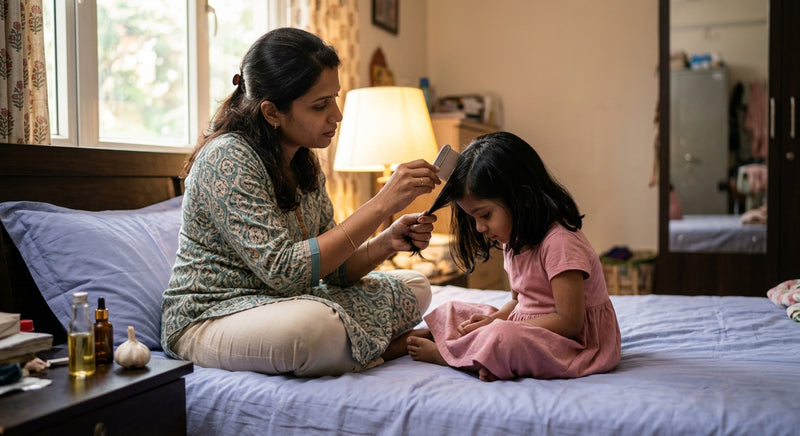
It's 7:10am. The school van honks in five minutes, and there's a knot the size of a marble behind your daughter's ear that the comb just will not pass. You grab a bottle. But which one — the detangler spray you spotted at the chemist, or the conditioner already sitting in the bathroom? I get asked this all the time, and the honest answer is that they aren't rivals. Their jobs overlap. The right pick comes down to your child's hair, the routine you can actually keep up on a Tuesday morning, and — this one catches people off guard — the season.
At a glance
- A rinse-out conditioner does the heavy repair — it smooths the cuticle and cuts comb friction the most.
- A detangler spray is a leave-in, no-rinse quick fix for dry hair on busy mornings.
- Both work by the same chemistry: positively-charged conditioning agents that cling to damaged hair.
- Indian weather changes the answer — monsoon frizz and hard water need more conditioning; a dry AC winter needs leave-in slip.
- You don't have to choose one forever. Most kids do best with a conditioner in the bath and a spray for touch-ups.
If you want the bigger picture on why tangles happen in the first place, we've written our complete guide to detangling kids' hair. This piece zooms right in on the product decision.
What's the actual difference between a detangler spray and a conditioner?
Short version: a conditioner is a concentrated, rinse-out treatment for the bath. A detangler spray is a diluted, leave-in mist for dry or damp hair, no washing out. Same family. Different dose, different delivery.
Here's what's happening on the strand. Every hair is wrapped in overlapping scales called the cuticle — think tiles on a roof. When those tiles lift, whether from friction, hard water, sun or sweat, strands snag on each other and you get tangles. Both products carry cationic (positively-charged) conditioning agents, often ingredients with names like behentrimonium or cetrimonium. Damaged, tangle-prone hair carries a slightly negative charge, so these agents are pulled straight to the roughed-up spots that need them. They lay the cuticle flat, coat the strand, and drop the friction so the comb glides.
A rinse-out conditioner does all this at a higher concentration. It sits on the hair for a minute or two before you wash the excess away, so it deposits more, and more evenly. A detangler spray is lighter and water-based, and it stays put. It gives you slip on demand — but it can't reach the same depth of smoothing.
Detangler spray vs conditioner: a side-by-side
| Rinse-out conditioner | Detangler spray | |
|---|---|---|
| When you use it | In the bath, after shampoo | On dry or damp hair, anytime |
| Rinse out? | Yes | No — leave-in |
| How much it smooths | Most — deeper, more even | Enough for a quick pass |
| Best for | Weekly wash day, very knotty or curly hair | School mornings, midday re-tangles, touch-ups |
| Time it takes | 2–3 extra minutes in the bath | Under a minute |
| Risk if overused | Can feel heavy on fine hair if not rinsed well | Product build-up if layered day after day without a wash |
Which one does the Indian season call for?
Most buying guides stop at hair type. But a child's hair behaves very differently across a Nagpur summer, a Kerala monsoon and a Delhi winter — and that shifts the whole answer.
Summer heat & sweat
Scalp sweat and dust turn hair sticky, and it clumps at the nape and behind the ears. Kids are washing more often too. So a light conditioner on wash days keeps the cuticle smooth without weighing the hair down, and a spray comes in handy after evening play when nobody has time for a full bath.
Monsoon humidity
Humidity is frizz season, plain and simple. Damp air swells the hair shaft and lifts the cuticle, so strands catch on each other and puff up — and frizzy hair tangles more. This is when a rinse-out conditioner really pays off: the fuller coating tames that swelling in a way a light mist can't. A spray on top helps with flyaways, but it's playing backup here.
Dry winter & the AC months
Cold, dry air — and a night under the air-conditioner — pulls moisture out of hair. That's what gives you static, snapping strands and morning bird's-nests. Now a leave-in detangler spray does its best work: that thin layer of slip stays on all day and heads off the dry-friction tangles that usually show up by afternoon.
Hard water — the year-round wildcard
Much of India runs on hard water, and this one surprises parents. The calcium and magnesium in it leave a mineral film on hair that roughens the cuticle, so strands feel straw-like and snag-prone no matter the season. If your hair and your child's both feel rough and dull, hard water is a likely culprit. A conditioner helps counter that rough feel after each wash — the same reason we get into it in why your child's hair tangles so much.
So which does YOUR child need?
Go by the hair in front of you, not the label on the shelf.
- Fine, mostly-straight hair, few tangles? A light conditioner on wash days is usually all you need. Skip the daily spray.
- Curly, coily or long hair that knots by lunch? Use both — conditioner in the bath, a spray for re-tangles.
- Chaotic school mornings? A leave-in spray on the ends, comb, done. Save the deep condition for the weekend.
- Post-swim, chlorine-rough hair? Conditioner first to smooth the cuticle, spray later if it re-tangles.
And honestly, the technique matters more than the bottle. Always work from the ends up, never from the scalp down — start at the tips, clear small sections, then move up. Comb on damp (not soaking) hair with a wide-tooth comb. We break the full morning method down in our guide to detangling long hair before school.
What to look for on the label
I formulate these products, so here's what I check before anything else:
- A cationic conditioning agent — this is what gives the slip. Without it, a "detangler" is mostly water and fragrance.
- Tear-free and mild — kids get product near their eyes; gentleness isn't optional.
- A sensible fragrance load — lightly scented is fine; heavily perfumed hair products can bother a sensitive scalp.
- Age suitability — a formula built for children's finer hair, not a scaled-down adult product.
For a rinse-out option that leans on gentle conditioning agents and detangles kids' and curly hair without a heavy after-feel, our Rejuvenating & Detangling Conditioner is made for exactly this — use it as your wash-day base, and keep a spray for touch-ups if your child's hair needs it.
When to see a doctor
Detangling is a comfort issue, not a medical one — but a few things do call for a paediatrician or dermatologist rather than a new bottle. See a doctor if your child has patches of hair loss, broken or bleeding skin on the scalp, persistent flaking or itching, or round scaly bald spots (which can signal a scalp infection, not just tangles). Sudden matting with scalp soreness deserves a check too. When the scalp itself looks unwell, treat the scalp first — no detangler fixes that.
In summary
- A rinse-out conditioner does the deep smoothing on wash day; a detangler spray is a leave-in quick fix between washes.
- Both work by depositing positively-charged conditioning agents that flatten the cuticle and cut comb friction.
- Match the product to the season: conditioner for monsoon frizz and hard water, leave-in spray for dry winter and AC static.
- Always comb damp hair from the ends upward with a wide-tooth comb, working in small sections.
- See a doctor for scalp hair loss, broken skin, persistent itching or round scaly patches — those aren't a detangling problem.
Frequently asked questions
Can I use a detangler spray instead of conditioner?
For quick touch-ups, yes — but not as a full replacement. A rinse-out conditioner is more concentrated and smooths the cuticle more deeply on wash day. A leave-in spray is lighter and made for convenience between washes. Most kids do best using the conditioner in the bath and keeping a spray for busy mornings or midday re-tangles.
Is a leave-in detangler safe for children's hair every day?
A gentle, child-appropriate leave-in spray is fine for daily use on the lengths and ends. Avoid the scalp, keep it away from the eyes, and wash hair with a mild shampoo every few days so product doesn't build up. If the scalp looks irritated or flaky, pause the spray and check with a doctor before continuing.
Which is better for frizzy hair in the monsoon?
Humidity swells the hair shaft and lifts the cuticle, which causes both frizz and tangles. A rinse-out conditioner tames this better than a light spray because it coats the strand more fully. Use the conditioner on every wash through the monsoon, and add a detangler spray on top only if flyaways or afternoon re-tangling are still a problem.
How do I detangle without hurting my child?
Work on damp, not soaking, hair with a wide-tooth comb. Always start at the ends and clear small sections, then move upward toward the scalp — never drag the comb from root to tip through a knot. Apply conditioner or a detangler spray first for slip, hold the hair above the knot to reduce pulling, and go slowly.
Does hard water make my child's hair tangle more?
Yes. Much of India has hard water, and the calcium and magnesium in it leave a film that roughens the cuticle, making hair feel rough and snag-prone. A conditioner after each wash helps counter that rough feel. If hair stays dull and straw-like despite conditioning, hard water is a likely cause — a filter or a periodic clarifying wash can help.