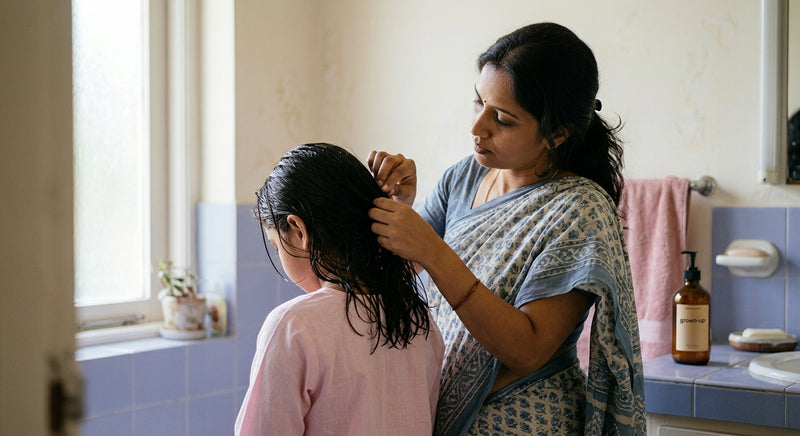
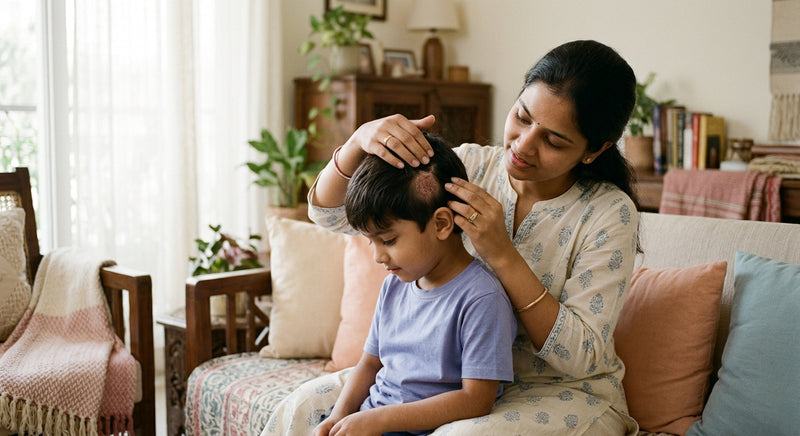
Eleven at night. The scratching has finally stopped, the baby is asleep on your arm, and you have two tabs open, Mustela Stelatopia in one and Janma in the other, trying to pick one before you lose the will. This question lands in my DMs more than almost any other.
Direct answer first. For eczema-prone baby skin, the brand name is rarely what decides whether a moisturiser helps. Three things do. Whether the formula is a real barrier-repair emollient rather than a watery lotion. Whether it's fragrance-free. And whether you actually put on enough of it, twice a day. Two well-made ranges will both clear that bar. What differs between them is where and by whom it's manufactured, what testing the maker can show you on request, how the texture behaves in Indian humidity, and the cost per gram when your child is getting through 150–200g a month.
At a glance
- I won't tell you what's inside another brand's tube. Formulas get reformulated and differ by market. The carton in your hand is the only authority.
- Judge any eczema-prone product on four things: fragrance, emollient richness, pack size against price, and the evidence the maker will show you.
- Janma is made in our own GMP-certified facility. We own our formulations. That's a verifiable fact you can hold us to.
- Our in-vivo testing recorded visibly calmer skin in as little as 1 day (24- and 36-month subjects), and a lab study showed increased Keratin-10 and Filaggrin expression.
- No moisturiser treats eczema. Not ours, not anyone's. A well-made emollient helps support the skin's natural barrier and comforts dry, sensitive skin. Medicated creams are a paediatrician's call.
What most "X vs Y" posts get wrong
Search this comparison and you'll find pages that confidently list a competitor's full ingredient deck, what it lacks, and why it loses. Most of that is guesswork, lifted off a three-year-old marketplace listing.
I'm not doing that. Mustela Stelatopia is a real range, a lot of Indian parents buy it, and many of them are happy with it. I haven't lab-analysed the tube sitting in your Amazon cart. International formulations change between markets and get reformulated over the years, and a cosmetic chemist guessing out loud isn't being useful to you, only loud. What I can give you is the method I'd use myself, standing at the chemist's counter with both cartons in hand, plus the Janma facts you can go and check without taking my word for any of it. This sits inside our complete guide to comparing baby skincare head to head, where we run the same method over cleansers, shampoos and sunscreens.
What an "eczema-prone" formula actually has to do
Atopic skin isn't dry skin that got worse. It's a barrier that leaks. The outermost layer, the stratum corneum, is built like a brick wall: flattened corneocytes as the bricks, a lipid mortar of ceramides, cholesterol and free fatty acids holding them together. In atopic skin that mortar is thin and the bricks never mature properly. So water evaporates outward and irritants walk inward.
The protein at the centre of all this is filaggrin. It bundles keratin filaments so skin cells flatten into proper bricks, and as it breaks down it becomes the skin's own natural moisturising factor, the amino acids that hold water inside the top layer. Reduced filaggrin function is one of the best-established features of atopic skin in the published literature. Keratin-10 is its structural partner in that same maturation step. Which is why, in formulation work, we don't chase "hydration" by itself. We look at whether a formula nudges those barrier proteins in the right direction. Hydration without barrier repair has washed off by morning.
Five things that actually differ between two eczema ranges
Run this on both cartons. Mustela's, ours, or the third one your paediatrician mentioned. A minute each, no expertise needed.
| What to compare | How to check it in 60 seconds | What Janma can show |
|---|---|---|
| Fragrance | Scan the INCI list for "Parfum" or "Fragrance". Where it sits in the list matters less than the fact that it's there at all. On broken, itchy skin I'd skip it. | Our formulations for dry, eczema-prone and diaper-area skin are dermatologically tested. |
| Emollient richness | Squeeze a pea onto your wrist. A cream for atopic skin should feel occlusive, and still be faintly there ten minutes later. If it vanishes like water, it's a lotion doing a cream's job. | A balm texture, deliberately — we formulate the richer format for barrier-compromised skin. |
| Evidence the maker will produce | Email the brand and ask: was this tested in vivo, on how many subjects, at what age? You'll know from the reply whether anyone has the data or is quoting a brochure. | In-vivo tested; visibly calmer skin in as little as 1 day (24- and 36-month subjects). Lab study showed increased Keratin-10 and Filaggrin expression. |
| Who actually makes it | Find the manufacturer's address on the carton, not just the marketer's. "Marketed by" on its own means somebody else made it. | Made in our own GMP-certified facility in Nagpur — we own our formulations. BioCert Organic, FDA Licensed (cosmetic mfg), BIS-compliant. |
| Cost per gram | Price divided by grams. Do it for both. Eczema care fails on under-application, and under-application is usually a price problem. | Our packs are sized for twice-daily use on a whole body, not for a face-only tube. |

Where Indian conditions change the answer
A formula built for a European winter and a formula built for Nagpur in May are solving different problems. At 80% humidity, a heavy occlusive can trap sweat in the neck folds and elbow creases and set off the exact itch you were trying to settle. Come December in Delhi with a room heater running all evening, that same richness is what the skin is asking for.
So the honest answer isn't "this brand wins". It's seasonal. What I tell parents: keep a richer balm for winter and flare weeks, and a lighter emollient for peak summer. We've broken that down properly in lotion vs cream vs balm for Indian weather. Your water matters as well. If the tap leaves a white ring around the bucket, those calcium salts are stripping surfactant residue onto the skin, and your cleanser is undoing more than your moisturiser can fix.
Which brings up the half of this comparison nobody makes. You can't out-moisturise a harsh wash. If you're switching creams, pick up the bottle the baby is being bathed with and look at that the same night. Our breakdown of which cleanser types suit Indian skin goes through why a syndet or a true foam wash behaves differently on atopic skin than a soap bar does. For babies, a tear-free head-to-toe foam wash dilutes the surfactant before it ever reaches skin, which is the whole point of the format.
What to do tonight, whichever tube you own
- Lukewarm water, under 10 minutes. Test it on your wrist, not your elbow. Hot water feels soothing and strips lipids.
- Cleanser only on the nappy area, hands, feet and neck folds. On a flare night, plain water is enough everywhere else.
- Pat dry, never rub, and leave the skin slightly damp.
- Moisturiser within 3–5 minutes of lifting the baby out, while the skin is still holding that water.
- Use far more than feels reasonable. For a one-year-old, roughly a 10-rupee-coin blob per limb. If it's fully absorbed in 30 seconds, you used too little.
- Downward strokes along the hair direction, not circles. Circular rubbing on atopic skin can provoke itch.
- Cotton clothing. Nails filed short tonight. Second application in the morning, before the day starts.

When to see a doctor
A moisturiser is supportive care, not treatment. Please see your paediatrician or a dermatologist if you notice weeping, yellow crusting, or spreading warmth and redness, which can signal infection. Also if the itch is breaking sleep most nights, if the skin is cracked and bleeding, if your baby is under three months with a widespread rash, or if there's no improvement after two weeks of consistent, generous moisturising. Medicated creams, including topical steroids, have a genuine and well-studied place in managing eczema. That is a doctor's prescription to make, and no cosmetic product substitutes for it.
So which one?
If Stelatopia is working for your child, stay with it. Honestly. A settled eczema routine is worth more than any upgrade. If you're choosing fresh, or what you're using isn't holding, compare on the five rows in that table instead of on the packaging, and email both makers about their testing. The one that comes back with specifics is the one I'd trust. We publish ours because we can: we make it ourselves, in our own facility, so there's no third-party manufacturer standing between a question and its answer.
For dry, eczema-prone skin that needs real barrier support, our Hydra Healing Moisturizing Balm is the one I'd reach for. Twice a day, generously.
In summary
- Compare any two eczema ranges on five things: fragrance, emollient richness, testing the maker will show you, who actually manufactures it, and cost per gram.
- Don't trust any article that lists what a competitor's tube contains — read the carton in your own hand, since formulas differ by market and change over time.
- Apply generously within three to five minutes of the bath, twice daily, on slightly damp skin — under-application is the most common reason emollients 'don't work'.
- Match texture to the season: a richer balm for winter and flare weeks, something lighter through peak humidity, and fix a harsh cleanser before blaming the moisturiser.
- See a paediatrician for weeping, crusting, bleeding cracks, sleep-breaking itch, or no improvement after two weeks — no cosmetic product replaces medical treatment.
Frequently asked questions
Is Mustela Stelatopia or Janma better for baby eczema?
Neither answer is universal. Judge both on the same five points: fragrance, how rich the emollient actually feels, what in-vivo testing the maker will show you, who physically manufactures it, and the cost per gram. Janma is made in our own GMP-certified facility and we own our formulations, so we can answer testing questions directly. If a product is already working for your child, consistency beats switching.
Can a moisturiser cure my baby's eczema?
No. No cosmetic moisturiser cures, treats or heals eczema, and any brand claiming it does is overstepping. What a well-made emollient does is help support the skin's natural barrier and comfort dry, sensitive skin, so flares tend to be less frequent and less severe. Medicated treatment, including topical steroids when appropriate, is your paediatrician's decision.
How much moisturiser should I actually use on eczema-prone skin?
Far more than most parents use. For a one-year-old, roughly a ten-rupee-coin blob per limb, twice daily, applied within three to five minutes of the bath while skin is still damp. If it disappears within thirty seconds, you under-applied. A 180g pack lasting a full month on a whole body is about the right consumption rate.
Should I switch creams if my baby's eczema flares?
Not immediately. Flares are often triggered by weather, a new detergent, hard water, heat or an illness rather than the cream. Change one variable at a time and give it ten to fourteen days before judging. Switching three products at once means you learn nothing from the outcome, and patch-test anything new on the inner forearm for forty-eight hours.
Does a balm work better than a lotion for atopic skin?
Usually, yes, in dry conditions. A balm carries more occlusive and emollient content, so it slows water loss from a leaky barrier far better than a watery lotion. In peak Indian humidity, though, a very heavy balm can trap sweat in skin folds and provoke itch, so many families do best alternating by season rather than committing to one texture year-round.
What is filaggrin and why does it matter for eczema?
Filaggrin is a protein that helps skin cells flatten into properly formed barrier bricks, and as it breaks down it becomes the skin's own natural moisturising factor. Reduced filaggrin function is one of the best-established features of atopic skin in published research. In a lab study, Janma's formulation showed increased Keratin-10 and Filaggrin expression, which is the barrier-support mechanism we formulate towards.