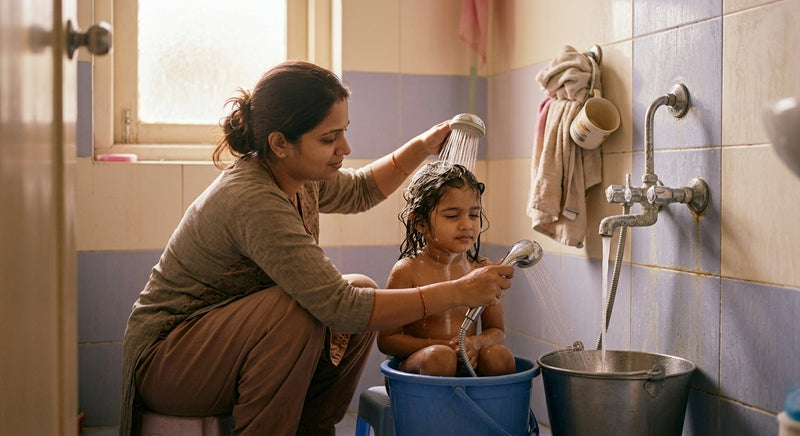
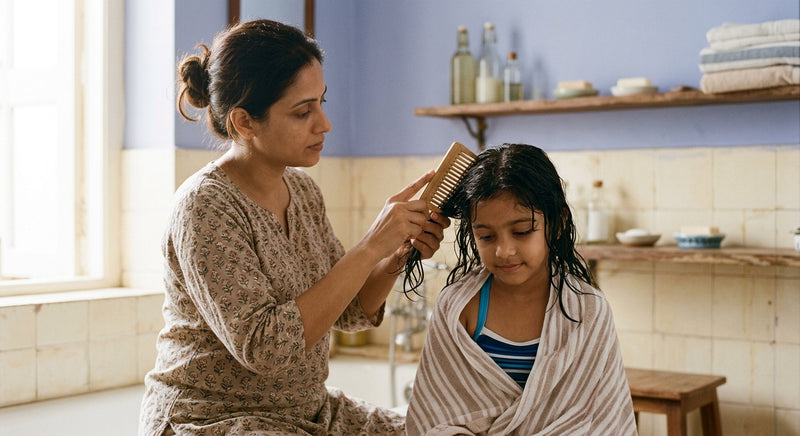
It's 6:50am. The hair got washed at 6:30. The bus comes at 7:15, and one tight plait would end this whole scene. Please don't.
Wet hair is the weakest hair your child has. Water gets into the strand, the internal bonds that hold it stiff temporarily let go, and the fibre stretches under a load it would normally shrug off. Bind it in that state and it dries locked into the stretched, creased shape you tied it in. Then there's the scalp. A damp plait in Indian humidity can still be damp at lunchtime, and a warm, wet, airless scalp is how an itchy, flaky, musty-smelling head starts. Wait until the hair is properly dry, or at minimum no longer cool to the touch, before any band goes near it.
At a glance
- Wet hair loses a lot of its strength. It stretches further and breaks more easily under the same pull.
- A braid holds that stretch for hours, and hair dries into whatever shape it was held in. That's why you see kinks and snapped ends at the band.
- The cuticle lifts when wet, so strands rubbing together inside a tight plait chip each other. Frizz, tangles, split ends.
- In monsoon, damp trapped against the scalp for hours is the bigger issue. Itch, flakes and smell follow.
- Sort out the drying and the styling sorts itself: squeeze with cotton, fan it, detangle with slip, braid only when it's dry.
Why damp hair gives way so easily
Water makes keratin stretchy, and stretchy hair snaps
Hair keratin holds its shape partly through hydrogen bonds. Those bonds are water-sensitive by design; that's the whole principle behind wet-setting a hairstyle. Soak the fibre and a good number of them release, water moves into the cortex, and the strand swells. Swollen, it stops behaving like a stiff wire and starts behaving like a rubber band. It extends much further before it gives. It also takes far less force to push it past the point where it doesn't spring back.
Now picture the elastic at the end of a school plait. Your child sleeps in it, sits through assembly, plays at break, and for six or seven hours the hair is under continuous low-grade tension while it dries around that band. That is the loading pattern that leaves the short broken ends parents notice near the tie and put down to "weak hair".
The cuticle lifts when it's wet
The outer cuticle is a layer of overlapping scales, like roof tiles. When the fibre swells, those scales lift slightly, and lifted scales catch on each other. Braid a hundred damp strands tightly together and they spend the whole morning grinding against their neighbours. Slow, quiet, completely invisible on the day. You see it six weeks later: a frizz halo, ends that won't sit flat, hair that tangles worse every wash.
Do that often enough, swell and bind and dry and repeat, and you get what we call hygral fatigue in formulation work: cumulative fatigue from repeated swelling and de-swelling cycles. Fine hair shows it first. Curly hair right after.
It dries in the shape you tied it in
Here's the bit most parents have never been told. Damp hair is being set, not just held. As it dries, new bonds form wherever the fibre happens to be sitting. A tight damp plait sets a crimp that lasts until the next wash, plus a crease exactly where the elastic bit in. That crease is a weak point. The next brush finds it.
Inside a damp braid, the scalp has the worse time
In most Indian homes this matters more than the breakage does. A thick braid is a dense, insulated bundle. It holds water against the scalp and the nape, blocks airflow, keeps that skin warm. The yeast and bacteria that live perfectly peacefully on every scalp are opportunists; give them warmth, moisture and hours of occlusion and their numbers shift. What a parent actually notices is itch behind the ears, small dry flakes on the shoulders of a navy uniform, and hair that smells faintly sour by evening even though it was washed that morning.
Oil compounds it. Sunday malish, a rushed shampoo, residual oil still sitting on the scalp, then a damp plait on top: you've laid an occlusive film over wet skin. Rinse properly, dry properly, or skip the plait. You need two of those three.
The season decides how bad this gets
The same braid behaves nothing alike in Nagpur in May and in Mumbai in July.
| Season | What the air does | What tends to show up | Do this instead |
|---|---|---|---|
| Summer (Mar–Jun) | Dry heat dries hair fast, but sweat re-wets the scalp all day | Sweaty, itchy scalp under a tight plait; salt residue; friction at the nape | Loose plait once dry; undo it the moment they're home; rinse the scalp on very sweaty days |
| Monsoon (Jun–Sep) | Air is already saturated — nothing evaporates. A thick braid can stay damp for hours | Persistent itch, flakes, musty smell, more tangling as the cuticle swells and re-swells | Wash at night, fan-dry fully, keep hair loose or in a soft low ponytail on humid days |
| Winter (Nov–Feb) | Cold air holds less moisture, but kids rush out of the bath and hair sits wet under a jumper collar | Cold, uncomfortable scalp; dry mid-lengths from heater air; breakage at the tie | Warm room, fan on low, dry fully before the school jacket goes on; never a wet bun overnight |
For the rains specifically, wash frequency and drying included, our full monsoon hair care guide for kids covers the whole routine. This piece is the narrower question of what the braid itself does.
And then there's your tap water
Hard water is underrated in all of this. Across much of central and western India the supply is hard, high in calcium and magnesium. Those minerals deposit on the hair shaft, combine with soap residue, and leave a rough, slightly chalky film. Rough hair holds water longer and tangles more, and the raised cuticle you already have from being wet gets no help at all.
So the hair that takes longest to feel dry is the same hair most likely to get braided damp. A final rinse from a mug of stored, cooler water helps the cuticle lie down. So does not skipping conditioner, which we'll get to.
"But dry hair is impossible to comb"
This is the real reason parents plait wet hair, and it's a fair reason. Dry, tangled, waist-length hair on a wriggling seven-year-old at 7am is a fight nobody wants. The fix sits upstream of the braid: make dry hair combable.
Detangling is best done while the hair is damp and slippery, with conditioner still on it or just rinsed off. That sounds like a contradiction and isn't. The damage from wet combing comes from friction and force, and a conditioner's entire job is to cut both. The cationic conditioning agents in a good kids' conditioner carry a positive charge, so they cling to the negatively charged, damaged patches of the cuticle and lay it flat. That is what lets a comb glide instead of drag. At your bathroom sink, it's the difference between tears and no tears.
- Squeeze the length in a cotton T-shirt or an old cotton dupatta. Don't rub with a terry towel — the loops grab lifted cuticle.
- Apply conditioner from mid-length to ends, never the scalp. Leave it a minute, rinse.
- Detangle now, while it's slippery: wide-tooth comb, start at the ends, work upward in sections.
- Let the hair out. Ceiling fan on, sections lifted off the neck for a few minutes.
- Do the cool test — run a hand down the length. Cool means still wet. Wait.
- Only then braid, and loosely. A soft fabric scrunchie, not a thin rubber band.
- Never send a child to bed with damp hair tied up. That's eight hours of occlusion, the worst version of this.
In a conditioner, look for light slip that rinses clean rather than a heavy coating, no strong fragrance load on a young scalp, and a formula built for fine child hair, which weighs down easily. Ours is a rinse-out detangling conditioner made for kids' hair, developed and manufactured in our own GMP-certified facility.
Is a damp bun any better?
A high wet bun is the worst of the lot. Most occlusive shape, slowest to dry, and steady tension right at the hairline where the hair is finest. If something must be done that minute, a loose low ponytail with a soft fabric tie is the least bad option. The loose and the low are doing that work. The ponytail isn't.
When to see a doctor
Most damp-braid trouble settles once the drying habit changes. Book a paediatrician or dermatologist if you see any of these instead of steady improvement.
- A round or oval patch where the hair is broken off short or missing, especially with scaling. That one needs a doctor, not a shampoo change.
- Scalp that is tender, swollen, oozing, crusted, or has boil-like bumps.
- Itch severe enough to disturb sleep, or scratching that has broken the skin.
- Flaking that keeps returning despite a proper drying routine and a mild wash.
- Visible thinning at the hairline or temples that doesn't recover after you stop tight styling.
- Any live lice or nits — that's a different problem with a specific treatment.
Nothing here is a diagnosis, and no cosmetic product treats a scalp infection. If something looks like an infection, it needs medical care.
The habit worth building
Change one thing and most of this goes away: hair gets tied only when it's dry. The cotton squeeze, the fan, the conditioner, the wide-tooth comb — all of it exists to make that possible inside the twenty-five minutes you actually have. Less tangling. Fewer snapped ends. No damp smell by Thursday. The rest of our kids' hair writing in the Janma Journal keeps landing on the same three things: less friction, less tension, and enough time to dry.
If mornings are a fight, a slippery, kid-appropriate detangling conditioner is the one change that makes dry hair combable. Once dry hair combs easily, the damp braid stops being necessary at all.
In summary
- Never tie damp hair — wet strands stretch and break under far less force, and they dry set into whatever shape the braid held them in.
- Check with the back of your hand: if the length still feels cool, it's still wet, so no band yet.
- In monsoon, wash long hair the night before and fan-dry it fully; a thick damp braid may not dry at all in saturated air.
- Detangle while damp and slippery with a kids' conditioner, wide-tooth comb, ends first — that's what makes dry hair combable in the morning.
- See a paediatrician or dermatologist for scaly patches of broken hair, tender or oozing scalp, sleep-disturbing itch, or thinning at the hairline.
Frequently asked questions
Is it really bad to braid my child's hair when it's damp?
Yes, for two reasons. Wet hair stretches under far less force than dry hair, so a braid holds it in a stretched, creased position for hours and it dries that way — which is where breakage at the band comes from. And a thick damp braid keeps the scalp warm, wet and airless, which invites itch, flakes and smell, especially through monsoon.
How dry should hair be before tying it?
Fully dry is ideal. The practical test is temperature: run your hand down the length, and if it still feels cool, water is still evaporating and it isn't ready. If you're short of time, a loose low ponytail with a soft fabric tie is far safer than a tight plait, because loose hair dries in a fraction of the time.
Can I comb my child's hair while it's wet, or is that damaging too?
Wet detangling is fine and often kinder — provided there's slip. The damage comes from friction and force, not water itself. Apply a conditioner mid-length to ends, leave it a minute, rinse, then use a wide-tooth comb starting at the ends and working upward in sections. Dry combing a tangled head is usually rougher than damp combing with conditioner.
Why does my daughter's hair smell even though she washed it this morning?
Most often it's a braid that never fully dried. Trapped moisture against a warm scalp for six or seven hours shifts the balance of the yeast and bacteria that normally live there, and a faint sour or musty smell by evening is the usual sign. Dry the hair completely before tying it and the smell typically settles within a couple of weeks.
Does oiling before a wash help protect wet hair?
It can. A light pre-wash oil sits on and partly within the shaft, which limits how much water gets in and how much the fibre swells during washing — less swelling means less cuticle lift. Use a small amount, keep it to an hour or so before the wash, and rinse thoroughly. Oil left on a damp scalp under a braid makes things worse, not better.
Is a wet bun overnight worse than a wet braid during the day?
Yes. A wet bun is the most occlusive shape there is, it dries slowest, and overnight means roughly eight uninterrupted hours of damp, warm scalp plus steady tension on the hairline. If hair must be washed at night, dry it fully with a fan before bed and leave it loose or in a very loose plait.