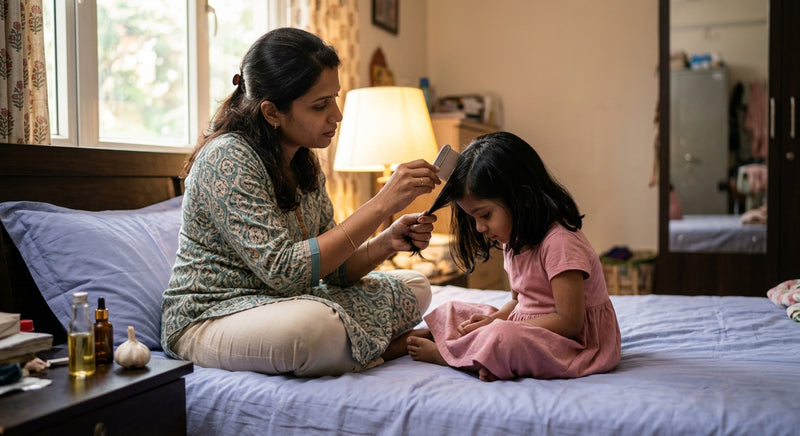
It's 11pm. You're about four months in, and your face has stopped making sense. Ten minutes after washing, your cheeks feel tight and papery. Your chin and jaw have three new spots that weren't there last week. And the moisturiser you've used happily for years is sitting on the shelf with a question mark over it.
Short answer first, because nobody wants an essay at this hour. A pregnancy-safe face moisturiser is a plain, well-preserved barrier cream — a humectant, an emollient and a light occlusive — with no retinoids, no hydroquinone, and no strong exfoliating acids left on the skin. The word "pregnancy" doesn't need to be printed on the front of the jar. What you want is a short ingredient list, a texture that suits how your skin is behaving this month, and a brand that can tell you where and how it was made.
The rest of this is the reasoning and the steps. For the wider picture — cleansers, actives, sun, trimester by trimester — our complete guide to pregnancy-safe skincare covers it. Come back here for the moisturiser decision.
At a glance
- Pregnancy skin often goes dry and oily at the same time — tight cheeks, congested chin. It's normal. Barrier and hormones, both at once.
- Look for glycerin, panthenol, squalane, oat, shea or ceramides high on the list. Skip retinoids, hydroquinone and leave-on strong acids.
- Go fragrance-free by default in pregnancy. Not because fragrance is dangerous — because your nose and your skin are both touchier than usual right now.
- Texture beats marketing. Gel-cream through the humid coastal months, cream for most people most of the time, balm on the dry patches only.
- Moisturise within about three minutes of washing, on damp skin, twice a day. That one change usually does more than switching brands.
Why does pregnancy make skin dry and spotty at once?
Three things are happening together, and they pull against each other.
Blood volume rises sharply and there's far more water moving around your body, which sounds like it ought to help. Often it doesn't — the outer layer of skin loses moisture faster than it holds it. Oestrogen shifts change how the barrier lipids behave, so the skin's own cling film gets leakier. Meanwhile androgen activity nudges the oil glands on the chin, jaw and back into overdrive. Parched cheeks, congested jawline. One face, one week.
The mistake I see most — and I've watched women in my own family make it — is treating the oily half and forgetting the dry half. Foaming face wash, twice a day. No moisturiser, because "my skin is oily now". Ten days later the barrier is so compromised that the skin overproduces oil and stings when you apply anything. It can look like an allergy, and only your doctor can tell you whether it is one — but a stripped barrier behaves this way too.
What actually makes a moisturiser pregnancy-safe?
I formulate for a living, so let me be unromantic about it. A moisturiser is three jobs stacked on top of each other, and a good one names all three on the label:
- Humectants pull water into the upper skin — glycerin, sodium hyaluronate, panthenol, sodium PCA, urea at low levels.
- Emollients fill the gaps between skin cells so it feels smooth — squalane, caprylic/capric triglyceride, shea butter, sunflower or almond oil.
- Occlusives slow water escaping — dimethicone, beeswax, kokum butter, petrolatum.
None of that is exotic, and none of it is a pregnancy problem. The genuine avoid-list for the face is far shorter than the internet suggests: retinoids in every form (retinol, retinyl palmitate, adapalene, tretinoin), hydroquinone, and high-strength leave-on exfoliating acids. The full reasoning, including what dermatologists usually allow instead, is in our honest breakdown of retinoids, hydroquinone and salicylic acid in pregnancy.
Two things from the formulation side that rarely come up:
Fragrance. Perfume in a face cream isn't a toxin. But pregnancy turns your sense of smell up, and a compromised barrier reacts more readily to fragrance allergens like linalool or limonene. Fragrance-free takes one variable off the table at the exact moment you can least afford extra variables. I'd call that housekeeping.
Essential oils. "Natural fragrance" usually means essential oils, and those sit among the more common contact irritants in cosmetics. If the scent comes from clove, cinnamon, peppermint or citrus oils, save it for later.
Which texture for which kind of skin?
Most wrong purchases happen right here. India isn't one climate, and you aren't the same skin in month three as in month eight.
| How your skin feels right now | Reach for | Why |
|---|---|---|
| Tight after washing, flaking around the nose, mild stinging | A fragrance-free cream with glycerin + ceramides or oat | Supporting the barrier takes water and lipids; a watery gel on its own just evaporates |
| Oily by noon, congested chin, but skin still feels tight underneath | A light gel-cream or lotion, non-comedogenic, twice daily | Skip the moisturiser here and the oil gets worse |
| Very dry, chapped patches — nose corners, mouth, eyelids | A balm, on those patches only, over your usual cream | The occlusive layer holds water in overnight; too heavy for a whole face in humidity |
| Reactive, red, burns with almost everything | Fewest ingredients you can find, fragrance-free, no actives at all for 2 weeks | Strip it back first, then reintroduce one product at a time |
In Nagpur in May, a balm on the whole face is unbearable — you can feel it sitting there. In Delhi in January, that same balm is the only thing standing between you and cracked cheeks. Same jar, opposite verdict. Buy for the season you're actually in.
How to read the label in 60 seconds
You're in a chemist's aisle with three tubes in your hand, or scrolling in bed with the baby-name tab still open. Either way, a minute is enough.
- Read the first five ingredients and stop. INCI lists run in descending order down to 1%, so those five basically are the product. Water, a silicone, an emulsifier, a thickener and nothing nourishing? The rest is decoration.
- Find the preservative — phenoxyethanol, sodium benzoate, potassium sorbate, benzyl alcohol. A water-based cream with a two-year shelf life and no preservative is either mislabelled or unsafe. This is the single most misunderstood thing in "clean" beauty.
- See where parfum/fragrance sits. High up means there's a lot of it. Best of all, it isn't there.
- Scan for the avoid-list: retinol, retinyl palmitate, retinaldehyde, hydroquinone, strong leave-on acids.
- Turn the pack over and look for a manufacturer name, address and licence number. In India, a cosmetic made in a licensed facility has to say so. If the pack names only a marketer, you're buying from someone who may not know their own formula.
That last one is a bias and I'll own it. We make everything in our own GMP-certified facility in Nagpur rather than white-labelling, so I've stood next to batches that failed stability at 40°C and never left the building. Knowing who can actually answer a question about a formula is worth more to me than anything printed on the front.
Your two-step routine for tonight
Tonight, exactly this. Four minutes, start to finish.
- Wash with lukewarm water, once at night. Not hot. In a hard-water city, hot water strips more than any cleanser does.
- Use a non-foaming or low-foaming cleanser — cream, milk, or a gentle gel. If your skin squeaks afterwards, it was too strong.
- Pat, don't rub. Leave the face slightly damp.
- Within three minutes, press on one fingertip-length of moisturiser — forehead, both cheeks, chin, nose — then spread. Damp skin gives a humectant more water to hold onto.
- A thin layer of balm on the dry patches only: nose corners, the crease beside the mouth, eyelids if they're flaking.
- Morning: rinse with water, moisturise, sunscreen. That's the whole thing.
- New product? Patch test on the inner forearm for 48 hours first. Pregnancy is not the time to discover a sensitivity on your cheek.
If you'd like it laid out properly across all three trimesters, including what to add back later, our trimester-wise AM/PM routine plan maps it week by week.
What about the breakouts — should I use something stronger?
Most of the time the fix is subtraction. Hormonal spots along the jaw and chin don't respond to scrubbing, and over-cleansing is the most reliable way to make them last longer. Wash twice a day at most. Don't stack an acid toner on a face that already feels tight.
If the breakouts are painful, cystic, or spreading, take that to your obstetrician or a dermatologist — there are options they can prescribe safely, matched to your trimester. What a moisturiser does in the meantime is help keep the barrier comfortable, so your skin isn't fighting on two fronts. That matters more than it sounds.
And the dark patches on my cheeks?
Darker patches across the cheeks, forehead or upper lip are common in pregnancy — your doctor or dermatologist is the one who can tell you what you're actually looking at. Whatever the label, sun exposure is the strongest lever you have over it — stronger than any cream. A mineral sunscreen with zinc oxide is the usual default in pregnancy: it sits on the surface rather than being absorbed, and it's less likely to sting reactive skin. Our Daily Defender mineral SPF 40 PA++++ was formulated for children's skin, which is exactly why it suits a face that has turned touchy — and adults use it just as happily. The humidity and white-cast problem gets a proper going-over in our piece on pregnancy-safe sunscreen for Indian weather.
When to see a doctor
Book an appointment instead of trying another cream if any of this shows up:
- Intense itching, especially on the palms and soles, particularly in the third trimester — with or without a rash. This needs checking urgently, the same day if possible.
- A rash that spreads quickly, blisters, weeps or comes with fever.
- Painful, deep cystic acne, or spots that are scarring.
- Skin that stings or burns with plain water and a bland moisturiser for more than a week.
- A mole that changes shape, colour or size during pregnancy.
None of this replaces your obstetrician or a dermatologist. It's the routine that sits underneath their advice.
The one thing to change first
If you change nothing else: stop washing with hot water, and moisturise on damp skin twice a day. Then give it two weeks before you judge any product. It's the change we'd suggest first to anyone who writes in saying their skin has gone mad in pregnancy. And after delivery the picture shifts again — what passes on its own and what needs care postpartum is worth reading before you throw anything out.
For the dry, reactive patches a light cream can't hold overnight, our Hydra Healing Moisturizing Balm is the fragrance-free, all-ages one we reach for. It's formulated to help support the skin's natural barrier, and it's made in our own facility, so we can tell you exactly what's in it.
In summary
- Choose a plain, fragrance-free moisturiser with a humectant, an emollient and a light occlusive — the ingredient list matters more than a pregnancy label.
- Avoid retinoids, hydroquinone and strong leave-on exfoliating acids on the face; check the first five ingredients and confirm a preservative is present.
- Match texture to your skin right now — gel-cream when oily and humid, cream for barrier repair, balm on dry patches only.
- Wash with lukewarm water and moisturise on damp skin within three minutes, twice a day, before you judge any product.
- See your obstetrician or dermatologist for intense itching on palms and soles, spreading or blistering rashes, painful cystic acne, or a changing mole.
Frequently asked questions
Is a normal face moisturiser safe in pregnancy, or do I need a special one?
A normal moisturiser is usually fine. Check the ingredient list for retinoids, hydroquinone and strong leave-on acids, and prefer a fragrance-free version while your skin is reactive. Products marketed specifically for pregnancy have no special safety status — the ingredient list is what matters, not the label on the front. If you are unsure about a specific ingredient, ask your obstetrician or dermatologist.
My skin is oilier in pregnancy. Should I skip moisturiser?
No. Skipping moisturiser on oily-but-tight skin usually makes the oiliness worse, because a stripped barrier compensates by producing more sebum. Use a light gel-cream or lotion instead of a rich cream, apply it twice daily on damp skin, and cut back on foaming cleansers. Most people see the shine settle within two to three weeks of that change.
Is hyaluronic acid safe during pregnancy?
Topical hyaluronic acid, usually listed as sodium hyaluronate, is a humectant that holds water in the upper layers of skin. It is widely considered suitable during pregnancy. One practical tip: apply it to damp skin and seal it with a cream on top, because in dry winter air an unsealed humectant can pull moisture out of the skin rather than into it.
Can I use my usual vitamin C serum while pregnant?
Topical vitamin C is generally regarded as acceptable in pregnancy, but sensitised skin often stings with higher-strength formulas. If your barrier is already reactive, pause all actives for two weeks, get the skin comfortable with just cleanser, moisturiser and sunscreen, then reintroduce one product at a time. Confirm anything you are unsure about with your doctor.
How do I tell if my moisturiser is causing the breakouts?
Stop the suspect product and change nothing else for two to three weeks. If spots appear within a few days of starting a product and always in the same area, that points to the product. Hormonal pregnancy acne tends to sit along the jaw and chin, comes in waves, and does not track with a specific product. Patch testing new items for 48 hours helps rule this out in advance.
What should I use on flaking eyelids and dry patches around my nose?
Use your regular moisturiser over the whole face, then a thin layer of a fragrance-free balm on those patches only, at night. Balms are occlusive, so they slow water loss overnight where the skin is thinnest. Applying a balm across the whole face is usually too heavy in Indian humidity and can feel congesting, so keep it targeted.