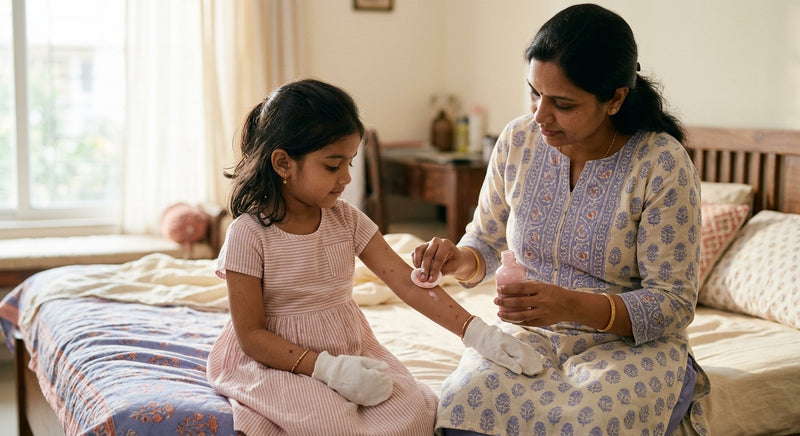
You spotted it while towelling her after a bath. A coin-sized patch on the outer thigh. Slightly raised, flaky at the edge, oddly calmer in the middle.
Ringworm (tinea) in children is usually a round or oval patch with a raised, scaly, itchy border and a quieter centre — a ring that gets wider over days, not smaller. There is no worm involved. It's a fungal infection living in the dead outer layer of skin, and it needs an antifungal your doctor prescribes. A moisturiser will not clear it. Get it confirmed, use exactly what the doctor writes, and keep it from travelling on shared towels, combs and damp clothes.
At a glance
- The giveaway is the edge: active, scaly, itchy rim with a clearer middle, and the patch widens week to week.
- Eczema is usually symmetrical and in the creases. Ringworm is usually one or two patches, anywhere, asymmetric.
- Do not start a chemist's combination cream containing a steroid. It calms the itch in two days and makes the infection spread wider and harder to recognise.
- Scalp patches with broken hair need oral treatment from a doctor — creams can't reach the hair follicle.
- Tonight: separate towel, cotton clothes, nails cut short, pat dry thoroughly, and a doctor's appointment before any cream goes on.
This article sits inside our complete guide to kids' bites, rashes and skin recovery, which covers the other itchy things that land on an Indian child in the same season.
How do I know it's ringworm and not eczema or a dry patch?
Look at the border, not the middle. Dermatophytes feed outward from where they landed, so the fungus is busiest at the rim — that's why you get a raised, slightly scaly, sometimes pimply edge with skin in the centre that looks almost normal. Run a fingertip across it. Ringworm has a lip you can feel. A dry winter patch doesn't.
Then give it a few days. Mark the edge mentally against something fixed — the waistband seam, the knee. Ringworm is noticeably wider by day four or five. Eczema flares and settles in the same place. It doesn't march.
Where it sits matters too. Eczema in kids is a creases-and-symmetry condition: both elbow folds, both knee hollows, cheeks. Ringworm turns up as one patch, or two or three unrelated ones, wherever the skin got friction and sweat — the thigh, the waistband, the neck under a collar, the scalp.
| What you're seeing | Likely | Behaves like |
|---|---|---|
| Round patch, raised scaly rim, clearer centre, getting wider | Ringworm (tinea) | Expands outward over days; itchiest at the edge; usually one or a few patches |
| Rough, ill-defined, dry patches in both elbow or knee creases | Eczema-prone skin | Comes and goes with weather and irritants; symmetrical; no advancing ring |
| Clusters of hard, very itchy bumps that keep reappearing in the same spots | Insect-bite reaction | New crops every few nights, often on exposed legs and arms |
| Flat pale or brown mark where a rash used to be, not raised, not itchy | Mark left behind after healing | Fades slowly over weeks to months; no edge, no spread |
Those recurring bumps in the third row fool a lot of parents into thinking the fungus is spreading — we wrote about that pattern in detail in itchy bumps that keep coming back. In practice, most cases get settled at the clinic in a minute: a dermatologist scrapes a few flakes from the edge, looks under the microscope, and you have an answer instead of a guess. Please don't diagnose this from a photo search at 2am.
Where did my child catch it — and why does it spread so fast here?
Dermatophytes want three things: warmth, dampness and friction. An Indian school day delivers all three. A 38°C afternoon. A polyester uniform. A PE kit that lives rolled up in a bag until Thursday. A shared cricket helmet, a kabaddi or wrestling mat, a barber's clippers, a cousin's cap passed around at a wedding, a towel on a hook between two siblings. Add monsoon humidity and nothing on a child dries properly.
Animals are the other big source. A new puppy or a street kitten carries a species of fungus that gives children beautifully textbook rings on the forearms and face. If the pet has a bald scaly patch, it needs the vet at the same time as your child needs the paediatrician — otherwise you'll be treating this on loop.

Why shouldn't I just use the cream the chemist gave me?
This is where I see things go wrong most often. Across India you can walk into a pharmacy, describe a ring, and be handed a combination cream — a potent steroid plus an antifungal, sometimes with an antibiotic as well. It feels brilliant for 48 hours. The itch stops, the redness fades, the parent relaxes.
Then what's actually happening catches up. The steroid switches off the local immune response, and that response is what was holding the fungus at the rim. The fungus keeps growing, now unopposed. The tell-tale ring loses its edge and its shape, the patch spreads much wider, and it becomes genuinely hard for even a specialist to recognise. Dermatology has a name for it — tinea incognito — because of how thoroughly it hides. Stop the cream and it rebounds worse than it started.
There's a formulation point underneath this, and it's one I care about as a cosmetic scientist. Potency on a child is not potency on an adult. A baby's skin is 20-30% thinner than an adult's, and a young child's isn't far behind — the same molecule at the same concentration penetrates more. On thin skin like the face, groin or armpit, a strong steroid applied for weeks thins the skin, leaves visible vessels and stretch marks, and those changes don't fully reverse.
Two things doctors wish parents knew. Finish the course: the skin looks normal well before the fungus is gone, and stopping at visual clearance is the commonest reason ringworm comes back in the same spot. Your doctor will usually keep you going past that point deliberately. And apply a thin layer a little beyond the visible rim, because that's where the live edge is — unless you've been told otherwise.
Creams simply cannot reach a fungus living down inside a hair follicle. Scalp ringworm — scaly patches with broken-off hairs or a bald area — is an oral-medicine situation, prescribed and monitored. No topical, however good, substitutes for that.

Can we still bathe, oil and moisturise?
Yes, and bathing daily helps. What matters is the two minutes after.
Drying is the step parents skip. Fungus thrives in warm, occluded, damp skin, so pat — don't rub — and do the folds last: groin, underarms, behind the knees, the neck crease. Use a different part of the towel for the patch, or better, a separate small cotton cloth you can wash daily.
On oil, my judgement: pause the heavy coconut-oil malish over the active patch while it's being treated. An occlusive film traps warmth and moisture against exactly the skin you're trying to dry out, and a layer of oil also sits between the skin and the prescribed antifungal, which has to get into the stratum corneum to work. Oil the rest of the body if that's your routine. Just not the ring.
For washing, keep it boring and mild. True soap sits at pH 9-10, and on a scratched, inflamed rim that stings and leaves the surrounding skin rougher and itchier — which drives more scratching. A fragrance-free syndet-style wash at a skin-friendly pH, like our Kids Gentle Body Cleanser, cleans without that sting. Nothing you buy off a shelf clears the fungus; that's the prescription's job. A gentle wash just stops you adding a second problem on top of the first.
- Cut and file the nails tonight — short nails do less damage during a 3am scratch.
- Switch to loose cotton. No tight elastic waistbands, no polyester shorts, no damp PE kit going back in the bag.
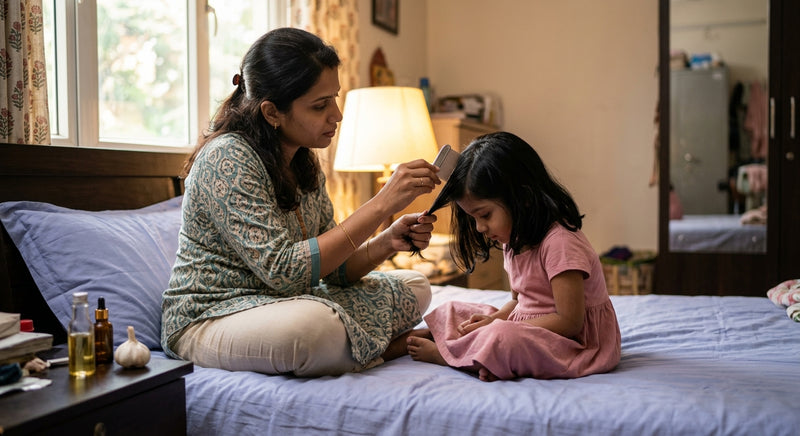
- Separate towel, separate comb, hot wash, sun-dry.
- Wash, pat completely dry, then the antifungal as prescribed — in that order, thin layer, slightly past the edge.
- Moisturise the rest of the body as usual; leave the active patch to the prescription.
- Check the whole family (and the pet) for rings and scaly scalp patches — treating one child while a sibling is quietly carrying it is how this becomes a three-month saga.
Scratching decides how the skin looks afterwards. Cool compresses, distraction and short nails do more than telling a child to stop — the tactics in how to stop a child scratching a healing patch apply here almost unchanged.
Expect a mark after the fungus is gone: a pale or slightly darker circle that can hang around for weeks. That is post-inflammatory pigment change, not leftover infection, and it behaves exactly like the marks we discussed in chicken pox marks: what actually helps. Sun protection and patience fade it. Scrubs, bleach and de-tan creams make it last longer.
When to see a doctor
Every suspected ringworm deserves a confirmed diagnosis, because the treatment is prescription-only and the lookalikes are treated completely differently. Go sooner — same week, ideally same day — if:
- The scalp, eyebrows or eyelashes are involved, or there's scaling with broken or missing hair.
- The patch is on the face, groin or around the nappy area.
- There are more than two or three patches, or one is spreading quickly.
- You've already applied a combination or steroid cream.
- There's pus, pain, swelling, a bad smell or fever.
- Your child is under two, has eczema-prone skin, is on steroids, or has any condition affecting immunity.
- It hasn't improved after about two weeks of prescribed treatment, or it returns soon after finishing.
Nothing here is a diagnosis. It's what to look at and what to ask. The scrape takes a minute and settles it.
Once your doctor confirms the skin has cleared, what's left behind is usually dry and scratched. A fragrance-free barrier moisturiser like our Hydra Healing Moisturizing Balm helps comfort it and supports the skin's natural barrier while the mark fades.
In summary
- Judge the edge, not the middle: a raised, scaly, itchy rim with a clearer centre that widens over days points to ringworm.
- Get it confirmed by a doctor — a quick skin scrape settles it, and the treatment is prescription-only.
- Never start an over-the-counter combination cream with a steroid; it calms the itch and makes the infection spread wider and harder to recognise.
- Scalp patches with broken hair need oral medicine from a doctor, because creams cannot reach the hair follicle.
- Tonight: short nails, loose cotton, a separate towel, a hot wash for bedding, and pat the skin completely dry after every bath.
Frequently asked questions
Is ringworm in children contagious?
Yes — by direct skin contact and by shared objects. Towels, bedsheets, combs, caps, helmets, wrestling and gym mats, and pets all pass it on. Give your child their own named towel, hot-wash and sun-dry anything that touched the patch, stop comb and cap sharing, and check siblings and any pet with a bald scaly patch. Covering the patch with loose cotton clothing reduces spread at school.
How long does ringworm take to clear in a child?
The skin usually starts looking better within a week or two of the right prescribed antifungal, but looking better is not the same as cured. Your doctor will deliberately keep you applying it past visual clearance, because stopping early is the commonest reason it returns in the same spot. Scalp ringworm needs oral medicine and takes considerably longer. Follow the duration your doctor writes, not the mirror.
Can my child go to school with ringworm?
Most schools allow it once treatment has started and the patch is covered with clothing or a loose dressing. Tell the class teacher, send a separate towel, and skip contact sports, swimming and shared mats until your doctor says the patch has settled. Scalp cases are different — ask your doctor specifically, since combs, caps and pillows spread it easily in a classroom.
Can I put coconut oil, neem or turmeric on ringworm?
They won't clear it, and heavy oil can work against you. An occlusive film traps warmth and moisture against skin you're trying to keep dry, and a layer of oil sits between the skin and the prescribed antifungal that needs to penetrate. Raw turmeric and undiluted essential oils can irritate an already inflamed rim. Oil the rest of the body if that's your routine; leave the active patch to the prescription.
Why did the cream from the chemist stop working after a few days?
Many over-the-counter combination creams contain a potent steroid. The steroid suppresses the local immune response that was holding the fungus at the rim, so the itch settles fast while the infection quietly spreads wider and loses its recognisable ring shape. Stop and show the tube to a doctor. Steroid names usually end in -asone or -onide, or read as hydrocortisone.
Will ringworm leave a permanent mark on my child's skin?
Usually not. What's left behind is a pale or slightly darker circle — post-inflammatory pigment change, not leftover infection — and it fades over weeks to a few months, often slower on brown skin. Keep the area moisturised, use sun protection on exposed spots, and avoid scrubs, bleach and de-tan products, which prolong marks rather than clearing them. Any patch that stays raised or scaly needs re-checking.