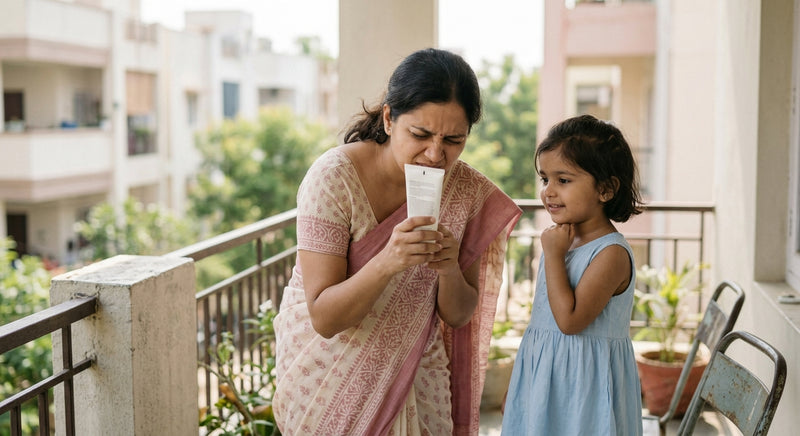
Two tubes on the same shelf, sixty rupees apart. One lists sodium fluoride. The other lists sodium monofluorophosphate — a word that takes longer to read than your child spends brushing. A parent sent us a photo of exactly this at 9pm, one line under it: which one do I buy?
Short answer: both deliver fluoride to enamel, and the ppm printed on the pack matters far more than which salt delivers it. Silica abrasive in the paste? Sodium fluoride carries a small evidence edge. Chalk? Then monofluorophosphate is the chemically sensible choice — and that, more than anything clinical, is why it is sitting in your bathroom cupboard.
What I am and what I'm not: I'm not a dentist. For the clinical side of children's teeth, our complete guide to kids' dental care and pedodontics is written with the dentists on our team. What I do every week is formulate and manufacture cosmetic products in our own facility, argue with raw-material specs, and read certificates of analysis. So I can tell you what those two names mean on a spec sheet, and what a formulator is really choosing between when they pick one.
At a glance
- Sodium fluoride (NaF) releases free fluoride the instant it meets saliva. Monofluorophosphate (SMFP) has fluoride bonded to phosphate and needs an enzyme in the mouth to release it.
- 0.221% NaF and 0.76% SMFP both equal 1000 ppm fluoride. Different numbers, same dose.
- SMFP exists mainly so fluoride can survive a chalk (calcium carbonate) abrasive on the shelf. NaF is usually paired with silica.
- Evidence leans slightly towards NaF in a silica base — but the gap is small next to ppm, brushing twice a day, and not rinsing afterwards.
- Many Indian pastes use both salts together. Add the fluoride up; that total is what counts.
What's actually different between the two
It comes down to how tightly the fluorine is held.
Sodium fluoride is an ionic salt. Drop it in water — or saliva — and it dissociates immediately into a sodium ion and a free fluoride ion. That free fluoride is the active form: it is what deposits into demineralised enamel and helps build the more acid-resistant mineral that protects a tooth after a snack.
Sodium monofluorophosphate works differently. Here the fluorine is covalently bonded to a phosphate group, in the monofluorophosphate ion. Put it in water and you don't get free fluoride. You get an intact, rather stable ion. It only becomes usable fluoride once phosphatase enzymes in saliva and plaque hydrolyse that bond and cut the fluoride loose.
That one difference explains the rest of this page: the percentages on the pack, which abrasive each salt tolerates, and the small clinical gap between them.
| Sodium fluoride (NaF) | Sodium monofluorophosphate (SMFP) | |
|---|---|---|
| How fluoride is held | Ionic — free fluoride the moment it meets saliva | Covalently bonded to phosphate |
| Release in the mouth | Immediate | Needs salivary and plaque phosphatase to split it |
| % needed for 1000 ppm F | 0.221% | 0.76% |
| % needed for 1450 ppm F | 0.32% | 1.1% |
| Abrasive it pairs with | Hydrated silica | Calcium carbonate (chalk), dicalcium phosphate |
| Its weak spot | Free fluoride binds calcium abrasives and drops out of solution | Release depends on enzyme activity, which varies between children |
Look at the percentages again. A pack saying 0.76% and a pack saying 0.221% can be carrying the identical fluoride dose. This surprises parents constantly, and it is the single most useful thing on this page: never compare the percentages of two different salts. Convert both to ppm first.
Does one of them prevent more cavities?
Slightly — and only in one pairing. Head-to-head trials, and the systematic reviews that pool them, lean towards sodium fluoride in a silica base over monofluorophosphate at the same ppm. The mechanism makes sense. Free fluoride is available for the full two minutes of brushing, while monofluorophosphate spends part of that window waiting to be hydrolysed, and enzyme activity varies from child to child and across the day.
Now hold that finding at the right size. The gap between the two salts is small. Between 500 ppm and 1000 ppm, bigger. Between brushing twice a day and brushing whenever someone remembers, bigger again. And rinsing the mouth out with a tumbler of water afterwards may cost you more than either salt gains — it washes away the fluoride you just paid for. Spit, don't rinse.
Monofluorophosphate's slower release was once pitched as an advantage, a sort of sustained reservoir. Tidy theory. The clinical data never showed it beating sodium fluoride, so treat it as marketing rather than a reason to choose.
Why so many Indian toothpastes use monofluorophosphate
This is the part I can speak to from the manufacturing side.
A toothpaste needs an abrasive — the gentle scrubbing particle that lifts plaque and stain. Two families dominate: hydrated silica, and calcium-based abrasives like calcium carbonate (plain chalk) or dicalcium phosphate. Calcium carbonate is cheap, locally abundant, and has been the backbone of mass-market and many herbal-positioned Indian pastes for decades.
Now put free fluoride ions into a tube full of calcium. They find each other. Fluoride binds calcium and forms poorly soluble compounds, and over a two- or three-year shelf life in a Nagpur summer the available fluoride can fall, even though the pack quite properly declares the amount added at manufacture. Monofluorophosphate, with its fluorine locked to phosphate, doesn't react the same way. It survives the chalk.
So the decision is usually made upstream of any clinical argument: chalk abrasive, therefore monofluorophosphate; silica abrasive, therefore sodium fluoride. Cost follows the same line, since silica is the pricier ingredient. That is the honest reason one word or the other is on your tube.
The specification that matters to a formulator isn't the fluoride added at the mixing stage. It is total soluble fluoride at the end of shelf life — measured on retained samples, at real storage temperatures. It is boring, unglamorous work that never appears on a pack. Janma makes skincare, not toothpaste, so I can't speak for any particular tube; what I can say is that making our own products in our own GMP-certified facility, where we own our formulations, is what lets a formulator ask that question at all.
Reading the pack in thirty seconds
Stand in the aisle and run this. It works on any brand, in any language on the back panel.
- Find the fluoride number first. Look for "ppm F", "ppm fluoride", or "w/w %" near the actives. If only a percentage is given, convert: multiply NaF% by 4525, or SMFP% by 1320. So 0.8% SMFP × 1320 ≈ 1056 ppm.
- Match ppm to age, not to the cartoon on the box. Age bands and the switch point are covered in our breakdown of 500, 1000 or 1450 ppm on kids' toothpaste, and specifically what age Indian kids can move to 1450 ppm.
- Check whether both salts are listed. Combination pastes are common. Add the fluoride contributions together — the total is the dose.
- Look for the abrasive. "Hydrated silica" or "calcium carbonate" will be in the ingredient list. It tells you why the salt was chosen, and chalk-based pastes tend to run more abrasive, which matters on soft milk teeth.
- Check the amount instruction, then ignore the picture. Pack art routinely shows a ribbon of paste across the whole brush head. Under 3 years, a smear the size of a grain of rice. Three to six, a pea. That is it.
- Scan for strong mint and heavy foaming agents. A flavour a child dislikes shortens brushing; a flavour they love gets swallowed. Both are worse than the salt debate.
What if our tap water already has a lot of fluoride?
Then the conversation changes, and not in the direction of the toothpaste aisle. Parts of Rajasthan, Gujarat, Telangana, Andhra Pradesh, Karnataka, Tamil Nadu, Haryana, Punjab, Bihar and Assam sit on groundwater that runs well above the Indian drinking-water limit of 1.0 mg/L (1.5 mg/L permissible where there is no alternative source, under IS 10500). In those districts, total daily fluoride from everything — water, food cooked in that water, swallowed paste — is the number that matters, and neither salt is safer than the other. Get your water tested and take the report to your child's dentist before choosing a ppm.
When to see a dentist
Book an appointment — don't wait for the next school check-up — if you see any of these:
- White, chalky patches along the gumline, or any brown or black spot on a tooth.
- Pain on cold, sweet or chewing, or a child favouring one side.
- Bleeding, swollen or receding gums.
- Persistent bad breath despite good brushing.
- You live in a high-fluoride belt, or your child regularly swallows toothpaste, and you want the right ppm decided for your family rather than guessed.
- Your child has never had a dental visit and is past their first birthday.
A pedodontist can also tell you whether your child's brushing is actually reaching the back molars, which is where almost all of the early damage happens.
Janma doesn't make a toothpaste — we make skincare, and we'd rather say that than sell you something adjacent; if you want the next piece of this puzzle, read our guide to choosing the right fluoride ppm for your child's age.
In summary
- Both salts deliver fluoride; convert the pack percentage to ppm before comparing anything.
- 0.221% sodium fluoride and 0.76% monofluorophosphate are the same 1000 ppm dose.
- Sodium fluoride has a small edge in silica pastes; monofluorophosphate exists to survive chalk abrasives.
- Use a rice-grain smear under 3 and a pea from 3 to 6, and have your child spit without rinsing.
- In high-fluoride water districts, test the water and let a dentist set the ppm rather than switching salts.
Frequently asked questions
Is sodium fluoride better than sodium monofluorophosphate for kids?
Marginally, and only when it's paired with a silica abrasive. Head-to-head evidence leans slightly towards sodium fluoride at the same ppm, because it releases free fluoride immediately rather than waiting for enzymes to break a phosphate bond. The gap is small. Getting the right ppm for your child's age, brushing twice daily, and spitting without rinsing all matter considerably more than which salt is in the tube.
How do I convert the percentage on the pack to ppm fluoride?
Multiply a sodium fluoride percentage by 4525, and a sodium monofluorophosphate percentage by 1320. So 0.221% sodium fluoride is about 1000 ppm, and 0.76% monofluorophosphate is also about 1000 ppm. For 1450 ppm you'd see roughly 0.32% sodium fluoride or 1.1% monofluorophosphate. Never compare raw percentages across two different salts; convert both to ppm first.
Why do Indian toothpastes use monofluorophosphate so often?
Mostly because of the abrasive. Many Indian pastes use calcium carbonate, which is inexpensive and locally abundant. Free fluoride ions react with calcium and become less available over a long shelf life, whereas monofluorophosphate keeps its fluorine bonded to phosphate and survives contact with chalk. Silica-based formulations don't have that problem, so they typically use sodium fluoride instead. It's a formulation decision, not a clinical one.
Can a toothpaste contain both sodium fluoride and monofluorophosphate?
Yes, and combination formulas are fairly common on Indian shelves. There's nothing wrong with it. The only thing that changes for you as a parent is the arithmetic: add the fluoride contributed by each salt to get the total ppm, and judge the paste on that total against your child's age band, rather than assuming two actives means twice the protection.
Does the fluoride salt matter if our drinking water is high in fluoride?
No. Both salts deliver the same ion, so neither is safer in a high-fluoride district. What matters is total daily intake from water, food cooked in that water, and swallowed toothpaste. India's drinking-water standard sets 1.0 mg/L as acceptable and 1.5 mg/L as the permissible ceiling where no alternative source exists. Get your water tested and take the report to your child's dentist before fixing a ppm.
Should I switch my child's toothpaste just to get sodium fluoride?
Usually not. If the current paste is at a suitable ppm for your child's age, they tolerate the flavour, and they brush twice a day, switching brands for the salt alone buys very little. Spend the effort elsewhere: correct the amount on the brush, stop the after-brush rinse, supervise the back molars, and deal with night feeds or bedtime milk if those are still happening.