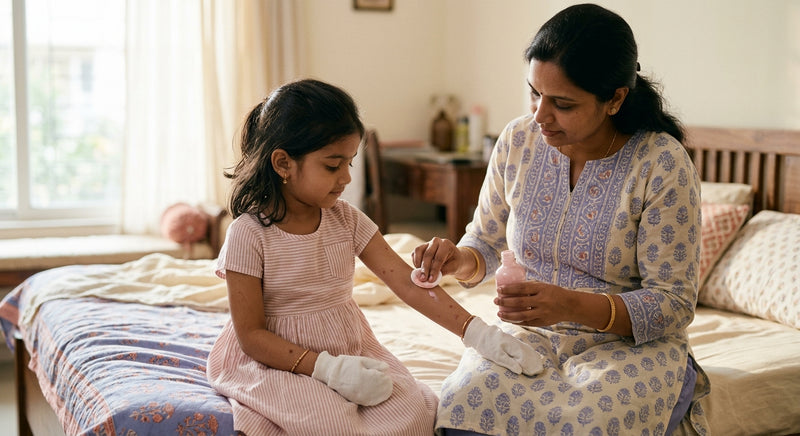
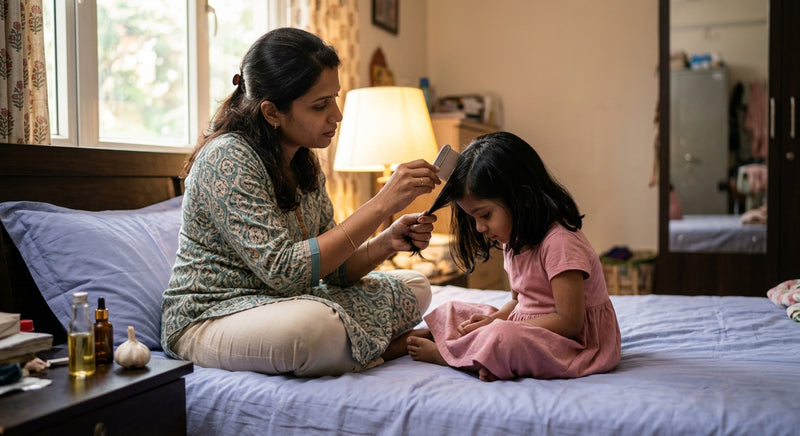
The camp list arrived on WhatsApp: sunscreen, soap, towel, water bottle. Four words for five days of standing in an open field between 10am and 4pm, showering in whatever water the campsite has, and sharing a soap bar with eleven other children.
Short answer first. A camp skin kit needs five things: a sunscreen in a format your child will reapply without an adult standing over them, their own cleanser, one balm that covers lips, chafe and dry, rough patches on knees and elbows, a hat with real fabric coverage, and a small labelled pouch they carry on their body rather than buried in the duffel. Everything else is optional. The rest of this piece is the sunscreen comparison — the decision most parents get wrong — and the full packing list.
At a glance
- Format matters more than the SPF number at camp. The best sunscreen is the one an eight-year-old will reapply at 12:30, alone, in three seconds.
- Pack two sunscreen formats: a lotion for the morning coat, a stick for face, ears and the tops of hands mid-day.
- Skip sprays. Wind, drift and a two-second application mean children get a fraction of the dose on the label.
- Don't decant sunscreen into an unlabelled travel bottle — you lose the batch and expiry, and emulsions destabilise fast in a 45°C bus boot.
- One multi-use balm replaces three separate products and takes up less space than a lip balm and a knee cream.
The wider picture — school hours, bus windows, uniforms, the reality of reapplication — is set out in our complete guide to sun protection for school-going kids in India. This piece is narrower. What physically goes into the bag.
What goes wrong at camp
Four things, in the order I see them.
Cumulative UV, not one dramatic burn. Camp schedules are built around outdoor blocks — treks, drills, field games — and those land squarely in the highest-UV window. A child who never turns red is still collecting a real dose across five days.
Sweat plus friction. Backpack straps on a trek. The inner thigh in shorts. The waistband. Sweat softens the outer layer of skin (the stratum corneum swells, and its lipids swell with it), and softened skin abrades far more easily. That's how a child comes home with a raw red stripe at the shoulder even though nothing "happened".
Whatever's in the shower. Campsite water is often bore water — hard, high in calcium and magnesium. Hard water plus a high-pH soap bar leaves an insoluble scum on the skin, and that scum is irritating for anyone eczema-prone. Add a shared bar that eleven kids have used and you have a hygiene problem sitting on top of a skin one.
Nobody reapplies anything. This is the honest one. The morning coat is the only coat, and it is mostly gone by lunch.
Which sunscreen format survives a camp duffel?
Spend your decision-making energy here. As a formulator, I'd say the gaps between these formats are structural, and they decide how much UV filter ends up on your child's skin.
| Format | What's happening in the formula | At camp |
|---|---|---|
| Lotion / cream tube | An oil-in-water emulsion carrying the highest usable load of zinc oxide per gram, spread as a continuous film. Film-forming polymers help it survive sweat. It needs rubbing in, which is exactly why it works. | Pack it. This is the morning coat. Best dose-per-application of anything here. |
| Stick | Anhydrous — waxes and butters, no water phase. It can't split or grow anything in a hot bag, and it will not leak. The trade-off is the waxy base: it lays down a thinner, patchier film, so it needs 4-6 passes back and forth over the same spot. | Pack it too. The reapply tool. Ideal for face, ears, nose bridge and the tops of hands. |
| Spray / aerosol | Filters suspended in a volatile carrier that has to evaporate before a film forms. Fine in still lab conditions. In open air a large share never lands, and children treat two seconds of hissing as "done". | Skip. Under-application is near-guaranteed, and aerosols near a face are a bad idea unsupervised. |
| Wipes and single-use sachets | A fixed, small quantity per unit, with no way to judge whether the whole body got covered. Convenient. The dose is where they fall down. | Backup only. Two sachets in a pocket for an emergency, never the main supply. |
What I'd send: one mineral lotion in the wash bag for the 7am full coat, and one stick zipped into the pocket of whatever they're wearing for the 12:30 top-up. Two products, one job, and the child only has to remember the small one. Mineral filters make more sense here than anything that needs precise timing — they sit on the surface and start working immediately, and if the stick ends up on a friend's arm too, nobody's harmed.
If reapplication is the sticking point in your house, we've written about what reapplying sunscreen at school realistically looks like — the same tricks work at camp, minus the teacher. And if your child refuses because of the pale grey film, that's a formulation problem with real fixes, covered in why kids' sunscreen leaves a white cast.
The other four things that earn space
Their own cleanser
Send a small bottle with their name on it, and tell them plainly to leave the shared bar alone. What to look for: a syndet (synthetic detergent) rather than a true soap, ideally around pH 5.5, and a short surfactant list. Soap sits at pH 9-10, which strips the skin's acid mantle and, in hard water, leaves that gritty film. A syndet doesn't. For a 3+ child, a gentle body cleanser in a 250 g bottle is plenty for a week and doubles as shampoo if they forget one.
One balm that does three jobs
Chapped lips from sun and wind. A chafed shoulder from the backpack strap. Dry patches on knees and elbows after five days of hard water. All three want the same thing: an occlusive layer that slows water loss and reduces friction. A thicker balm — butters and waxes over a humectant base — is the right texture, because a light lotion just soaks in and stops working. Our Hydra Healing Moisturizing Balm is the one I'd send: it's for all ages, it comforts dry, chapped skin, and in lab study it increased Keratin-10 and Filaggrin expression, which is the technical way of saying it helps support the skin barrier rather than just sitting on top of it. Show your child where to use it. A swipe on the lips at bedtime. A smear on the shoulder before the trek, while the skin is still fine.
A proper hat
Woven cotton, wide brim or a legionnaire flap. A cap protects the forehead and abandons the ears, neck and cheeks — which is precisely where I see camp burns. Clothing is the cheapest and most reliable UV protection there is, and it never needs reapplying. Two full-sleeve cotton tops beat any amount of extra sunscreen.
A pouch they carry
A labelled ziplock with the stick, the balm and two sachets, in the day bag they take to activities. Anything left in the duffel is functionally in another city by 9am.
- Broad-spectrum mineral sunscreen, larger tube — labelled with their name
- Sunscreen stick for face, ears and hands, in the day pouch
- Their own gentle cleanser, syndet-based, no shared bar
- One multi-use balm for lips, chafe and dry patches
- Wide-brim cotton hat plus two full-sleeve tops
- Two pairs of dry socks per day — damp feet in closed shoes are how fungal trouble starts in humid weather
- A note in the bag, in their words, listing when to reapply
What to leave at home
Spray sunscreen, for the reasons above. Anything fragranced and heavy — it will migrate to the eyes on a sweaty day. Adult body wash, which is built for adult skin and adult sebum levels. Fancy multi-step routines: a tired ten-year-old will do two steps, so make them the right two. And medicated creams you haven't cleared with the camp — those go to the camp nurse with written instructions, never into the child's pouch.
Hill camp, beach camp or a field in Nagpur?
The kit barely changes. The intensity does. Altitude raises UV meaningfully, and sand and water bounce it back up at the face and under the chin — the spots the morning coat always misses. If your child's camp is at a hill station or on the coast, read our piece on sun protection on hill and beach holidays before you pack, and add a rash guard. For a plains camp in peak May heat, prickly heat and sweat rash matter as much as UV: loose cotton, a shower as soon as they come in, and a light layer of balm only where the skin is dry.
When to see a doctor
Most camp skin trouble settles in a few days at home with a gentle wash, a balm and shade. Take your child to a paediatrician if a sunburn blisters, if they're burnt over a large area or feel feverish and unwell, if a rash is spreading, weeping or crusting yellow, if a chafed patch looks infected, or if any patch keeps growing after a few days of simple care. Fever with a rash always deserves a same-day look.
If you're getting one thing right in that bag, make it the sunscreen — our Daily Defender Kids Mineral Sunscreen SPF 40 PA++++ is made for exactly these long outdoor days.
In summary
- Pack two sunscreen formats — a lotion tube for the morning coat and a stick in their pocket for the midday reapply.
- Skip sprays and don't rely on wipes: both deliver far less filter than the label suggests once a child applies them.
- Send a larger sunscreen tube than feels necessary, since a small one usually runs out by day three.
- Send their own syndet-based cleanser so they never touch the shared soap bar in hard campsite water.
- Keep the day pouch tiny — stick, balm, two sachets — because anything inside the duffel is out of reach all day.
Frequently asked questions
What sunscreen should I pack for my child's summer camp?
Pack two formats. A broad-spectrum mineral lotion in a larger tube for the full morning application, and a sunscreen stick in their day pouch for reapplying on the face, ears, nose and tops of the hands. The lotion delivers the best dose; the stick is the one they will actually use alone at midday without help from an adult.
Is one 50 g tube of sunscreen enough for a week of camp?
Usually not. A rough working figure for a school-age child's exposed skin is around 8 to 10 grams per application. At two applications a day across five days, a small tube runs out well before camp ends. Send a larger tube, or two smaller ones, and label both with your child's name so they don't get mixed up.
Can I send a spray sunscreen to camp instead?
I'd avoid it. Sprays rely on a volatile carrier evaporating to leave an even film, and in open air a large share of the dose drifts away before it lands. Children also treat two seconds of spraying as finished. Unsupervised, near a face, in wind, it's the format most likely to leave your child under-protected.
Should my child take their own soap to camp?
Yes, and label it. Shared soap bars are a hygiene issue, and true soap sits at pH 9 to 10, which strips the skin's acid mantle. In the hard bore water common at campsites, that leaves an irritating film. Send a small bottle of a gentle syndet cleanser — around pH 5.5, short ingredient list — and tell them to skip the shared bar.
How do I stop sunscreen leaking all over the duffel bag?
Choose an anhydrous stick for anything travelling in a pocket — it has no water phase, so it can't leak or split in heat. Keep the lotion tube upright inside a sealed ziplock, cap taped if you like. Don't decant into a travel bottle: you lose the batch and expiry details and risk contaminating a preserved emulsion.
What should I do if my child comes home from camp sunburnt?
Cool the skin with a lukewarm shower, avoid soap on the burnt area, and apply a plain, fragrance-free moisturiser or balm to comfort dry, tight skin. Keep them out of the sun and give plenty of fluids. See a paediatrician the same day if the burn blisters, covers a large area, or comes with fever, chills or a child who seems unwell.