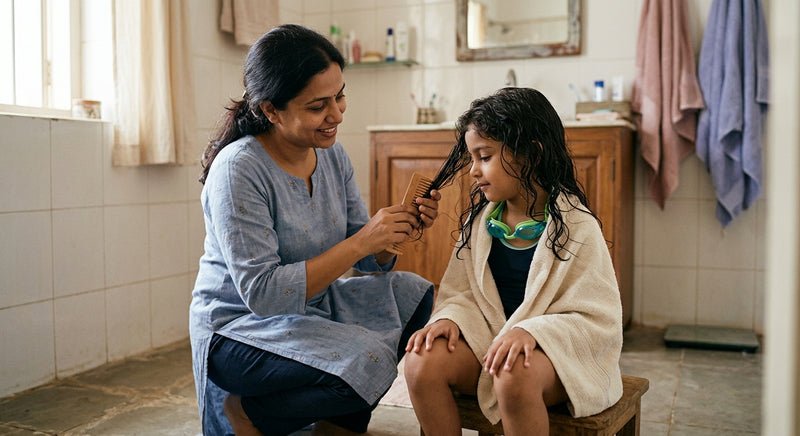
It's 7:40 on a Monday. Your eight-year-old's ponytail still looks damp-dark from Sunday night's champi. The strands separate into little clumps. There's a mark on the school shirt collar, and by Wednesday the scalp has a faint sour smell. You barely used any oil. So why is it still sitting there?
The short version: oil a school-age child's hair once or twice a week. About half a teaspoon to a teaspoon for shoulder-length hair. Mid-lengths and ends first, only a light film at the roots. Then wash it out the same day, 30 to 60 minutes later, not two mornings later. Buildup almost never comes from which oil you picked. It comes from how much stayed on, how long it sat there collecting sweat and dust, and whether the wash that followed was strong enough to lift it off in your city's water.
At a glance
- Oil conditions the hair fibre. It does not feed the follicle. More is not better.
- Half to one teaspoon for shoulder-length hair. Ends first, scalp last, with whatever is left on your fingertips.
- 30-60 minutes before the wash does most of what an overnight soak does, without the pillow transfer and dust.
- In monsoon, skip overnight oil completely. A damp, occluded scalp is where the itching starts.
- Hard water plus a mild kids' shampoo means oil that only half-leaves. Emulsify on dry hair first, then two short lathers.
Champi is one habit inside a routine that keeps changing month to month. Our complete guide to kids' hair across the seasons covers the rest of it: frizz, tangles, washing frequency, and what humidity does to a hair fibre.
Why does oil build up on a child's hair in the first place?
Four things stack up, and only the first one is the oil.
1. Unabsorbed oil. A hair fibre can only take up a small fraction of its weight in lipid. Past that, the oil just coats the cuticle surface, and a coated cuticle is sticky in a way clean hair isn't.
2. Oxidation. Oils rich in unsaturated fatty acids react slowly with air and warmth. Mustard, sesame, sunflower, almond. They thicken, turn tacky, and pick up that stale, slightly sour smell. That's rancidity, not dirt, and no amount of combing will fix it.
3. Your child's own sebum. Somewhere around eight to ten, scalp oil output starts climbing with early puberty hormones. The child who genuinely needed oil at four may be making plenty on their own at ten. Add a sweaty games period and you've doubled the load. I've written separately about whether a sweaty scalp after PE needs a daily wash.
4. Hard water. Calcium and magnesium ions in the water react with fatty acids from the oil and the wash to form insoluble, scum-like deposits that cling to the cuticle. It's why the same routine behaves one way in Mumbai and another in Delhi. More on that here: hard water changes kids' hair city by city.
How much oil does a school-age child really need?
Far less than most of us grew up using. Measure it once in a spoon so your hand learns the quantity.
The order matters more than the amount. Pour the oil into your own palm, rub both palms together, and start at the ends. That is the oldest, most weathered part of the hair, and the part that benefits. Then mid-lengths. The scalp gets only what's still clinging to your fingertips, in small circles, fingertips and never nails. Most of us do this exactly backwards: a pool of oil on the crown, which then has to be washed out of the one place that's hardest to rinse.
How long should the oil stay on? The overnight question, honestly
Lipid uptake into the cuticle happens fastest in the first stretch, and warmth speeds it along. An hour under a warm towel gets you most of the softness. The extra ten hours of an overnight soak add very little, and they cost you three things: a pillowcase that transfers oil back onto a freshly washed face and ear-line, a night of airborne dust sticking to the hair, and a scalp sitting occluded under oil in a humid bedroom.
Nearly every "my child's hair is always greasy" I hear is the same story. Sunday-night oiling, rushed Monday-morning wash, and it never fully clears. The residue never resets. Move the champi to a Saturday or Sunday morning, washed out before lunch, and the problem usually disappears inside two weeks.

Does the oil you choose change how much buildup you get?
Yes. Chain length, saturation and melting point all show up as texture on your child's head.
Coconut oil is dominated by lauric acid, a straight, medium-chain (C12), saturated fatty acid with unusually high affinity for hair keratin. It slips between cuticle scales and into the cortex better than bulkier triglycerides, so proportionally less of it is left loitering on the surface. It is also oxidatively stable, which is why it doesn't turn tacky or smell stale quickly. Its one real drawback is Indian: below roughly 24°C it solidifies, so a Delhi or Nagpur January champi can leave a waxy film unless you warm it properly.
Sesame and mustard are larger, more unsaturated molecules. They sit more on the surface, feel heavier, and oxidise faster. That's the Wednesday smell. Mustard also carries allyl isothiocyanate, which is warming by design and can sting a child's scalp. I keep it off kids entirely.
Almond oil is light and pleasant, mostly oleic acid, and it conditions the surface rather than penetrating. Lovely feel. It does need washing out properly.
My practical call for school weeks: a mostly-coconut base through summer and monsoon, and a warmed coconut-and-almond blend in dry winter, when you want a little more left on the ends.
Champi by season: what changes across the Indian year
| Season | What goes wrong | How to oil | How to wash |
|---|---|---|---|
| Dry summer heat (40°C+) | Sweat mixes with oil, dust sticks, the scalp smells by the second day | Light hand — ends and mid-lengths only, barely anything on the scalp. Oil and wash the same morning | Twice that week; rinse cool, not hot |
| Monsoon | Hair never fully dries, the scalp stays damp and occluded, itching and flaking turn up | Pre-wash only, 30 minutes maximum. No overnight oil at all | Wash the same day, every time. Dry the scalp fully before tying |
| Dry winter / North India | Static, frizz, split ends, a tight itchy scalp | A touch more on mid-lengths and ends, 45-60 minutes, oil warmed so it isn't waxy | Once or twice weekly; conditioner on the ends every wash |
| Humid coast or hard-water city | Oil and minerals together leave a dull, gummy film that resists rinsing | Keep the scalp film minimal; weight the oil towards the ends | Emulsify on dry hair, two short lathers, final rinse with stored or filtered water if you can |
The wash is what removes the oil
This is the step that decides whether champi leaves softness or buildup. Kids' shampoos are built on mild amphoteric and non-ionic surfactant systems at a skin-friendly pH so they don't sting eyes. That is exactly right for a child, and it also means they lift oil more gently than a harsh adult sulphate formula. Technique makes up the difference.
- Comb the oil through with a wide-tooth comb before you wet anything. It spreads the film and loosens tangles while the hair is still strong.
- Put the shampoo on dry, oiled hair first: a coin-sized amount, massaged in for 30 seconds. Surfactant meeting oil without water competing for it emulsifies far better.
- Now wet and lather. Two short lathers beat one long one every time.
- Rinse until the roots feel faintly clean-squeaky while the ends still feel smooth, then stop.
- Conditioner on mid-lengths and ends only, never the scalp. Scalp residue is the problem you're solving, so don't add to it. Our detangling conditioner is meant for exactly that lower two-thirds.
- Pat dry with a cotton t-shirt instead of twisting hair in a towel.
- Let it dry properly before any ponytail or plait. Here's why you should never braid damp hair.

A school-week plan you can keep
Saturday or Sunday morning: champi, 45 minutes, washed out before lunch, hair fully dry by afternoon. Midweek: nothing on the scalp. If there's games or PE and the scalp sweats, a plain water rinse at bath time is usually enough. If hair is long and tangling, a conditioner-only rinse on the ends keeps mornings peaceful without adding oil. That's the whole plan. Two oilings a week at most, and the hair stays soft instead of coated.
If your child's hair is frizzy rather than greasy, oil is a blunt instrument for it. Frizz is largely a humidity-and-cuticle story, which I've unpacked in why humidity frizzes kids' hair.
When to see a doctor
Take your child to a paediatrician or dermatologist if the scalp itches persistently, or if scaly patches keep returning within two or three washes. Go too if there are pus-filled bumps, boils, or broken, weepy skin. Nits, constant scratching, or hair thinning in defined patches all need a look as well. Oiling a scalp that is already inflamed generally makes it feel worse, and a scalp condition needs a diagnosis, not a product off a shelf.
What to look for in the wash itself
A tear-free, pH-balanced kids' shampoo with a mild surfactant base. You don't need anything labelled clarifying or deep-cleansing. Children's hair doesn't need stripping. It needs a wash that rinses clean in hard water and doesn't sting. Check that it's dermatologically tested, and that the brand will tell you where it's made. Ours comes out of our own GMP-certified facility, because we own our formulations rather than buying them in.
For the weekly champi wash-out, our Loving & Balancing Shampoo is the gentle, tear-free wash we'd reach for.
In summary
- Use half to one teaspoon of oil for shoulder-length hair, applied ends-first with only a light film on the scalp.
- Wash the oil out 30 to 60 minutes later on the same day rather than leaving it on overnight.
- Switch champi to a Saturday or Sunday morning so hair is fully clean and dry before the school week starts.
- Choose a mostly-coconut oil for summer and monsoon, and warm it before use in dry northern winters.
- Massage shampoo into dry oiled hair for 30 seconds before wetting, then do two short lathers — this is what clears oil in hard water.
Frequently asked questions
How often should I oil my school-going child's hair?
Once or twice a week is plenty for most school-age children. Any more and you are adding oil faster than a weekly wash can remove it, which is how buildup starts. If your child is nine or older and the scalp is already producing more of its own sebum, once a week on the mid-lengths and ends is usually enough, with nothing on the scalp midweek.
Is overnight oiling bad for kids' hair?
It is not harmful, but it adds very little. Most of the softening happens in the first 30 to 60 minutes, while the extra hours transfer oil onto the face and pillow, collect dust, and keep the scalp occluded overnight. In monsoon especially, skip it — a damp, oil-covered scalp is where itching and flaking tend to begin. Oil in the morning, wash before lunch.
Which oil leaves the least buildup on children's hair?
Coconut oil, in practice. Its lauric acid is a short, straight, saturated chain with high affinity for hair keratin, so more of it moves into the fibre and less sits on the surface. It is also oxidatively stable, so it does not turn tacky or smell stale quickly. In cold northern winters, warm it first so it does not set into a waxy film.
How do I get oil out of my child's hair in hard water?
Apply shampoo to dry, oiled hair first and massage for about 30 seconds before adding any water — surfactant emulsifies oil far better without water competing for it. Then wet and do two short lathers rather than one long one. A final rinse with stored, filtered or boiled-and-cooled water helps where calcium is high, since minerals are what make the residue cling.
Should I oil my child's hair before school?
Better not. Oil left on through a school day picks up sweat, dust and classroom grime, and under a tight ponytail that mixture often leaves a child scratching by evening. Keep champi to a weekend morning, washed out the same day. If the scalp sweats midweek after games, a plain water rinse or one mild wash is the right response, not more oil.
My child's hair is frizzy — will more oil fix it?
Only a little, and not for the reason most people assume. Frizz is mainly a humidity-and-cuticle issue: moisture moving in and out of the fibre lifts the cuticle scales. A light film of oil on the ends can smooth the surface, but a conditioner on the mid-lengths and ends after every wash, plus letting hair dry before tying it, does far more than extra oil ever will.