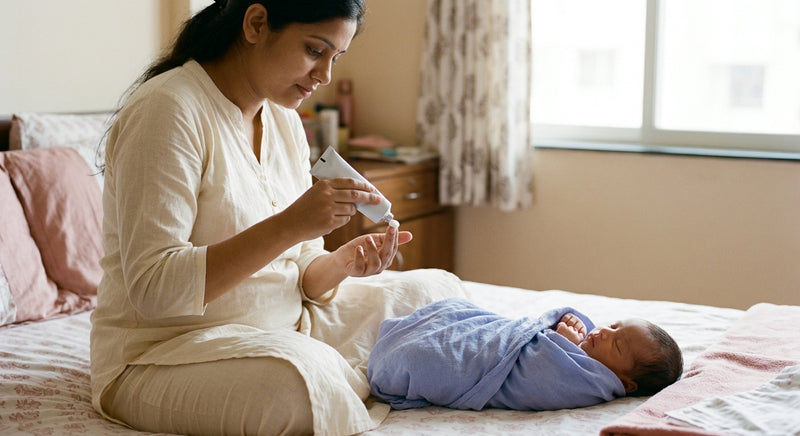
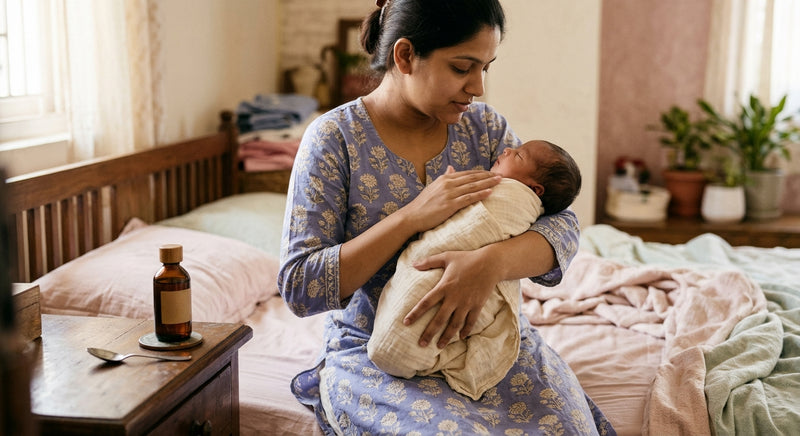
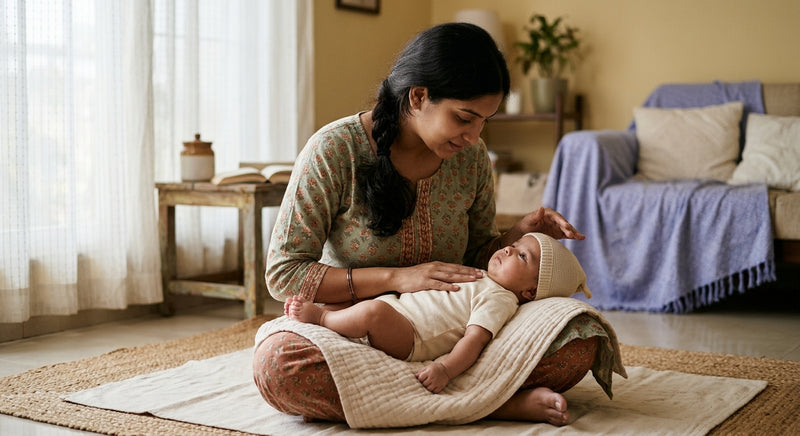
Your mother-in-law has the til oil out, tilgul is setting on the kitchen counter, and you're standing in the bathroom doorway wondering whether a full warm-oil bath is really a good idea for a four-month-old. It is, mostly. Til (sesame) oil is one of the more sensible traditional massage oils for an Indian baby, on intact skin, after a patch test, and January genuinely suits it. The oil isn't what I'd change. Three details in how the old oil bath usually gets done are: how hot the oil is, how much of it goes on, and what happens to it afterwards.
At a glance
- Plain, cold-pressed til oil is fine for most babies past the first month, on unbroken skin, after a 24-hour patch test.
- Warm the oil by standing the bottle in a bowl of hot water. Never on a direct flame. Test it on your inner wrist, not your palm.
- 5-10 ml covers a whole newborn. More oil doesn't buy more benefit. It buys a slippery baby and a harder wash.
- Leave it on 10-15 minutes, then wash with a mild baby cleanser. Oil left sitting in hard water becomes a film that traps sweat.
- Skip the oil bath if your baby is unwell, has broken or weeping skin, or there's a family history of sesame allergy. Check with your paediatrician first.
Is til oil actually safe for a baby's massage?
For a healthy baby with unbroken skin, yes. Sesame oil is light, it absorbs reasonably well, it doesn't smell sharp, and it is the oil most South Indian families have been putting on babies for generations: nalla ennai in Tamil households, ennai kuliyal for the oil bath itself, til or gingelly oil in English on the bottle. The honest caveat is that no baby massage oil has a large, settled evidence base behind it, til included. Plain, fresh, cold-pressed, single-ingredient, and tolerated by your own baby's skin matters far more than which oil you pick. Til clears that bar.
Two things here are worth acting on, not just noting. Sesame is a recognised food allergen. If anyone in the family has a sesame allergy, or your baby has reacted to something before, raise it with your paediatrician before you start rather than after. The second: if your baby already has eczema-prone skin, or open, weeping patches, oil is the wrong thing to be rubbing in. A barrier cream is what that skin wants. The rest of this piece assumes skin that is simply dry, not inflamed.
Still deciding between oils, or wondering whether to switch as the weather turns? We've gone through that properly in whether a baby's massage oil needs to change with the season, and the whole practice, strokes and pressure and timing, sits in our complete guide to baby massage and malish.
Why til oil, and why in January?
Makar Sankranti and Pongal both land in mid-January, at the turn of the Tamil month of Thai, and both carry sesame with them. Tilgul in Maharashtra. Til-gud laddoos up north. In the South, the oil bath before the festival. The Ayurvedic reasoning is that til is ushna, warming, and suited to the cold, dry half of the year. Read that as a seasonal instinct rather than a measured property, because nobody has shown that sesame oil raises a baby's temperature.
The instinct is a good one anyway, for a plainer reason. January is when Indian baby skin dries out, and it dries out differently depending on where you are standing. A Nagpur or Delhi morning in January is genuinely dry; skin loses water fast, and the oil's job is to slow that down. A Chennai or Coimbatore Thai morning is mild and humid, so the same quantity of oil sits on the surface instead of sinking in, and a heavy hand leaves your baby sticky until bedtime. Same oil, same festival, two very different amounts.
There is one reason all of this matters more for a baby than it does for you: a baby's skin is 20-30% thinner than an adult's. It loses water faster. It also takes up whatever you put on it faster. Which argues for a short, light, plain-oil massage, and against the enthusiastic version.
What the traditional oil bath gets right, and the three parts to change
Most of ennai kuliyal is sound. Warm oil, slow hands, a bath afterwards, a well-fed sleepy baby at the end of it. What I'd change are the parts that were designed around an adult body and never got scaled down for a four-kilo one.
| How it's usually done | What I'd do with a baby |
|---|---|
| Oil heated in a vessel straight on the flame | Stand the oil bottle in a bowl of hot water for 2-3 minutes. Test a drop on your inner wrist. Barely warm, not hot |
| Generous oil over the whole body, face and scalp included | 5-10 ml in total. Skip the face. A few drops on the scalp at most, and none at all if there's cradle cap |
| Firm rubbing, arms and legs pulled straight | Light, slow, flat-palm strokes. No pulling, no straightening, no cracking joints |
| A drop of oil in the nostrils, ears or navel | Nothing goes inside the nose, ears or eyes. Ever |
| Besan or shikakai scrubbed on to strip the oil off | A mild, tear-free baby wash and your hands. No scrubbing |
| Oil bath followed by a sun-bath on the terrace | A few minutes of early-morning indirect light at most. Not midday, and not oiled skin in direct sun |
The limb-pulling is the one I will argue about. Parents get told, often by someone they trust, that the Sankranti massage will straighten a baby's legs. It won't. We've set out what malish can and cannot do for bow legs in babies, because pulling is where babies actually get hurt.

How much oil, and how warm?
Pour into your own palm first. Never straight onto the baby. One teaspoon, about 5 ml, covers a newborn's legs, arms, chest and back. Two teaspoons for a chubby one-year-old. If your hands are sliding rather than gripping, there's too much on: wipe some off on a cotton cloth and carry on.
Temperature is simpler than people make it. Body-warm, nothing more. Your palm is a poor judge because it's thick-skinned and used to heat; the inner wrist, or the inside of your elbow, tells the truth. Room temperature matters just as much. A naked oiled baby on a 19°C Nagpur January morning will be miserable and shivery however warm the oil is, so shut the window and close the door. Don't run a heater straight at the baby either. Dry blown air undoes the whole point of the massage.
Do this tonight: a 10-minute Sankranti malish
You don't need the festival to start. Tonight works. Pick a gap between feeds, roughly 45 minutes after a feed and well before the bath.
- Patch test first: a drop of the oil on the inside of your baby's forearm, left for 24 hours. Redness, bumps or scratching at that spot means stop.
- Close the windows. Spread a thick towel on the bed or the floor, and keep a second one within reach.
- Stand the oil bottle in a bowl of hot water for 2-3 minutes. Test on your inner wrist.
- Undress your baby down to the nappy. Keep the nappy on until you reach the legs, because oiled babies are slippery and cold air invites surprises.
- Pour a teaspoon into your palm, rub your hands together, and work legs → arms → chest → tummy → back. Long, slow strokes outward from the centre. Soft clockwise circles on the tummy.
- Stop if your baby arches, stiffens or cries properly. A grumble is boredom. A real cry is a no, and tomorrow is fine.
- Let the oil sit 10-15 minutes while you talk, sing, or let them kick about.
- Bathe with warm water and a mild baby cleanser. Pat dry with the second towel, don't rub.
- Moisturise within three minutes of the towel, while the skin is still faintly damp.
Three or four times a week is plenty in winter. Daily is fine too, if your baby enjoys it and the skin stays calm. We've broken the strokes and the timing down by age, newborn, 3-6 months, 6-12 months, in the malish routine by age, because a four-month-old and a ten-month-old want quite different massages.
Washing til oil off without stripping the skin
This is the step families skip, and in most Indian cities it is the one that causes trouble. Hard water — Chennai, Hyderabad, Bengaluru, most of Delhi — reacts with oil and leaves a dull film on the skin that holds sweat and dust against it. The film is what turns into prickly bumps in the neck folds by evening, not the oil.
So wash properly, and gently. Besan and shikakai are what my own family used, and they do lift oil, but they lift it by abrasion, and a baby's skin hasn't the thickness to spare. What works better is a soap-free cleanser at a skin-friendly pH that emulsifies oil, used once over the whole body with your hands. Once, not twice. No loofah. Our Head to Toe Baby Foam Wash is what we make for exactly this job: tear-free, mild enough for post-malish washing, and it comes out pre-foamed, so you aren't working up lather on a wriggling baby.

When NOT to give the oil bath
Skip it, festival or not, if any of these are true: your baby has a fever, a cough or cold, or is simply off-colour; the skin is broken, weeping, cracked or freshly scratched open; there's an active rash you haven't identified; your baby was born preterm and hasn't been cleared by the paediatrician; or there's a family history of sesame allergy. Keep oil away from a vaccination site for a couple of days as well. And nothing goes inside the nose, ears or eyes. The old practice of a drop in each nostril carries a real aspiration risk and no benefit.
One more, because it gets forgotten in the rush of the festival: until the cord stump has dropped off and healed, keep it clean and dry, and keep oil off it entirely.
If your baby's skin is already dry or eczema-prone
Oil is not a moisturiser. It sits on the surface and slows water loss, which is useful, but it delivers no water of its own and does nothing to rebuild the barrier that's leaking. For most babies that difference is academic in October. By January it isn't.
In winter, then, treat the malish and the moisturiser as two separate jobs. Til oil for the massage. A proper barrier cream afterwards, on the dry patches: shins, outer arms, cheeks, the backs of the knees. Look for humectants and barrier lipids rather than simply more oil, and for a formulation that has been tested on babies. Atopic-type skin issues affect up to ~48.6% of babies, so this caveat is not a rare one.
And if the dryness is the kind that returns within a day of every bath, no oil and no amount of massage will settle it. That is worth raising with your paediatrician rather than working through more products at home.
When to see a doctor
Book a paediatrician's appointment if, after a massage, you see spreading redness, hives, swelling around the mouth or eyes, or any change in breathing. Stop the oil and go the same day. Also see a doctor if a rash weeps, crusts yellow, or looks infected; if the dry patches are itchy enough to wake your baby repeatedly; if the skin cracks and bleeds; or if your baby cries through every massage no matter how light your hands are. Nothing in this article replaces an examination, and a 10-minute consult settles most of these in one visit.
For the moisturising step after the Sankranti oil bath — the dry shins, the winter cheeks — our Hydra Healing Moisturizing Balm is the one I reach for to comfort dry, sensitive skin. It's made in our own GMP-certified facility, it's dermatologically tested, and a lab study found it helps support the skin's natural barrier.
In summary
- Plain, cold-pressed til oil is a sound choice for a baby's winter massage on intact skin, after a 24-hour patch test.
- Warm the bottle in hot water, never on a flame, and test the oil on your inner wrist before it touches your baby.
- Use 5-10 ml with light flat-palm strokes — no pulling limbs, and nothing inside the nose, ears or eyes.
- Leave the oil on 10-15 minutes, wash it off with a mild tear-free cleanser, then moisturise within three minutes of the towel.
- Skip the oil bath if your baby is unwell, the skin is broken, or sesame allergy runs in the family — and see a paediatrician for hives, swelling or any breathing change.
Frequently asked questions
Is til (sesame) oil safe for a newborn's massage?
For a healthy, full-term newborn with intact skin, plain cold-pressed til oil is generally fine once the cord stump has healed and after a 24-hour patch test on the forearm. Keep it to about 5 ml, body-warm, with light strokes. Avoid it on broken or weeping skin, if your baby is unwell, or if sesame allergy runs in the family — ask your paediatrician first.
Can I use the same til oil we cook with?
If it's plain, cold-pressed, single-ingredient gingelly or til oil from a freshly opened bottle, yes — that is what most South Indian families have always used. What you should not use is toasted or roasted sesame oil, blended oils, or anything that's been sitting open in a warm kitchen for months. Sesame oil turns rancid, and rancid oil can sting.
Is til oil too heating for a baby in summer?
The warming or ushna quality of til is an Ayurvedic classification, not a measured rise in body temperature, so it won't overheat your baby. The practical issue in a humid Indian summer is different: oil sits on the skin instead of absorbing, traps sweat in the neck and groin folds, and invites prickly heat. Use less of it, wash it off properly, or switch to a lighter oil for those months.
At what age can I start the ennai kuliyal oil bath?
Most paediatricians are comfortable with oil massage once the umbilical cord stump has dropped off and healed, usually somewhere in the first two to four weeks. Start with a patch test and a short three-minute massage rather than a full oil bath. For preterm babies, wait for your paediatrician's clearance — the skin barrier is less mature and needs a different approach.
Should I put til oil in my baby's scalp and nostrils at Sankranti?
Scalp, yes, in moderation — a few drops worked in gently, washed out the same day, and skipped entirely if there's cradle cap. Nostrils and ears, no. The traditional drop of oil in each nostril carries a genuine risk of the oil reaching the airway, and there is no benefit to set against that risk. Keep all oil outside the nose, ears and eyes.