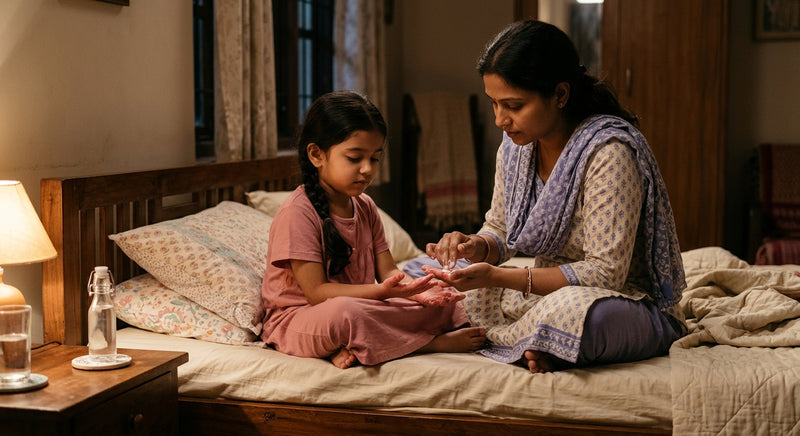
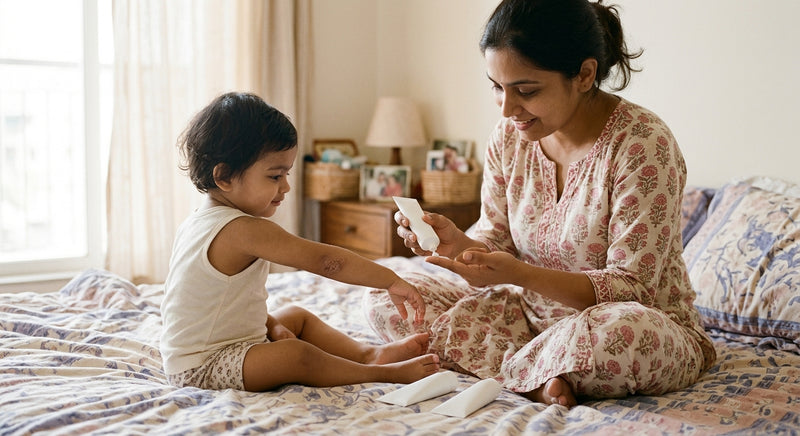
Mid-August in Nagpur. Your mother-in-law hands you the same bottle the family has used since Diwali. You finish the malish, and an hour later your baby's back is still tacky, with a scatter of tiny red bumps in the neck folds. Two states away, a friend in Delhi is already asking whether she should buy a "winter oil" for November.
The answer is duller than either of you wants. In most homes the oil can stay exactly as it is. What has to move with the calendar is the amount, the timing, the room and the bottle hygiene. A tablespoon that feels nourishing in a January bedroom sits as a sticky film in a June one. An open bottle that sailed through winter can turn in six humid weeks. Four brand switches a year won't touch any of that. Adjusting the routine will.
At a glance
- One well-chosen oil your baby tolerates can run all year. The quantity is what should change, not the bottle.
- Winter: more oil, a warmer room, a longer gap before the bath, and a balm on the dry patches after.
- Summer: roughly half the oil, a shorter malish, and a proper wash so nothing sits in the folds.
- Monsoon: barely touch the oil. Rethink where you keep it. Humidity is what spoils oil and feeds fold rashes.
- Never start a new oil in the middle of a flare-up. Patch test first, and change one thing at a time.
If you're still building the ritual itself — how long, which strokes, what age to start — our complete guide to baby massage and malish walks through the fundamentals. This piece is only about what the calendar changes.
So what actually changes with the season?
Four things, and only one of them is the oil.
| Season | Oil & quantity | Timing | What to watch for |
|---|---|---|---|
| Winter (Nov-Feb) | Same oil, more of it — about a tablespoon for a full body. Slightly heavier oils feel better now. | Malish 10-15 min before the bath; bathe in a warm, draught-free room. | Ashy shins, dry cheeks, cracked heels. Oil alone often won't hold — you'll need a cream or balm after. |
| Summer (Mar-Jun) | Same oil, roughly half the quantity. Lighter feel wins. | Early morning, or after the evening cools off. Never in a hot afternoon room. | Prickly heat in neck, chest and nappy line. Sticky residue that traps sweat. |
| Monsoon (Jul-Sep) | Same oil, small quantity — but check the bottle for smell and colour every few weeks. | Short malish, prompt bath. Don't let oil sit on damp skin for an hour. | Fungal-looking rashes in folds, oil turning rancid, scalp staying greasy for days. |
| AC rooms (all year) | Treat as a mild winter — the air is dry even in May. | Normal timing; re-moisturise before the night's sleep. | Dry patches on arms and legs despite it being summer outside. |
The season-proof malish routine, step by step
This is the sequence I'd hand a new parent and tell them to run all year. Only two or three points change, and the season is named at each of them. Twenty minutes end to end, bath included.
- Set the room before you touch the bottle. Comfortably warm. No fan blowing straight on the baby, no AC vent overhead. In December that means shutting the window. In May it means doing the malish before 9am rather than at noon.
- Decant a week's worth into a small steel katori. Fingers never go into the main bottle. That's how water and skin bacteria get in, and it's the single biggest reason an oil goes off in the monsoon.
- Warm it between your palms. Rub for ten seconds. Not on a flame, not in the microwave, not in a bowl of hot water your toddler could tip over.
- Measure by season. Winter: about a tablespoon for a full body. Summer and monsoon: half that. If the skin still looks wet-shiny after five minutes of massaging, you used too much.
- Massage 5-10 minutes, in order. Legs, then arms, then chest, then a gentle back. Long strokes, light pressure, your palm flat. Stop if the baby squirms away — a fought malish helps nobody.
- Wait the right amount of time. Winter: 10-15 minutes so the oil settles. Summer and monsoon: 5 minutes, then bathe. Oil left sitting on sweaty skin is what turns into blocked pores and heat rash.
- Bathe in lukewarm water with a gentle, tear-free wash. You're lifting the oil film, not scrubbing the skin bare. Test the water on the inside of your wrist. Indian tap water swings hard between seasons, and a bucket that stood in the sun all afternoon can be far hotter than it looks. A mild option like our Head to Toe Baby Foam Wash does the job without stripping.
- Pat dry, then seal within five minutes. Damp skin holds moisturiser far better than dry skin does. Light lotion in summer, something richer on the dry spots in winter.
- Dry the folds properly, last. Behind the ears, under the chin, neck creases, armpits, knee backs, groin. Boring step. It saves you more monsoon trouble than any product on the shelf.
In winter, oil alone stops being enough
Parents find this one frustrating. You increase the oil, you follow every step, and by January the shins still look ashy and the cheeks are rough to the touch. Most massage oils are pure emollients: they smooth and soften, but they don't hold water the way a formulated cream does, and North Indian winter air pulls moisture out faster than an oil layer can compensate for. Heaters make it worse. A closed room with a blower running is drier than the street outside.
So the winter routine grows one step. Oil for the malish, then a cream or balm afterwards on the patches that keep coming back. If your family adds warming ingredients to the winter oil, read our honest look at ajwain, lahsun and sarson malish oil and whether it's safe for a baby before you infuse anything at home. Some of those traditions are lovely. A couple of them are irritating on skin this thin.
Summer is about the clock as much as the quantity
Most summer trouble I hear about isn't caused by the oil at all. It's how much, and when. A full winter measure at 1pm in a 38°C room gives you a baby who is slick and hot by 2pm and covered in prickly heat by evening. Halve the oil. Move the malish to the coolest part of the morning. Bathe within about five minutes instead of letting it sit.
Monsoon is hard on the bottle
Humidity does the damage here, and it does it to the oil rather than the baby. Cold-pressed and home-pressed oils have no added preservation to speak of, so a bottle that's been open on a bathroom shelf since Ashadha can turn by the end of August. Rancid oil smells faintly of old paint or crayons, and it stings freshly bathed skin. Buy smaller bottles through these months. Store them dark and cool — a kitchen cupboard, not the windowsill above the bucket. Cap tight. Smell it before every use. If you're weighing a homemade or ghani oil against a manufactured one, we've compared the two in cold-pressed vs branded baby massage oil.
Do you ever actually need a different oil?
Sometimes. Seasonally, rarely. The reasons that hold up: the current oil stings or reddens the skin, it clearly clogs (small white bumps where you massaged), your baby has eczema-prone skin and a paediatrician has advised a specific option, or the oil has gone off. "It's October now" doesn't make the list.
If you do switch, switch carefully. Patch test on the inner forearm, a coin-sized amount, and leave it 24-48 hours before a full-body malish. Change one thing at a time. New oil and new soap in the same week tells you nothing if a rash appears on Thursday. And don't start a new oil while the skin is already flaring — wait until it's calm, or you'll never know which change helped and which didn't.
Age is the bigger variable anyway. A three-week-old, a five-month-old and a ten-month-old need quite different pressure, duration and positioning — our malish routine by age breaks that down.
Hard water, and why your "seasonal" problem may not be seasonal
Across much of Maharashtra, Rajasthan, Gujarat and the NCR, tap water is hard enough to leave a film on skin. Parents read the resulting winter tightness as a failing oil. It isn't. A short bath, a mild wash rather than a soap bar, and moisturiser applied on damp skin will do more than any oil switch. Boiling and cooling water for the final rinse is fussy, and on the worst days it works.
When to see a doctor
Book a paediatrician's appointment if you see: a rash that's weeping, crusting yellow or spreading fast; skin that's hot, swollen or painful to touch; a fold rash that doesn't settle within a week of keeping the area clean and dry; hives, facial swelling or breathing changes after a new oil (that's urgent); or persistent dryness and itch that's disturbing your baby's sleep despite a consistent routine. Newborns under three months with any spreading rash should be seen sooner rather than later — and always ask before applying anything medicated.
For the dry patches winter leaves behind — shins, cheeks, knuckles, the nappy line — a richer barrier layer after the bath is usually what finally comforts them, and our Hydra Healing Moisturizing Balm was formulated for exactly that job.
In summary
- Keep the same well-tolerated oil year-round and change the quantity instead — about a tablespoon in winter, half that in summer and monsoon.
- Decant a week's oil into a small steel katori so fingers never enter the main bottle, and store it in a dark, cool cupboard through the monsoon.
- In winter, add a cream or balm on damp skin after the bath — massage oil alone rarely holds against heater-dry air.
- In summer, shift malish to the cool morning hours, shorten it, and wash within about five minutes so nothing sits in the folds.
- Patch test any new oil for 24-48 hours, change one product at a time, and see a paediatrician for weeping, spreading or fast-worsening rashes.
Frequently asked questions
Should I use a different massage oil in summer and winter?
Usually not. One oil your baby tolerates well can run all year. What should change is the quantity — roughly a tablespoon for a full-body winter malish, about half that in summer — plus the timing and the room temperature. Switching oils four times a year adds risk of irritation without solving the actual problem, which is almost always quantity and residue.
Can massage oil go bad in the monsoon?
Yes, especially cold-pressed and home-pressed oils, which have little preservation. Humidity, warmth and fingers dipped into the bottle all speed it up. Rancid oil smells faintly of old paint or crayons and can sting freshly bathed skin. Buy smaller bottles during the monsoon, store them in a dark, cool cupboard rather than the bathroom, and smell the oil before every use.
How much oil should I use for a baby massage?
About one tablespoon for a full-body massage in winter, and roughly half that in summer and monsoon. A simple check: press a dry cotton cloth against your baby's tummy after the massage. If it comes away visibly wet rather than faintly marked, you used too much. Excess oil sits on the skin, traps sweat and contributes to heat rash.
Should I bathe my baby right after malish in summer?
Wait about five minutes in summer and monsoon, then bathe with lukewarm water and a gentle wash. In winter you can leave a longer gap of 10-15 minutes so the oil settles. Oil left sitting on sweaty skin through a hot afternoon is a common cause of prickly heat, so a prompt wash in warm weather genuinely helps.
Does my baby need moisturiser as well as massage oil in winter?
Often, yes. Massage oils soften the skin but don't hold water the way a formulated cream does, and dry winter air plus room heaters pulls moisture out faster than an oil layer can offset. Oil for the malish, then a cream or balm on damp skin within five minutes of the bath, is the combination that settles ashy shins and rough cheeks.
How do I test a new massage oil safely?
Apply a coin-sized amount to the inner forearm and leave it 24-48 hours before any full-body massage. Change only one product at a time, so a reaction can be traced. Don't introduce a new oil while the skin is already flaring — wait until it's calm. Stop immediately and see a doctor if you see hives, facial swelling or any breathing change.