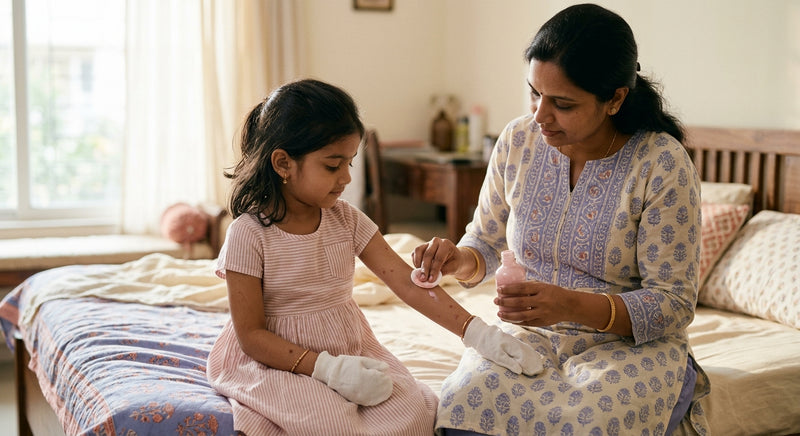
Sunday practice ends, the cricket vest comes off over his head, and there it is: a raw red stripe under one arm, sitting exactly where the armhole seam sat. That looks like classic friction damage. A damp seam rubbing the same small patch of thin skin for an hour, in 38°C heat, with sweat and salt trapped in the fold. The fix is mechanical before it is anything else. Cut the rubbing, get your child out of wet kit fast, and shield that fold with a thin layer of barrier balm before the next session.
It starts turning up once children move into structured sport, around six or seven. Then it returns at eleven or twelve, when the kit gets tighter and the sessions run longer. Rarely serious. Almost always preventable, which is the annoying part, because most of us end up treating the skin when the problem is the jersey.
At a glance
- Chafing is friction plus moisture. Not dirt. Scrubbing the area harder only makes it worse, faster.
- The armpit is a closed fold: skin rubs skin and fabric, so three surfaces are moving against each other.
- Wet skin abrades at a fraction of the force dry skin needs. Getting out of damp kit within ten minutes does more than any cream.
- Indian seasons change the mechanism: salt and heat in summer, kit that never dries in monsoon, cracked dry skin under fleece in winter.
- Hard water leaves detergent sitting in the armhole seam. One extra rinse cycle on the washing machine clears up a surprising number of mystery cases.
Why does sports gear rub the underarm specifically?
Three things stack up in that one spot. The armpit is skin folded onto skin, so there is contact before any jersey goes on. The sleeve seam adds a third surface. Then comes the movement. A bowling action, a badminton smash, freestyle arms: that seam travels through a full arc several hundred times in one session.
Sweat is the multiplier. Damp skin softens at the surface, and softened skin gives way under rubbing that dry skin would shrug off. When the sweat dries, the salt left behind sits in the fold like very fine grit. It is the same mechanism we describe in our complete guide to heat, sweat and friction rashes in kids, just in a different fold.
Which piece of kit is usually the culprit?
Before you buy anything for the skin, turn the gear inside out and run a finger along the armhole. You are feeling for a raised, overlocked ridge. That ridge is what is doing the damage. In our house the same offenders keep coming back:
- Sleeveless jerseys and vests. Worst of the lot. No sleeve means the seam sits right in the crease, and cheap club kit is almost always overlocked rather than flatlocked.
- Backpack and kit-bag straps. A cricket bag slung on one shoulder drags the shirt into the armpit with every step to the ground.
- Sports bras and crop tops for girls around ten to thirteen. A band that has quietly gone a size too small over a growth spurt rides up into the fold. Check the size before you check the skin.
- Swim costume straps. Wet fabric, a full stroke arc, and pool water still sitting on the skin through the auto ride home.
- Karate and judo gi collars. Football bibs pulled over an already-wet jersey. Arm-guard elastic. Each one is a stiff edge parked in a moving fold.
How underarm chafing changes across the Indian year
The rash looks much the same in April and in December. Why it showed up is not the same at all, and neither is the fix.
| Season | What's happening under the arm | Change this |
|---|---|---|
| Peak summer (Mar-Jun) | Heavy sweat, salt drying on the skin, the jersey glued into the fold. In a Nagpur or Delhi April, an evening session still starts at 38°C. | Loose sleeves instead of sleeveless. Every water break, a towel dab in the armpit. Rinse within ten minutes of finishing. |
| Monsoon (Jun-Sep) | Nothing dries. Kit hung indoors is still damp at 6am, sweat can't evaporate, and the fold stays wet for hours at a stretch. | Two sets of kit, dried under a fan, never shut into a cupboard. If a rash turns up with a raised, ring-like edge, that is a doctor's call, not a cream. |
| Winter (Nov-Feb) | Less sweat, more cracking. Dry north-Indian air plus a fleece tracksuit means skin that is already tight splits under the same rubbing it tolerated in July. | Moisturise the night before, not only afterwards. A thin cotton base layer under the tracksuit. Never fleece straight onto skin. |
| All year (hard water) | Detergent that never fully rinsed out of a thick armhole seam sits against damp skin for the whole session. | Half the usual detergent, an extra rinse cycle, and no fabric softener on sports kit at all. |
About that hard water. Across much of central and north India it is hard enough that detergent doesn't rinse clean out of thick seams, and it leaves behind a stiff residue you can sometimes feel with a fingernail. So if your child chafes in every kit, whatever the brand, look at the washing machine before you look at the skin. It is the most overlooked cause I come across, and testing it costs nothing: strip-wash the jerseys twice in plain water and see how the next fortnight goes.
What to do tonight
- Rinse the area with plain lukewarm water. No soap on raw skin, and no loofah.
- Pat dry with a soft towel. Dabbing, not wiping. Then have your child hold that arm up for two minutes so the fold actually air-dries.
- Apply a thin layer of a plain, fragrance-free barrier balm. Thin means you can still see the skin through it.
- Loose cotton t-shirt tonight. No vest, no tight sleeves, nothing sleeveless that could rub while they sleep.
- Put the offending jersey in the wash with an extra rinse, and set out a different one for tomorrow.
- Skip deodorant, talc and antiseptic spirit completely until the skin is smooth again.
For the post-practice wash itself, you want something that lifts sweat and salt without stripping: mild, low-foam, close to the skin's own pH, no added fragrance. If you would rather not stand comparing labels at 11pm, our Kids Gentle Body Cleanser is formulated for exactly this age group and this kind of daily, sweaty rinsing. Use it on the rest of the body and keep plain water on the sore fold for two or three days.
The 60-second routine before the next practice
All of this happens before the kit goes on. Once the vest is on, you have missed the window.
- Make sure the underarm is completely dry. Damp skin plus balm is worse than either alone.
- Take a pea-sized amount of balm and warm it between your fingers for a few seconds so it spreads thin.
- Smooth it into the fold and about two centimetres out onto the inner arm, with the arm raised. Cover where the seam travels, not only where it hurts.
- Wait until it stops feeling tacky, roughly thirty seconds, then dress.
- Repeat on the shoulder if a bag strap is involved.
A balm holds up better than a lotion here, because it stays put through sweat instead of washing off in the first fifteen minutes. What to look for on the label: fragrance-free, a texture thick enough to stay in the fold but that still spreads thin without dragging, and nothing medicated. In this fold a balm's job is simply to cut friction and comfort dry, rubbed skin.
What doesn't help (and what makes it worse)
Talc into a damp fold is the classic mistake. It clumps, and a clump is a lump of grit exactly where you didn't want one. Antiseptic spirit stings a child badly and dries out skin that is already compromised. Adult roll-on antiperspirant on broken skin is worse still, so wait until the skin is intact. Heavy oil before a session sounds sensible and isn't: it traps heat and slides around. Save the oil for a quiet evening, not a match in May.
Most simple friction redness settles on its own within a few days, once the rubbing actually stops. If it isn't settling, something is still rubbing. Usually a second jersey with the same seam, or a bag strap nobody thought to check.
When to see a doctor
Book a paediatrician if the skin is broken and weeping, if there is yellow or honey-coloured crusting, if a painful lump or boil forms in the armpit, if your child has fever or the area feels hot and is spreading, if a ring-shaped patch with a raised edge appears, or if simple friction redness hasn't improved in five to seven days of doing everything above. Anything painful out of proportion to how it looks deserves a same-week appointment. Nothing in this article is a diagnosis. A doctor examining the skin will tell you far more in two minutes than any guide can.
Stopping it from coming back
Buy or borrow a second set of practice kit. It sounds trivial. It is also the change that pays back most, because it means a damp jersey never goes back on. Choose flatlock seams where you can, and run your hand inside the armhole in the shop before you pay; it takes five seconds. On anything with elastic, size up rather than down. And fold the towel dab into water breaks, so the coach's whistle does the reminding for you.
Once a child's skin has learnt to react in one fold, the other folds usually follow. That is why we have written separately in the Janma Journal about inner thigh chafing in active kids, and about why polyester school uniforms and ghamori are less straightforward than the fabric labels suggest.
For the kit bag, the thing worth keeping on hand is a fragrance-free balm made for children's thinner skin rather than a light adult lotion. If that is easier to buy than to research, our Hydra Healing Moisturizing Balm is made for this kind of daily, sweaty, rubbed use: it helps soothe and comfort dry, sensitive skin, and in a lab study showed increased Keratin-10 and Filaggrin expression, which is how a formulation helps support the skin's natural barrier. Made in our own GMP-certified facility in Nagpur.
In summary
- Treat underarm chafing as a gear problem first — feel the armhole seam before you buy anything for the skin.
- Get your child out of damp kit within about ten minutes and rinse with plain lukewarm water, no soap on raw skin.
- Apply a thin, fragrance-free barrier balm before practice, on dry skin, covering where the seam travels.
- Adjust by season: loose sleeves and towel dabs in summer, two sets of kit in the monsoon, moisturise the night before in winter.
- Wash sports kit with half the detergent and an extra rinse — hard-water residue in the seam is a common hidden cause.
Frequently asked questions
Is underarm chafing the same as heat rash in children?
No. Heat rash comes from blocked sweat ducts and usually looks like tiny pinprick bumps over a wider area. Chafing is mechanical — a red, sore, sometimes shiny patch that follows the exact line of a seam or strap. Chafing hurts and stings; heat rash tends to itch. They can appear together after a hot session, but only chafing improves the moment you change the gear.
Can I put deodorant or talc on my child's chafed underarm?
Not while the skin is sore. Deodorant and antiperspirant contain alcohol and fragrance that sting badly on damaged skin, and talc clumps in a damp fold, adding grit exactly where you want less friction. Wait until the skin is smooth and unbroken again. If body odour is the underlying reason you reached for it, a proper post-practice wash usually solves more than a roll-on does.
Which fabric is best for sports kit if my child chafes easily?
Fabric matters less than the seam. A flatlock seam in polyester beats a thick overlocked seam in cotton every time. That said, for long humid sessions a light moisture-wicking synthetic keeps the fold drier than heavy cotton, which holds sweat. Turn any new jersey inside out before buying and feel the armhole — a raised ridge is what does the damage.
Can underarm chafing turn into a fungal infection during the monsoon?
Damaged, permanently damp skin in a warm fold is more vulnerable, and humid Indian months are when parents notice it most. Signs worth a doctor's look include a rash with a raised, ring-shaped border, spreading edges, intense itch rather than soreness, or anything not improving in five to seven days. Don't self-treat with an antifungal cream on a guess — have it examined.
How long does underarm chafing take to settle?
Simple friction redness usually starts easing within a couple of days once the rubbing genuinely stops and the area stays dry. If it isn't better in five to seven days, something is still rubbing — often a second jersey with the same seam, a bag strap, or a sports bra band that's grown too tight. Persistent or broken skin needs a paediatrician rather than another cream.
At what age do kids start getting chafing from sports gear?
It tends to start once sport becomes structured and sessions run an hour or more, often around six or seven. There's a second spike around eleven to thirteen, when kit gets tighter, sweat increases and children stop mentioning small discomforts to parents. Check the underarms yourself during that phase — most kids will only tell you once the skin has already broken.